Frank Melville Memorial Park in Setauket: Visitor Guide
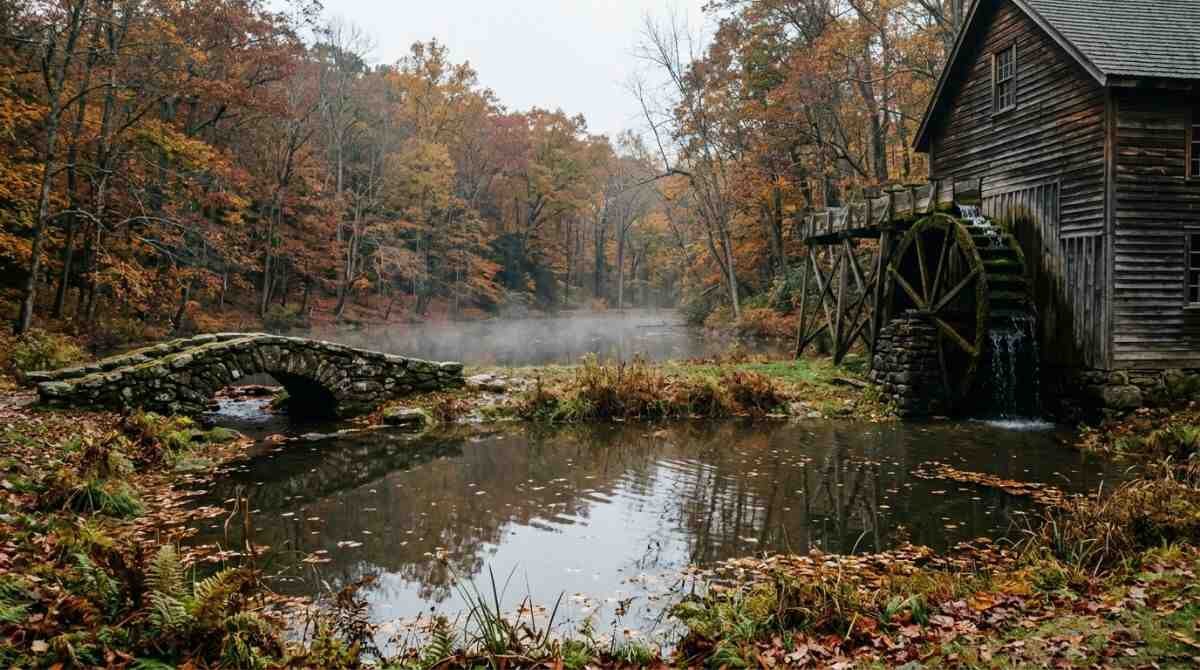
Frank Melville Memorial Park occupies a compact stretch of land at the corner of Main Street and Old Field Road in Setauket, beside the village’s historic churches. A mill pond, a stone bridge, a replica grist mill and a handful of old buildings share the grounds, and trails run on toward Conscience Bay. This guide gathers what the park’s own website, local historians and the National Register record say about the place, with notes on rules and seasons for anyone planning a visit.
Location and basic information
The park’s address is 1 Old Field Road, Setauket, NY 11733. According to the park’s About page, it is owned and operated by the Frank Melville Memorial Foundation, a New York nonprofit, and is open every day from sunrise to sunset. The same page describes the grounds as nearly twenty-four acres, while the park’s home page gives 26 acres and mentions an estuary, natural woodland and more than 200 plant species. The two figures differ, so the acreage is best treated as approximate.
The park’s phone number is (631) 771-1010, and questions can go to frankmelvilleparkinfo@gmail.com, both listed on the official site. Entry is not described as ticketed anywhere on the pages reviewed, but the site does not state a fee policy either, which makes the contact details worth keeping handy.
A short history of the park
The park’s own description says it was established in 1937 by Jennie MacConnell Melville and her son, Ward Melville, in memory of Frank Melville Jr. Ward Melville is better known across the Three Villages as the figure behind Stony Brook Village, and a longer treatment of that connection appears in the existing guide to Stony Brook. The park was added to the National Register of Historic Places on July 19, 2010, according to Wikipedia’s entry on the park.
The pond predates the park by centuries. Beverly C. Tyler, the Three Village Historical Society’s historian, wrote in a 2015 article for TBR News Media that the Setauket millpond became a center of commerce for the community after settlement in 1655, and that this role faded in the early twentieth century. Tyler also noted that Native Americans lived in the area for roughly 8,000 years before English settlement, a figure he gave without citing a source, so it reads best as a general estimate. In another piece published in April 2020, he described the park as horseshoe-shaped and completed in 1937.
Several layers of history sit on top of one another here. A milldam controls the flow of water toward Conscience Bay, a cottage once belonged to Everett Hawkins, whom Tyler calls the last Setauket miller, and a restored barn carries lumber with an unexpected origin, discussed below.
The historic buildings
The park’s home page lists five historic structures: a Greek Revival post office, a replica grist mill, the last miller’s cottage, a twentieth-century barn known as Hap’s Red Barn, and the Bates House. The The Park page adds detail about several of them.
- The mill house. The park’s page says a mill house was built in 1665 at the south end of the pond and moved north as the pond silted. The Hawkins family gave it, along with the cottage, to the Melvilles in 1936. A replica with a working wheel was then built, and it now serves as the park’s headquarters. Wikipedia, by contrast, dates the present mill house to 1937, which may mean the 1665 date refers to the original structure rather than the replica.
- The miller’s cottage. The park describes it as the oldest structure on the grounds. It is still used as a residence and overlooks the estuary that leads into Conscience Bay.
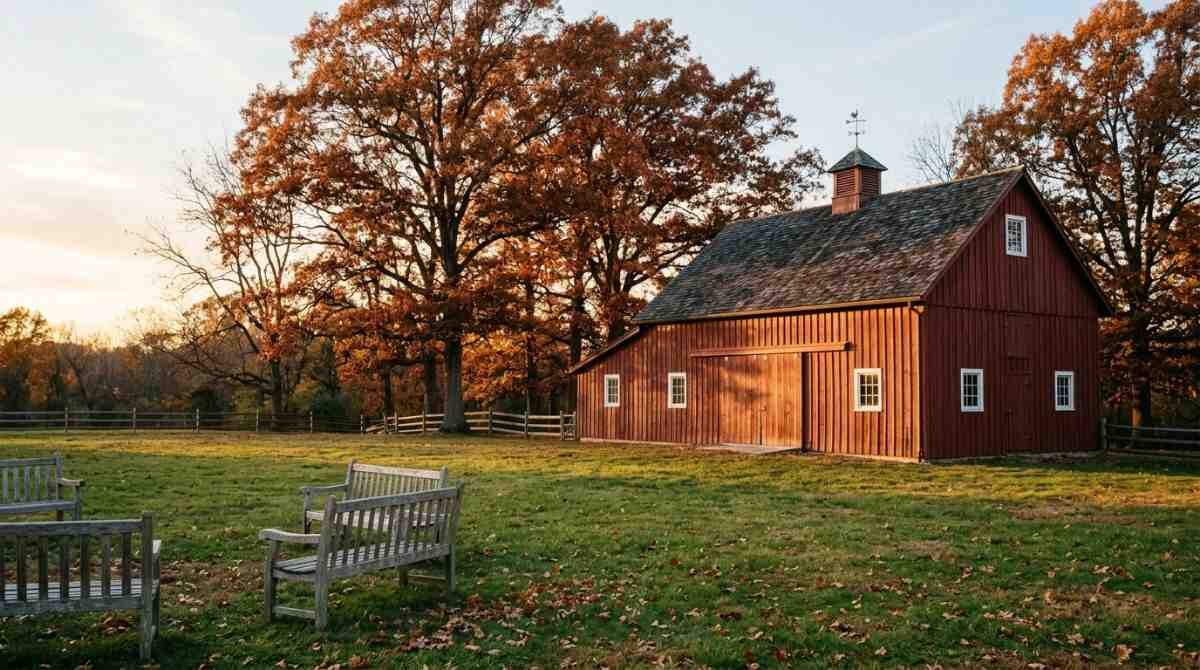
- Hap’s Red Barn. Tyler’s 2020 article reports that the restored red barn was built with materials from World War I barracks at Camp Upton in Yaphank. Wikipedia separately records a Satterly Barn dating to the early 1700s on the property, so the grounds contain more than one barn story.
- The Bates House. Wikipedia describes it as a 1922 Colonial Revival house acquired in 1955 and rented for events. The foundation also operates a separate site for it, linked from the park’s Park page.
Because visitors see these buildings from the paths rather than from inside, the park works well as an outdoor walk rather than an indoor tour.
The ponds and walking routes
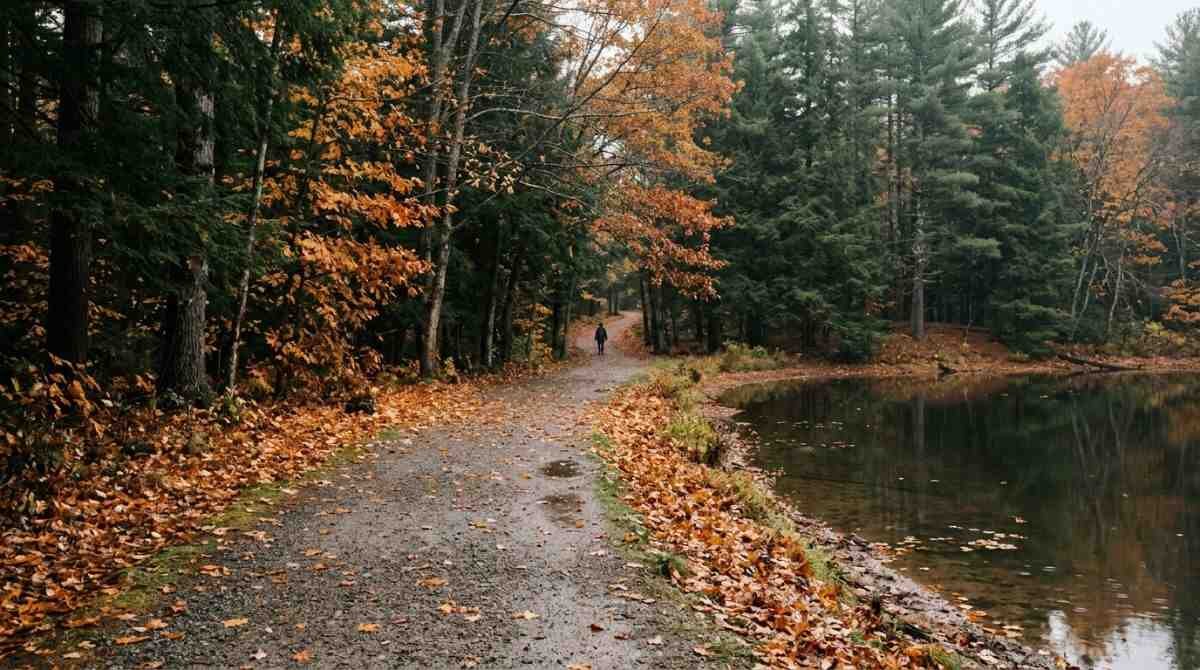
Walking is the main activity. The Park page states that three laps around the post office pond equal 1.2 miles, and that one loop around both ponds measures 0.9 miles. Tyler’s earlier article put the path around the lower mill pond at about a third of a mile. The numbers are consistent with a small park where visitors choose how many circuits to make.
The site also says the ponds have become shallow from runoff and sediment, and that a dredging project to restore their 1930s depth was awaiting approval from the New York State Department of Environmental Conservation when the page was last updated in 2025. Anyone visiting should expect that conditions at the water’s edge may differ from older photographs, and the foundation’s President’s Letter on the official site is the place to check for progress.
The trails also lead toward Conscience Bay and Caroline Church, as the home page notes. The church’s own history is covered in an existing article on Caroline Church of Brookhaven.
Plants and wildlife
The park’s home page promises wildlife, plant life and water views along the trails. In June 2025 the foundation reported new tree plantings around the pond and in other parts of the park, chosen to support the local ecosystem and to suit the historic landscape; each had mulch and support stakes, and the post expects them to become shade trees over time. No species list appears in that post.
Wikipedia adds that a Three Village Garden Club Arboretum is maintained by local volunteers within the grounds, and that Patriot’s Hollow State Forest lies on the park’s east side. Tyler’s 2020 article also mentions dark evergreens planted about eighty years earlier as mature trees, a detail that explains the dense green backdrop around the pond.
A small “Take a Book, Leave a Book” library was announced on the foundation’s news page, which gives walkers a place to swap paperbacks.
Rules worth knowing
The park’s rules page sets out several limits that shape a visit.
- Pets must be leashed at all times, and owners must clean up after them.
- Fishing is prohibited to protect wildlife, with one exception: catch-and-release fishing from the south side of the Old Field Road Bridge, standing on the bridge.
- Drones are banned at all times.
- Cars and limousines are not allowed inside the park; the page directs visitors to park on Main Street near the post office.
- Posed or professional photography requires a Photography Pass, and sessions are allowed Monday through Thursday only. Casual snapshots on the bridge do not require one.
- Group gatherings, large picnics and organized events are not permitted on weekends, and weekday gatherings or group nature walks need advance approval by email.
Fridays through Sundays are reserved for weddings and private events at the Bates House, which can mean a quieter or busier atmosphere depending on the day.
Programs and seasonal notes
The park’s home page lists a handful of recurring programs. Free youth programs run in summer at Hap’s Red Barn, weekly wellness sessions such as yoga and meditation are held Monday through Thursday at the Bates House, and a summer concert series called “Wind Down Sundays” takes place from 5:30 to 7:00 PM at the barn, with visitors bringing their own chairs or blankets. Those programs are described as summer offerings, and the official events page at frankmelvillepark.org/fundraisers is the place to confirm whether anything is scheduled for the colder months.
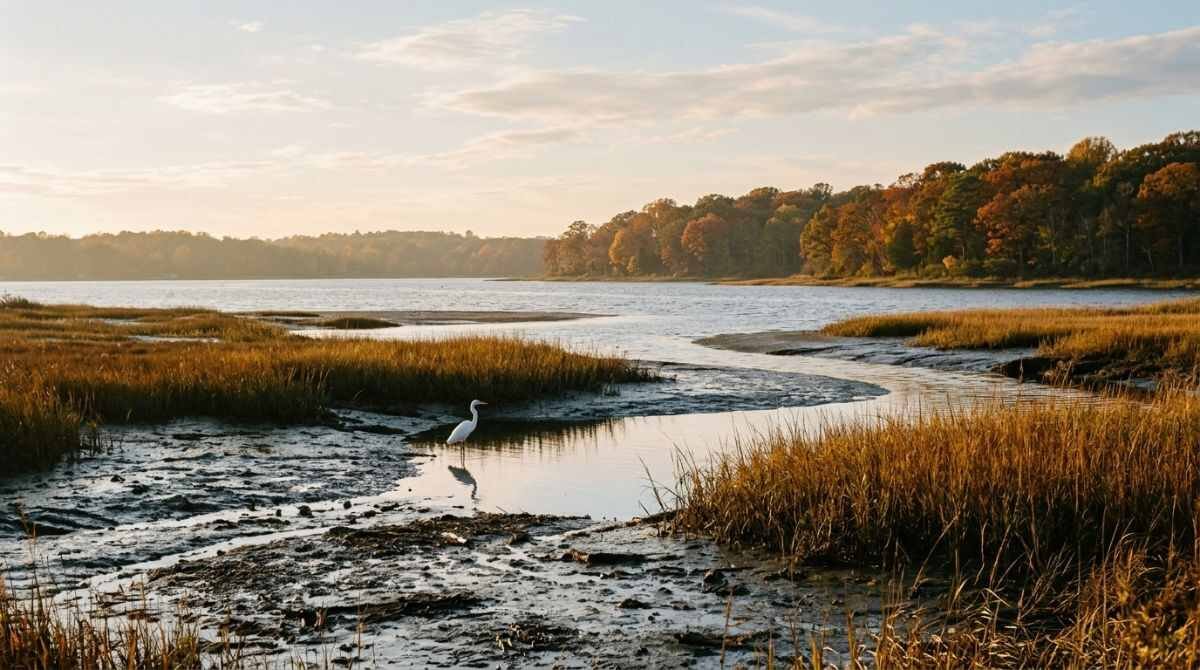
The official pages do not publish a foliage forecast or off-season hours. What they do provide is a year-round sunrise-to-sunset schedule, a short loop that suits a brisk autumn walk, and a landscape shaped by evergreens, which keep their color after deciduous trees have dropped their leaves. Winter visitors should keep in mind that the pond-edge conditions and any dredging work may affect access.
Getting there and parking
The park sits at Main Street and Old Field Road, within walking distance of the Setauket Village Green. Since cars are not permitted inside the grounds, the official guidance is to park on Main Street near the post office. Readers who want context on the surrounding village can consult the existing Setauket and East Setauket neighborhood guide.
Nearby reading
The pond area sits close to several other historic sites. The Presbyterian burial ground discussed in counting gravestones at the Setauket Presbyterian Church and the story told in the Abraham Woodhull and Culper Spy Ring article both concern the same part of the village. This article is general information and not advice of any kind.
Further reading
- Short Nature Walks Long Island: a related title for this activity. See it on Amazon (affiliate link)
As an Amazon Associate I earn from qualifying purchases. A commission may be earned if you buy through this link, at no extra cost to you.
Hours, programs and prices change; confirm details with the official sources linked above before visiting.
Sources
- Frank Melville Park (official site)
- Frank Melville Park: The Park
- Frank Melville Park: Rules and photography
- Frank Melville Park: About Us
- Frank Melville Park: New plantings around the park and pond
- Frank Melville Memorial Park has rich history (TBR News Media, Beverly C. Tyler)
- Three Village Historian Pays Tribute to Setauket Park (TBR News Media)
- Frank Melville Memorial Park (Wikipedia)