Caroline Church Has Been Holding Services Since 1729
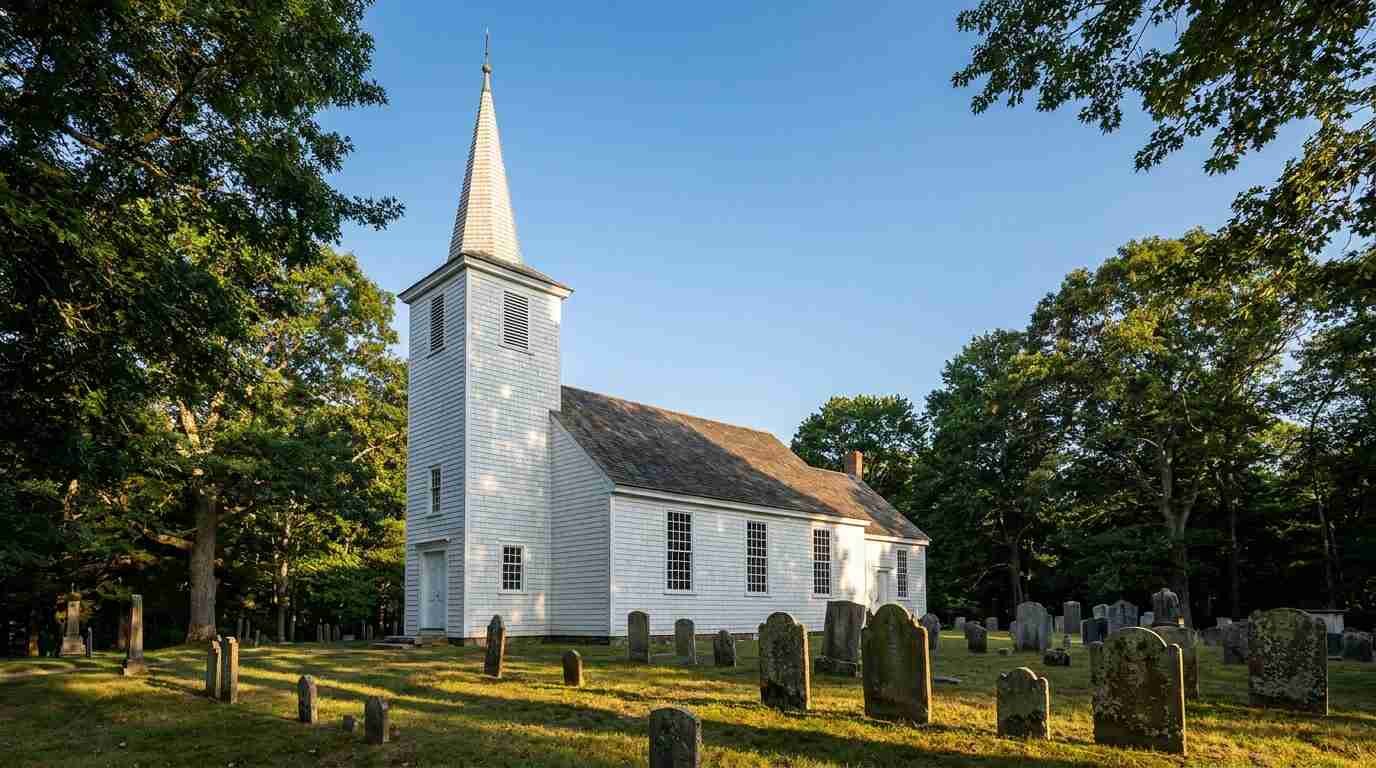
The building at the junction of Dyke and Bates Roads in Setauket was erected in 1729. George Washington would not be born for three more years. The Constitution was still more than half a century away. And the congregation that built it — organized six years earlier, in 1723, as an Anglican mission of the Society for the Propagation of the Gospel — had no particular reason to think the political arrangement underpinning their worship would ever change.
It did, of course. The British Crown they prayed for lost its colonies. The Church of England they belonged to reorganized itself on American soil as the Protestant Episcopal Church. The Loyalist parishioners who refused to make their peace with the new republic emigrated, most to Canada and Nova Scotia, leaving Caroline Church depleted and its building badly damaged. None of that killed it. The congregation came back, the building was repaired, and services resumed. They have continued, without interruption, for nearly three centuries.
Caroline Church of Brookhaven is the second-oldest Episcopal church building in continuous use in the entire United States.
How It Began
The Anglican mission that would become Caroline Church took shape during a decade of effort that the church’s own records describe as painstaking and protracted. The precise date construction started is not documented, but the building was complete and the vestry recorded its consecration on January 25, 1730. The same vestry minutes that set down the consecration date also recorded, unanimously, a renaming. The church had originally been called Christ Church. The congregation voted to honor Queen Wilhelmina Karoline of Brandenburg-Anspach, queen consort to George II of England, who had given the church altar cloths and a communion service. The vestry minutes recorded the decision with a formality that reflects how seriously they took it: the church “Shall in honour of our gracious Queen, her most Serene Britannic Majesty be hereafter called Caroline parish and Caroline Church, and this be entered upon record in Our Vestry books ad futuram rei Memoriam.” For the future memory of the matter.
Those gifts from the queen — the altar cloths, the communion service — remain in the church’s possession and are still used on special occasions.
The original structure was a wooden building, 30 by 46 feet — the same footprint it occupies today. The square tower carrying the steeple was part of the original construction. Time has gradually twisted its flat sides and vertical lines into what the church’s own history describes as eccentric spirals. A burial ground was established around the church in 1734. By 1744, the congregation had grown enough to require a gallery addition to accommodate the overflow.
The strong Loyalist character of the congregation was not incidental to the church’s early identity. These were people who had organized their community life around the premise that the Anglican establishment and the British Crown were inseparable. The act of naming the church after Queen Caroline was a statement of that conviction, entered into the record for the future.
The Revolution Arrives
After the Battle of Brooklyn in August 1776, Long Island fell under British occupation and remained so for seven years. For Caroline Church, this was theoretically comfortable — its congregation had prayed for the Crown, and the occupying forces were the Crown’s own. Services continued. Tradition holds that the rector at the time, probably the Reverend James Lyons, described in the church’s history as “a man of wit and talent and basic virtues but with a sharp Hibernian tongue and temper,” grew sufficiently irritated with the soldiers billeted nearby to interrupt a Sunday sermon and observe: “Here I am preaching the blessed Gospel to you and there are your d——d Redcoats in my garden stealing my potatoes!”
The ground around the church became actively contested in August 1777. The village green separating Caroline Church from the Setauket Presbyterian Meeting House was the site of what is recorded as the Battle of Setauket. Loyalist forces under Lieutenant Colonel Richard Hewlett — not British regulars, as later dramatizations suggest, but American-born Loyalists of the 3rd Battalion of DeLancey’s Brigade, garrisoned in Setauket from late spring 1777 — had fortified the Presbyterian Meeting House across the green. A Patriot force sailing from Connecticut opened fire from positions near the large glacial boulder in the woods west of the green. The skirmish lasted a few hours. The Continentals returned to their boats and crossed back over the Sound to Connecticut.
Bullets from that day are still embedded in the walls of Caroline Church. The church was 48 years old when it absorbed them. During the 1937 restoration of the interior, a further bullet was found in the church steeple — assumed to date to 1777 — and it has been displayed in the vestibule since.
After the War
The departure of the British was more devastating to Caroline Church than the skirmish had been. When the Crown’s protection ended, Loyalist parishioners faced a straightforward choice: accept the new republic or leave. Many left, typically to Canada and Nova Scotia. A letter from the wardens and vestry to Trinity Church in lower Manhattan, written in the years after the Revolution, captured the situation plainly: “At the close of the late Revolutionary war their church which was before flourishing was left in a very destitute condition — the building was very much injured — some of the most wealthy & respectable of the congregation went from the country, & those who remained were left as sheep without a shepherd.”
That letter probably saved Caroline Church. Trinity responded with 160 pounds in 1807 and another 200 pounds in 1811. The Protestant Episcopal Church had already formally organized — its first General Convention assembled in Philadelphia in 1785, and Samuel Seabury, consecrated in Scotland in 1784, had become the first bishop in America. The congregation that had prayed for Queen Caroline found its footing again under Charles Seabury, son of the bishop, who served as Caroline Church’s rector for thirty years until shortly before his death in December 1844.
Over the following century, the interior accumulated changes that obscured the original colonial structure. A false ceiling went in, hand-hewn beams were enclosed, new furnishings installed. By the mid-19th century the simple wooden interior of 1730 was largely buried.
The 1937 Restoration
In 1934, the Melville family — active Caroline parishioners — decided to fund a full restoration in memory of Frank Melville, Jr., and return the church to its 18th-century character. The work began in 1937. The parish house was detached from the main building, reestablishing the free-standing silhouette of the original structure. Inside, the walls were stripped back to expose the hand-hewn oak timbers and the barrel ceiling. In the vestibule, columns and beams emerged from behind later construction, along with the wooden ship’s-knee brackets in the upper corners — the same structural logic that had framed the hulls of vessels built in Setauket harbor for generations. The whale oil lamps hanging over the pews were restored and electrified. The Sheraton chairs originally owned by Bishop Seabury and donated by his son, the rector Charles Seabury, were returned to their places.
The 1777 bullet was found in the steeple during this work and has remained in the vestibule since.
After the restoration, Caroline Church was added to the New York State Register and the National Register of Historic Places in 1991. In 2023, the congregation marked its 300th anniversary — three hundred years from the 1723 founding of the original Anglican mission, celebrated in the same building, on the same ground, by a congregation still drawing from the same community it has served since before the country existed.
What the Building Communicates
Caroline Church does not announce its significance with interpretive signage. It has a spire — the same 42-foot tower visible from the North Shore since 1729 — and an active congregation, and a graveyard whose oldest stones predate the Declaration of Independence by more than forty years. Bennett stones, Jayne stones, Edwards stones, Woodhull stones. The families recorded in the church’s burial register are the same family names that appear on roads, in town records, and in decoded Culper spy ring correspondence.
For buyers considering Setauket, the church is evidence of something that no developer can manufacture. This is a built environment that was here before the country it now sits in. A structure with bullet holes from 1777 still visible in its walls. A congregation that survived its own political collapse and rebuilt itself. The people who find their way to the Three Village area and stay — choosing a community with a functioning Episcopal church from 1729 and a graveyard from 1734 and a village green that has held its shape for centuries — are making a specific kind of decision. Not the newest thing. A place that has already proven it endures.
You Might Also Like
- Counting Gravestones on a Tuesday Morning — The Presbyterian graveyard across the green, where Abraham Woodhull is buried.
- The Setauket Three and the Streets They Left Behind — How the Culper Ring’s presence shaped the Three Villages’ real estate identity.
- Setauket and East Setauket, NY — The North Shore Neighborhood Guide — Community character, schools, commute, and market snapshot.
- Historic Homes on Long Island: What Buyers Should Know Before Falling in Love With an Old House — The practical side of owning a historic property.