Counting Gravestones on a Tuesday Morning
The Setauket Presbyterian Church graveyard is not a tourist attraction. There are no signs directing you to it, no audio tour, no gift shop at the entrance, no organized foot traffic at nine in the morning on a weekday. What there is: roughly 800 graves, established beginning in the 1660s, in ground that has been used for burial continuously for more than 360 years. The names on those stones are the names of the people who built this place. And a few of them are names that appear in decoded spy ring correspondence, in the records of George Washington’s headquarters, in the affidavits that established what actually happened here during seven years of British occupation.
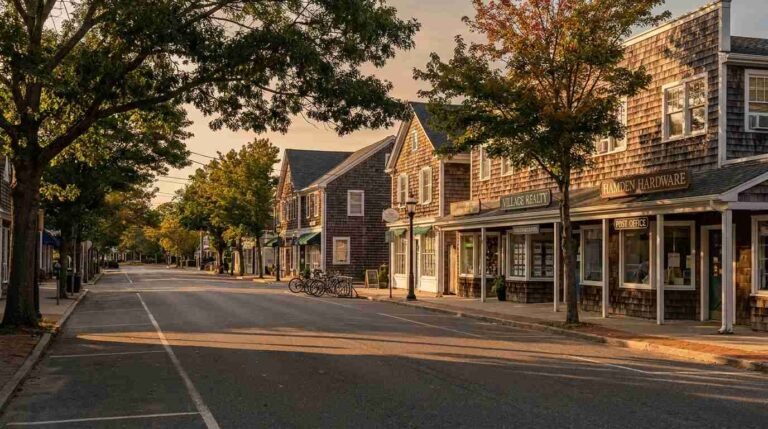
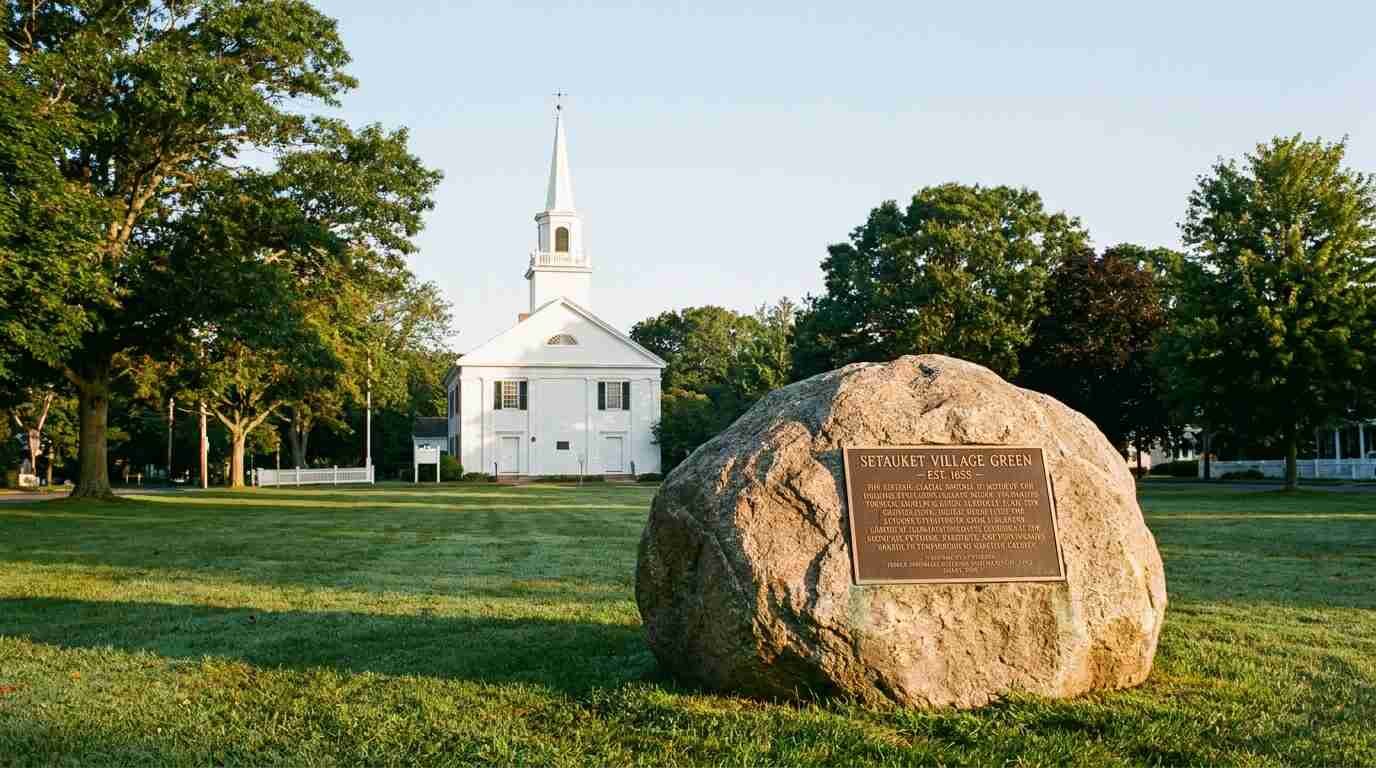
The Setauket Presbyterian Church and Burial Ground at 5 Caroline Avenue occupies one side of the village green. Caroline Church of Brookhaven, which held services for the Loyalist congregation throughout the British occupation and still carries musket balls in its walls from 1777, faces it from the other side. Between them sits the green itself and the glacial boulder — Patriots’ Rock — behind which Continental soldiers took cover during the brief, inconclusive engagement of August 22, 1777 that history records as the Battle of Setauket. Every element of the scene is within a few hundred feet of the next.
The graveyard predates the current church building by 150 years.
What Stands Here
The present church was built in 1812 in the Federal style — a three-by-five-bay, heavy timber-framed structure — replacing an earlier building that had been struck by lightning and burned. The burial ground beneath and around it goes back to the 1660s, when Setauket was first settled by English migrants from New England. The founding colonial families of the Town of Brookhaven are here: Bayles, Davis, Dickinsons, Floyds. Benjamin Talmadge (1723–1786), father of the spy ring’s commanding officer, Benjamin Tallmadge, is buried here. The graves of Long Island’s 17th-century settlers and their descendants accumulate across roughly 800 sites, running from the first generation of colonial families into the 19th century and beyond.
Abraham Woodhull is buried here. He died on January 23, 1826. His memorial was built using bricks salvaged from his family homestead — a structure dating to 1690 that burned down in 1931. Someone made the decision that those bricks belonged here, at the church, near the man himself. That is the kind of impulse that defines how Setauket has always handled its own history: not behind glass, not in a museum two towns over, but in the ground where it happened, tended and visible.
Who Woodhull Was
For anyone who knows the Culper Spy Ring primarily through AMC’s television dramatization — a show filmed in Richmond, Virginia, depicting a village that still largely exists on Long Island’s North Shore — it is worth establishing Woodhull as a historical figure rather than a character. Abraham Woodhull (1750–1826) was a Setauket farmer. Beginning in October 1778, he directed the most effective intelligence network the Continental Army possessed, operating under the alias Samuel Culper Sr., a name derived from Culpeper County, Virginia, at George Washington’s suggestion. Woodhull coordinated the gathering of intelligence about British troop movements and operations in New York City and its transmission to Washington’s headquarters in the field. After the Revolution, he served as the first judge of Suffolk County.
The network he ran was composed almost entirely of people he had known since childhood — most of them from Setauket. Austin Roe, a tavern keeper, rode more than 55 miles each way into Manhattan to gather intelligence and bring it back, sometimes over a thousand miles total during his service. Caleb Brewster, a whaleboat captain who had grown up in East Setauket, ferried dispatches across Long Island Sound under near-constant threat of British capture. Anna Smith Strong, whose husband had been imprisoned by the British as a suspected rebel, used a clothesline on Strong’s Neck visible from the water to signal to Woodhull when Brewster had landed and where. Robert Townsend, the one member of the ring not from Setauket — he was from Oyster Bay — gathered intelligence inside British-occupied Manhattan under the alias Samuel Culper Jr.
All but Townsend attended school together on the Setauket village green. Their adult lives, their property lines, their family connections were interwoven. The spy ring that Washington built here was not a collection of assets recruited from separate lives. It was a community — the same community — asked to do an extraordinarily dangerous thing by people it trusted. Benjamin Tallmadge, who ran the ring’s operations and served as Washington’s chief of intelligence, had grown up in Setauket beside these same men.
The Battle on the Green, and What It Left
The church grounds were a military target in 1777. Loyalist forces — American-born soldiers of Colonel Gabriel Ludlow’s 3rd Battalion of DeLancey’s Brigade, garrisoned in Setauket under Lieutenant Colonel Richard Hewlett — had fortified the Presbyterian Meeting House as a defensive position. The Continental attack came from the water, a force under General Samuel Holden Parsons crossing from Fairfield, Connecticut. They landed near Setauket Harbor and opened fire on Hewlett’s fortified position, taking cover behind the glacial boulder on the green. Three hours of fire followed. The Continentals could not dislodge the Loyalists without artillery capable of breaching the fortified church, and the small cannon they had brought was insufficient. Parsons withdrew. His men returned to their boats.
The rock they sheltered behind still sits at the edge of the green, marked with a plaque placed by the Daughters of the Revolution in 1927. Across the green, Caroline Church carries the musket balls from that exchange in its walls. The graveyard received no new occupants from the skirmish — casualties on both sides were minimal — but the ground itself bore witness to the argument. The people buried in those 800 graves had neighbors, cousins, family members on both sides of the occupation. Setauket was a Loyalist-held town whose most famous contribution to American history was a spy ring working against the occupation from within it.
Walking It
The Three Village Historical Society at 93 North Country Road in Setauket maintains the regional archive on the Culper Ring, offers walking tours of the relevant sites, and runs an interactive exhibit — Culper SPIES! — at its headquarters in the c.1800 Ebenezer Bayles/Stephen Swezey house. The tour circuit covers the church grounds, the site of the Woodhull homestead, the location of Roe’s Tavern, and the Smith-Strong family graveyard on Strong’s Neck where Anna and Selah Strong are buried together.
But the graveyard at the Presbyterian Church does not require a tour. It is publicly accessible, outdoors, and legible to anyone willing to read the stones. The Woodhull memorial, the Talmadge grave, the founding family surnames — these are not reconstructions or replicas. The graveyard is the primary source. It has been sitting here in roughly its current form since the 17th century, and it will still be here when the next house on the village green sells, and the next one after that.
For buyers drawn to places with genuine historical depth rather than curated heritage aesthetics, Setauket is among the few communities on Long Island that can genuinely deliver on that promise. The history is not in a name on a road sign. It is in the ground, readable, weathered, and open.
You Might Also Like
- Caroline Church Has Been Holding Services Since 1729 — The Loyalist church across the green, still standing, still in use, bullets from 1777 still in its walls.
- The Setauket Three and the Streets They Left Behind — How the Culper Ring’s documented presence shapes the Three Villages’ real estate identity.
- Setauket and East Setauket, NY — The North Shore Neighborhood Guide — Community character, schools, commute, and market snapshot.
Sources
- Setauket Presbyterian Church and Burial Ground, Wikipedia
- Abraham Woodhull, Wikipedia
- TURN to a Historian — The 1777 Garrison of Setauket (Todd Braisted)
- General Washington’s Setauket-Based Culper Spy Ring (Emma Clark Library)
- Untapped New York — 12 Places to Discover in Setauket
- TBR News Media — Abraham Woodhull and the Culper Spy Ring
- Three Village Historical Society
- Setauket, New York, Wikipedia