Open Since Before the Zip Code Existed
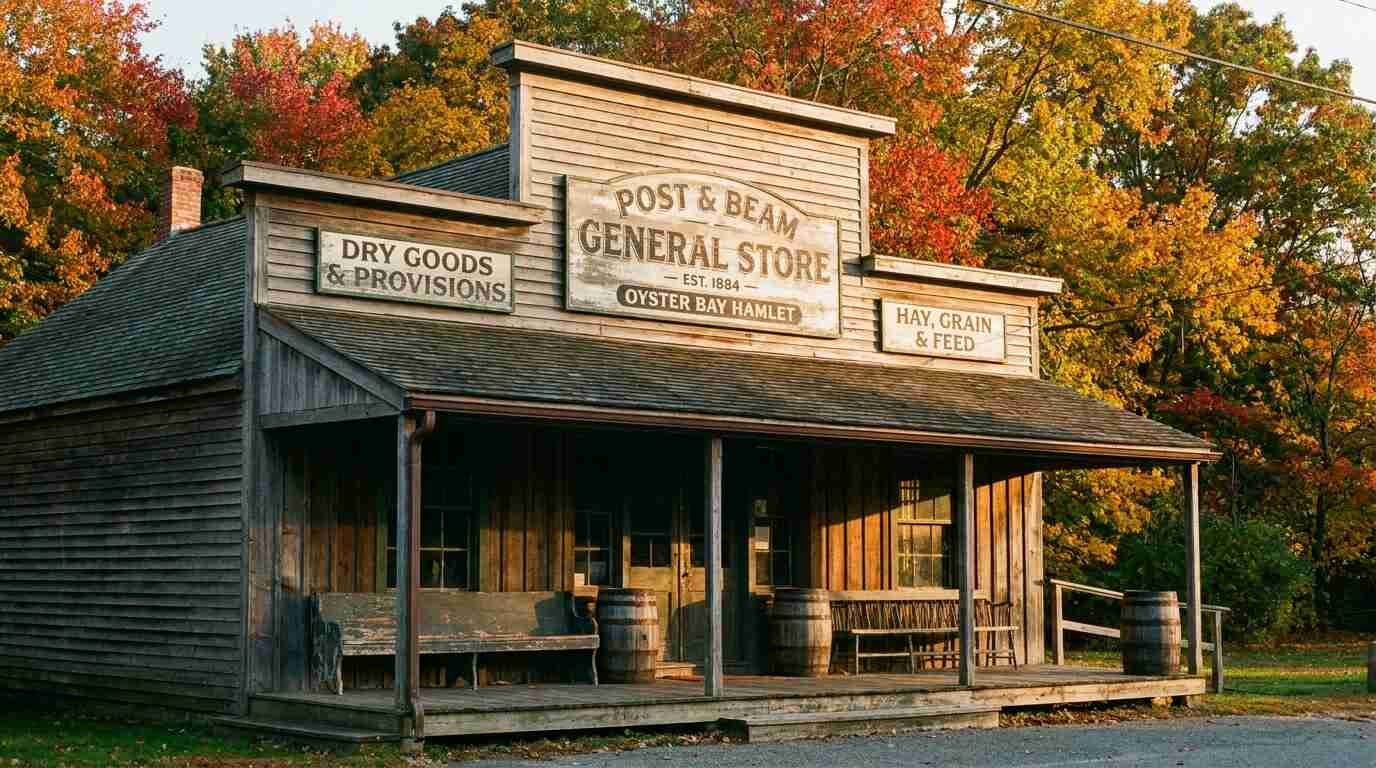
Zip codes were introduced in the United States in 1963. The St. James General Store on Moriches Road had already been open for 106 years by then.
That kind of arithmetic does not come up often in conversations about Long Island real estate. Communities here get evaluated on schools, commute times, tax rates, inventory levels, price per square foot. Those measures are real and they matter. But there is another measure — harder to quantify, rarely discussed in listings, and perhaps more predictive of long-term residential satisfaction than any of the above — and that is the age and continuity of a community’s institutions. Not its buildings, necessarily. Its operating institutions. The businesses and organizations that have been doing the same thing, in the same place, through the same changes in the surrounding economy and culture, for long enough that they have accumulated actual history rather than simply aged.
The Three Village area — Setauket, East Setauket, Stony Brook, Old Field, Poquott — has an unusual concentration of these. Unusual not in the sense that every other town on Long Island lacks all of them, but in the sense that the cluster here is dense enough, and old enough, to constitute something more than coincidence.
The Store at 516 Moriches Road
The St. James General Store sits just west of the Three Village core in the adjacent hamlet of St. James, close enough geographically and historically to belong to the same conversation about institutional continuity on the North Shore.
Ebenezer Smith built it in 1857. Smith was a descendant of Richard “Bull” Smith, the founder of Smithtown, and a man who had spent the preceding decade doing things that would be remarkable in any era: trading along the Mississippi River Valley, hearing about the California Gold Rush, heading west, returning to Long Island with enough to build a store. He put it up at the corner of Moriches and Harbor Hill Roads in the heart of what was then the business district of a community of about thirty houses. Farmers and sailors came to buy what they needed. The store also served as the local post office. In the late 19th century it became home to the first telephone in the hamlet.
When the Smithtown and Port Jefferson Railroad extended a branch to St. James, there was concern in the community that a station would bring land speculators and uncontrolled suburban development. It didn’t. What it brought instead was a new category of customer: wealthy New Yorkers and their circle, drawn to the North Shore as a summer destination. The old store ledgers contain the names of architect Stanford White, former New York City Mayor William Jay Gaynor, Lionel Barrymore, Irving Berlin, Buster Keaton, Myrna Loy, and heavyweight boxing champion James J. Corbett — a ledger of North Shore summer society browsing the same counters where local farmers had bought provisions since before the Civil War.
At the turn of the 20th century, Ebenezer’s son Everett inherited the business. Everett died in 1940. His father-in-law Karl Ericson took over and ran the store until he was 90 years old. In 1959, Louise and Andrew Havrisko stepped in — neighbors who had watched the store their whole lives — and kept it from becoming a private residence. The Suffolk County Parks Department acquired the property in 1990 and established its historic significance formally. The store was placed on the National Register of Historic Places. Structurally, it has been unchanged since 1894.
The store’s manager, in a recent account, put it simply: “It has never closed its doors.” Not through two world wars, not through the Depression, not through the suburbanization of virtually everything around it, not through the death of every original owner and custodian in succession. The current inventory mixes penny candy with locally made goods and North Shore-specific books and artifacts. The floorboards creak in the spots they have creaked in for more than a century and a half. Under the portrait of Ebenezer Smith that hangs above the original counters, the Suffolk County Parks Department designates it the oldest continuously operating general store in the United States.
The Inn at 150 Main Street
The original structure at what is now 150 Main Street in Stony Brook was built in 1751 by Richard Hallock. That building — known as the Old Homestead — is one of the oldest standing structures on Long Island’s North Shore. In 1835, Jonas Smith, then one of the most prominent ship owners in the country, purchased it as a summer house. After Smith’s death in 1867 the house changed hands several times before Mrs. Frank Melville acquired it in 1929 and converted it into a Women’s Exchange, serving tea and sandwiches to visitors who had begun discovering Stony Brook as a destination.
Ward Melville, who had succeeded his father as head of the Melville Corporation — the third-largest retailer in the United States at the time, whose holdings would eventually include CVS, Marshalls, and KB Toys — inherited the property from his mother and undertook a full renovation starting in 1939. He renamed it the Three Village Inn. In the same year, he invited the existing businesses of Stony Brook to a meeting at the Inn and unveiled the plan that would become the Stony Brook Village Center: a colonial-style planned business community built at his own expense, with cast iron lampposts, bluestone walkways, and a two-acre village green opening toward the harbor.
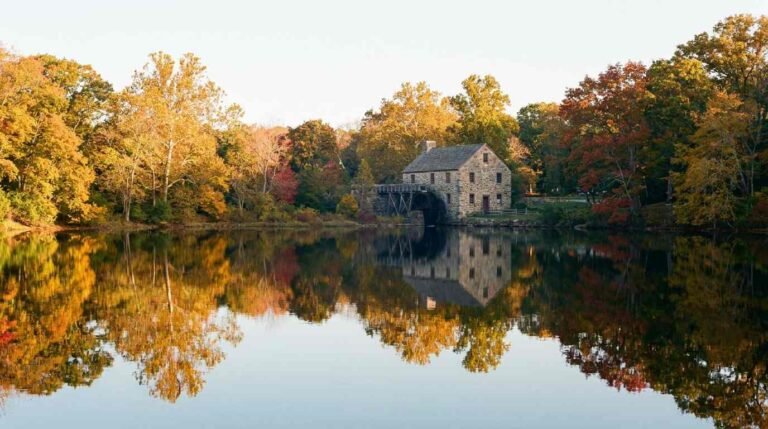
The Village Center, completed in 1941 and deeded by Melville to a not-for-profit organization — later renamed the Ward Melville Heritage Organization — is recognized as the first planned shopping center in the United States. It was built not to maximize retail revenue but to give local businesses a permanent home insulated from speculative turnover. More than 80 years later it is still operating, still holding its colonial character, still home to a deli, a flower shop, a wine store, a post office, and seven restaurants alongside specialty shops. The Three Village Inn has operated continuously from 1939 to the present, its 1751 structure still at the core of the property.
The Civic Fabric
Institutional continuity in the Three Village area extends beyond the commercial. The Three Village Garden Club was organized on May 1, 1929, with the founding meeting held in Stony Brook. The minutes from that meeting record the vote between two proposed names: the SOS Garden Club, and the Three Village Garden Club. The latter won. That meeting gave the area its name — the first documented reference to “Three Village” as a designation. The club has been continuously active since, operating for nearly a century through a succession of meeting locations, maintaining a public nature sanctuary on Bates Road, and remaining one of the more durable civic organizations on the North Shore.
The Three Village Chamber of Commerce, founded in 1969 by Setauket attorney Roy Dragotta, is now more than 55 years old. It has operated through the same cycles of economic expansion and contraction that reshaped the retail landscape of virtually every other Long Island community without erasing the institutions it was founded to support.
What It Means to Buyers
The age of local institutions is not a sentimental data point. It is a signal about the kind of community that has formed in a place — about the character of the residents who chose to stay, the economic stability that allowed businesses to persist rather than turn over with every rent cycle, and the civic investment that treats a general store or a garden club as worth preserving rather than replacing.
Communities where businesses close after two years and civic organizations dissolve after five are telling a specific story about their residents. Communities where the same store has been open since 1857, where the inn at the harbor has operated since 1939 in a building from 1751, where the garden club just turned 97 — these are telling a different story. Not a perfect one, and not one that translates directly into a dollar figure on a listing sheet. But a legible one.
For buyers evaluating where to put down roots — not where to buy, flip, and leave, but where to live — the Three Village area’s institutional record is worth reading. The continuity is not decorative. It is evidence of something that took a long time to build, has resisted considerable pressure to dissolve, and is still functioning.
You Might Also Like
- Setauket and East Setauket, NY — The North Shore Neighborhood Guide — A full profile of the community, from schools and commute to market conditions.
- St. James, NY — The North Shore Neighborhood Guide — The adjacent hamlet where the General Store has stood since 1857.
- Stony Brook, NY — The North Shore Neighborhood Guide — Profile of the village at the center of the Ward Melville Heritage Organization’s stewardship.
- Best Long Island Towns for NYC Transplants in 2026 — A wider lens on which North Shore communities deliver what transplants are actually looking for.
Sources
- St. James General Store, Wikipedia
- ABC7 New York — St. James General Store, 168 years open
- Smithtown Patch — Our General Store
- Mirabelle at Three Village Inn — History
- Stony Brook Village Center, Wikipedia
- Three Village Chamber of Commerce — History
- TBR News Media — History close at hand: The name Three Village