Long Island Commuter Rail Expansion Plans Could Reshape Home Values Along Key Corridors
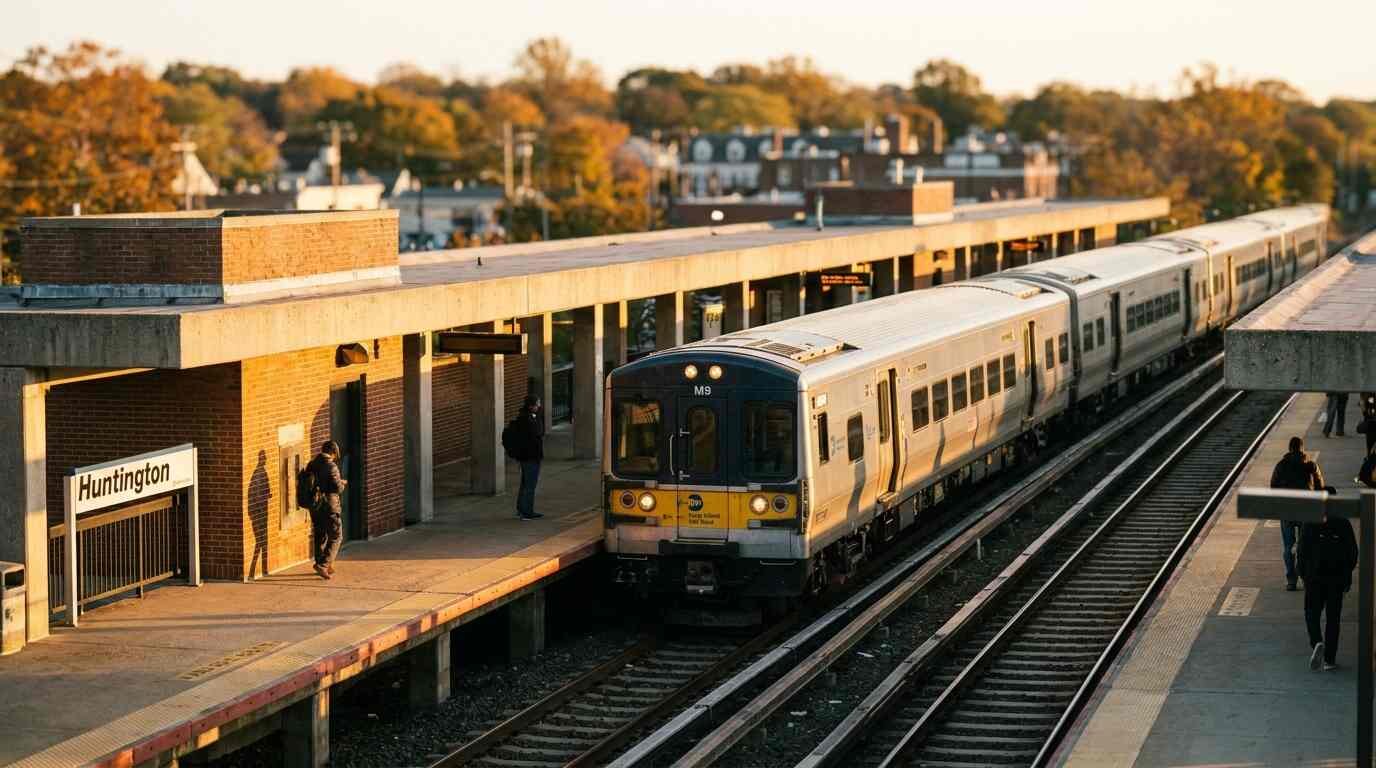
Every few years, the conversation restarts. Local officials rally in a parking lot near a train station. The MTA releases a planning document. Newsday runs a piece. And North Shore homeowners — particularly those living east of Huntington — dare, again, to imagine what their commute might look like if the Port Jefferson Branch finally gets electrified.
I’ve been watching this story for a long time. As someone who works this stretch of the North Shore every day, I track it not just as a transit story but as a real estate story — because the moment an infrastructure project gains serious momentum, it starts moving prices before a single shovel enters the ground.
Right now, that momentum is real enough to pay attention to.
Which Long Island Corridors Are in the Expansion Crosshairs
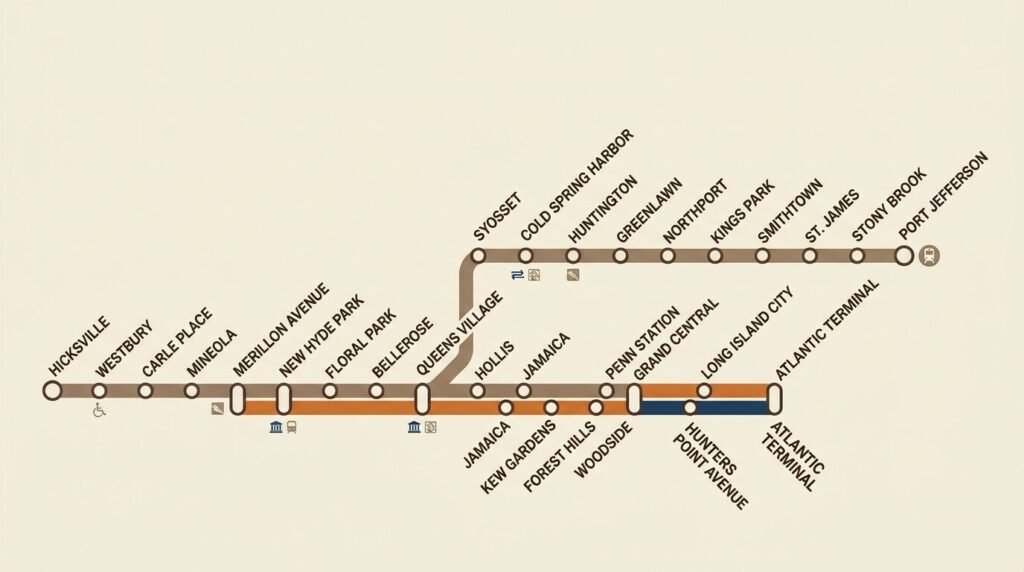
The Port Jefferson Branch of the LIRR — the line running from Floral Park east through Huntington, Northport, Kings Park, Smithtown, Stony Brook, and on to Port Jefferson — has carried diesel trains east of Huntington since electrification stopped at that station in 1970. Riders east of Huntington cannot board an electric train, cannot reach Grand Central Madison without a transfer at Jamaica, and run on a single-track schedule that limits frequency.
The MTA’s 2025–2044 Twenty-Year Needs Assessment formally included full electrification of the Port Jefferson Branch — estimated at $3.8 billion — as one of the system’s major proposed expansion projects. The current $68.4 billion MTA capital plan, approved by the MTA Board, earmarks $6 billion for the LIRR overall, with funds designated to study electrification of the Port Jefferson Branch and the corridor between Ronkonkoma and Yaphank. The Lawrence Aviation Superfund site in Port Jefferson Station has been identified as the probable location for the electric storage yard that electrification would require — a critical piece of the puzzle that local officials and the MTA have been working to advance.
The Oyster Bay Branch is in a similar situation and has appeared in the same long-range discussions.
To be direct: none of this is funded for construction yet. Inclusion in the twenty-year needs assessment is a planning milestone, not a commitment. The realistic timeline for full Port Jefferson electrification, if funded in the next capital cycle, likely stretches well into the 2030s and possibly 2040. But the planning groundwork, the political momentum, and the land acquisition work are all active — and that matters for buyers and sellers right now.
How Transit Access Has Historically Moved Home Prices
The research on transit and property values is consistent enough across markets to treat it as a working assumption rather than a hypothesis.
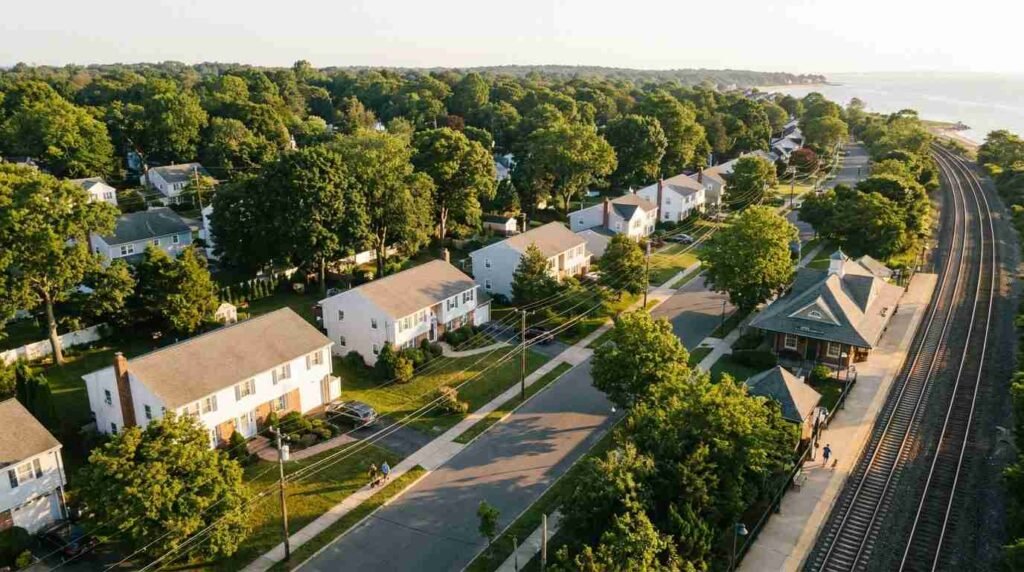
Academic and industry studies of commuter rail markets in the northeast show that properties within a half-mile of rail stations consistently command premiums over comparable homes positioned further away. A Freddie Mac analysis of the Washington DC Metro area found that homes within a quarter-mile of a station sold for roughly 8.6% more than those beyond a mile. A broader study of seven metropolitan regions published by industry researchers found median sale price premiums of 4% to 24% for residential properties within a half-mile of high-capacity transit options, including commuter rail. The transit shed, as planners call it — typically the half-mile walkable radius from a station — is where price effects concentrate most reliably.
What’s particular to the LIRR story is the timing dynamic. Infrastructure announcements move prices in anticipation, not just after completion. Long Island has lived this before: when the Third Track project was funded and construction began on the Main Line between Floral Park and Hicksville, property near those stations saw increased buyer interest in the surrounding communities — particularly where parking, walkability to the station, and new platform infrastructure signaled permanence.
The LIRR Today, an active blog covering Long Island commuter rail in close detail, has documented the history of Port Jefferson Branch promises and their political context extensively — including the infrastructure preparation (high-level platforms built east of Huntington in the 1980s in anticipation of electrification that didn’t arrive) that remains in place today.
Neighborhoods to Watch If the Expansion Gets Serious Funding
If Port Jefferson Branch electrification moves from planning to funded construction, the price dynamics would play out differently at different points along the line.
Huntington and Cold Spring Harbor already have electric service and direct one-seat access to Manhattan. They are the established beneficiaries and will remain so. The expansion story doesn’t add new value here — it consolidates it.
Northport, Kings Park, and Smithtown are the intermediate stations — currently diesel territory, close enough to Huntington to feel the market’s gravitational pull but still discounted for the service gap. These are the communities where electrification would produce the most dramatic relative change. Buyers already pay a Huntington premium; Northport has been narrowing that gap as buyers accept the transfer. Direct service would close it further.
Stony Brook is the volume station on the eastern half of the branch — Stony Brook University is Long Island’s largest single-site employer, and the station sees heavy use accordingly. Electrification here would be felt immediately in the surrounding residential market, particularly in the Setauket and East Setauket neighborhoods we covered in depth in our Setauket neighborhood guide.
Port Jefferson Village would gain the most symbolically — a direct one-seat ride to Grand Central Madison, which diesel trains currently cannot access. The village’s real estate already carries a premium for its character, its harbor, and the ferry connection we wrote about here. Electrification would be a second premium stacked on top of an existing one.
Miller Place and Mount Sinai don’t have LIRR stations — the Wading River Branch that once ran through those communities was abandoned decades ago. The expansion plan doesn’t include new stations in this part of the North Shore. Buyers in these communities commute by car to Stony Brook or Smithtown. Improved service frequency at those stations still helps them, indirectly.
What This Means If You’re Buying Near a Proposed Stop
If you’re a buyer considering homes within walkable distance of a Port Jefferson Branch station east of Huntington, there are two legitimate things to weigh here — and one to ignore.
What’s legitimate: transit access genuinely improves a community’s quality of life and commute economics. Even the current diesel service gives North Shore residents access to a rail network that most car-dependent American suburbs lack entirely. The existing discount relative to electrified territory represents real value for a patient buyer. If electrification funds are committed in the 2025–2029 MTA capital cycle, properties near stations east of Huntington could appreciate meaningfully before construction completes.
What’s also legitimate: this project has been promised for sixty years without resolution. The capital funding needed — hundreds of millions in planning alone, $1.6 billion or more in a subsequent capital cycle to leverage federal matching — is not yet secured. The political will is stronger now than it has been in decades, but political will and MTA capital commitments are different things.
What to ignore: any seller or agent using electrification as a near-term pricing argument. If someone is trying to justify a price premium specifically because of an announcement that hasn’t translated to funded construction, that argument deserves scrutiny.
Pawli’s Take: Should You Buy Ahead of the Announcement?
Here’s my honest read: if you are buying in Northport, Kings Park, Smithtown, or Stony Brook, you are already buying in markets that have real value independent of any transit upgrade. The schools are strong, the neighborhoods are established, and the North Shore character that draws people here doesn’t depend on the MTA getting its capital program right.
What the electrification story adds is optionality. If it moves forward — if the 2025–2029 capital plan includes meaningful planning funds for this project — buyers who are already in those communities will capture that upside. If it takes another decade, they will still own homes in places people genuinely want to live.
I’ve been buying and selling on this stretch of the North Shore for over ten years. The Port Jefferson Branch story has always been part of the background. What feels different now is the specificity: a named site for the rail yard, a funded twenty-year assessment, a bipartisan coalition of elected officials who have been unusually consistent. That doesn’t guarantee anything. But it’s not nothing, either.
If you’re trying to time a purchase around a government infrastructure announcement, I’ll be direct: don’t. Buy the house, the street, the school district, the life you want — and let the train upgrade be a bonus if it comes.
Real estate markets change. This post reflects conditions as of May 2026. For current listings and market data, contact Pawli at Maison Pawli.
This is for informational purposes only — consult a licensed attorney or financial advisor for your specific situation.
Sources
– MTA Board Approves $68.4B Capital Plan; LIRR to Receive $6B — News12 Long Island – Port Jefferson Branch Electrification Gains Ground in MTA’s 20-Year Plan — TBR News Media – Perspective: Are We ‘All Aboard’ for Electrification? — TBR News Media – OP-ED: Port Jefferson LIRR Branch Electrification 2024 Update — Mass Transit Magazine – Port Jefferson Branch — Wikipedia – Property Values ‘Thrive’ Near Transit — Smart Cities Dive – Proximity to a Metro Rail Station and Its Impact on House Prices — Freddie Mac – The Plague of False Promises: The Long Wait for Port Jefferson Branch Electrification — The LIRR Today – LIRR Main Line Expansion Project — MTA
You Might Also Like
– LIRR Commute from Long Island to NYC: What You Actually Need to Know – The Fed Paused — Now What? A Realistic Translation for North Shore Buyers Who’ve Been Waiting – Port Jefferson vs. Northport: Which North Shore Village Is Right for Your Next Chapter?