The Gold Coast of Long Island: Gilded Age Estates, Architectural Heritage, and What Survives
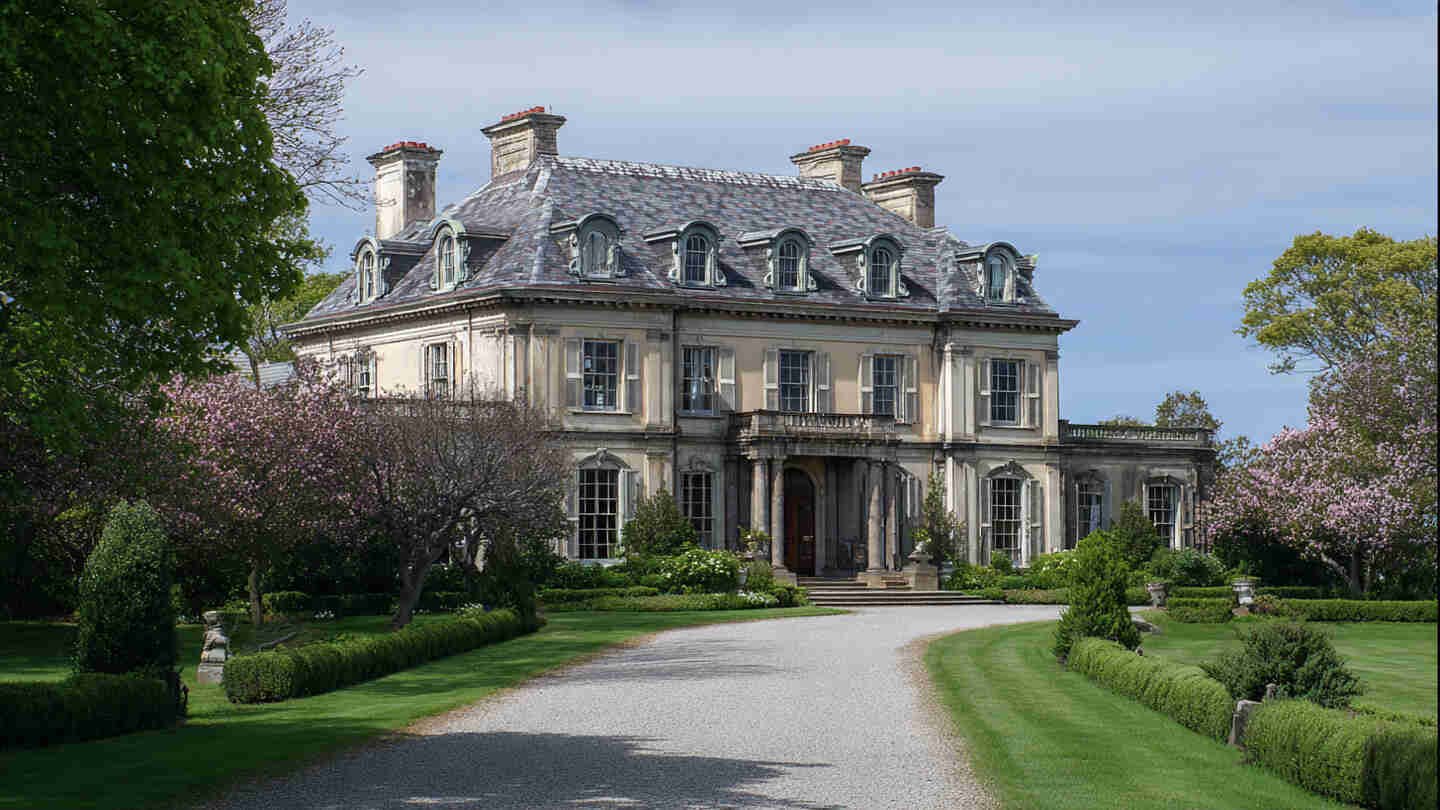
The first time I drove through the gates of a Gold Coast estate — one of the ones that hadn’t been subdivided, that still had its original allée and a carriage house bigger than most houses I’d sold — I pulled over. Not to take notes. Just to look. There’s a particular quality of silence inside a property like that, a stillness that doesn’t feel empty so much as accumulated. Decades of intention, compressed into limestone and wrought iron and the specific angle of a pergola that someone spent three months deciding.
That’s what the Gold Coast is, at bottom: accumulated intention. The men and women who built these estates in the late nineteenth and early twentieth centuries were not simply buying land. They were constructing arguments — about beauty, about permanence, about what it meant to live well. Some of those arguments have aged better than others. But the physical evidence is still here, on the bluffs and along the back roads of Nassau and western Suffolk counties, and if you know how to read it, it tells you more about Long Island’s character than any market report ever will.
I’ve spent years working in and around these properties — listing them when they come to market, showing buyers through the ones that have been carved into condominiums or converted into laboratories, researching the ones that exist only in county deed records and old Newsday photographs. What follows is the guide I wish had existed when I started.
What the Gold Coast Was — and Where It Ran
The Gold Coast designation is informal and elastic, but in its most precise use it refers to the string of country estates that lined the North Shore of Long Island from roughly Great Neck in Nassau County east through Oyster Bay, Cold Spring Harbor, Huntington, and into the western fringe of Suffolk County — a stretch that reached its peak density between about 1895 and 1929. The terrain was the draw: high bluffs over Long Island Sound, deep harbors, glacially sculpted topography that broke the flat monotony of the interior. The railroad made it reachable from Manhattan. The Robber Baron economy made it affordable, for certain people, to build on a scale that had never been seen in American domestic architecture.
At its height, the Gold Coast contained more grand private estates per square mile than anywhere else in the country. The names read like a Who’s Who of the Gilded Age: the Vanderbilts at Centerport and Sands Point, the Morgans at East Island, the Phippses at Old Westbury, Otto Kahn at Cold Spring Harbor, the Mackays at Roslyn. These were not summer cottages. They were year-round operations — farms, stables, greenhouses, staff quarters, gate lodges — entire self-contained communities organized around the leisure and status of a single family.
Most of them are gone. The Depression began the attrition; the estate tax finished it. By the 1950s, developers were buying up the properties by the hundreds of acres, bulldozing the service wings, subdividing the grounds into quarter-acre lots, and leaving the main house — if it survived at all — marooned in a subdivision that made no sense of it. Some estates became golf courses or country clubs. Some became corporate campuses. A handful became museums or arboreta. And a small number — a remarkable number, given the economic headwinds — survived intact as private residences or have been restored to something close to their original condition.
Those survivors are what this guide is primarily about.
The Architecture: What You’re Actually Looking At
Gold Coast estate architecture is eclectic almost to the point of incoherence — but that eclecticism is itself historically significant. The men who commissioned these houses had money and ambition but no inherited architectural tradition of their own, and they responded by shopping the entire history of European design. You get Tudor Revival in Glen Cove and French Norman in Oyster Bay and Italian Renaissance in Lattingtown and Georgian Colonial in Cold Spring Harbor, sometimes within a mile of each other.
What unifies them is craft. The budgets were essentially unlimited, and the craftsmen who built these houses — the stonemasons, the cabinetmakers, the plaster workers, the iron forgers — were among the best in the world, many of them recent immigrants from Italy and Central Europe who had trained in traditions that American mass production had not yet displaced. The joinery in a Gold Coast drawing room, the steam-bent woodwork in a trophy room, the hand-laid mosaic in an orangery — these are not decorative flourishes. They are evidence of how buildings were made when the making of a building was considered an art form.
For buyers considering Gold Coast–adjacent or Gold Coast–surviving properties today, this matters practically. The structural quality is often extraordinary — far better than anything built during the postwar tract era. But the renovation calculus is complicated by preservation easements, material costs, and the challenge of finding craftsmen who understand what they’re working with. I covered this in detail in Before You Touch the Bow Windows — required reading before you make an offer on anything pre-1930 in this corridor.
The Estates That Survived: A Field Guide
Oheka Castle — Cold Spring Harbor
Otto Kahn’s 1919 French château on Chichester Road is the most complete survivor on the Gold Coast — 127 rooms, 443 acres at its peak (now 23), still standing in something close to its original form after a remarkable restoration in the 1980s and ’90s. It now operates as a hotel and event venue, which means the public can actually get inside and see what Gilded Age residential scale looked like from the inside. I wrote about the restoration arc and what it means for buyers considering similar projects in The Cold Spring Harbor Phoenix.
Planting Fields Arboretum — Upper Brookville
The Coe Estate — now a New York State arboretum — is one of the best-preserved Gold Coast properties in terms of grounds and outbuildings. The greenhouse and orangery complex, in particular, is a masterwork of early twentieth-century horticultural architecture and a window into the Gilded Age obsession with environmental control. My post on The Planting Fields Orangery as Artifact goes into the glass structures in detail.
Old Westbury Gardens — Old Westbury
The Phipps Estate is another state-preserved property, and it’s one where the above-grade architecture gets all the attention — but the more interesting story is below the surface. The infrastructure that made these estates function — the coal vaults, the root cellars, the service tunnel networks — is largely invisible to visitors and rarely survives in other Gold Coast properties. I covered the underground systems at Old Westbury in What Old Westbury Gardens Does Not Show You.
Vanderbilt Museum — Centerport
William Kissam Vanderbilt II built Eagles Nest on Centerport Harbor between 1910 and 1936, and the result is one of the most architecturally idiosyncratic properties on the North Shore — a Spanish Revival complex that treats the harbor view as a structural partner, not a backdrop. It’s now a Suffolk County museum. I wrote about the design logic at length in Why the Vanderbilt Mansion at Centerport Was Designed to Feel Like No American House That Had Ever Been Built Before.
Sands Point Preserve — Sands Point
The former Guggenheim and Gould properties at Sands Point constitute the densest surviving cluster of Gold Coast architecture accessible to the public — Hempstead House, Castlegould, and Falaise, three radically different buildings on 216 contiguous acres. The Sands Point story is also the story of the Gold Coast’s most secretive enclave, which I covered in The Forgotten Millionaires’ Row.
What the Service Wing Tells You
One of the most instructive things about Gold Coast estates — both architecturally and for buyers considering conversion projects — is the service infrastructure. These properties were not simply large houses. They were systems. The kitchen wing, the laundry, the servants’ quarters, the stable block, the gate lodge, the icehouse, the generator house — each of these had a functional logic and a spatial relationship to the main house that reflected the social organization of the period.
When that social organization collapsed — when the staff of thirty-five became impossible to sustain, when the coal furnace became an oil furnace and then a heat pump, when the formal dining room seated eight instead of forty — the service infrastructure became a liability. Most of it was demolished. What survived, in the estates that were preserved rather than subdivided, is often the most architecturally interesting part of the property.
The carriage house in particular has had a remarkable afterlife. Converted to guest cottages, to artist studios, to auxiliary dwelling units that command prices the original builders would have found baffling, they’ve become one of the most interesting product categories in North Shore real estate. I wrote about the conversion economics in What the Carriage House Knows and about the Oyster Bay–specific market in The Adaptive Reuse of Oyster Bay’s Gilded Surplus.
The servant stair and service wing as architectural typology — and what it reveals about the social grammar of Gilded Age domestic life — is covered in The Servant Stair and the Service Wing.
The Craftsmen Behind the Estates
The Gold Coast estates did not build themselves. Behind every corbeled limestone arch and every hand-planed mahogany panel was a craftsman — usually unnamed in the historical record, usually working within a tradition that has since largely disappeared. Tracing those craftsmen is one of the more absorbing research problems in Long Island architectural history.
Some of the most interesting connections run through the furniture trades. Port Jefferson’s nineteenth-century furniture makers shared technique and personnel with the shipwrights who built the schooners in the same harbor — the joinery was the same, the materials overlapped, and several craftsmen moved between hull-building and highboy-building over the course of their careers. I covered that crossover in Tonnage and Tenon.
The Matinecock Quaker community in Locust Valley produced a generation of estate carpenters whose framing philosophy was directly shaped by the utilitarian discipline of the Friends Meeting House tradition — an influence I traced in The Joiner’s Argument in Locust Valley. And the Tiffany Studios’ Oyster Bay workshop developed finishing techniques specifically designed to deceive the eye — ebonizing cherry to look like ebony, aging surfaces to suggest greater antiquity — which tells you something about the period’s complicated relationship with authenticity. That story is in The Ebonized Cherry Problem.
The Legal Sediment: Deeds, Covenants, and What Survives
Buying a Gold Coast–adjacent property today means reading the legal record the way a geologist reads a cliff face — layer by layer, oldest first. The chain of title on a property that has changed hands since the 1890s carries the residue of every transaction, every restriction, every encumbrance that anyone thought to record.
Some of what you find is benign. Some of it is not. Pre-1960 utility and access easements are common in Gold Coast–corridor properties and can significantly affect renovation scope and resale value — I covered the mechanics in The Easement You Didn’t Know You Bought. Restrictive covenants, many of them originating in the deed restrictions that Gold Coast developers wrote to control what happened to their neighbors’ properties after subdivision, are still live legal instruments in some cases — see The Covenant in the Deed.
The chain of title itself — how to read one, what the inflection points mean, what a title commitment is actually telling you — is covered in What Your Title Commitment Is Actually Telling You. And if you want to understand how 17th-century land transfer documents still echo in Gold Coast property boundaries, Chain of Title and the Matinecock Deed is the place to start.
The Auction Market: Where Estates Go to Be Dispersed
Many Gold Coast estate contents — and in some cases the properties themselves — have passed through the auction market over the past century. The auction record for Long Island estate sales is one of the most revealing documents in the region’s economic and cultural history, and I’ve spent considerable time in it.
The Mackay Estate auction in particular — specifically a dispute over a chandelier that became a foundational case in New York auction law — is worth understanding if you’re buying a historic property that comes with fixtures. The case and its ongoing relevance are covered in The Chandelier Clause.
The broader auction ecosystem — the language of failure (reserve, withdrawn, bought in), the role of underbidders in shaping market prices, the systematic undervaluation of certain furniture categories at probate — is covered in the auction series. Start with Reserve, Withdrawn, Bought In.
The Lloyd Neck Question: Landscape as Exclusion
Not all Gold Coast legacy is architectural. Some of it is spatial — the way the estates were sited, bordered, and buffered created landscapes of deliberate inaccessibility that persist to this day. Lloyd Neck is the most extreme example: a peninsula whose road network and lot configurations were shaped so thoroughly by the Marshall Field III estate’s boundary geometries that the exclusion reads as aesthetic program rather than accident. I covered the cadastral logic in Lloyd Neck’s Cadastral Uncanny.
The Vanderbilt connection to the internal road network of Commack and Huntington Station — the way the Motor Parkway shaped suburban street grids that look nothing like parkway infrastructure — is a different expression of the same phenomenon: Gilded Age money leaving its fingerprints on the landscape long after the money itself has moved on. That story is in The Vanderbilt Connection Nobody Talks About.
Cold Spring Harbor Laboratory: When a Gold Coast Estate Becomes a Nobel Prize Factory
The most remarkable institutional conversion on the North Shore is Cold Spring Harbor Laboratory — a research campus that occupies former Gold Coast estate grounds and has produced, from those grounds, work that has fundamentally altered human understanding of genetics. The history of how that campus came to be, and what it says about the multiple lives a Gold Coast property can have, is covered in The Gold Coast Estate That Became a Corporate Campus.
The Laboratory’s visual and architectural history intersects with one of the more difficult episodes in Cold Spring Harbor’s past — the Eugenics Record Office, which operated on the same grounds in the early twentieth century and whose institutional logic shaped the campus in ways that are still visible. I covered the visual epistemology of that period in Cold Spring Harbor Laboratory’s Visual Epistemology.
If You’re Considering a Gold Coast Property
A few things I tell every buyer who comes to me interested in this category.
The renovation math is different here. Gold Coast–era construction is generally sound — better framing, better materials, better craftsmanship than anything built in the postwar decades. But renovation costs don’t scale linearly with quality. Preservation easements, landmark designations, and the difficulty of sourcing matching materials can add 30 to 50 percent to a project budget that would be straightforward in a more recent building. Do the homework before you fall in love with the bones.
The legal record goes deeper than you expect. I’ve seen buyers surprised by easements recorded in 1908, by deed restrictions tied to estates that no longer exist, by access rights claimed by neighbors whose property was subdivided from the same original parcel three generations ago. A title search is not optional here — it’s the whole game. And reading the chain of title carefully, not just checking the boxes, is the difference between a clean close and a years-long dispute.
The market for these properties is thin by definition. There are not many of them, the buyer pool is specialized, and the comparable sales data is sparse. Pricing is as much art as science — which means the broker you work with matters more than it does in the commodity market. I approach Gold Coast pricing the way I approach the properties themselves: with respect for what makes them singular, and without the illusion that the Zestimate is going to tell you anything useful.
The conversion plays have real upside. Carriage house conversions, gate lodge rehabilitations, service wing adaptations — these are some of the most interesting investment opportunities in North Shore real estate right now, precisely because the supply is limited and the demand for unique, character-rich residential space continues to grow. The key is understanding what you’re actually buying and what the conversion entails. The posts linked throughout this guide are the research foundation.
The Posts in This Cluster
Everything linked below is part of the Gold Coast series on this blog. Read them in any order — each stands alone — but together they form something closer to a coherent account of what the Gold Coast was, what it is now, and what it means to buy, sell, or simply understand property in its shadow.
- The Cold Spring Harbor Phoenix: Buying and Saving Gold Coast Ruins
- The Servant Stair and the Service Wing
- What the Carriage House Knows
- The Adaptive Reuse of Oyster Bay’s Gilded Surplus
- What Old Westbury Gardens Does Not Show You
- The Planting Fields Orangery as Artifact
- Why the Vanderbilt Mansion at Centerport Was Designed to Feel Like No American House That Had Ever Been Built Before
- The Forgotten Millionaires’ Row: Sands Point
- The Landlord Nobody Remembers (Centerport)
- The Gold Coast Estate That Became a Corporate Campus
- The Joiner’s Argument in Locust Valley
- Chain of Title and the Matinecock Deed
- Lloyd Neck’s Cadastral Uncanny
- Before You Touch the Bow Windows
- The Chandelier Clause
Go Deeper
These posts go further on specific topics covered in this guide.
- Who Builds Like That Anymore: The Craftsmen Behind the Gold Coast Estates and Whether Any of Their Techniques Survive
- The Gold Coast Estate as Tax Problem: How Heirs Have Been Selling, Subdividing, and Converting Since 1945
- Harbor Hill and the Estates That Didn’t Survive: What the Gold Coast’s Demolished Mansions Tell Us About Wealth, Maintenance, and the Limits of Preservation
A Final Note
I grew up knowing about the Gold Coast the way most Long Islanders do — vaguely, through the F. Scott Fitzgerald association, through the occasional newspaper piece about an estate being torn down or a carriage house selling for two million dollars. It wasn’t until I started working in real estate here, started sitting in the deed rooms and walking through the properties that had survived and the lots that showed no trace of what had stood there, that the full weight of it settled on me.
There’s a house I pass regularly on a back road in Lloyd Neck. It was a gate lodge once — built to shelter the staff who managed access to an estate whose main house no longer exists. The gate lodge is a private home now, well-maintained, beautifully proportioned, completely unremarkable to anyone who doesn’t know what it was. To me it looks like a sentence fragment from a paragraph that was erased. But the sentence is still there, and if you know how to read it, it says quite a lot.
That’s the Gold Coast, in miniature. It’s still here. You just have to know how to look.
Real estate markets change. This page reflects conditions as of April 2026. For current listings and market data, contact Pawli at Maison Pawli.