Harbor Hill and the Estates That Didn’t Survive: What the Gold Coast’s Demolished Mansions Tell Us About Wealth, Maintenance, and the Limits of Preservation
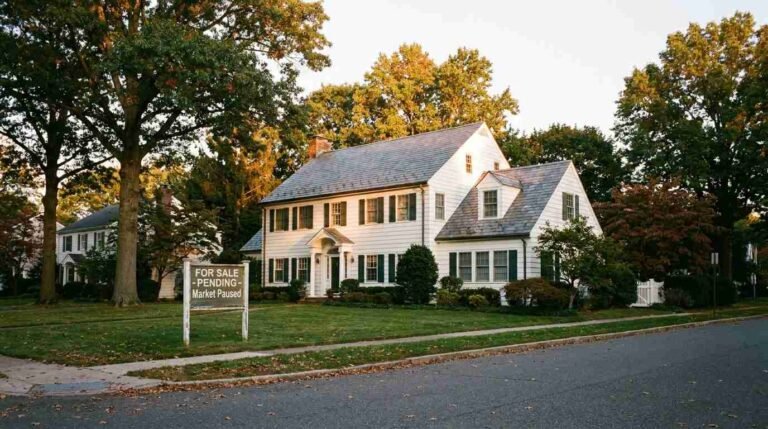
There’s a housing development in East Hills called Country Estates. Elm Drive, Ash Drive, Lufberry — clean mid-century streets with tidy lawns and adequate but unexceptional houses. What the residents of Country Estates know, and most of their neighbors on the wider North Shore do not, is that they are living on the site of one of the most extraordinary private estates ever built in the United States.
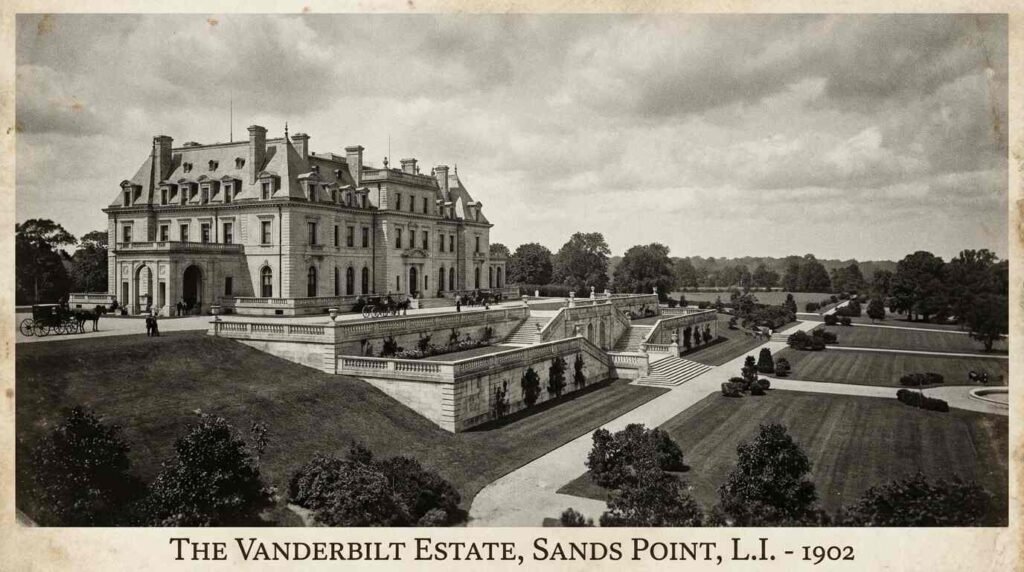
Harbor Hill — Clarence Mackay’s 688-acre French château on the highest point in Nassau County, designed by McKim, Mead & White with Stanford White overseeing every detail — stood atop that hill from 1902 until 1947, when it was demolished by the son who inherited it and could not afford to maintain it. The fountain with its four equestrian statues ended up in Kansas City. The Marly Horse replicas — pink marble, nearly three stories tall — were eventually relocated to a Roslyn park and a high school parking lot. The main limestone house became rubble. Country Estates went in.
I think about Harbor Hill when I’m showing Gold Coast properties — the ones that survived, the carriage houses converted to residences, the institutional campuses that saved what private heirs could not. The demolished estates are the counterweight to the restoration story. They’re what the ones that made it were rescued from.
The Numbers Behind the Loss
Of the more than 1,000 grand estates built along Long Island’s North Shore between roughly 1890 and 1930, fewer than a third remain in any recognizable form today. The figure sounds dramatic, but the math behind it is straightforward: the forces that made these properties impossible to sustain arrived in quick succession and didn’t relent.
The income tax came first, in 1913. The estate tax was established in 1916. The Great Depression followed the 1920s peak, when many of the houses were at their most lavish. A generation of domestic workers — the gardeners, groundskeepers, housemaids, chauffeurs, and kitchen staff that made a 60-room house functional — refused, after the war, to return to that kind of service. Property taxes climbed. And the heirs who received these properties typically received them with significantly diminished family fortunes, at the precise moment when the carrying costs were at their highest and the pool of qualified buyers was at its shallowest.
A historical paper on the Gold Coast decline published by the Nassau County Historical Society summarized the forces precisely: income and inheritance taxes, the dramatic increase in property taxes, the Depression, Robert Moses’s eminent domain seizures for the Northern State Parkway right-of-way, and the postwar generation’s unwillingness to enter domestic service — all converging simultaneously on a class of property that required all of those resources to survive.
What Harbor Hill Actually Was
Stanford White designed perhaps two hundred buildings in his career. Harbor Hill was, by his own assessment and those of his contemporaries, among his most ambitious. The main façade was modeled on François Mansart’s Château de Maisons of 1642 — a deliberate reference to French classical architecture that announced, from the highest point in Nassau County, that its owner was not merely wealthy but educated in the vocabulary of European grandeur.
Clarence Mackay, born in 1874, was the son of John Mackay, one of the discoverers of the Comstock silver lode and a figure who had parlayed mining wealth into a telecommunications empire. When his father died in 1902, Clarence inherited an estimated $500 million fortune. He and his wife Katharine Duer Mackay had received the Harbor Hill land as a wedding present and were already mid-construction when the inheritance arrived.
The finished estate encompassed 688 acres, formal gardens designed by Guy Lowell, outbuildings designed by Warren & Wetmore, stables that were considered the finest on the East Coast, a dairy operation, a game preserve, and a social calendar that placed Harbor Hill at the center of New York’s Gilded Age society. Charles Lindbergh was celebrated there the night of his 1927 ticker-tape parade. The Prince of Wales was received there in 1924.
Then in 1929, the stock market crashed. Katharine had left Clarence years earlier. Harbor Hill’s 688 acres cost a fortune to maintain even in prosperous times. In 1938, Clarence Mackay left the property for the last time. He died four days later, of cancer, at 64. His son John Mackay III inherited an estate he couldn’t afford. By the early 1940s, vandals and arsonists had worked through the rooms. The mansion was demolished in 1947. The land was sold to developers in the late 1950s and became Country Estates.
The Pattern Behind Harbor Hill
Harbor Hill is the Gold Coast’s most documented demolition because it was its most spectacular loss. But it was neither the first nor an outlier. It was the representative case of a pattern that played out across dozens of properties.
The Walter Jennings estate, Burrwood — designed by Carrere & Hastings in 1899 on Cold Spring Harbor — lasted until 1995. The Alva Belmont estate in Sands Point, a replica of an Irish castle, was demolished in 1945 to make way for new development, just three years after William Randolph Hearst sold it. The Meudon estate in Lattingtown — the William Guthrie property, designed in French Classical Revival style — was torn down in the 1960s, the land subdivided for homes.
The tax burden appears repeatedly in the historical record as the terminal factor — the point at which the arithmetic finally closed. A mansion requiring a staff of forty and annual maintenance costs in the tens of thousands of dollars could not be carried by an heir whose inheritance had already been reduced by estate taxes and whose income was not sufficient to sustain the operational overhead.
The ones that survived typically did so through institutional conversion, donation to a public entity, or sufficiently early sale to a buyer with resources and motivation to maintain the structure. The properties that passed through probate to heirs who didn’t fall into any of those categories were overwhelmingly demolished.
What Was Lost Architecturally
The cultural loss tends to be described in terms of spectacle — the rooms, the parties, the scale. But the architectural loss is more specific and less recoverable.
Stanford White’s Harbor Hill was a demonstration of applied European classicism at a scale that had no American precedent — and that scale was the point. The proportions of a Mansart château work at Mansart’s scale. Harbor Hill was not just an imitation; it was an argument that American wealth could commission work that could stand alongside its European models without apology. When the house was demolished, that argument lost its physical form.
The outbuildings — the Warren & Wetmore stables, the kennels, the dairy barn — represented a separate strand of architectural achievement, vernacular and functional rather than monumental. The stables at Harbor Hill were considered among the finest in the country. The kennels, shaped like a horseshoe with individual dog runs converging at the center, were a piece of clever functional design that no one would think to build today. The retaining walls that held the west terrace of the main house are still visible in the backyards of homes in Country Estates, if you know where to look.
What I think about when I stand at Planting Fields or walk the grounds of what survives at Cold Spring Harbor Laboratory is that those properties have their meaning partly because of what’s gone. They’re not just themselves — they’re representatives of a class of property that was almost entirely destroyed. Understanding what was lost is the context that makes the surviving estates legible as something more than large old houses.
What This Means for Properties That Survive
The demolition history shapes the present-day North Shore market in ways that are worth naming.
First, the surviving estates have a rarity value that was created by the demolition wave. There are far fewer of them than there were ninety years ago, and the ones that remain are irreplaceable. That rarity doesn’t automatically translate into preservation — it translates into competition for adaptive reuse, which is why carriage house conversions and institutional repurposing are among the most active market segments in Gold Coast-adjacent real estate.
Second, the maintenance cost problem that destroyed Harbor Hill has not been solved — it has been managed. The properties that survive do so because someone found a sustainable model: events and hospitality, institutional mission, or subdivision of landholdings to generate proceeds that fund the house’s maintenance. A private buyer taking on a Gold Coast structure today is taking on the same fundamental equation that defeated the heirs of Harbor Hill.
Third, the preservation easements and historic district designations that surround many surviving estates exist precisely because of the demolition history. When a preservation easement constrains your renovation budget, it is the distant institutional response to the 1947 demolition of a Stanford White masterpiece.
What Remains at Harbor Hill
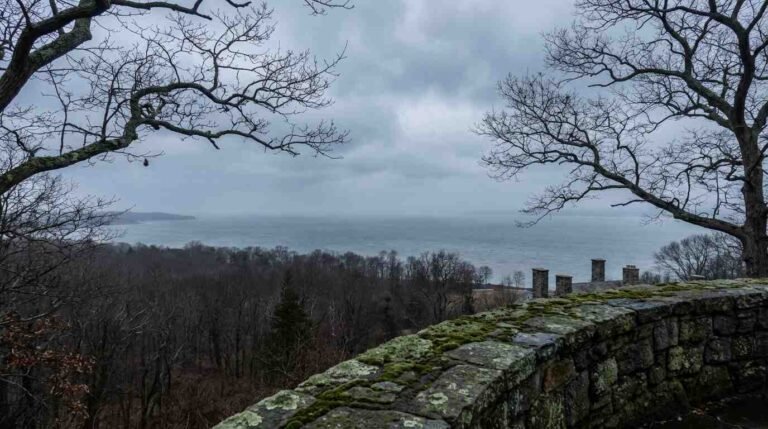
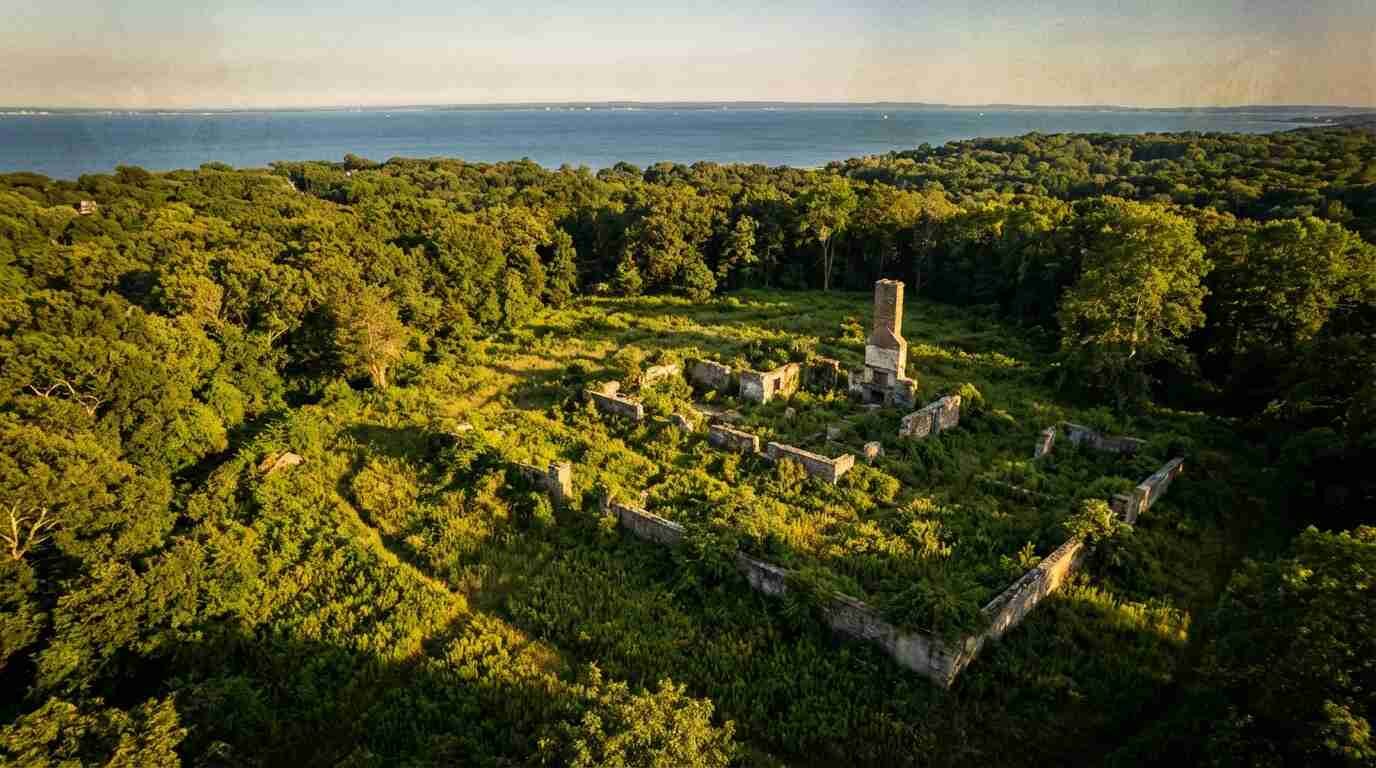
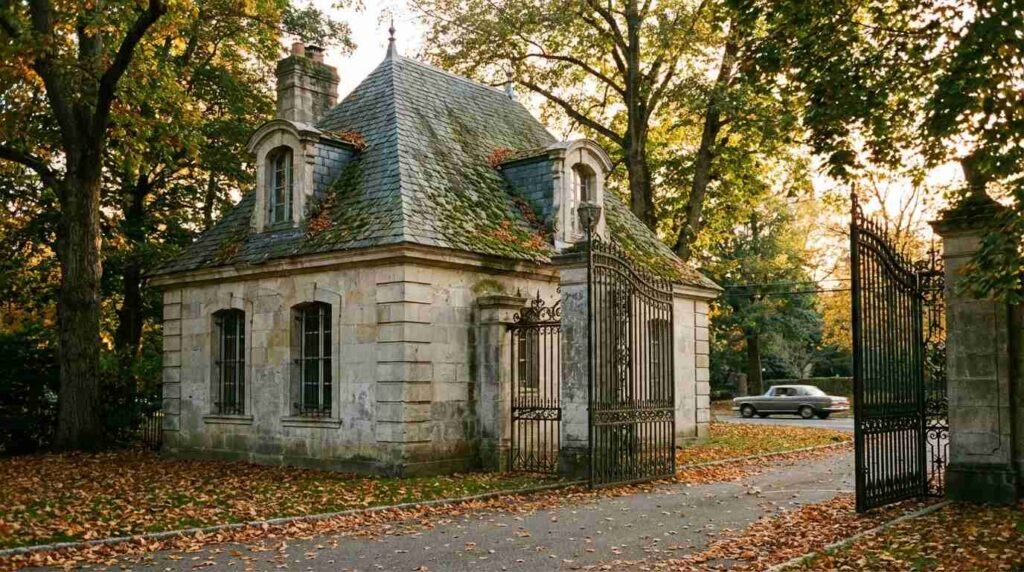
The Mackay Estate Gate Lodge — a miniature version of the main house, built in the same French Baroque limestone, standing at the intersection of Harbor Hill Road and Roslyn Road — is currently being restored by the Village of East Hills with assistance from the Roslyn Landmark Society. The dairyman’s cottage survives. The water tower survives. The retaining walls survive, hidden in landscaping. The John Mackay III stone house on Melby Lane survived a 2020 demolition attempt that was struck down by the East Hills Planning Board, and has since been preserved.
Fragments, in other words. The gate lodge as a miniature of something that no longer exists. The walls that held up a terrace no one will stand on again. A fountain reassembled in Kansas City.
I’ve shown houses in Country Estates. They’re solid, modest, appropriate to their time. The people who live there have no particular obligation to think about what was there before them. But I think about it — the hill, the château at its summit, the Lindbergh party, the horses in the courtyard, the forty people it took to keep the whole thing running — and I think about the son who inherited it and couldn’t. That’s the real story of the Gold Coast: not the parties, but what came after them.
You Might Also Like
- The Chandelier Clause: How a Single Fixture at the Mackay Estate Established Legal Precedent
- The Servant Stair and the Service Wing
- What Old Westbury Gardens Does Not Show You
- Before You Touch the Bow Windows: Preservation Easements on Gold Coast-Adjacent Properties
- The Cold Spring Harbor Phoenix: Buying and Saving Gold Coast Ruins
Sources
- Roslyn Landmark Society — Harbor Hill Estate Profile
- Roslyn Landmark Society — Mackay Estate Gate Lodge Profile
- Atlas Obscura — The Ruins of Harbor Hill
- Untapped New York — 13 Lost Mansions of Long Island’s Gold Coast
- Vanderbilt Cup Races Blog — Clarence Mackay’s Harbor Hill Estate Buildings
- Nassau County Historical Society / Spinzia — Gold Coast Estate Class
- Wikipedia — Harbor Hill