
The Road That Can’t Change Fast Enough: Why Route 25A in Three Villages Has Been Stuck in Committee Since 2017

Something unusual happened at Brookhaven Town Hall in late 2017. A two-year community planning effort — six public meetings, more than 300 residents, civic leaders, elected officials, and state transportation staff working through what Route 25A through Stony Brook, Setauket, and East Setauket should actually become — resulted in a formal visioning report that the Town Board adopted. Not tabled. Not referred to a subcommittee. Adopted.
Then the land use codes that were supposed to follow never came.
As of early 2022, community leaders were still waiting, per reporting by TBR News Media. The recommendations for safer roads, pedestrian improvements, better building design standards, and traffic mitigation that 300 residents had spent months developing sat on the shelf while developers continued to drive what got built on the corridor. The people who knew 25A best had done their part. The bureaucratic machinery hadn’t finished doing its.
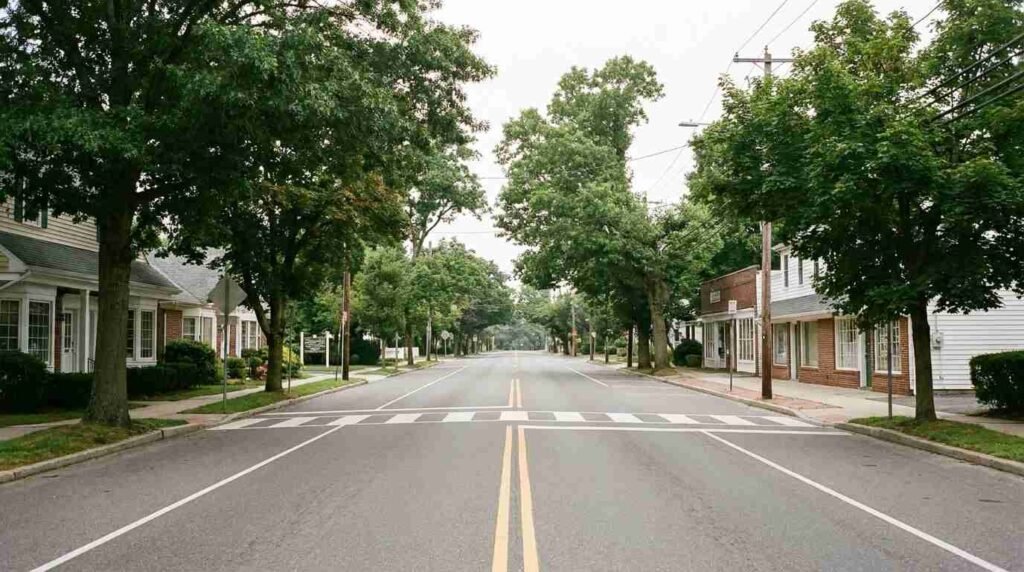
Why This Intersection of Community and State Authority Is So Complicated
Route 25A is a state highway. That single fact explains more about the difficulty of changing it than anything else.
Because 25A is maintained by the New York State Department of Transportation, any physical change to the roadway itself — new signals, intersection redesigns, lane configurations, pedestrian crossing improvements — requires NYSDOT authorization, funding, and engineering review. The town of Brookhaven can rezone parcels along the corridor. It can create overlay districts, establish design standards for new construction, require sidewalks on private development. What it cannot do is install a traffic signal on a state route without going through Albany.
That jurisdictional split creates a gap that community advocates know well. Residents who want a safer crosswalk at a particular intersection can bring the request to their town council member, who can write a letter to the county legislator, who can engage NYSDOT’s regional office in Hauppauge. The process works — it has produced real improvements along 25A over the years, including sidewalk enhancements near Nicolls Road funded through state capital programs. But it works slowly, and it works on the state’s timeline, not the community’s.
The February 2020 Three Village Civic Association meeting illustrated the dynamic. Suffolk County’s Department of Public Works chief engineer appeared to present a signal improvement project at 25A near Nicolls Road — a relatively limited intersection improvement that involved removing a slip ramp and reconfiguring a turn lane. The work was described as “a relatively simple project.” The community had been waiting for it. The machinery was, at that point, finally in motion.
That’s the texture of infrastructure change on a state-controlled corridor: individual improvements move forward, each requiring its own chain of approvals, each measured in years.
What the 2017 Visioning Report Actually Recommended
The Route 25A Three Village Visioning Report, commissioned through a citizen advisory committee co-chaired by civic leaders from Setauket Harbor Task Force and The Stony Brook School, ran from January to March 2017 and produced a detailed set of recommendations across several categories. Pedestrian and bicycle safety improvements were prominent — the report acknowledged explicitly that the corridor’s development over the prior forty years had been built around cars at the expense of everyone walking. Strip centers without shared parking, no coherent access management, and intersections designed for traffic throughput rather than human-scale movement had accumulated over decades.
The recommendations included creating a safer roadway, improving pedestrian and bicycle infrastructure, establishing building design standards to bring coherence to new construction, and preserving the historic and natural character of the corridor — particularly around areas like East Setauket Pond Park, where the disconnect between the road environment and the surrounding character was most visible.
When Brookhaven adopted the report, the next step was translating those recommendations into land use codes: actual zoning rules that would require future development to conform to the community’s vision rather than default to whatever the prior auto-centric code allowed. That translation is where things have moved slowly. Pandemic shutdowns interrupted the planning process. Staffing changes on the town’s Planning Board created gaps. The work of converting a community vision into legal code — with all the public hearings, council reviews, and legal drafting that entails — competes with every other item on the municipal agenda.
What This Means for Buyers Along the Corridor
For buyers considering homes on streets that feed into Route 25A between the Smithtown town line and the Poquott Village line, the infrastructure timeline is worth understanding as a real factor — not a reason to avoid the area, but a piece of the picture that doesn’t always come up at the showing.
The Three Village community has demonstrated, over years of organized advocacy, that it cares enough about 25A to do the work: the citizen advisory committee, the public meetings, the visioning process, the ongoing civic association engagement with elected officials. That kind of documented community investment in a corridor’s future is a meaningful indicator for buyers thinking long-term.
The pace of actual change is a separate question. Streets that feed into an arterial with pending infrastructure improvements — new sidewalks, reconfigured intersections, potential overlay zoning that constrains the worst commercial development — are buying into a future that exists on paper but moves on NYSDOT’s schedule. Some of that future will arrive. Some of it will take longer than anyone expected in 2017.
For buyers specifically drawn to the walkability and character of the Three Village hamlet centers — the mill pond in Stony Brook, the green at Setauket, the library and park at East Setauket’s Main Street — that character already exists and isn’t dependent on 25A changing. The arterial corridor and the village center are meaningfully different environments, and the quality of life that draws buyers to Three Village doesn’t require the state highway to be different than it currently is.
What 25A’s pending transformation does suggest, if the visioning process eventually becomes code, is a corridor that gradually becomes more hospitable for the residents and businesses already there — and potentially more valuable for properties near it. The timeline is uncertain. The community intent, at least on the record, is not.
You Might Also Like
- Setauket and East Setauket, NY — The North Shore Neighborhood Guide
- The Block That Time-Locked: Why Port Jefferson Village’s Walking Culture Survived When Every Town Around It Didn’t
- Summer in Stony Brook: The 2026 Guide to Everything Happening on the Village Green and Beyond
Real estate markets change. For current listings and market data, contact Maison Pawli at maisonpawli.com/about/.
Sources
Route 25A Three Village Area Visioning Report (2017) — Brookhaven Town Board adopted
TBR News Media — Route 25A visioning report still waiting for town land use codes (February 2022)



Your posts restore my faith in humanity and power of kindness
thank you
Love how you make challenging concepts seem manageable and easy to grasp