North Shore vs. South Shore: What Relocating Buyers Actually Need to Know
Every week I talk to at least one buyer who has done exactly fifteen minutes of research before declaring they want to be “somewhere on Long Island.” They’ve seen a beach in a photo, or a friend moved out here and loves it, or the commute math finally penciled out after two years of Manhattan rents. They have a budget and a moving date and exactly one question: where do I start?
The answer almost always begins with the same conversation — North Shore or South Shore? — and it’s a question that sounds simpler than it is. These are not interchangeable versions of the same thing. They are two distinct landscapes, two different relationships with water, two different personalities encoded into their housing stock, school districts, and commute patterns. Getting this choice right saves a buyer enormous time. Getting it wrong means spending years in a house that almost fits.
So here is the honest version of that conversation, the one I give clients when we have an hour and a cup of coffee and the real estate brochure is not in the room.
The Water Is Different — and That Changes Everything
The most important thing to understand about Long Island’s geography is that the two shores are facing completely different bodies of water, and those bodies of water behave completely differently.
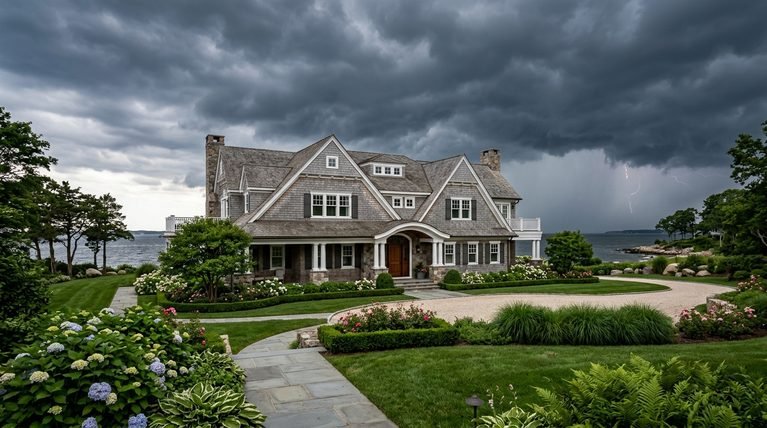
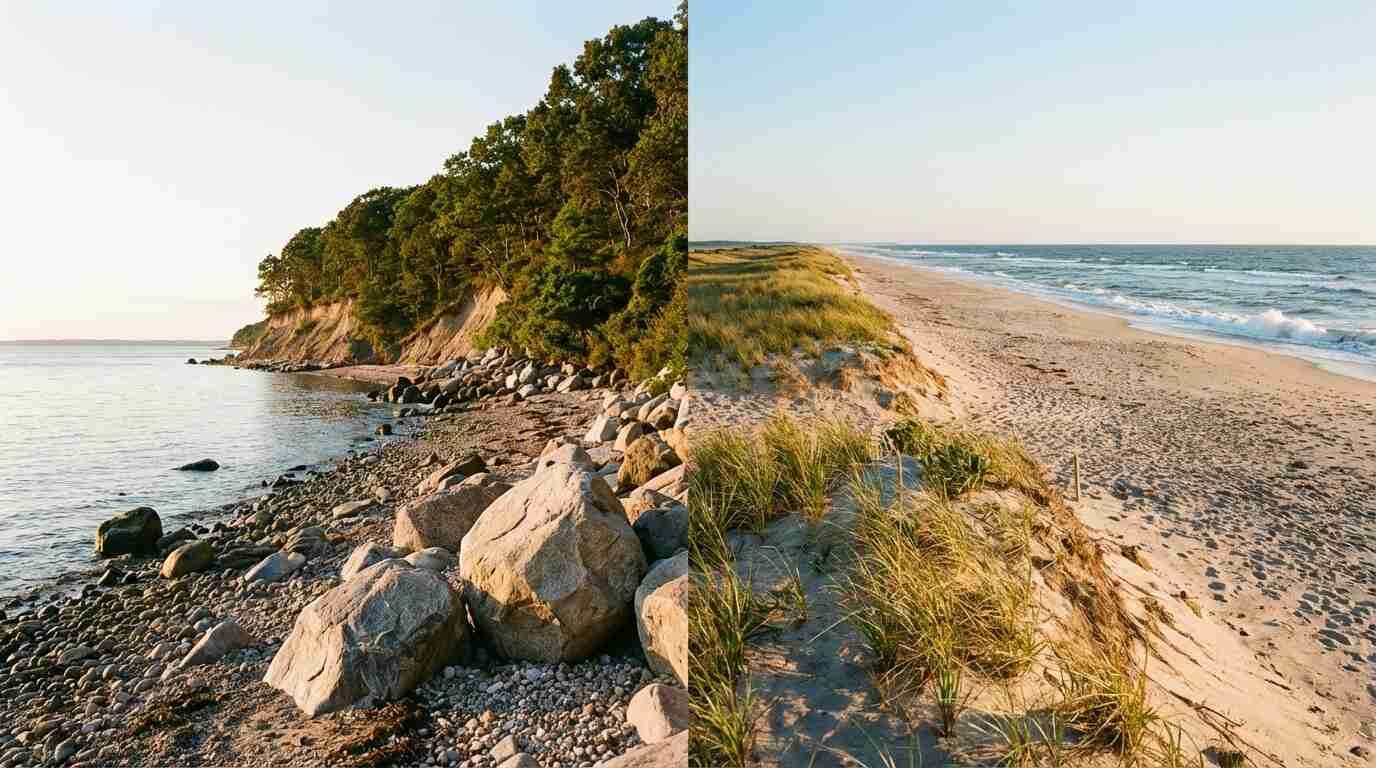
The North Shore faces Long Island Sound — a semi-enclosed estuary stretching between Long Island and Connecticut. The Sound is calmer, cooler, and more sheltered than the open Atlantic. Its beaches tend to be smaller, rockier, and more intimate. The water temperature runs colder through the summer months. The tidal variation is more pronounced. And crucially for anyone buying near the water: the Sound’s enclosed character means less open-ocean storm exposure on most properties, though bluff erosion along the North Shore is a significant and growing issue buyers should understand before closing.
The South Shore faces the Atlantic Ocean, but most of it faces it indirectly — through a chain of barrier islands (Jones Beach Island, Fire Island, Long Beach Island) that create a protected back-bay system known as the Great South Bay and South Oyster Bay. The bay water is warmer, shallower, and better for certain kinds of boating and shellfishing. The ocean beaches — Jones Beach, Robert Moses, Smith Point — are wider, sandier, and carry the full energy of the Atlantic. The South Shore’s oceanfront property is more exposed to storm surge and flooding; FEMA maps and flood insurance are a front-of-mind consideration in ways they aren’t on most North Shore parcels.
Neither is better. They are different. A buyer who wants to kayak to a sandbar and watch the sunset over calm water is describing the South Shore. A buyer who wants to swim in colder Sound water from a rocky bluff with a view of Connecticut is describing the North Shore. This seems minor until you’ve lived somewhere for a decade.
Housing Stock: What You’re Actually Buying
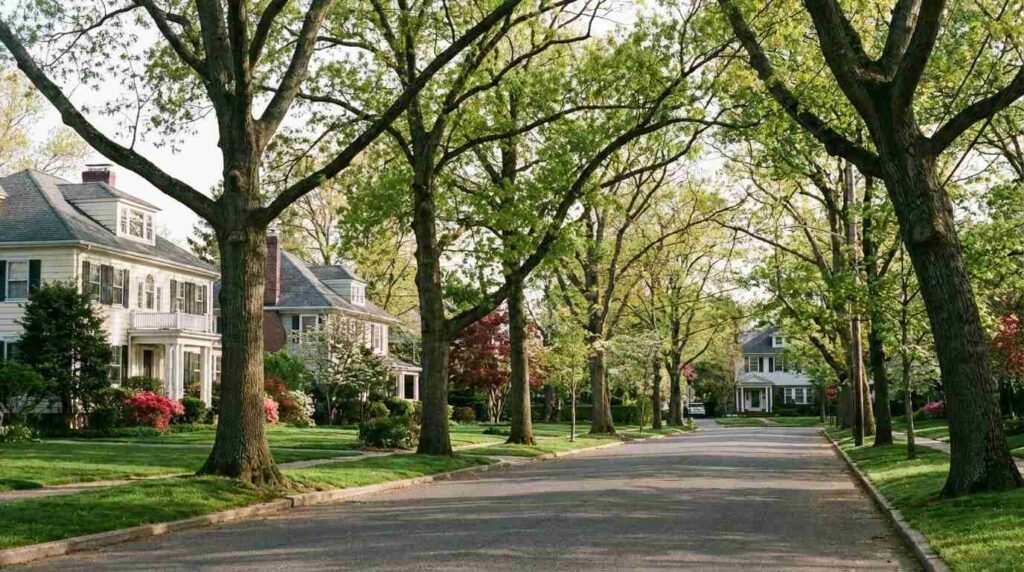
The North Shore’s housing inventory skews older, more architecturally varied, and more expensive per square foot. The Gold Coast era left a physical legacy of large Victorian and early-20th-century homes on substantial lots, and the post-war period added Colonial Revivals and split-levels that have aged well in communities with strong school districts and high owner-occupancy rates. Many North Shore communities never went through the intensive post-war subdivision process that characterized large sections of Nassau County and the South Shore — which means larger lots, more mature trees, and more irregular street grids that feel genuinely settled rather than planned.
The South Shore has its own architectural inventory, but it runs differently. The closer you get to Nassau County — the Five Towns, Long Beach, Oceanside — the denser the housing stock becomes, and the tighter the lots. Further east along the South Shore, into the Patchogue and Bay Shore areas, the inventory opens up considerably and the price points become more competitive. Fire Island’s communities are a category unto themselves — seasonal cottages, no car access, a culture of community ownership that produces a real estate market with almost no comparable in the region.
One thing relocating buyers consistently underestimate: Long Island’s housing stock is old. Whether you’re buying North or South Shore, you are very likely buying into a house built before 1980, and possibly before 1960. That means the questions about foundations, oil tanks, electrical panels, and permitted renovations are relevant everywhere. What changes is which specific issues are more prevalent. North Shore homes on bluff properties add erosion and structural questions to the checklist. South Shore homes in flood zones add elevation certificates and flood insurance calculations. A good inspection isn’t optional anywhere on this island — it’s the minimum.
For more on what inspectors are actually finding in Long Island’s older housing stock, the Home Inspection Red Flags That Matter Most on Long Island’s Older Housing Stock companion post covers that territory in detail. [[link will be: /home-inspection-red-flags-long-island-older-housing-stock/ — update when published]]
Schools: The Question Behind Every Question
When buyers say they want to know the difference between the North Shore and South Shore, they often mean they want to know about the schools. School district quality on Long Island is hyperlocal — it doesn’t track with geographic region as cleanly as buyers from other parts of the country expect. There are exceptional school districts on both shores, and there are districts on both shores that struggle.
That said, some patterns hold. The North Shore communities anchored by strong tax bases — Cold Spring Harbor, Huntington, Syosset, Port Jefferson — have produced consistently high-performing districts over decades, partly because the commercial and industrial tax base in those municipalities has absorbed a share of the school funding burden that might otherwise fall entirely on residential properties. The Hauppauge School District, which I’ve written about in some detail, is a particularly clear example of how an industrial park’s tax footprint can sustain a school district at a level that surprises buyers when they first see the home prices.
South Shore districts follow their own logic. Long Beach has invested heavily in its schools despite the fiscal pressures that come with its beachfront geography. Bay Shore, Patchogue-Medford, and other South Shore districts have undergone significant shifts in the past decade, in both directions depending on the community. The takeaway for relocating buyers is always the same: do not assume. Look at the specific district, look at the specific elementary school your address would be zoned to, and look at how property values in that district have tracked over five and ten years. School quality and property value retention are correlated in ways that matter enormously to resale.
This is one of the reasons I always tell buyers to define their school district requirements before they define their town. The district shapes the budget conversation more than the geography does.

Commute: The Math That Overrides Everything Else
Long Island Rail Road service is the dominant variable, and it breaks differently by shore.
The North Shore is served by the Port Jefferson Branch and the Oyster Bay Branch. The Port Jefferson Branch runs from Penn Station through Jamaica and out to Port Jefferson, with stops in communities like Huntington, Northport, Cold Spring Harbor, Stony Brook, and Port Jefferson. Travel times from the far end of the branch — Port Jefferson — run roughly 90 minutes to Penn Station on a good day, closer to 100 minutes during disruptions. From Huntington, roughly 65 minutes. From Cold Spring Harbor, closer to 70.
The South Shore has denser LIRR coverage through the Babylon Branch and the Long Beach Branch. Babylon to Penn Station runs roughly 60–70 minutes. Long Beach to Penn Station is closer to 55 minutes on express service. The South Shore’s rail access, particularly in Nassau County and the western towns of Suffolk, is generally faster and more frequent than the North Shore’s.
For buyers who are commuting to Midtown five days a week and the commute time is the primary constraint, this is worth running seriously. The difference between a 65-minute commute and a 90-minute commute is not negligible — it is roughly 400 hours per year. The buyers who end up most satisfied are the ones who rode the train before they signed anything.
Remote and hybrid work has softened this calculus considerably since 2020, but not eliminated it. If you’re in the office two or three days a week, the commute time matters less than it once did. If you’re in the office five days, it still matters quite a bit.
Price: What the Market Actually Shows
North Shore prices, particularly in the communities with the strongest school districts and Sound access, run higher than comparable South Shore communities on a per-square-foot basis. That is a generalization with many exceptions, but it holds broadly. In communities like Cold Spring Harbor, Huntington Bay, Lloyd Neck, and Port Jefferson Station, the combination of school quality, water proximity, and housing character produces prices that reflect genuine scarcity — there is simply not much inventory, and what comes available moves.
South Shore pricing is more varied. Nassau County’s South Shore communities — Long Beach, Oceanside, Merrick, Freeport — carry their own premium because of proximity to the city and ocean access. Further east along the South Shore, the price-to-square-footage ratio opens up considerably, and buyers who need more space for their budget often find it in communities like Patchogue, Bay Shore, or West Islip.
The honest framing for a relocating buyer is this: figure out what you need — commute time, school district, water access type, lot size, house character — and then find where that combination exists at your price point. The Shore designation is a starting filter, not a destination. Many buyers end up in communities that surprised them, because the community met their actual criteria rather than their mental image of what Long Island was supposed to look like.
The Question I Always Ask
Before I show anyone a house on either shore, I ask them one question: what does a Saturday look like in your ideal version of this place?
The answer tells me more than any checklist. If the answer involves kayaking, clam digging, watching the sunset over the bay, and a farmers market within walking distance — that’s a South Shore answer, probably somewhere along the Great South Bay. If the answer involves hiking a bluff trail, swimming in cold water, driving to a small downtown for dinner, and a commute that’s longer but a yard that’s bigger — that’s a North Shore answer.
Both of those lives are good lives. They’re just different lives. My job, and the job of any broker who is actually paying attention, is to help buyers figure out which one they’re describing before they sign anything.
This post is a spoke in the Complete Guide to Buying a Home on Long Island’s North Shore — the full guide covers mortgage options, title searches, inspections, contingencies, and more.
You Might Also Like – Beyond the 30-Year Fixed: Mortgage Options First-Time Buyers on Long Island Rarely Hear About – The Easement You Didn’t Know You Bought – North Shore Bluff Homes and the Erosion Question: What Buyers Need to Know
Real estate markets change. This post reflects conditions as of April 2026. For current listings and market data, contact Pawli at Maison Pawli.
Sources – Long Island Rail Road schedules and branch information: mta.info/lirr – FEMA National Flood Insurance Program / Flood Map Service Center: msc.fema.gov – NYS Education Department school district data: data.nysed.gov – Suffolk County Real Property Tax Service Agency: suffolkcountyny.gov/Departments/Assessor