How to Sequence a North Shore Fixer-Upper Renovation to Avoid the Permit Trap
The first thing a client of mine said when she closed on a 1958 split-level in Kings Park was: “I’m calling the contractor Monday.” It was a Friday afternoon. She had a list, a budget, and an absolutely reasonable sense of urgency. What she didn’t have was any idea that her contractor couldn’t legally touch the structural wall she wanted opened until four months had passed and two separate permit applications had cleared — and that if he had started without them, she would have been looking at mandatory demolition of his work on the town’s order.
That sequence problem — the gap between what feels logical and what the permit process actually requires — is where North Shore renovations go wrong. Not in the contractor selection. Not in the budget estimate. In the order of operations.
I’ve walked enough buyers through North Shore fixer-uppers to have seen this play out across towns, price points, and project scopes. The permit trap isn’t a hidden mystery. It’s a predictable set of bureaucratic dependencies that most buyers don’t know exist until they’re inside one.
Why Sequence Matters More Than You Think
A renovation has a natural logic to it: you want to see the bones before you cover them, you want the messy work done before the finish work, and you want everything inspected before it’s enclosed. That logic is correct. The problem is that permit applications and inspector scheduling impose a second layer of sequencing on top of the physical one — and the two don’t always align.
In Suffolk County, building permits are issued at the town level, not the county level. The Town of Brookhaven, the Town of Huntington, the Town of Smithtown, and the other North Shore municipalities each have their own building departments, their own fee structures, their own review timelines, and their own inspection protocols. A renovation that would take two months to permit in one town can take five months in another — not because of any difference in the scope of work, but because of departmental backlog and staffing.
The contractor shortage that has been hammering North Shore renovation timelines for the past several years — which I’ve written about at length here — has made this worse by turning inspector scheduling into its own bottleneck. Getting a permit approved is one thing. Getting an inspection scheduled within a workable window is another.
If your trades run out of sequence — if framing is closed before the rough electrical is inspected, for instance, or if HVAC is installed before the structural work that would have required its relocation — you’re not just behind schedule. You may be facing mandatory exposure of completed work for re-inspection, which means opening finished walls, rescheduling trades you’ve already paid, and losing weeks you didn’t budget.

The Work That Comes Before the Permit
Before you can pull a permit for most structural or mechanical work, you need a set of plans. Not sketches. Architectural drawings, stamped by a licensed architect or engineer, that show the scope of work in sufficient detail for the building department to evaluate code compliance.
This is where most buyers lose their first two to four weeks — sometimes much more. They assume that because they’re buying an existing house, the renovation plan can follow the permit application. In most cases in Suffolk County, it has to lead it. The application requires the drawings. The drawings require the design work. The design work requires site visits, measurements, and in older North Shore housing stock, often some exploratory demolition to understand what’s actually inside the walls.
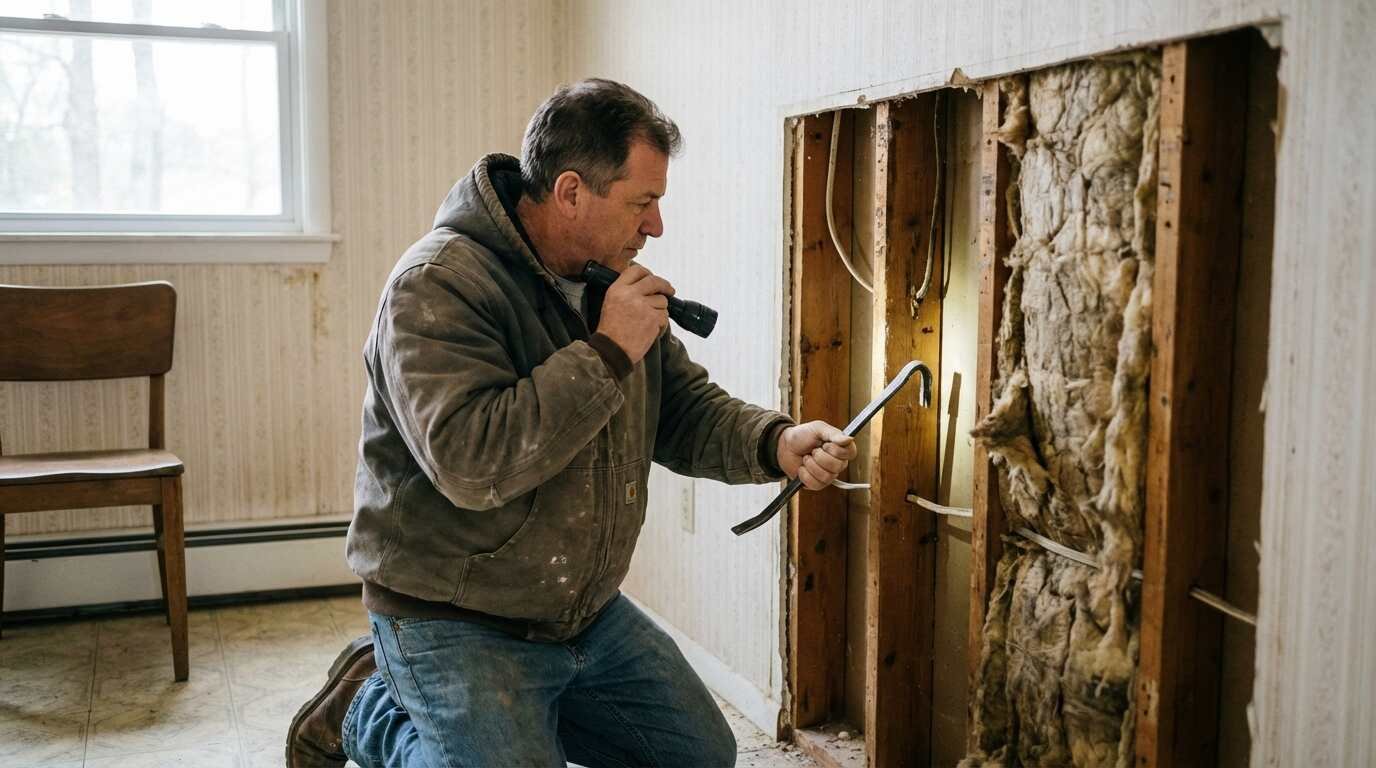
That exploratory phase — informally called “opening up” — is itself something that needs to be handled carefully. Minor exploratory demolition that doesn’t affect structural elements typically doesn’t require a permit. But if what you find changes the scope of the project (and it often does, particularly in pre-war and early postwar homes), the plans need to be revised before the permit application can go forward.
On North Shore split-levels and ranches from the late 1950s and early 1960s, what you find inside the walls frequently does change the scope. I’ve walked through glacial till foundation problems on Kings Park and Setauket ranches that nobody flagged at inspection. I’ve seen asbestos insulation wrapping HVAC ductwork in postwar construction that the general contractor wasn’t expecting. Each of those discoveries adds a step between the purchase and the permit.
The Correct Order of Operations
Here is how a sequenced North Shore renovation should run, and why each step has to precede the next.
Step 1: Exploratory assessment before design. Before you hire an architect to draw anything, hire a structural engineer for a walkthrough. If the house has oil tanks on the property — a common situation in North Shore neighborhoods built before the transition to gas heat — get a tank sweep done now, not mid-renovation when a buried tank discovery can halt everything. The buried oil tank question is something sellers need to deal with proactively, but buyers inheriting the problem face the same logistical disruption. Know what’s there before anyone puts a shovel in the ground.
Step 2: Asbestos and lead paint assessment before demolition. In Suffolk County, asbestos abatement in homes built before 1980 is regulated under New York State Department of Labor rules. Before any demolition begins on materials that may contain asbestos — floor tiles, pipe insulation, plaster, certain textured ceiling materials — you need a licensed inspector’s assessment. If abatement is required, it has to be completed by a licensed contractor before other demo begins, and the abatement itself requires notification to the Department of Labor. Budget three to six weeks minimum if abatement is in play.
Step 3: Design and permit applications — submitted together, in the right order. Once you know what you’re working with structurally and environmentally, the architect can prepare a full set of drawings. For major renovations — anything involving structural changes, additions, or relocation of mechanical systems — you’ll typically need at minimum a building permit from the town, and depending on scope, separate specialty permits for plumbing and electrical. Submit them together where possible. Staggered submissions create staggered approval timelines, which creates scheduling gaps between trades.
Step 4: Structural work first, mechanical second. Once permits are approved and work begins, structural work must precede mechanical installations that depend on structural configuration. If you’re opening up a load-bearing wall to create an open-plan kitchen, the structural work — steel beam installation, post placement, foundation reinforcement if required — has to be inspected before rough framing closes. Your HVAC contractor needs to know where those new structural elements land before they run ductwork. Your electrician needs the same clarity before roughing in.
Step 5: Rough inspections before closing walls. This is the most expensive mistake I see buyers make when they’re trying to accelerate a timeline. Rough plumbing, rough electrical, and rough HVAC all require separate inspections in most North Shore towns before the walls can be closed. If your GC closes the walls before those inspections because the insulation contractor’s window is narrow and you don’t want to lose the date — and the inspector requires exposure for re-inspection — the insulation contractor comes back, the drywall contractor’s schedule slips, and you’re paying for two mobilizations instead of one.
Step 6: Insulation, then drywall, then finishes. After rough inspections clear, insulation follows, then drywall, then the finish sequence: flooring, tile, cabinetry, trim. On older North Shore homes — particularly Depression-era FHA construction that’s more common than people realize — there are often dimension irregularities in finished spaces that affect material quantities. Budget overages are common in this phase if the exploratory assessment in Step 1 didn’t catch everything.
Step 7: Certificate of occupancy as a defined project endpoint. A renovation isn’t finished when the last coat of paint dries. It’s finished when the Certificate of Occupancy is issued. In North Shore towns, getting a CO can require a final inspection, confirmation that all specialty permits have closed, and occasionally sign-off from the Health Department if the project involved septic system work. If your contractor pulls permits and doesn’t follow through on CO — a surprisingly common situation — you’re holding a renovated house without a legal occupancy certificate, which complicates resale and can affect your homeowner’s insurance.
The Specific Bottlenecks in Suffolk County
Beyond the general sequence, there are a few North Shore-specific complications worth flagging.
The Health Department permit. Any work that touches septic — including kitchen and bathroom additions that increase fixture counts — requires a separate Suffolk County Department of Health Services permit. The SCDHS permit process operates on its own timeline, independent of the town building department. If you’re adding a bathroom or expanding a kitchen with a dishwasher where one didn’t exist before, the Health Department application should go in simultaneously with the town building permit application, not after.
Preservation easements on Gold Coast-adjacent properties. If your North Shore fixer-upper sits within a historic district or carries a preservation easement, there may be an additional layer of review before any exterior modifications can begin. This is particularly relevant for properties in Cold Spring Harbor, Oyster Bay, and Gold Coast-adjacent communities — and the review process there has its own timeline that runs parallel to, but not in lockstep with, the building department process.
The contractor scheduling gap. In 2026, the gap between permit approval and the ability to schedule licensed trades on the North Shore is running two to four months in many specialties. Plumbers and electricians in particular are backlogged. The sequence implication is this: your permit approval date is not your start date. If you’re filing permits in September expecting to begin structural work in November, you may find your licensed plumber’s earliest availability is February — after which the rest of the schedule compresses into spring, when contractor availability tightens further.
What Savvy Buyers Are Doing Differently
The buyers I’ve seen navigate North Shore fixer-uppers well are doing a few things that look simple but require discipline. They’re getting the structural engineer and the environmental assessments done during due diligence — before closing, if the seller permits it, or within the first two weeks of ownership. They’re treating the permit application as a day-one priority, not a week-three task. And they’re building their contractor schedule around realistic permit timelines — three to five months for a full renovation permit in most North Shore towns in current conditions — rather than treating permit approval as a formality that happens in the background.
The buyers who end up in the permit trap almost universally made the same mistake: they thought of permitting as an administrative parallel track that the contractor handles, and focused their own attention on materials selection and design choices. When the permit comes back with a revision request — which it frequently does on structural work in older housing stock — they’ve lost weeks they weren’t tracking.
The sequence is the strategy. The renovation follows the permits. The permits follow the design. And the design follows the assessment of what you’re actually working with. Get that order right, and the timeline becomes predictable. Get it wrong, and you’re not renovating a North Shore fixer-upper — you’re managing a series of compounding delays. If you’re in the early stages of evaluating a North Shore property with renovation potential, I’m happy to talk through what realistic timelines look like for the specific scope you have in mind. Reach out through Maison Pawli.
You Might Also Like
- The Contractor Shortage Nobody Warned You About
- Why Your 1960s Ranch Renovation Is Fighting the Soil
- The Asbestos Ceiling Nobody’s Talking About
- Before the Bulldozer: Depression-Era FHA Homes on Long Island
- The ‘Sweat Equity Ceiling’: Why Some North Shore Fixer-Uppers Will Never Appraise Out
Real estate markets change. This post reflects conditions as of April 2026. For current listings and market data, contact Pawli at Maison Pawli.
This post is for informational purposes only. Consult a licensed contractor, architect, and attorney regarding the specific permitting requirements for your renovation project.
Sources
- JZ Development — Long Island Construction Permit Guide 2026
- Rich’s Construction — Bathroom Remodeling Permits: Suffolk County NY Guide 2025
- Land Planning Services — How Long Does It Take to Get a Permit in Suffolk County?
- Lipsky Construction — The Ultimate Guide to Building Permits in Suffolk County (2025)
- Suffolk County Department of Health Services — Residential Permits