The Gold Coast Estate That Became a Corporate Campus: How Cold Spring Harbor Laboratory Inherited One of Long Island’s Most Storied Properties
There is a building at Cold Spring Harbor Laboratory that began life as a whale oil warehouse.
The Jones Laboratory — the oldest continuously operating research laboratory in the United States, according to the institution’s own archives — was originally constructed in the early nineteenth century to store barrels of oil processed by John D. Jones’ Cold Spring Whaling Company. The barrels were sealed with bungs. The road that runs through the campus today, Bungtown Road, carries that industrial history in its name. The whaling industry collapsed in the 1860s. The building stood. In 1893, it was leased to the Brooklyn Institute’s Biological Laboratory, renovated into a dark room, lecture hall, and operating space, and the life sciences arrived at Cold Spring Harbor.
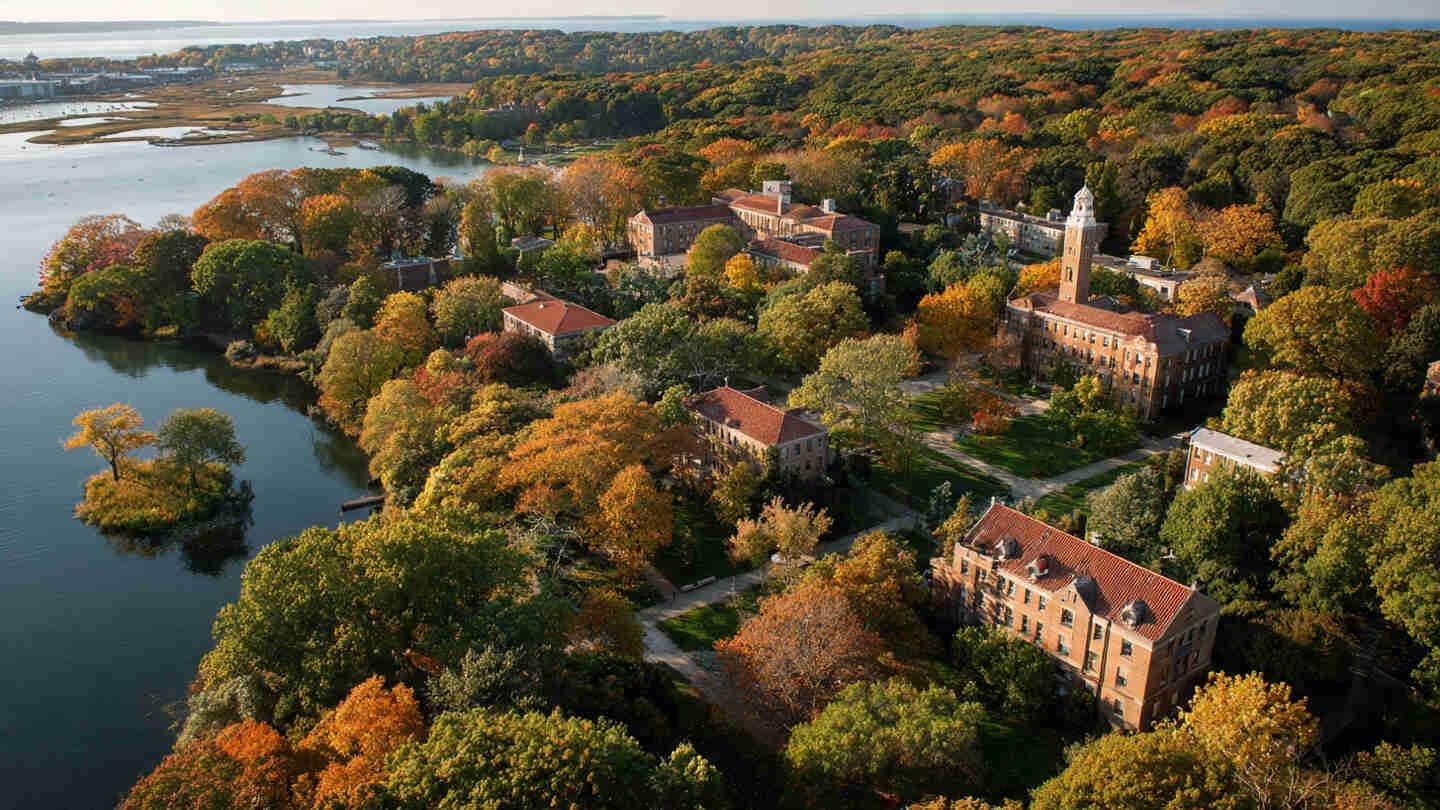
That arc — industrial utility, institutional repurposing, scientific consequence — is the organizing principle of the entire Cold Spring Harbor Laboratory campus. A Nobel Prize-winning research institution now occupies land shaped successively by Gilded Age whaling fortunes, Carnegie philanthropic ambition, and the architectural conventions of a scientific establishment that had no template to follow. The campus at 1 Bungtown Road is not a Gold Coast estate in the traditional sense — there is no single great house, no Olmsted garden, no grand stair hall. It is something stranger and more interesting: a campus that assembled itself across a century and a half, absorbing buildings from different eras and purposes, none of them designed to coexist, all of them now doing exactly that.
The Carnegie Building: A Mediterranean Argument on the Shore of Long Island Sound
In 1904, the Carnegie Institution of Washington established its Station for Experimental Evolution on a parcel just south of the existing Biological Laboratory, and the campus entered its defining architectural chapter. The first research laboratory erected by the Carnegie Institution — now known as the Carnegie Library — was completed in 1905, and its design repays close attention.
The two-story structure was built near the head of the harbor in what the institution’s own architectural records describe as a Mediterranean variant of the Second Renaissance Revival style. It was constructed of brick with frame partitions and stucco finish, featuring classical detailing around the doors and windows set off by brick trim. Its flattened hipped roof carried flaring overhanging eaves supported by wooden brackets; a smaller monitor roof sat on top of the main roof, with short horizontal clerestory windows lighting the attic space between. The effect, as the archives note, was close enough to the hundreds of libraries the Carnegie Foundation had funded across the country that it might have been mistaken for one.
That ambiguity was not accidental. The Carnegie Institution’s Station needed to signal both scientific seriousness and civic permanence. The Mediterranean Revival idiom accomplished this: warm but rigorous, classical without being ostentatious, rooted in a tradition of scholarship the institution was ambitious enough to claim.
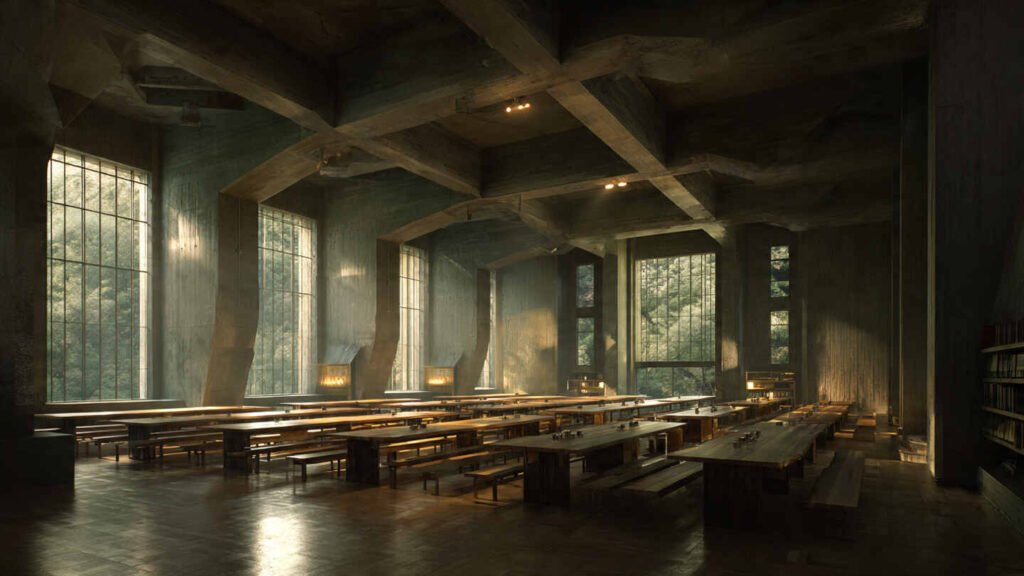
The building’s interior program was equally telling of the era’s research priorities. The ground floor housed two large Breeding Rooms on the south and east sides, an Aquatic Animals Room filled with aquaria on the north, and a Work Room and Food Room flanking the entrance vestibule. The second floor was given over to a series of research rooms, a Secretary’s Room, and a small Library. The entire south end — lit from above by an extensive multipaned skylight, since lost — was a Bird and Insect Room.
This is a floor plan that tells you precisely what science looked like in 1905: observational, taxonomic, obsessed with controlled breeding and visible variation. George Shull began planting his famous maize experiments in the garden just east of the building in 1906, reporting by 1908 results that would eventually establish the genetic principle of hybrid vigor — the foundation of modern agricultural genetics. Barbara McClintock’s cornfields, where she would later identify the “jumping genes” that earned her the 1983 Nobel Prize, were adjacent to the same structure.
The Carnegie Library now houses the Laboratory’s archives and serves as a center for the history of science. The multipaned skylight is gone. The breeding rooms are long converted. But the Mediterranean stucco exterior, the bracketed eaves, the brick-trimmed window reveals — these survive substantially intact, a 1905 building that wears its original ambition without apology.
Blackford Hall: The Problem of Feeding Scientists in Summer
The Biological Laboratory’s curriculum had expanded dramatically by the early 1900s — ten courses and several specimen-collecting excursions by 1906, its archives record — and the campus’s original buildings could no longer contain it. The solution arrived through grief: when the widow of the Laboratory’s earliest benefactor, Eugene C. Blackford, donated $25,000 (the equivalent of roughly $875,000 today) in his memory, it funded the design, construction, and furnishing of what became Blackford Hall.
Dedicated on June 1, 1907, Blackford Hall was then the tallest building on campus and was remarkable for a reason that had nothing to do with height. It was among the first residential buildings in America to be constructed entirely of reinforced concrete. The material choice was structural pragmatism elevated to statement: concrete was read then as a technology of the future, a repudiation of Victorian weight and ornament, an argument that science’s architecture should look like science’s values.
The program was straightforward. The main floor held a dining room designed for 120 people, a meeting hall, and a serving room. The second floor was a women’s dormitory accommodating 30 residents. The basement contained a kitchen, laundry, storage, and servants’ quarters. Blackford Hall was built without a heating system — the Laboratory’s courses were held only in summer, and the building reflected that seasonal logic. The Lab was sometimes referred to, in those early decades, as a summer camp for biologists.
The first Symposiums on Quantitative Biology were held in Blackford before the meetings outgrew it and moved to Bush Lecture Hall in 1953, then to Grace Auditorium in 1986. Renovations over the decades added dining space, a basement bar, expanded kitchen facilities. The concrete bones are still there, beneath the accretions. Today the building functions as the social center of the campus — three meals a day, the Blackford Bar open to the community each evening — which is precisely what it was always designed to do.
The Animal House: McClintock and Hershey Worked Here
The building the archives call the Animal House has one of the more counterintuitive histories on the campus. Built as a breeding facility for the Carnegie Institution — described in the 1911 Carnegie annual report as designed to relieve the main building of the dirt that is inseparable from animal culture — it was a brick and stucco structure housing the messier biological work that the main building’s refined interior could not accommodate.
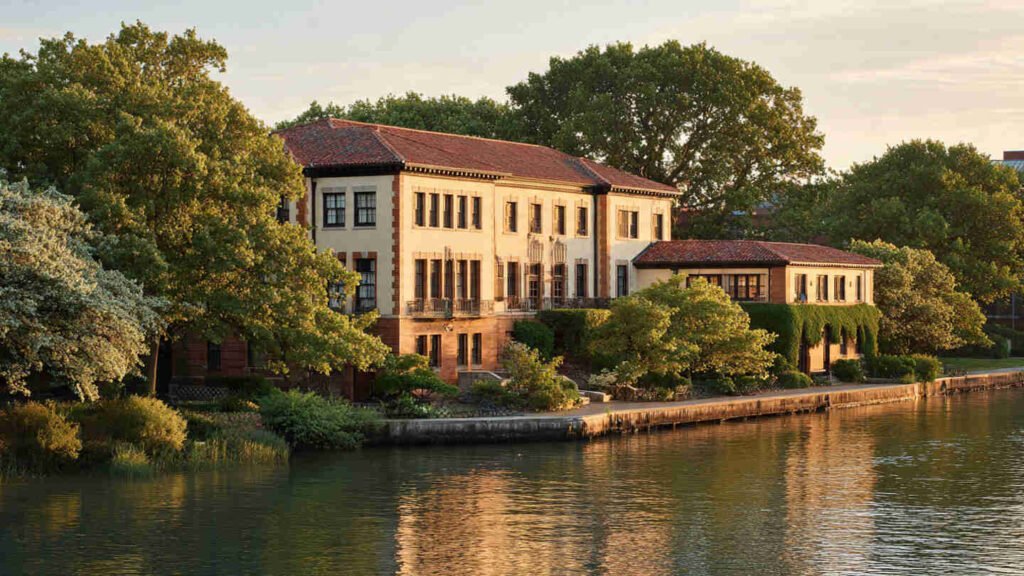
By the time Barbara McClintock arrived in 1941, the breeding pens had been replaced by experimental laboratories. The building subsequently housed two of the Laboratory’s eight Nobel laureates: McClintock herself, who conducted her maize genetics research here, and Alfred Hershey, the 1969 Nobel laureate in Physiology or Medicine, whose bacteriophage experiments helped confirm that DNA was the molecule of heredity. The building today houses three Cold Spring Harbor Cancer Center members.
This is the quiet argument of the CSHL campus: the same walls that sheltered the Carnegie Institution’s eugenic research — the Eugenics Record Office operated here from 1910 to 1939 before being shut down after an institutional review — also sheltered the genetics research that eventually repudiated everything eugenics claimed to be doing. The campus carries this history without euphemism; the Laboratory maintains the full records of the Eugenics Record Office as historical material. Architecture cannot redeem what happened in these buildings. But it can insist on the continuity of place — which is a different and more honest thing.
What Survived, and What It Means for the North Shore
The Cold Spring Harbor Laboratory campus does not look like a Gold Coast estate because it was never designed as one. It accumulated. It borrowed. It repurposed a whale oil warehouse, built a stucco Carnegie library in the Mediterranean Revival idiom, poured one of the first reinforced concrete institutional buildings in America, and continued layering research facilities across 110 acres on the west shore of Cold Spring Harbor — today comprising more than 40 buildings — without ever resolving the architectural conversation into a single coherent statement.
That is precisely what makes it remarkable in the context of the North Shore’s postwar reckoning with its Gold Coast inheritance. The great houses were, by and large, either demolished or converted into schools, country clubs, and institutional campuses. What CSHL represents is something different: not conversion of a great house, but the organic growth of an institution on land that never had a great house to begin with. The social infrastructure — the laboratories named for their most famous occupants, the McClintock building, the Demerec, the Sambrook, the Hershey — is a kind of institutional vernacular, the architecture of science rather than of wealth.
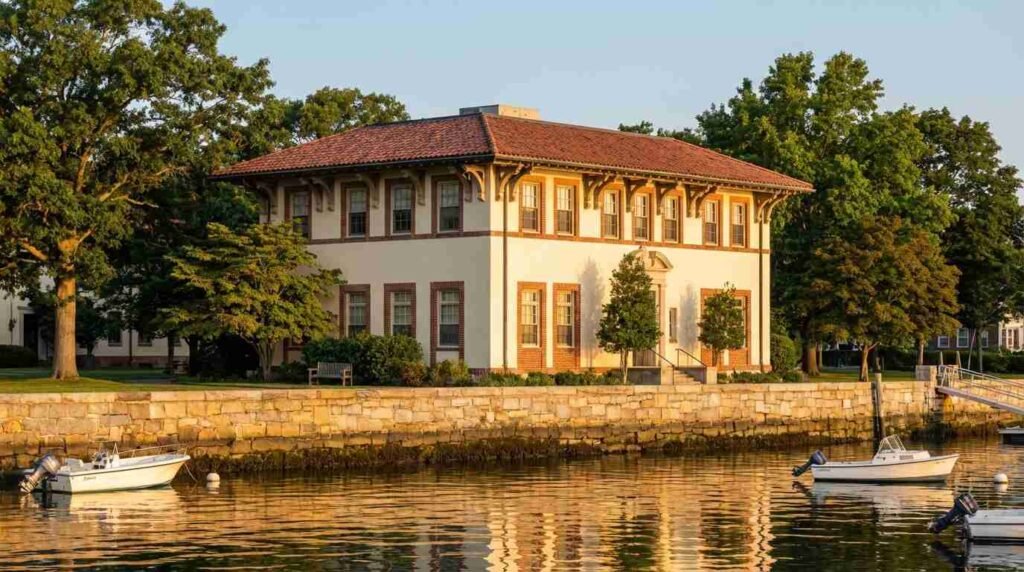
I find myself thinking about this distinction whenever I’m showing properties in the Cold Spring Harbor area. The village has always carried a particular quality — serious, wooded, not interested in announcing itself — that you feel before you can fully explain it. Some of that quality comes from the water, from the harbor’s protected geometry. Some of it comes from the Laboratory: this place has been doing consequential work for 130 years, and the accumulated seriousness of that presence shapes the character of the surrounding community in ways that are real even when they’re hard to specify.
For buyers considering Cold Spring Harbor — and there are always serious buyers considering Cold Spring Harbor — the Laboratory is not an amenity in any conventional sense. It is a presence, an anchor, a reminder that this particular stretch of the North Shore has been a site of genuine ambition across a very long time. The buildings on Bungtown Road carry that history in their materials and their proportions. The whale oil barrels are long gone. The science remains.
You Might Also Like: Cold Spring Harbor Laboratory’s Visual Epistemology | The Cold Spring Harbor Phoenix: Buying and Saving Gold Coast Ruins | The Servant Stair and the Service Wing
Sources: Cold Spring Harbor Laboratory, CSHL’s Oldest Haunts | CSHL Library & Archives, Carnegie Building History | CSHL Library & Archives, Building Blackford Hall | Wikipedia, Cold Spring Harbor Laboratory
Part of the Gold Coast Series: This post is one of fifteen pieces in the Maison Pawli Gold Coast cluster. For the full guide — surviving estates, architectural history, legal sediment, and what buyers need to know — visit The Gold Coast of Long Island: Gilded Age Estates, Architectural Heritage, and What Survives.