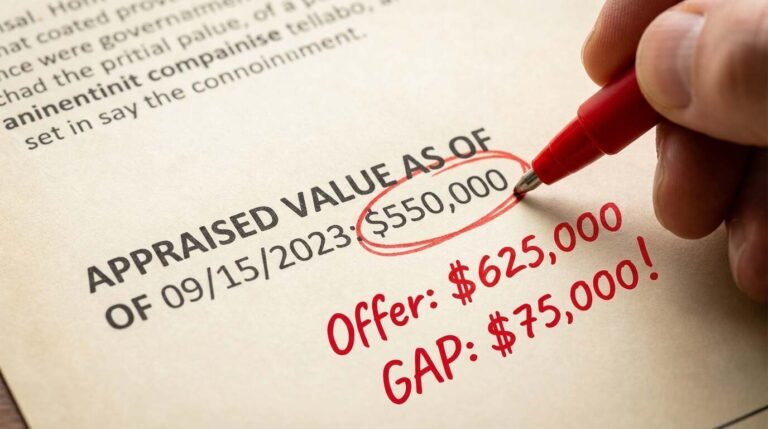
When the Buyer Blinks: How to Read and Respond to a Lowball Offer Without Losing the Deal

There’s a moment that happens in nearly every listing — the moment when an offer comes in and the number on the page is so far below the ask that the seller’s first instinct is to not respond at all. To let it sit there as a statement. To take the slight personally and move on.
I’ve talked a lot of sellers off that ledge. Not because every lowball deserves a full-throated counter — some really don’t — but because the emotional response to a low number almost always misses what the number is actually telling you.
A lowball offer is data. The question is what kind.
What a Low Offer Usually Means
There are really only a few reasons a buyer submits a number significantly below ask.
The first is that they have a genuine read on the market that differs from yours. They or their agent have looked at the comps, identified what they believe to be a pricing gap, and bid accordingly. This is not a personal judgment about your home — it’s a transactional position. It may be right or wrong, but it’s worth understanding their reasoning before you dismiss it.
The second is that they’re testing. Some buyers — particularly experienced ones — open low on principle, expecting a counter, budgeting for a negotiated midpoint. The lowball is not their number; it’s their opening move. They expect the dance.
The third is that something about your listing — its days on market, the photos, a detail in the disclosure, the price history — has signaled that you might have more flexibility than your list price suggests. In this case, the offer is a mirror. It’s showing you something buyers are reading about your position, whether or not you intended to broadcast it.
And the fourth — the one sellers least want to hear — is that the house is priced wrong for where the market actually is.
Understanding which of these you’re dealing with changes everything about how you respond.

The Counter as a Communication Tool
When a seller receives a low offer, the instinct is often to counter at or very near the full ask, essentially saying: this is a non-starter. I wrote about how days on market tells the market something — and the same logic applies here. A counter at 98% of ask to a buyer who bid at 88% of ask sends its own message. It says you’re not really engaging. Often, the buyer walks.
A more strategic counter acknowledges the offer without capitulating to it. It narrows the gap meaningfully — not all the way, but enough to communicate that you’re a serious seller, you’ve considered their position, and you’re willing to move to find a number that works. The math matters less than what the counter says about your posture.
A good counter also, wherever possible, changes something other than just the price. Closing timeline. Included fixtures. Post-closing occupancy. Personal property the buyer has indicated interest in. These additions signal good faith and give both sides something to work with beyond the pure dollar figure — which is almost always the point of highest emotional charge.
Before You Counter: Know Your Real Floor
This is the conversation that needs to happen before the offer comes in — not after.
Your real floor isn’t the price you’d be willing to accept on a good day. It’s the number below which the transaction doesn’t make financial sense given your carrying costs, your payoff, your relocation timeline, and the transaction costs outlined in your net sheet. I’ve written before about how the seller net sheet works — and why it’s not a legal document, but its primary utility is exactly this: it shows you, before any offer arrives, what different sale prices actually put in your pocket after fees, transfer taxes, attorney costs, and outstanding liens.
Sellers who know their floor going into negotiation are dramatically better negotiators than those who try to calculate it in real time while an offer is sitting on the table. The pressure of an open offer, a deadline, and an eager agent on the other side is not the environment for clear financial thinking.
When the Low Offer Reflects Pricing Reality
This is the hard one. Because sometimes a low offer isn’t a test and isn’t a negotiating ploy — it’s a market signal that the listing price was optimistic relative to where buyers are actually transacting.
A cluster of low offers — or, worse, a long stretch of silence broken by a single low offer — is the market speaking. I wrote about charm pricing and what the appraisal record shows — about how the gap between what sellers believe their home is worth and what the comparable sale data supports gets exposed quickly and expensively when a house sits. A lowball offer on a listing that’s been active for sixty days is telling you something different than a lowball offer on day three.
The timing matters. So does the pattern.
Before any North Shore seller counters a low offer at a number they can’t support with comps, it’s worth spending twenty minutes actually pulling the recent sale data for comparable properties in the same neighborhood, same square footage, same condition tier. If that data supports your price, counter confidently. If it doesn’t fully support your price — if you listed aggressively hoping the market would meet you — the low offer is not the problem. It’s information about the problem.

What Not to Do
Don’t reject without countering unless the offer is genuinely disrespectful and you have strong competing interest. Even a rejection with a counter preserves the relationship. A flat rejection often ends it.
Don’t take longer than twenty-four hours to respond. A low offer does not deserve a slow response — it deserves a fast, clear one. A seller who sits on an offer signal either desperation or disorganization, neither of which helps your negotiating position.
Don’t let the number you want cloud your read on the buyer’s motivation. A buyer who offers low on a house they’ve toured twice and sent their agent back to measure for furniture is not a buyer who’s indifferent to your home. They want it. The low number is a tactic, not a verdict. That’s a buyer worth working with.
And don’t make the counter personal. The language of a counter shouldn’t carry emotional freight. It’s a business communication. The assessed value is not the market value and the list price is not a moral position — it’s a starting point for a negotiation. The buyers know that. The sellers who know it too are the ones who close.
A Word on Commercial Context
Everything above applies to residential transactions. For commercial property sellers on Long Island — a strip retail building, a mixed-use parcel, a small office condo — the offer negotiation is structurally different. Commercial buyers are almost always running internal IRR models and cap rate analyses that have nothing to do with how much they love the building’s bones. The lowball in a commercial transaction is usually a mathematical position, and the best counter is a mathematical response: here’s why the income stream and the comparable cap rates support this price, not that one.
If you’re navigating a commercial sale on Long Island, I’ll have more on that specifically in a post coming shortly — but the fundamental principle is the same: understand what the offer is actually communicating before you decide how to respond.
The Offer Is the Beginning of a Conversation
Most sales on Long Island’s North Shore don’t close at the first offer price. They close at a number both parties arrived at through at least one round of negotiation — often two or three. The offer is an opening statement, not a verdict. Sellers who treat it as such, who respond strategically rather than emotionally, who know their floor and communicate their position clearly, consistently close faster and closer to their target than sellers who wait for the “right” offer that arrives at the number they want.
It doesn’t usually work that way. The right offer is often the low one, improved by a counter that was thoughtful enough to keep the buyer at the table.
This is for informational purposes only — consult a licensed attorney or financial advisor for your specific situation.
Real estate markets change. For current listings and market data, contact Pawli at Maison Pawli.
Sources
- National Association of Realtors — Home Buyer and Seller Generational Trends Report 2025: https://www.nar.realtor/research-and-statistics/research-reports/home-buyer-and-seller-generational-trends
- Zillow Research — Negotiation Patterns in Northeast Residential Markets: https://www.zillow.com/research/
- CoreLogic — Home Price Index and Market Conditions: https://www.corelogic.com/intelligence/u-s-home-price-insights/
- [VERIFY: Pull current CoreLogic and NAR data for Long Island negotiation-to-sale price ratios before publishing.]
You Might Also Like: For a complete overview of everything involved in selling on the North Shore — pricing, staging, legal obligations, and closing — see The North Shore Seller’s Guide.