Who Builds Like That Anymore: The Craftsmen Behind the Gold Coast Estates and Whether Any of Their Techniques Survive
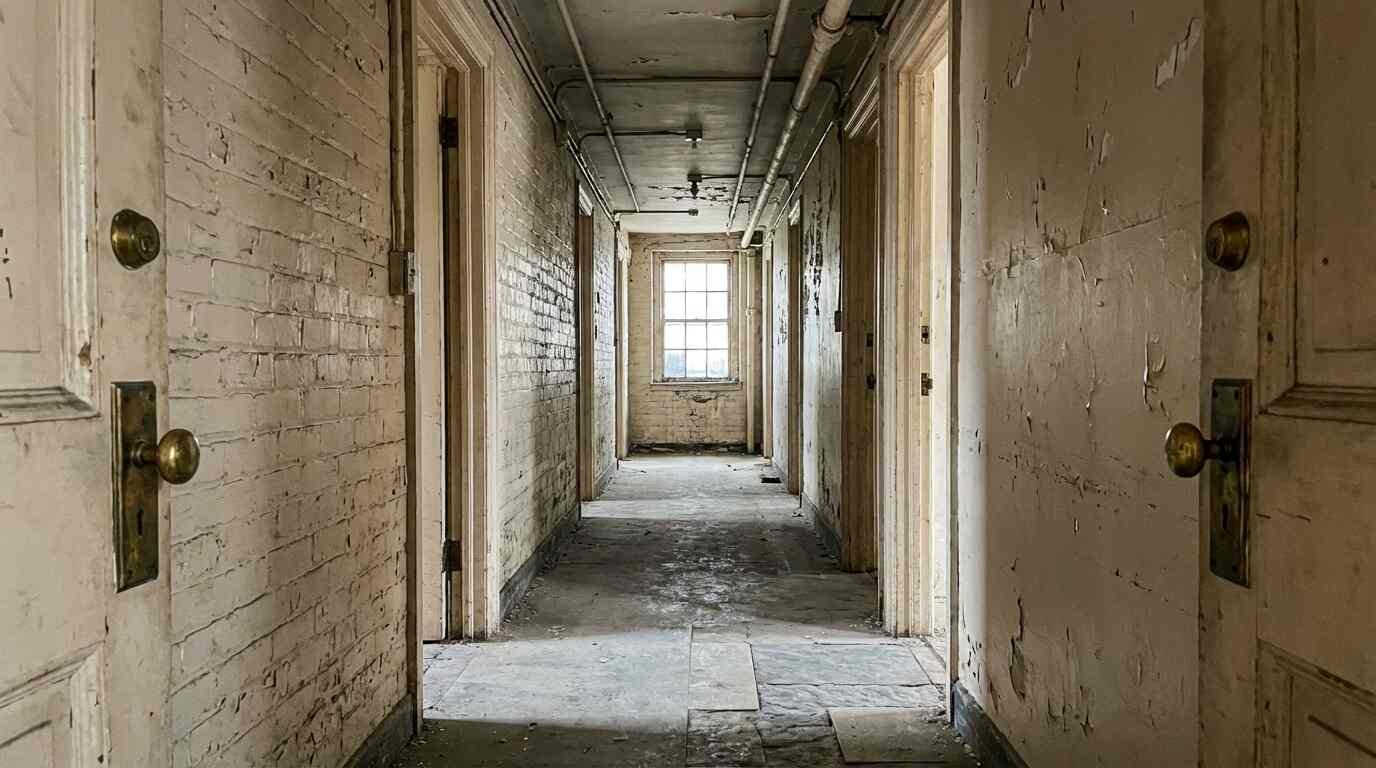
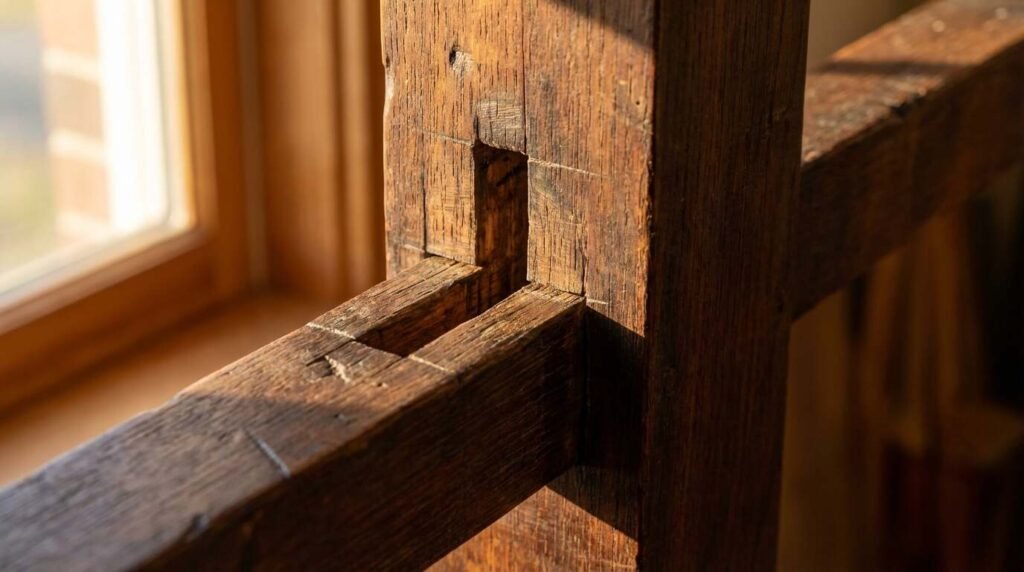
The first time I walked the service corridor of a Gold Coast estate — not the public-facing rooms, not the grand stair hall, but the working spine behind the walls — I stopped at a door frame I wasn’t expecting. The joinery was mortise-and-tenon, hand-cut, fitted so precisely that a century of Long Island humidity had barely worked it loose. Someone had stood at a bench and fit that joint by feel, the way a watchmaker sets a gear. Nobody had specified it in a drawing. It was just how the work was done.
That’s the question that has stayed with me ever since: who were the people who built these estates, and where did that knowledge go?
The Gold Coast estates were not assembled from catalogs. They were built by skilled tradesmen — joiners, plasterers, ironworkers, tile setters, stonemasons — who came from everywhere: from Sicily and the Apulian interior, from County Cork and the Bavarian highlands, from the furniture districts of Grand Rapids and the shipyards of New England. They brought techniques that had developed over generations, refined through apprenticeships and guild structures that were already beginning to fray when they arrived in Nassau and Suffolk Counties in the 1890s and early 1900s. What they left behind, in the walls and ceilings and woodwork of the estates that survive, is one of the most concentrated archives of early twentieth-century craft tradition in the northeastern United States.
The Trades That Built the Estates
The Gold Coast construction boom at its height — roughly 1895 to 1929 — required a depth of skilled labor that Long Island’s existing workforce could not supply on its own. Estate developers and their architects recruited nationally and internationally.
The plasterwork came first in the visual hierarchy. The great rooms of estates like Harbor Hill, Oheka, and the Vanderbilt mansion at Centerport required ornamental plasterers who could execute classical medallions, coffered ceilings, and compound cornices in situ — working from scaffolding, applying finish coats by hand, modeling wet plaster with tools and fingers. Many of these men had trained in Italy, where the stucco tradition runs back to the Renaissance. Others came from the Parisian ateliers that had been training decorative craftsmen since Haussmann. The Italianate vocabulary that dominates Gold Coast interiors wasn’t just an aesthetic choice — it was an acknowledgment that the Italians were simply better at this work than anyone else.
The woodwork is where things get philosophically interesting. Long Island had its own deep joinery traditions, and I’ve written before about the Matinecock Friends Meeting House joiners who influenced Gold Coast estate carpenters — the way a vernacular Quaker building tradition became a kind of graduate school for the craftsmen who would later work on much grander commissions. But the estates also brought in specialists from outside. The steam-bent woodwork at Sagamore Hill, for example — the kind of compound curve that a flat-sawn plank cannot execute — required a craftsman who understood how white ash behaves under heat and moisture pressure, how long to hold a bend before the wood sets, how to build a form against which the curve will be held as it cools. That knowledge came from the carriage trade and the boat trade — shops where bent wood wasn’t decorative but structural. Port Jefferson’s shipwright tradition fed directly into this; the men who had bent frames for schooners knew exactly how to bend a chair rail for a dining room forty feet long.
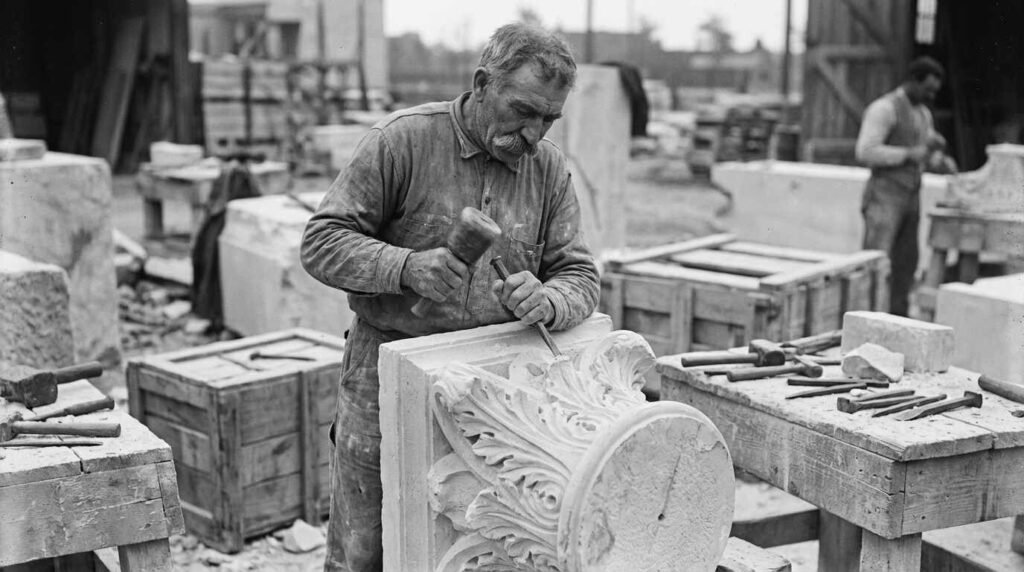
The metalwork — the hardware, the grilles, the ornamental iron — came from foundries in New York, New Jersey, and Connecticut, some with European-trained pattern makers on staff who could execute custom commissions from architect’s drawings. The tile work drew on a network of Moravian, American Encaustic, and imported Spanish and Portuguese suppliers, installed by craftsmen who understood bond patterns, substrate preparation, and the coefficient of expansion differences that would crack an improperly bedded floor within a decade. The stone carving on estate exteriors — the keystones, the cartouches, the balusters of terraces — was almost entirely the work of Italian immigrant stone carvers, most of them Calabrian or Sicilian, working under master carvers who had trained in the classical tradition.
The furniture itself deserves its own chapter. Tiffany Studios maintained a workshop in the region, and the finishing techniques they developed — including the ebonized cherry work at Laurelton Hall — were proprietary processes that combined chemical staining with surface treatments that could make cherry read as ebony to a buyer who didn’t look too closely. The goal was aesthetic deception in service of beauty, which is a very particular thing. The Vanderbilt collection at Centerport includes coopered furniture — barrel-stave construction applied to upholstered pieces — that required a cooper’s training applied to a furniture-maker’s sensibility. These are not simple crossovers.
What the Architecture Demanded
The scale of the estates imposed demands on their builders that ordinary residential construction did not. The service wing architecture — the hidden kitchen corridors, the servants’ stairs, the mechanical rooms — required a degree of systems coordination between trades that was genuinely novel in the early twentieth century. Heating, ventilation, refrigeration, telephone infrastructure, dumbwaiter systems: these were technologies in rapid development, and the craftsmen who installed them were working from blueprints and instructions that were often incomplete or contradictory.
What emerged from this negotiation between design and reality was a tradition of improvised expertise. The electricians who wired Oheka learned on Oheka. The plumbers who ran supply lines through the service wings of the Phipps estate at Old Westbury — a building whose below-grade infrastructure was as ambitious as its public rooms — developed techniques for managing pipe runs through walls of unusual thickness that became standard practice for estate work throughout the North Shore. The knowledge accumulated on each project and was carried to the next one by the same foremen and specialty contractors.
This is how craft traditions actually propagate: not through formal instruction alone, but through repeated problem-solving in the presence of a master. The Gold Coast estates were the Long Island version of the cathedral building tradition — complex enough to require lifetime specialization, concentrated enough geographically to allow knowledge to accumulate and transfer.
Where the Craftsmen Came From, and What Happened to Them
The 1920 census records for Nassau and Suffolk Counties show a striking concentration of skilled tradesmen in the communities closest to the estate zones: Oyster Bay, Cold Spring Harbor, Locust Valley, Lattingtown. Italian-born plasterers and stone carvers cluster in certain neighborhoods with an almost sociological precision, which reflects the way that estate labor recruitment worked — one craftsman brought a brother, a cousin, a neighbor from the same village in Calabria. English-born gardeners and coachmen settled in other clusters, often near the carriage facilities and grounds operations that required their specific skills.
The Crash of 1929 and the Depression decade that followed did not simply slow Gold Coast construction — they ended the estate-building era almost completely. The craftsmen who had built their working lives around this form of commission had to find other outlets. Some moved into high-end residential work in New York City. Some found employment in the institutional construction boom of the 1930s — the schools, post offices, and civic buildings that New Deal programs funded. Some retired or returned to Europe. The apprenticeship pipelines that had fed new tradesmen into the estate trades were severed, and they were never fully restored.
What Survives: The Honest Accounting
The ornamental plaster traditions have thinned dramatically. There are plasterers on the North Shore who can patch period plasterwork, execute simple profiles, and repair ornamental details — but the deep capacity for original in-situ ornamental modeling that the Gold Coast estates required exists today mostly in a handful of specialist firms concentrated in New York City and a few regional restoration shops. If you own a Gold Coast property with significant plaster damage, your restoration contractor is probably bringing in a specialist from outside the region. This is the hard truth.
The woodworking traditions are in better shape, partly because the tools and materials of joinery have changed less dramatically than those of other trades, and partly because the furniture-making revival of the late twentieth century kept certain techniques alive. There are joiners and furniture makers on the North Shore today — some of whom I’ve encountered through the preserved carriage house and estate conversion work that has driven so much of the interesting restoration activity in this area — who understand mortise-and-tenon joinery, hand-cut dovetails, and the behavior of period hardwoods at a level that would have satisfied a Gold Coast estate foreman.
The ironwork survives almost nowhere in its original form of production. The foundries are gone. What remains is the ironwork itself — the gates, the grilles, the hardware — which can be repaired by skilled metalworkers but cannot easily be replicated. When a piece of original ornamental iron is lost or beyond repair on a Gold Coast property, replacement is typically cast from surviving originals, a process that captures the form but loses the hand texture of the original pattern-making.
The stone carving tradition has fared somewhat better, again because the knowledge was preserved in ecclesiastical and institutional work that continued through the Depression and after. Italian-American stone carvers working in the New York region maintained the classical vocabulary through church commissions and cemetery monument work in ways that kept the skills transmissible. There are stone carvers working in the Northeast today who can execute the kind of classical ornament that appears on Gold Coast estate exteriors — though the economics of doing so at any significant scale are prohibitive.
What This Means If You Own One of These Properties
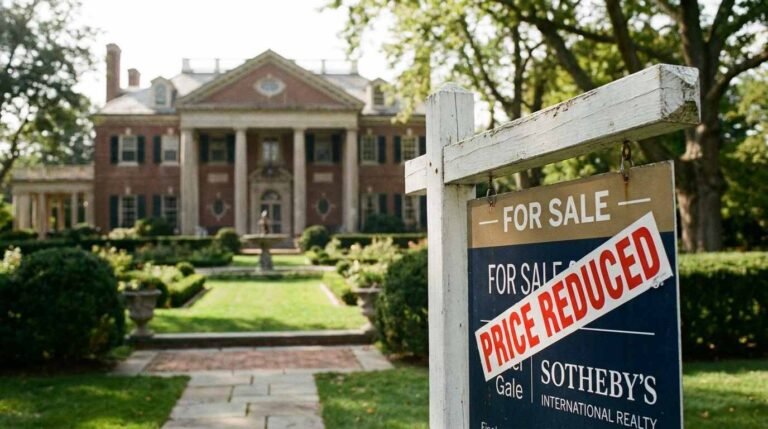
I think about this history every time I see a Gold Coast-adjacent property on the market with “original details” in the listing. Those details — the plaster crown, the hand-fitted door casing, the original hardware — are not just aesthetic features. They are irreplaceable, in the literal sense: if they’re damaged or removed, what goes back is almost certainly not equivalent. This changes the calculus of renovation in ways that most buyers don’t fully appreciate until they’re mid-project.
The preservation easements that govern some Gold Coast and Gold Coast-adjacent properties exist partly to formalize this protection — to put legal weight behind the aesthetic and historical argument for preserving original fabric. But even on properties without easements, the intelligent approach is the same: understand what you have before you touch it, find the craftsmen who can work with it rather than around it, and treat the budget for proper restoration as a floor rather than a ceiling.
The people who built the Gold Coast estates were doing something that cannot be fully recovered. But enough of what they knew survives, in the craftsmen still working today and in the buildings themselves, that stewardship is possible. It requires patience, and it requires finding the right people — which is harder than it should be, and worth every phone call it takes.
This is for informational purposes only. For current listings and market data, contact Pawli at Maison Pawli.
You Might Also Like
- The Joiner’s Argument in Locust Valley: How the Matinecock Friends Meeting House Framing Influenced a Generation of Gold Coast Estate Carpenters
- The Bent Wood Secret of Sagamore Hill: How Roosevelt’s Craftsmen Steam-Curved White Ash
- The Servant Stair and the Service Wing: What the Hidden Architecture of Gold Coast Estates Reveals About Today’s Luxury Floor Plans
- The Cold Spring Harbor Phoenix: Buying and Saving Gold Coast Ruins
Sources
- Stern, Robert A. M., Gregory Gilmartin, and John Massengale. New York 1900: Metropolitan Architecture and Urbanism 1890–1915. New York: Rizzoli, 1983.
- Spinzia, Raymond E., and Judith A. Spinzia. Long Island’s Prominent North Shore Families: Their Estates and Their Country Homes. Bayside, NY: T-K Graphics, 2006.
- Nassau County Museum System. Gold Coast era estate documentation archives.
- New York State Historic Preservation Office. https://parks.ny.gov/shpo/
- Preservation League of New York State. https://www.preservenys.org/
- 1920 U.S. Census — Nassau and Suffolk County occupational data (via Ancestry.com)
- National Park Service, Sagamore Hill National Historic Site. https://www.nps.gov/sahi/