Poured Concrete and Postwar Optimism: The Forgotten Modernist Office Parks of Route 110 and What Their Bones Reveal
Before Silicon Valley had a corridor, Long Island had Route 110.
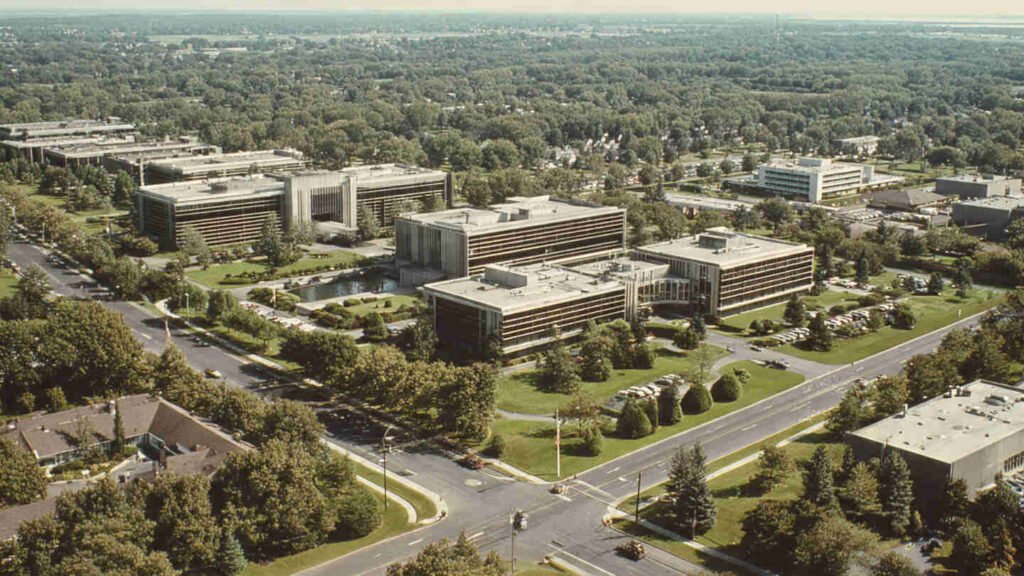
The road runs north-south through Melville in the Town of Huntington, connecting the Long Island Expressway to the cold water of the Sound, passing through what was, from roughly 1955 to 1985, one of the most concentrated nodes of defense aerospace employment in the United States. The office parks that define the Route 110 landscape today — low-rise, setback, landscaped to a 1960s idea of corporate dignity — are the built residue of that concentration. Most of them are half-empty. Some have been converted. A few have been demolished. But the bones of the corridor are legible to anyone who knows how to read a building, and what they reveal is an architectural argument for a very specific idea of American industrial ambition — one that deserves more serious attention than it typically gets.
The Industrial Prehistory
The Route 110 corridor’s connection to aerospace and defense runs deeper than the office parks. The aviation industry arrived on Long Island before the road was what it is today. By the early 1900s, Farmingdale — adjacent to the Route 110 corridor at the corridor’s southern end — had established itself as a center of aircraft manufacturing. Fairchild Aviation opened there in the 1920s. By 1928, Sherman Fairchild had developed his Fairchild Flying Field to test aircraft. Grumman Aircraft Engineering Corporation built planes in Farmingdale from 1932 until moving to Bethpage in 1937. Seversky Aircraft moved in, became Republic Aviation, and built more than 9,000 P-47 Thunderbolt fighters during the Second World War.
This was not a corridor by design. It was a corridor by gravity — the accumulation of manufacturing skill, engineering talent, runway infrastructure, and supply-chain relationship that made Long Island’s mid-island zone the logical home for the aerospace industry’s postwar expansion. When the Cold War began and the defense budget grew, the office parks followed the factories northward up Route 110.
Melville’s transformation was characteristic of this moment. For most of its history, the hamlet was agricultural — rural land, farms, open field. The mid-twentieth century changed that in a single generation. Large-scale office parks and industrial campuses replaced the farms, and the Route 110 corridor became, as Long Island business history records it, a destination for regional employment and economic activity. What distinguishes this moment from similar suburban commercial development elsewhere is the specific character of the tenant: defense contractors, aerospace subcontractors, the engineering support infrastructure for an industry that was simultaneously producing fighter jets and calculating moon trajectories.
The architecture followed the tenant.
The Corporate Modern Language
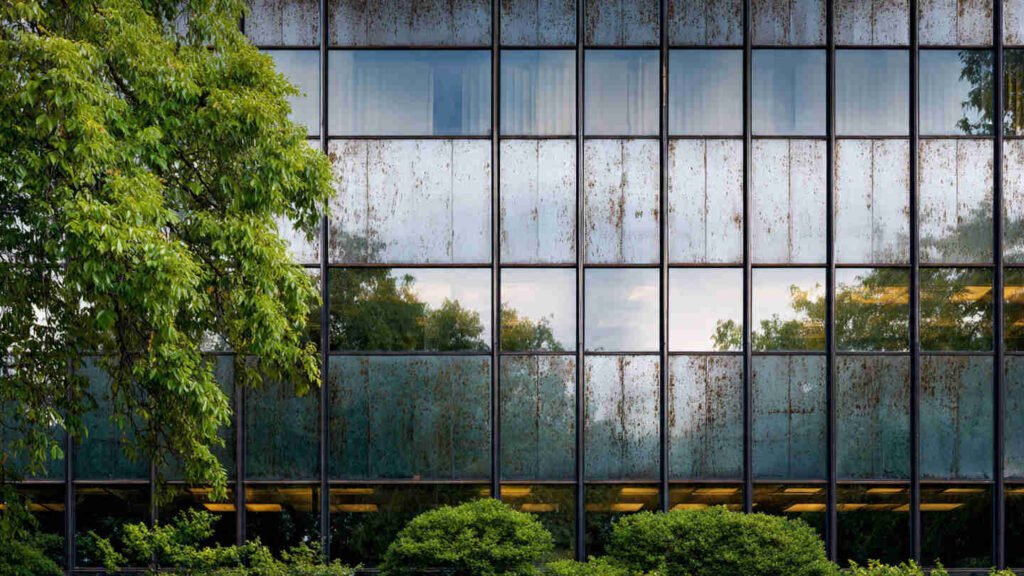
The buildings that went up along Route 110 in the late 1950s and early 1960s were not generic commercial construction. They were the expression of a design philosophy — sometimes called Corporate Modern or International Style — that took the formal lessons of European modernism and applied them to the American suburban office campus. The results varied from the earnest to the excellent, but the language was consistent: flat or nearly flat rooflines, ribbon windows or full curtain wall glazing, structural frames expressed on the exterior, landscape integrated into the site plan as a compositional element rather than an afterthought.
The corporate campus model that Route 110 exemplified was, at its best, a genuine architectural proposition. It argued that the workplace deserved the same design attention as the civic building. It argued that the American worker — particularly the American engineer, the category most relevant to the defense corridor — deserved light, space, and a site that communicated the seriousness of the work being done within. The best corporate campuses of this era demonstrate what this proposition could achieve: integrated ensembles of International Style research buildings, curtain wall towers, and sculpted concrete manufacturing structures that are now considered among the most significant postwar commercial architecture in the country.
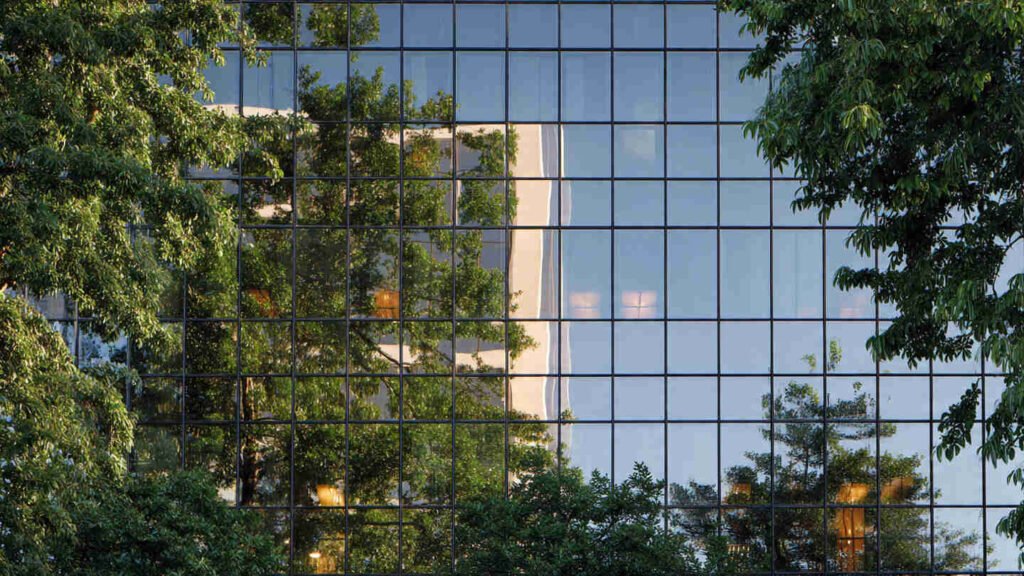
Long Island’s Route 110 corridor did not produce work at that level of architectural distinction. But it produced buildings that shared the same ambitions and, in some cases, the same design vocabulary. The curtain wall systems — aluminum-framed glass walls that replaced masonry bearing walls with a thin skin of metal and glass — were the period’s signature gesture. They communicated transparency, rationality, the open exchange of ideas between inside and outside. In the context of classified defense work, this was ironic. In the context of architectural history, it was sincere.
Paul Rudolph and the Argument in Concrete
The most architecturally significant building associated with the Long Island modernist commercial moment of this era is not on Route 110 itself. It is the Endo Laboratories building designed by Paul Rudolph, one of the most formally ambitious architects of the postwar American period. The structure’s approach to concrete — a careful interplay of hammered, striated, and smooth surfaces, purposefully contrasted with walnut paneling in the interior — represented Rudolph’s characteristic Brutalist sophistication applied to a commercial commission. The building was, by contemporary accounts, widely admired by the architectural community.
Robert Moses, then president of the Long Island State Park Commission, reportedly ordered the planting of rows of hemlock trees along the Meadowbrook Parkway specifically to block passing motorists’ view of the building.
This exchange — Rudolph’s concrete argument for a demanding architecture of industry, Moses’s hemlock rebuke — is a useful frame for understanding the Route 110 corridor’s broader architectural fate. The buildings along Route 110 were, in their better examples, serious architectural proposals for how the American industrial campus should look. They did not receive the hemlock treatment. They received something almost as final: the market cycle.
The Vacancy Problem, Understood as Architecture
Route 110’s office vacancy rate has been a persistent story in Long Island business coverage for the better part of two decades. The specific numbers shift; the structural reality does not. The buildings were designed for tenants who needed large floor plates, flexible engineering spaces, and the specific prestige of a defense-corridor address. When the defense spending that had sustained the corridor contracted and Grumman’s Long Island employment eventually declined following its 1994 merger with Northrop, the tenant base hollowed out. The buildings remained.
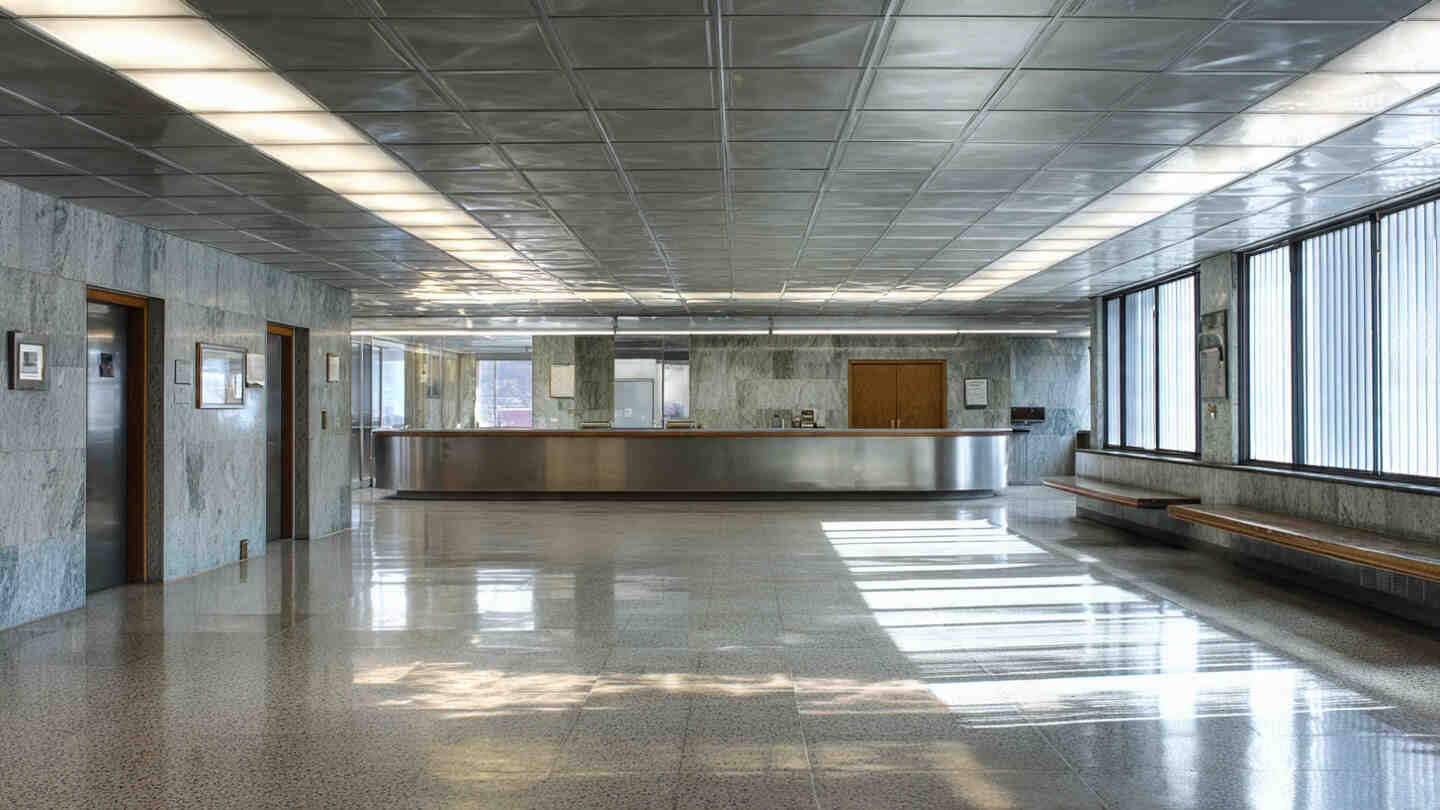
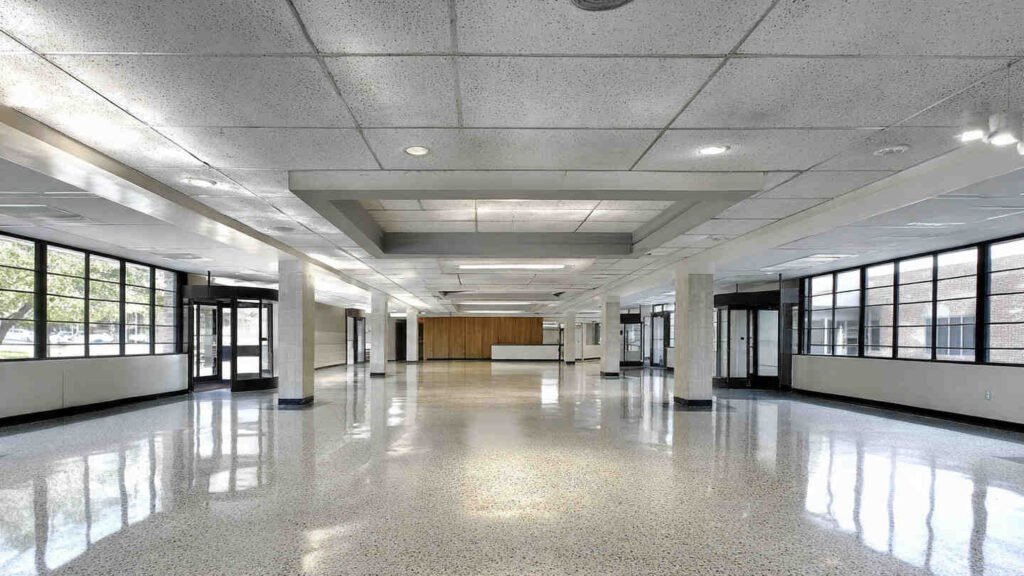
This is the moment when architecture becomes archaeology. The curtain wall systems that read in 1962 as progressive — evidence of a company confident enough in its future to wrap its workplace in glass — now read as period details, as dateable as the chrome bumpers on a 1963 automobile. The lobby materials — terrazzo floors, anodized aluminum signage rails, acoustic tile in the corporate palette of the period — survive in buildings that have cycled through multiple tenants, each successive occupant less invested in the architectural intentions of the original commission.
What survives, in the best of these buildings, is the site planning. The relationship between building and landscape — the parking disciplines, the landscape buffers, the way the buildings were set back from the road to create an entrance sequence — was the period’s most durable contribution to commercial design. These were not strip commercial buildings. They were designed, at some level, as compositions. That compositionality, even emptied and partially decommissioned, is legible. It is the argument the buildings are still making, long after the tenants have left.
What the Corridor Means for Real Estate in 2026
The Route 110 corridor is relevant to anyone thinking about mid-island residential real estate — about Melville, about Huntington Station, about the communities that grew up around and among these office parks — because the corridor’s next chapter will shape those communities as much as its first chapter did.
The adaptive reuse conversation happening around Route 110 — conversion of underperforming office space to mixed-use, residential, medical, or light industrial — is being driven by Suffolk County planning process and by private developers who have recognized that the physical infrastructure of these campuses is worth repurposing rather than demolishing. The buildings’ bones — the structural frames, the floor plate flexibility, the site infrastructure — are valuable. The architectural details are, in some cases, worth preserving as evidence of a period that shaped this part of Long Island more profoundly than any other.
The families considering homes in Melville and Huntington are, in many cases, families with connections to the industries that built Route 110 — aerospace, defense, engineering. Their parents or grandparents drove this corridor to work. The office parks are part of their landscape memory, even as those parks stand empty or half-occupied. What replaces them will determine what the mid-island corridor looks like for the next generation.
That is a significant question. It deserves an architectural answer commensurate with the one the corridor received in 1962.
You Might Also Like: Building the Moon Buggy in Bethpage | The Forgotten Factory Town: How Hauppauge Industrial Park Rose From a Potato Field | Why Hauppauge School District Homes Hold Value Like Almost Nowhere Else on Long Island
Sources: Long Island Guide, Melville, New York | Republic Jet Center, A Quick History of Republic Airport, Long Island | Metropolis Magazine, Pockets of Long Island Once Went Crazy for Modernism | ArchDaily, Modern Tide: Midcentury Architecture on Long Island