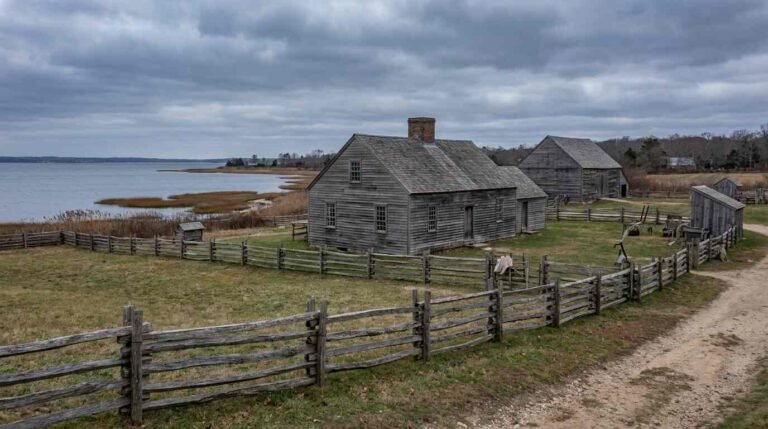
Chain of Title and the Matinecock Deed: What 17th-Century Land Transfer Documents Reveal About the Legal Foundations — and Fictions — of Gold Coast Ownership

When I am doing due diligence on a property with a significant history — and on the North Shore, that category is larger than most buyers realize — I eventually arrive at the beginning of the chain of title. For most residential properties, the beginning of the chain is a deed from the early twentieth century, or perhaps the late nineteenth. For the Gold Coast estates and their successors, the chain runs considerably further. And for a specific class of North Shore and Oyster Bay Township properties, it runs to documents that were produced in the 1650s and 1680s between English settlers and the Matinecock people — documents that present, for anyone willing to read them with analytical care, a foundational ambiguity that the law has resolved through centuries of subsequent conveyance rather than through the harder question of whether the original transactions established what they purported to establish.
This is not a comfortable subject, and I do not raise it as one. I raise it because the history of how land became ownable on the North Shore is part of the history of every property on the North Shore — and because an accurate understanding of that history is more interesting, and ultimately more honest, than the version that begins when the title insurance policy does.
What the Colonial Deeds Say and What They Are
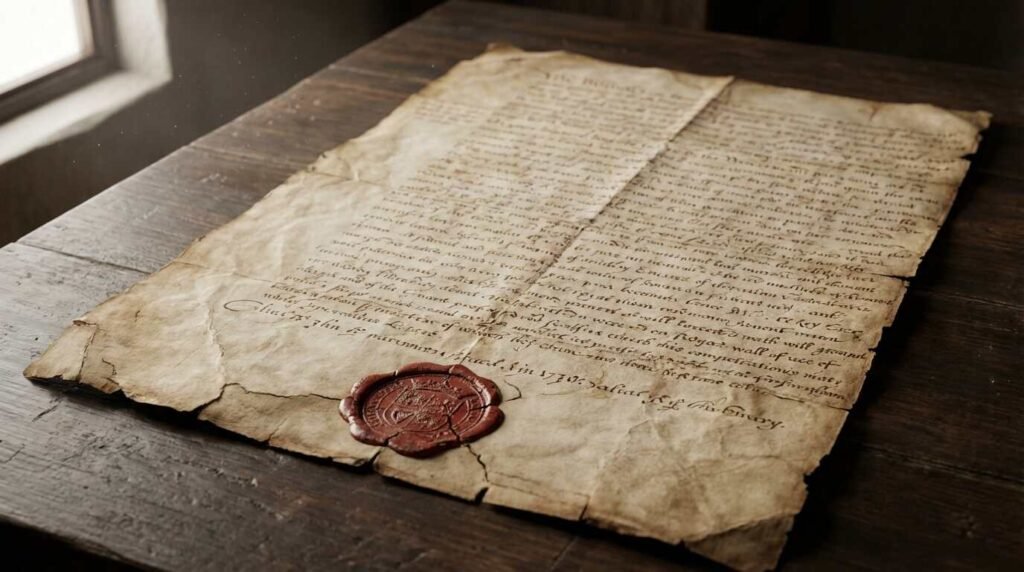
The Oyster Bay Town Records, published in an edited edition in 1916, contain the surviving deed documentation for land transactions between English settlers and Indigenous inhabitants of the Oyster Bay and Huntington townships during the mid-to-late 17th century. These documents — some of them held in original form in the New York State Archives Colonial Land Papers collection — follow a recognizable form: a recitation of the parties, a description of the land by reference to natural features and occasional metes, a statement of consideration (typically consisting of a specified quantity of goods — cloth, wampum, knives, and similar trade items), and signatures or marks of the parties.
Under English common law as it existed in colonial America, these documents functioned as deeds of conveyance — instruments by which fee simple title passed from grantor to grantee. The colonial courts and their successors treated them as establishing the foundational grants from which all subsequent conveyances derived. The chain of title that underlies Gold Coast ownership, and indeed most North Shore ownership predating the Revolutionary era, traces to these transactions.
The Framework Problem: What the Matinecock Understood Themselves to Be Transferring
The legal and historical scholarship on colonial-era Indigenous land transactions in the Northeast has established, with considerable documentary support, that the Algonquian peoples of Long Island — including the Matinecock, who occupied the territory encompassing much of what is now Nassau County and the western portions of what is now Suffolk — operated under a fundamentally different framework of land tenure than English common law contemplated.
John Strong’s foundational study The Algonquian Peoples of Long Island from Earliest Times to 1700 (1997) addresses this directly: Algonquian land concepts centered on usufructuary rights — rights to use specific resources in specific seasons — rather than the alienable, exclusive, perpetual fee simple ownership that English common law deeds purported to convey. In the Matinecock framework, what could be transferred was the right to use a tract for particular purposes; what could not be transferred, because the concept did not exist, was permanent exclusive ownership extinguishing all prior rights.
The practical consequence of this divergence was that Matinecock signatories to colonial deeds — whatever consideration they received and whatever they understood themselves to be agreeing to — almost certainly did not understand themselves to be conveying the permanent, exclusive, alienable interest that the English grantees believed they were acquiring. Whether the English parties to these transactions understood the divergence is a question the historical record does not answer uniformly.
Colonial Deed Validity Under English Common Law at the Time
A deed requires, under English common law, a grantor with capacity and authority to convey, a description of the thing conveyed, consideration, and delivery and acceptance. The Matinecock deeds satisfy these formal requirements as English courts and their colonial successors understood them. The grantors were identified, consideration was paid, and the instruments were delivered and accepted.
What the formal validity analysis does not resolve is the question of informed consent as modern legal frameworks would understand it — whether the Matinecock signatories understood the nature and legal consequence of what they were executing. This question, by modern standards of contractual formation, is not obviously answerable in favor of the transactions’ validity. The consideration paid — trade goods valued in colonial accounting at amounts that bore no relationship to the long-term value of the interests conveyed — raises questions about adequacy that colonial courts did not apply to Indigenous transactions with the same scrutiny they would have applied to transactions between English parties.
Legal scholarship on colonial Northeast Indigenous land transactions has identified these structural problems with considerable precision. The deeds functioned as valid instruments within the colonial legal system that recognized them. Whether they would survive scrutiny under modern legal standards of capacity, informed consent, and consideration adequacy is a different question, and one that the subsequent history of American property law has largely rendered moot through mechanisms I will address below.
How the Foundational Ambiguity Was Extinguished
The legal fictions embedded in the colonial Matinecock deeds were not resolved through litigation or judicial analysis — they were buried by the weight of subsequent conveyance, colonial legislation, and the eventual displacement of any legal forum in which Matinecock successors might have pursued a remedy.
The colonial legislatures of New York, following the Restoration and the consolidation of English control over the former New Netherlands territory, enacted a series of enactments that confirmed colonial grants, extinguished competing claims, and established the fee simple ownership framework as the governing legal structure for all subsequent transactions. By the time of the Revolutionary era, the chain of title running from the colonial Matinecock deeds through subsequent English conveyances was embedded in a legal structure that treated the foundational transactions as fully settled.
The physical displacement of the Matinecock through the 18th century — through epidemic mortality, economic dependency, land loss, and eventual dispossession from the territories in which they had maintained any substantial presence — extinguished any practical capacity to maintain legal challenges to the foundational deeds, even had the colonial and later American courts been receptive to such challenges. They were not.
The Shelter Island Proprietors’ Patent of 1666 presents a parallel case: a foundational land grant instrument whose legal genealogy, traced to its origins, reveals the same structural features. The chain of title is unbroken and legally valid as property law currently understands it. Its origins are in transactions that, honestly examined, do not bear the markers of fully informed, freely negotiated conveyances between parties operating under shared legal and conceptual frameworks.

What, If Any, Legal Avenues Remain
Federal Indian law — specifically the Indian Trade and Intercourse Act (the Non-Intercourse Act) of 1790 and its successors — has provided the legal basis for a category of claims by Eastern tribal nations challenging the validity of pre-constitutional land transactions executed without federal approval. These claims, most prominently pursued by tribes in Maine, Massachusetts, and Rhode Island in the 1970s and 1980s, produced significant settlements and in some cases land returns. The Mashpee Wampanoag, the Penobscot, and the Passamaquoddy nations pursued Non-Intercourse Act claims with varying success.
The Matinecock, as a federally unrecognized tribe, currently lack standing to pursue Non-Intercourse Act claims. The legal avenue that has produced results for federally recognized Eastern tribes is not available to them in the same form. Whether federal recognition status might change, and what legal consequences might follow, is a question that sits outside what the current record supports me in answering — but it is a question that the history of the colonial deeds, read carefully, does not permit pretending away.
Every property on the North Shore rests on a chain of title. The title insurance policy begins somewhere in the middle of that chain. I spend a significant portion of my professional life thinking about what title commitments reveal and what they do not — and the most important thing they do not reveal is where the chain begins, and what the beginning actually looked like.
That history does not make any current owner’s title defective as American property law currently stands. It does make it honest to acknowledge, when we speak of Gold Coast ownership and its storied lineage, that the foundation of the chain was not a clean transaction between parties operating under equivalent legal frameworks and with equivalent understanding of what was being conveyed. The Matinecock understood it differently. That difference was not accidental, and it was not resolved — it was extinguished.
The houses built on that foundation are extraordinary. The foundation itself deserves a more honest accounting than it typically receives.
This post is for informational purposes only and does not constitute legal advice. Consult a licensed New York real estate attorney regarding your specific situation.
You Might Also Like
- Shelter Island’s Proprietors’ Patent: How a 1666 Colonial Land Grant Still Echoes in Modern Property Boundaries
- What Your Title Commitment Is Actually Telling You: How to Read a Chain of Title Like a Property Historian
- The Covenant in the Deed: How Restrictive Covenants Shaped Long Island Neighborhoods
Sources
- New York State Archives — Colonial Land Papers
- Oyster Bay Town Records, Published Edition (1916)
- John Strong, The Algonquian Peoples of Long Island from Earliest Times to 1700 (Empire State Books, 1997)
- Stuart Banner, How the Indians Lost Their Land: Law and Power on the Frontier (Harvard University Press, 2005)
- Indian Trade and Intercourse Act (Non-Intercourse Act), 25 U.S.C. §177
Part of the Gold Coast Series: This post is one of fifteen pieces in the Maison Pawli Gold Coast cluster. For the full guide — surviving estates, architectural history, legal sediment, and what buyers need to know — visit The Gold Coast of Long Island: Gilded Age Estates, Architectural Heritage, and What Survives.