
Mortgage Rates Are Well Below Last Year — What That Means If You’re Selling This Summer

The call I’ve been waiting to make started happening again in late April. Buyers who went quiet during the rate spike — people who toured homes last fall, got the sticker shock on monthly payments, and said “let’s wait and see” — are circling back. Not tentatively. With intent.
Mortgage rates are the reason. After hovering in the mid-sixes for most of winter and spiking briefly to 6.46% in early April, the 30-year fixed-rate mortgage now averages 6.37%, according to Freddie Mac’s Primary Mortgage Market Survey released May 7, 2026. A year ago at this time, that same rate averaged 6.76%. That’s a nearly 40-basis-point improvement — and in real payment terms, on a $600,000 mortgage, that difference is roughly $160 a month. For a buyer sitting on the fence, that’s not nothing. That’s a car payment. That’s a decision.
What the PMMS Data Is Actually Telling Us
The Freddie Mac PMMS is the most widely cited weekly snapshot of mortgage costs, drawn from thousands of purchase applications submitted by lenders across the country. It isn’t a projection. It’s what real borrowers are actually being offered, in real time.
What the data shows right now: purchase application activity has risen more than 20% year over year. That’s a meaningful acceleration, and it’s happened not because buyers suddenly feel optimistic about the economy in the abstract — it’s because lower rates have made the math on homeownership slightly less brutal than it was in 2025. Sam Khater, Freddie Mac’s chief economist, noted in the April 23 release that rates are currently at their lowest level in the last three spring homebuying seasons. That context matters. We are not in a blowout market. But we are in a meaningfully better one than sellers faced twelve months ago.
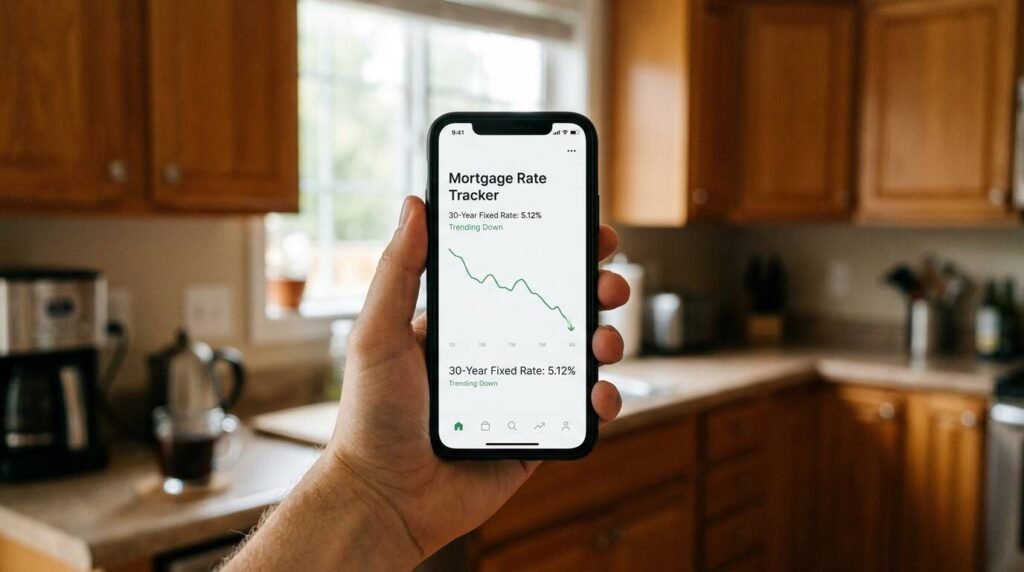
How Falling Rates Shift Buyer Demand — and Your Pricing Window
There’s a behavioral pattern that plays out every time rates move. The first wave of re-engaged buyers is always the most motivated — the people who had already done their financial homework, gone through pre-approval, and were genuinely ready to act. They don’t need to be convinced that a house is right for them. They’re just looking for the rate to reach a number that makes monthly payments feel manageable.
That wave is happening now.
The second wave takes longer. It’s the buyers who were earlier in the process, still running mental calculations, watching the Fed, hedging. They’ll start scheduling showings in four to six weeks. By the time a home has been on market long enough to feel stale, those buyers are fully engaged — but they’re looking at properties priced for the momentum, not the moment.
This is the asymmetry sellers need to understand. Listing into a demand wave reads very differently on the data than listing after it. Homes that went on the market in mid-April, when rates were still declining toward their recent low of 6.23%, are the ones that benefited from compressed time on market. If you’re watching from the sidelines right now, you’re still in a reasonable window — but the window has a shape, and we are somewhere in the middle of it.
Should You List Now or Wait for Rates to Drop Further?
This question comes up every cycle, and my answer is always the same: no seller has ever regretted listing into improving demand. Waiting for rates to fall further is a reasonable instinct — but it’s a risky strategy.
Here’s why. Rate movement at this stage of the cycle is neither guaranteed nor linear. The most recent PMMS actually ticked slightly upward from 6.30% the week before to 6.37% this week. Rates don’t drop in a straight line, and no economist — including the ones at Freddie Mac — will tell you with confidence where they’ll be in sixty days. What we do know is that buyer demand has already responded to rates in the mid-sixes. You don’t need rates at 5.5% to attract qualified, motivated buyers. You need inventory that’s appropriately priced and well-presented.
The sellers I worry about are the ones who said “let’s wait until it gets below 6%” in 2025. Some of them are still waiting.
What the Inventory Picture Means for Your Timing
Nationally, existing-home sales fell 3.6% in March, but the headline understates the complexity of what’s happening. Inventory has been building — we’re now at 4.1 months of supply nationally, up from 3.8 months in February. That’s still tight by historical standards, but it’s the most inventory buyers have had to choose from in years. On Long Island’s North Shore, our local story is more constrained. The lock-in effect — homeowners reluctant to swap their 3% pandemic-era mortgages for a loan in the sixes — continues to suppress listings. That means the homes that do come to market are facing a more motivated, less competition-saturated buyer pool than national figures suggest.
If you’re a seller in Mount Sinai, Miller Place, or Port Jefferson, the math looks different than it does in the Sun Belt. You’re not competing against a flood of new supply. You’re entering a market where buyers have already pre-qualified and are actively looking for options. That is not a bad place to be.

Maison Pawli’s Take: How We’re Advising Sellers Right Now
Pricing correctly in this environment means pricing for the buyers who are already in the market — not the ones who will materialize if rates drop another quarter-point. I’ve had sellers price aspirationally in the first week and watch demand soften by week three, when the first-round buyers have already committed elsewhere. The data on days on market is unforgiving: a house that sits reads as a house with a problem, even when the problem is simply a number that was five percent too high at the start.
What I’m telling sellers right now: come in clean, come in accurate, and come in ready to move. The buyers making calls this week are not browsing. They’re buying.
For a broader look at how timing affects results on the North Shore specifically, Selling in Spring vs. Selling in October is worth reading before you set a listing date.
—-
Real estate markets change. This post reflects conditions as of May 7, 2026. For current listings and market data, contact Pawli at Maison Pawli.
This is for informational purposes only — consult a licensed financial advisor for guidance specific to your situation.
—-
Sources
- Freddie Mac Primary Mortgage Market Survey — May 7, 2026
- Freddie Mac PMMS Release — April 23, 2026
- NAR Existing-Home Sales Report — March 2026
- Maison Pawli: Selling in Spring vs. Selling in October
- Maison Pawli: The Lock-In Effect — Why North Shore Inventory Is So Tight
—-