A Week After the Nor’easter, Long Island Homeowners Are Sorting Out Claims and Cleanup
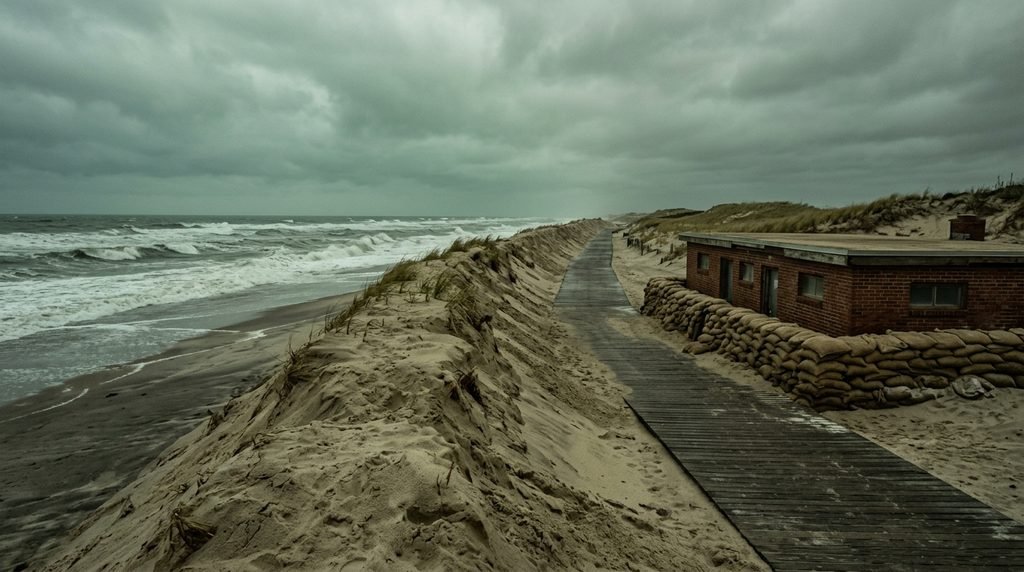
A sand wall six to eight feet high went up along the Central Mall at Jones Beach before the first rain of the weekend, with sandbags stacked around the oceanfront buildings nearby. New York State Parks regional director George Gorman explained the effort in a September 25 wire report: “We learned after Sandy that we took a hit here,” he said, describing why the wall and sandbags went in.
What arrived over the next three days was a nor’easter that settled just south of Long Island and took roughly two days to loosen its grip, leaving downed trees, tidal flooding, and tens of thousands of dark houses behind it. The timeline below is assembled from published reports. Where outlets disagree on a figure, both numbers appear with their sources, and the practical questions for homeowners, sellers, and buyers follow the weather.
Friday, September 25: Preparation
Forecasters had pointed to peak gusts near 55 mph from Friday evening into Saturday, along with coastal flooding, heavy rain, dangerous surf, and beach erosion. PSEG Long Island brought in additional personnel and outside contractors and said it expected the event to affect the entire Island. Southampton barred driving on its beaches from Friday morning through Tuesday morning, Fire Island ferries suspended all passenger trips through Sunday, and FOX 5 New York reported that residents had been told to prepare for as much as three feet of floodwater.
Saturday, September 26: The Wind Arrives
Wind did the damage on Saturday. In Brooklyn, a 56-year-old New York City Housing Authority employee died when a tree fell in a parking lot at the Cypress Hills Houses, the one fatality that both CBS New York and Weather.com reported. Later in the evening, News 12’s live blog logged the restoration of the LIRR’s Long Beach Branch at 10:06 p.m., after flooding in Island Park had halted trains.
Sunday, September 27: Outages and the Slow Exit
Sunday is the day most of the published numbers describe. According to CBS New York, PSEG Long Island had 24,042 customers without power at 6:30 a.m. and 18,501 by noon, with more than 93,700 restored since Friday. Weather.com and Spectrum News put the regional total near 130,000 customers across the Northeast and mid-Atlantic, with New York State and Long Island among the hardest-hit areas. Forecasters said the system was sitting just south of Long Island and could linger for roughly another 24 hours.
At 1:30 p.m., the Nassau County Executive said, “It looks like the worst is over, that we survived,” in a statement logged by CBS New York.
Smaller disruptions showed up all over the North Shore. In Melville, the 17th Annual Over 50 Fair went ahead at the Hilton Long Island/Huntington despite rain and strong winds, though ten exhibitors and one speaker canceled, TBR News Media reported.

Monday, September 28: Drier Air
By Monday morning the system was pulling away. Weather.com counted about 18,000 customers still without power in the early hours, and ABC7 described rain tapering and drier weather returning across the New York metro area and Long Island, though wind of 35 to 40 mph was still forecast from the Jersey Shore to Long Island that morning. Broadcast footage of the weekend is available in Weather.com’s live report from East Hampton and in Good Morning America’s September 28 segment.
Where the Damage Landed
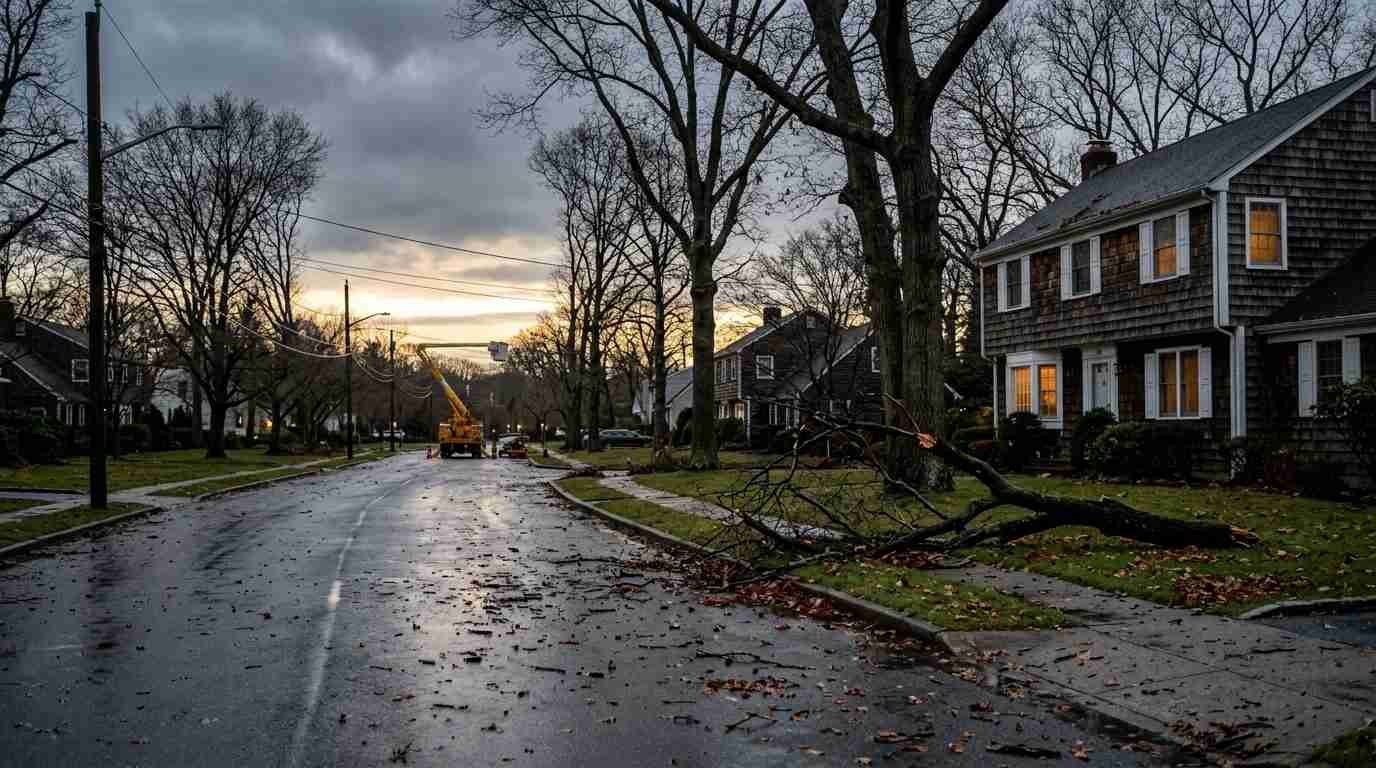
Tree reports came from nearly every part of the North Shore. Huntington counted about 200 downed trees, and Highway Superintendent Andre Sorrentino described the pattern this way: “Every time the wind kicked up, more trees fell.” Oyster Bay Supervisor Joseph Saladino put his town’s count near 75 trees and branches, Hempstead logged 19 overnight, and a fallen tree closed several lanes of Middle Neck Road in Great Neck. A tree landed on a backyard shed in Rocky Point, another blocked Walt Whitman Road in Melville, and Port Jefferson Branch service was suspended between Huntington and Port Jefferson after a tree came down east of Kings Park.
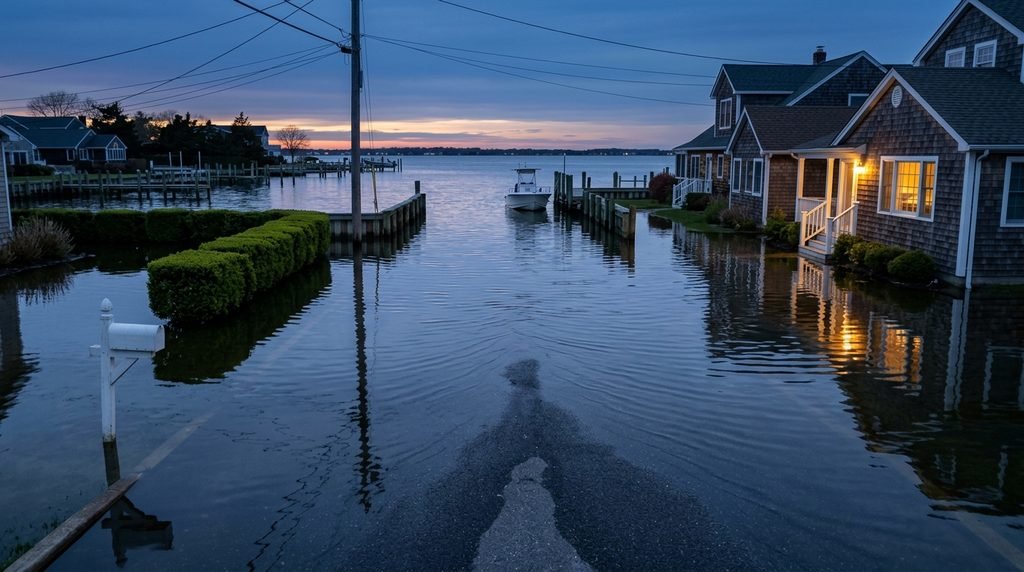
Flooding showed up mainly along the South Shore and the bays. News 12 and CBS New York listed Island Park, Freeport, South Massapequa, Lindenhurst, and Patchogue, and in Riverhead the Riverwalk along the Peconic River stayed under water. Bayville reported flooding that was less severe than in South Massapequa, and Glen Cove Mayor Pamela Panzenbeck said the city had been fortunate. LIRR President Rob Free said crews pumped millions of gallons of water out of the Island Park area before the tides refilled it. Suffolk County Executive Ed Romaine warned of waves of seven to ten feet from Fire Island to Montauk and significant erosion, and Governor Kathy Hochul urged people to stay out of the water.
Across these reports, Sound-facing communities appear mostly in connection with trees and power lines, while the tidal flooding entries cluster on the South Shore and in bay-side communities. That is a pattern in the coverage collected here, not a measured comparison. The way water type shapes risk and upkeep is laid out in Sound vs. Bay vs. Harbor: What the Water Type Actually Means for Your Maintenance Budget and Resale Value.
The Numbers as Reported
Figures are snapshots taken at different times, and the outlets did not always agree.
| Measure | Reported figure | Source |
|---|---|---|
| Peak gust, Montauk Point | 81 mph | Weather.com |
| Peak gust, Suffolk County | Up to 60 mph at Montauk | CBS New York |
| Rainfall | Montauk 2.85 in., Islip 2.28 in., Central Park 1.68 in. | CBS New York |
| PSEG Long Island customers out | 24,042 at 6:30 a.m. Sunday; 18,501 at noon | CBS New York |
| Trees and branches reported down by PSEG Long Island | More than 1,000 trees, more than 530 large branches | CBS New York |
| Huntington downed trees | About 200 | News 12 |
| Fatalities reported | One, in Brooklyn | CBS New York, Weather.com |
The Week After: Claims and Documentation
Claims paperwork starts with documentation. FEMA’s guidance for flood claims tells policyholders to contact their agent or insurer right away with the policy number ready, to photograph structural damage and standing water levels, to separate damaged belongings from undamaged ones, and to build an inventory listing purchase dates, values, and receipts where they exist. FEMA says an adjuster should respond within a few days, though catastrophe volume can slow processing.
For flood losses covered by the National Flood Insurance Program, FEMA states that a sworn proof of loss is due within 60 days of the flood, and payment does not move until a complete, signed copy is in. For a loss on September 26 or 27, that window closes in late November, and the adjuster can confirm the exact date for a specific claim.
Which policy responds depends on what hit the house. Standard homeowners policies generally exclude flood, so water that came in with the tide is a flood-coverage question, while wind and falling-tree damage usually runs through the homeowners policy. The wording of each policy controls. Background on how those layers work is in Flood Insurance on Long Island’s North Shore: What FEMA Maps Don’t Tell You About Sound-Facing Properties and Why Long Island Homeowners Insurance Keeps Climbing — Even Away From the Flood Zone.
Saturated ground adds its own caution. As the wind died down, Nassau County Executive Bruce Blakeman cautioned, according to News 12, that the situation was not over because the ground remained waterlogged, a reminder that storm effects can outlast the storm itself.
If the House Is on the Market, or About to Be
New York sellers must deliver a Property Condition Disclosure Statement, and the form changed in 2024. A summary from a law firm describes two changes that took effect March 20, 2024. The form now asks whether the property sits in a FEMA-designated floodplain, whether it falls in a 100-year or 500-year floodplain, whether flood insurance is carried, and whether the structure has had water penetration or damage from a natural flood event. The same update ended the option of skipping the form by giving the buyer a $500 credit at closing.
A seller whose basement took on water during the storm therefore meets the expanded flood questions added in 2024, and a buyer reading the answers is looking at the same page. The firm recommends that each side consult counsel about their rights and remedies if no statement is provided. For buyers, the flood answers are one input alongside the inspection, and the surrounding steps are covered in the inspection report as a negotiating document, the disclosure rules at open houses, and why the insurance quote comes before the offer.
This is for informational purposes only — consult a licensed attorney or financial advisor for your specific situation. Storm figures reflect reports published between September 25 and 29, 2026, and may have been revised since.
You Might Also Like
- North Shore Bluff Homes and the Erosion Question: What Buyers Need to Know
- Holding Back the Sound: The Brutal Economics of North Shore Bulkheads
- Where the Barrier Island Begins: A Driving Tour of Dune Road’s Western End
Sources
- NBC Palm Springs (wire report), September 25, 2026: Long Island prepares for rare September nor’easter with sand walls, utility crews
- News 12 Long Island, live blog, September 27, 2026: Nor’easter causes power outages, downed trees and flooding on Long Island
- CBS New York, live updates, September 27, 2026: Nor’easter brings down trees, causes flooding in New York, New Jersey area
- Weather.com, published September 27, updated September 29, 2026: Deadly nor’easter lingers; tens of thousands without power
- Weather.com video, September 27, 2026: Meteorologist Reynolds Wolf reports from East Hampton
- Spectrum News, September 27, 2026: Powerful nor’easter floods Northeast, leaves over 130,000 without power
- FOX 5 New York, September 27, 2026: Deadly nor’easter causing dangerous flooding in Northeast US
- ABC7 New York, live updates: Nor’easter 2026: Storm loosens grip as rain tapers and drier weather returns
- Good Morning America video, September 28, 2026: Hundreds of thousands without power as deadly nor’easter tears through region
- TBR News Media, October 4, 2026: 17th Annual Over 50 Fair brings community together despite the nor’easter
- FEMA: Filing a Flood Insurance Claim
- mccmlaw.com (law firm summary): New changes to PCDS regarding flood disclosure and loss of seller $500 opt-out credit