
The Disclosure Doctrine at the Open House: What Sellers Are Legally Required to Reveal Before the First Visitor Walks Through the Door

There is a question I get at nearly every listing consultation that I have learned to answer carefully: Do I have to disclose that before we open the doors? The answer, almost always, is yes — and the more important answer is that the obligation arose well before the doors opened at all.
New York’s Property Condition Disclosure Act, codified at Real Property Law §§460–467, establishes a statutory disclosure framework that many sellers treat as a formality and their attorneys treat as a liability minefield. The gap between those two orientations is where post-closing litigation is born. Understanding what the law requires, when it requires it, and what it does not protect you from is not optional housekeeping before your open house. It is the legal foundation on which the event rests.
The Statutory Obligation and Its Timing
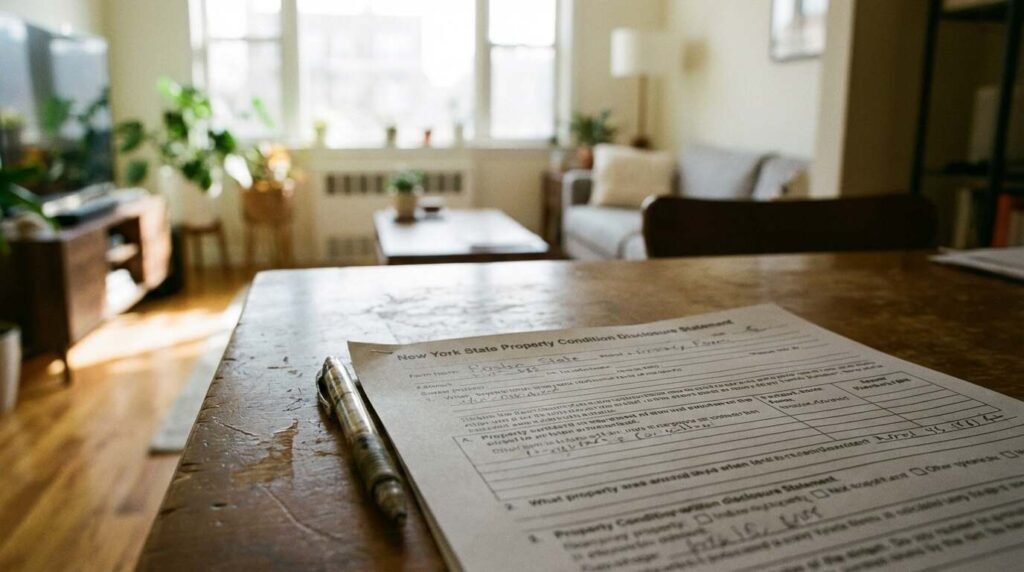
Under RPL §462, a seller of residential real property — defined as one-to-four family dwellings — is required to deliver a completed Property Condition Disclosure Statement (PCDS) to a prospective buyer prior to the signing of a binding contract of sale. The form itself, promulgated by the New York State Department of State, runs to 48 questions spanning structural systems, environmental conditions, water and sewer, mechanical systems, and legal status of the property.
The critical word is prior. The PCDS obligation does not arise at contract — it precedes it. And while the statute does not specifically name the open house as a triggering event, the practical and legal reality is that the obligation to have accurate disclosure information prepared and available is most acutely tested at the moment a seller invites the public inside.
A seller who conducts an open house knowing of a material latent defect — a foundation crack masked behind newly installed drywall, a history of basement flooding obscured by fresh waterproofing paint — is not in a neutral legal posture simply because no written contract has yet changed hands. The open house is the beginning of the transaction, not its antechamber.
What the $500 Credit Does and Does Not Do
RPL §465(1) permits sellers to bypass the PCDS entirely by crediting the buyer $500 at closing in lieu of providing the statement. This provision is widely misunderstood. I hear it cited, sometimes by sellers and occasionally by their agents, as a general release mechanism — a way to avoid disclosure obligations wholesale.
It is not.
The $500 credit-in-lieu provision is a statutory shortcut for the written PCDS form. It does not immunize sellers from fraud claims, misrepresentation claims, or breach of contract claims arising from active concealment or affirmative misrepresentation. New York courts have been consistent on this point. Where a seller has made verbal representations at an open house — assuring visitors that the roof was replaced two years ago when it has not been, representing that there is no moisture history when there is — those representations are actionable independent of whether a PCDS was delivered.
The Second Department has addressed seller misrepresentation claims in the residential context through a framework that distinguishes between nondisclosure (generally not actionable absent a duty to disclose) and active concealment or affirmative misrepresentation (actionable as fraud regardless of whether a PCDS was provided). A seller who elects the $500 credit and then verbally misrepresents the condition of a property during an open house has not purchased immunity — they have paid $500 to forgo a written document while simultaneously creating oral evidence of fraud.
Patent Defects, Latent Defects, and the Open House Visitor’s Burden
New York law draws a consequential distinction between patent and latent defects that operates with particular force in the open house context.
A patent defect is one that is reasonably discoverable upon ordinary inspection. A cracked window, visible water staining on a ceiling, a clearly unlevel floor — these are conditions a buyer is on constructive notice of having seen and accepted. Courts have consistently held that where a buyer had the opportunity to observe a defect during a showing or open house and failed to pursue it, the claim of post-closing discovery is substantially weakened.
A latent defect is one that is not reasonably discoverable without specialized investigation — a failing septic system with no surface symptoms, aluminum wiring behind intact panels, a buried oil tank whose soil contamination has not yet reached the surface. The seller’s obligation with respect to latent defects is affirmative. The PCDS specifically asks about oil storage tanks (Question 22), environmental hazards (Questions 33–38), and underground conditions. A seller who knows of a latent defect and does not disclose it — whether through the PCDS or, where the credit-in-lieu is elected, through other means — is not protected by the buyer’s failure to discover what could not be discovered.
The open house creates a particular tension here: sellers understand, correctly, that presenting a property in its best light is expected. What they sometimes fail to understand is that there is a legal line between presentation and concealment, and that the open house environment — high traffic, limited time per visitor, the social pressure of a public event — does not move that line.
Verbal Representations at Open Houses: The Evidentiary Problem
Of the misrepresentation claims that arise from open house events, the most legally exposed category involves verbal representations made by sellers or their agents to visitors. These are conversations that typically go unrecorded, occur in environments full of distraction, and are later recalled with competing precision by the parties who experienced them.
Courts evaluating post-closing misrepresentation claims arising from open house representations have had to reconstruct these conversations from buyer testimony, agent notes, and in some cases from text message or email follow-up inquiries that reference what was said during the event. The seller’s agent, it bears noting, is the seller’s agent — representations made by the agent during the open house are attributable to the seller under standard principal-agent doctrine.
RPL §443 governs broker disclosure obligations, and the agent’s duties run to accurate representation of the property’s condition in all marketing and showing contexts. An agent who knows of a defect — or who is in a position to have known — and represents otherwise during an open house has created exposure for both themselves and their principal.
The practical guidance I give my own sellers on this point is straightforward: if you don’t know the answer to a question a visitor asks, say so. Do not speculate. Do not reassure. Do not fill silence with optimism. Questions about the roof, the mechanicals, the history of the basement, the environmental history of the site — these are the categories where well-intentioned improvisation has a way of becoming litigated misrepresentation.

What Buyers Who Discover Undisclosed Defects Can Pursue
A buyer who attends an open house, enters into a contract, closes on the property, and subsequently discovers a material latent defect that was known to the seller and not disclosed has several potential avenues, depending on the specific facts.
A fraud or fraudulent concealment claim requires proof that the seller knew of the defect, concealed it with intent to deceive, that the buyer reasonably relied on the absence of disclosure, and that the buyer suffered damages. This is a high standard, but it is met with some regularity in post-closing residential disputes — particularly where physical evidence of concealment exists (fresh paint over obvious water damage, recently installed covering over structural problems) or where documentary evidence of the seller’s knowledge is recoverable in discovery.
A misrepresentation claim is somewhat more accessible, requiring proof that the seller made a false statement of material fact, that the buyer relied on it, and that the buyer was damaged. Where the misrepresentation occurred verbally at an open house, the evidentiary challenge is proof — but courts have not excluded such claims on that ground alone.
Where the PCDS was delivered and the seller answered questions falsely, the buyer may pursue breach of the statutory disclosure obligation, in addition to fraud or misrepresentation. The $500 credit-in-lieu arrangement forecloses only the PCDS-based statutory claim, not the common law ones.
Rescission — unwinding the transaction — is available in the most serious cases, though courts apply it selectively in residential real estate contexts given the equitable complexity of returning parties to their pre-contract positions after closing has occurred.
An open house is not a carnival. It is a legal event with a documentary record that begins before the first visitor arrives and extends to the moment of closing. The sellers who understand this — who approach the PCDS as a legal obligation rather than a marketing inconvenience, who brief their agents on what to say and, critically, what not to say — are the ones who move through the transaction cleanly.
The others sometimes find out, too late, what the law already knew.
This post is for informational purposes only and does not constitute legal advice. Consult a licensed New York real estate attorney regarding your specific disclosure obligations.
Real estate markets change. For current listings and market data, contact Pawli at Maison Pawli.
You Might Also Like
- The As-Is Clause Is Not a Shield: What Sellers Remain Liable For After Closing
- The Seller’s Disclosure Form Is a Legal Document: Why Most Sellers Treat It Like a Survey
- Staging Is a Material Representation: Where the Line Between Presentation and Misrepresentation Falls
Sources
- New York Real Property Law §§460–467 — Property Condition Disclosure Act
- New York State Department of State — Property Condition Disclosure Statement Form
- New York Real Property Law §443 — Disclosure of Broker’s Role
- New York Real Property Law §465 — Credit in Lieu of PCDS
This post is part of our comprehensive guide: The Long Island Open House: What Sellers Must Disclose, What Buyers Should Ask, and What the Law Actually Says.