The Perfume Coast: Chasing Frankincense Through Oman’s Dhofar Region
Three thousand years ago, camel caravans loaded with Dhofari frankincense left this coast for Egypt, Rome, and Jerusalem. The trees are still here. So is the smoke.
Salalah sits at the bottom of the Arabian Peninsula with the Dhofar Mountains behind it and the Arabian Sea in front, and in the summer the monsoon does something extraordinary here: it transforms one of the driest regions on earth into a landscape of extraordinary green, the mountains swathed in mist, the wadis running with water, the air cool and scented with the sap bleeding from Boswellia sacra trees along the ridgelines. This seasonal transformation — the khareef — was known to the ancient traders who organized their departures around it. The rains softened the ground, the trees produced more resin, and the caravans loaded and moved north.
What the Trees Produce
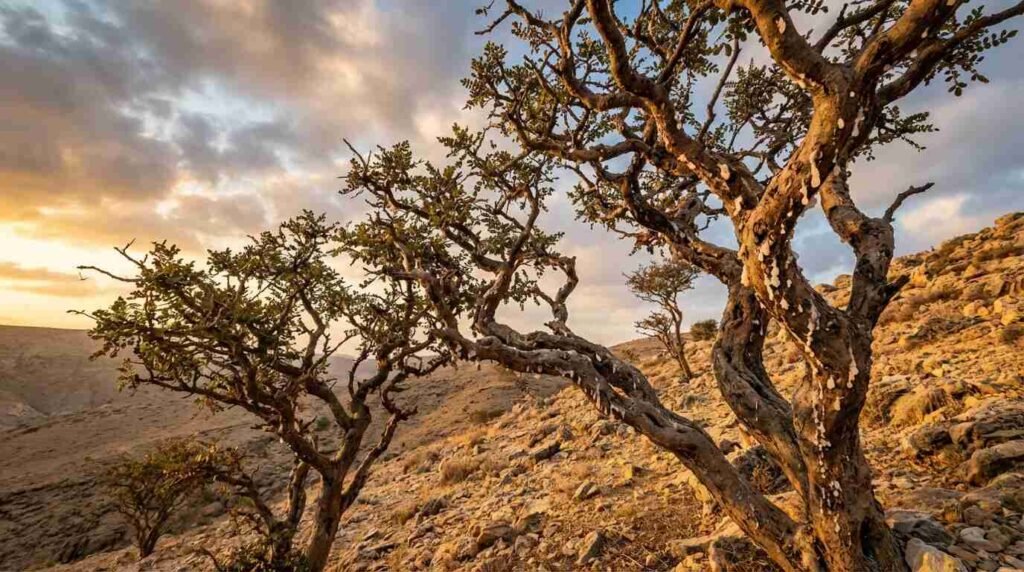
Boswellia sacra is not a large tree. It grows twisted, with a papery peeling bark and leaves clustered at the branch ends, and it prefers limestone outcrops at altitude — the Dhofar mountains above Salalah, and nowhere else on earth in comparable concentration. Researchers at the University of Natural Resources and Life Sciences in Vienna have documented what Omani frankincense traders have always known: the Boswellia sacra trees of this specific region produce a resin with a chemical profile distinct from all other frankincense sources. The terpenoid composition, the volatile oil content, the whiteness of the hardened tears — these are measurably different from Ethiopian frankincense, from Somalian, from Indian. The best Dhofari resin is called hojari, and it has been considered the world’s finest grade for as long as grades have existed.
The tapping is still done by hand. A triangular incision in the bark, the sap bleeding out and hardening in the dry air over two weeks into white and pale yellow tears, the harvest collected into sacks and brought down to the souq at Salalah. The trees are tapped three times in a season, with the first tapping considered the most resinous and the last the least — a distinction that traders in ancient Sumhuram understood and that traders in today’s Salalah souq will explain to you in the same terms, if you ask.
Wadi Dawkah and the UNESCO Site
The Land of Frankincense World Heritage Site, inscribed by UNESCO in 2000, encompasses four locations: Wadi Dawkah, where wild Boswellia sacra trees grow in a protected valley; the ancient port of Sumhuram near Khor Rori, from which frankincense was shipped to the ancient world; the caravan oasis of Shisr, identified by some scholars as the legendary lost city of Ubar; and Al-Baleed, the archaeological site at Salalah’s edge that was a major entrepôt from the 3rd century BC through the medieval period.
Wadi Dawkah is the tree reserve, and it is worth arriving in the early morning when the light comes low across the limestone and the trees cast long shadows into the wadi. The frankincense trees grow in clusters along the rocky slopes, unhurried, producing nothing on a human schedule. Some of the trees in the protected zone have not been tapped in years; the resin gums up in the bark wounds and fossilizes, leaving streaks of white down the trunk. Wild frankincense, untended and unsold, smells different from the harvested version — rawer, more resinous, a slightly green edge that the souq product has lost by the time it reaches the burner.
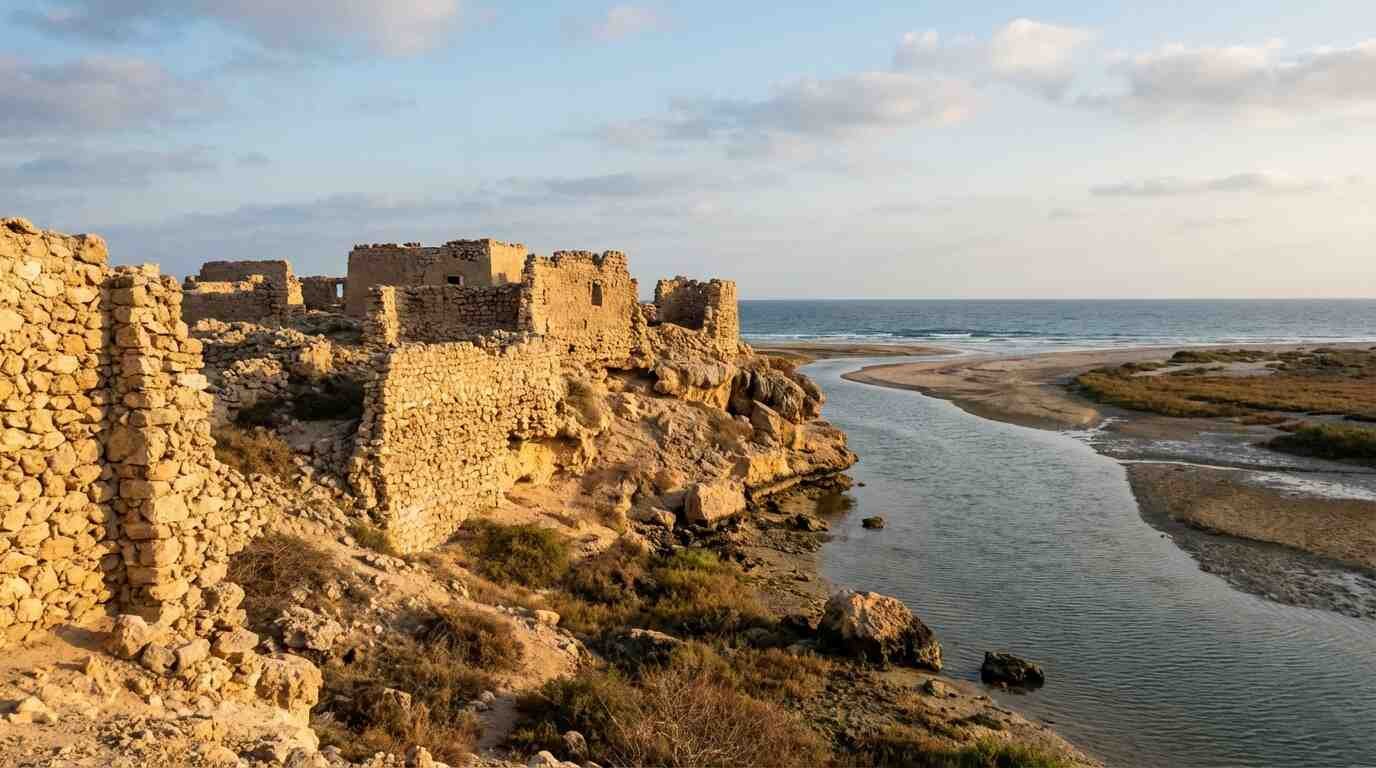
The ancient port of Sumhuram, at the mouth of Khor Rori creek where it meets the sea, is now a ruin of limestone walls set on a promontory above the estuary. The excavations here have turned up evidence of trade with southern Arabia, the Hadramawt, Ethiopia, and the Mediterranean world across a period spanning roughly the 1st century BC to the 4th century AD. Storage chambers have been found alongside residential and administrative structures; inscriptions in the South Arabian script document trade transactions in terms that have the cadence, across the distance of translation, of commercial paperwork: goods received, goods dispatched, accounts settled. The incense economy was literate.
The Souqs of Salalah
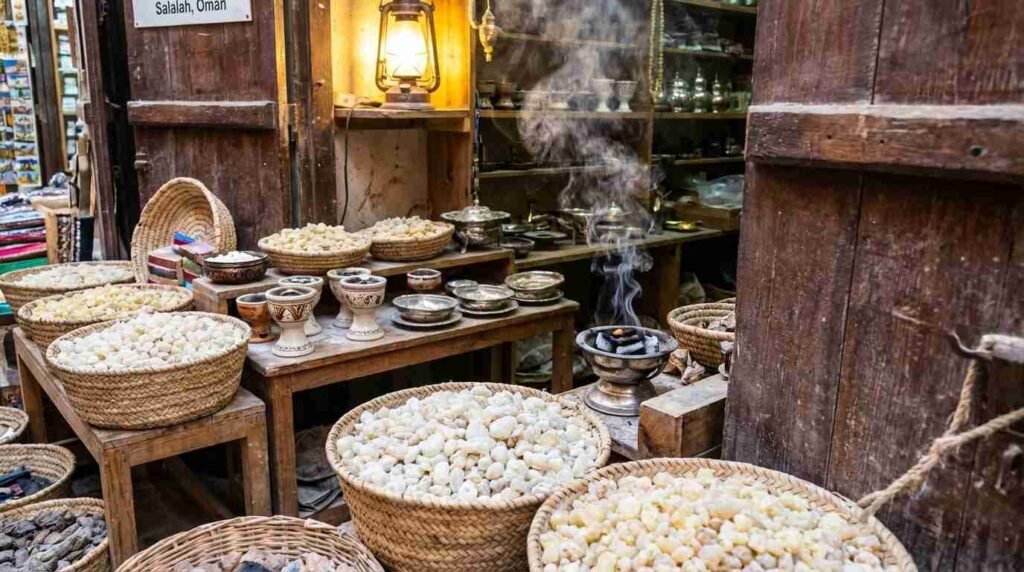
The frankincense souq in Salalah’s old town is not a curated experience. It is a working commercial space organized around a commodity that has been traded here for centuries, and the vendors are not performing authenticity — they are selling frankincense to local buyers who will burn it at home, at weddings, at funerals, in the ordinary daily practice of an Omani household. The tourist trade is present but not dominant.
The hojari tears are sold by grade: the whitest and most translucent command the highest prices, the darker and more opaque are sold cheaper or mixed. Frankincense sellers will often let you burn a piece on a coal in the souq to smell the difference between grades — the hojari burns clean and high, a smoke that is bright and resinous with none of the woody heaviness that lower grades produce. The ancient world paid extraordinary prices for this specific quality. Roman emperors burned it by the cartload.
Adjacent to the frankincense section are the silver souq and the incense accessories market — the ceramic burners, the charcoals, the rose water and ambergris that are combined with frankincense in the Omani blending tradition. The combination of scents in a well-stocked souq — resin, rose, the mineral sharpness of silver — is not something perfumers have successfully replicated in a bottle. The context is part of the compound.
Arrival and the Khareef
Salalah receives most of its visitors during the summer khareef months of July and August, when the green transformation of the mountains draws Omanis and Gulf tourists from the heat of the interior. The frankincense country is different outside the monsoon: brown and dry, the mountains returned to their limestone character, the trees back to their skeletal silhouette. Both versions are worth seeing. The Oman Ministry of Heritage and Tourism has invested significantly in site infrastructure at the UNESCO locations, and the journey from Muscat — roughly a thousand kilometers by road, or a one-hour flight — deposits you in a part of the country that moves at a different pace, with a different history behind it.
The scent of frankincense in Dhofar is not what you know from incense sticks or church services. It is a living compound — tree resin, salt air, mountain limestone, the particular heat that releases the volatile oils before the smoke fully forms. It is one of those olfactory experiences that reorganizes what came before it. I am not usually someone who attributes much to smell. I was wrong about that.
Sources
– UNESCO World Heritage List, Land of Frankincense (2000): whc.unesco.org/en/list/1010 – Oman Ministry of Heritage and Tourism: omantourism.gov.om – University of Natural Resources and Life Sciences Vienna, studies on Boswellia sacra: boku.ac.at – National Geographic, frankincense coverage: nationalgeographic.com