Suffolk County Septic Systems in 2026: Rules, Real Costs, and Up to $45,000 in Grants
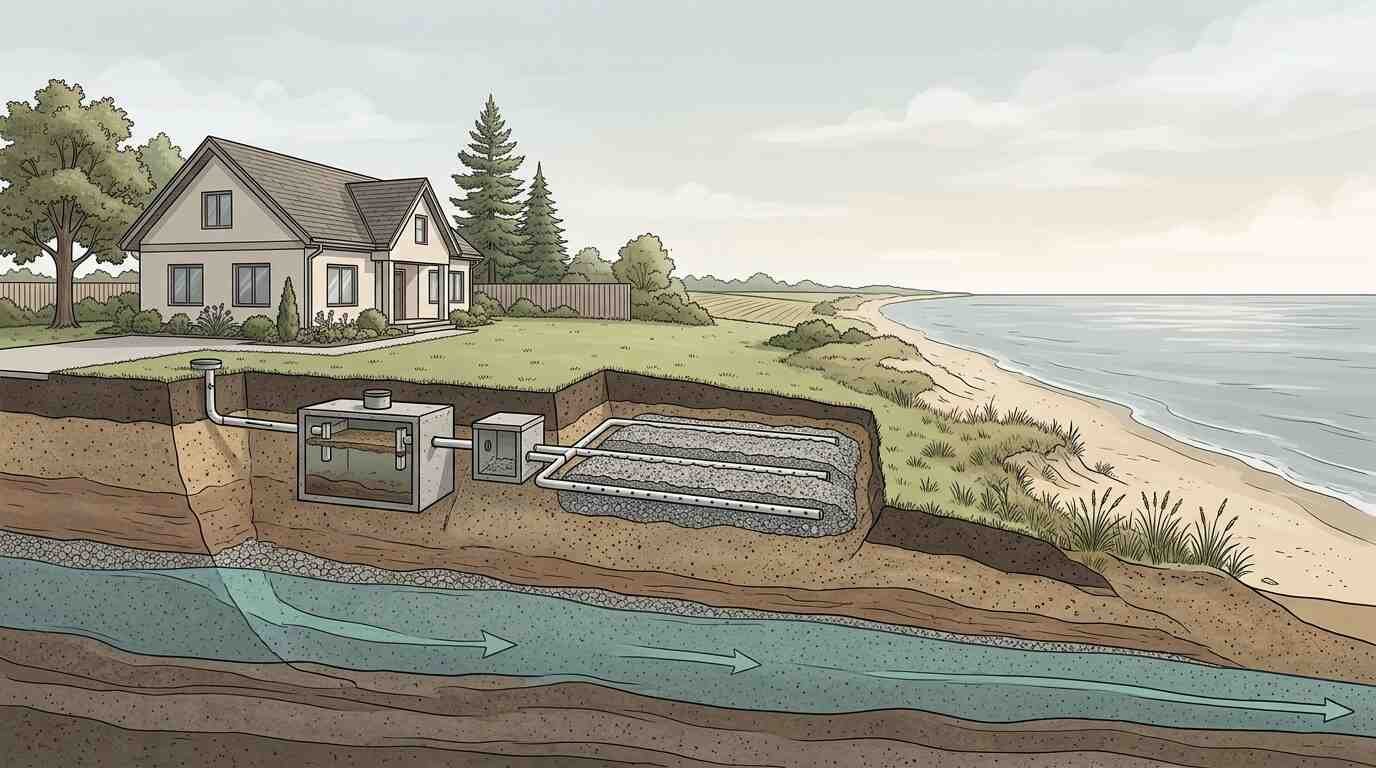
Roughly 360,000 standard cesspools and septic systems remain in use across Suffolk County, Newsday reported this year, and most were built to dispose of household waste rather than treat it. That distinction matters because nitrogen in wastewater does not stay where it is buried. It moves through the soil into groundwater and from there toward the harbors and bays that give the North Shore much of its appeal.
For anyone who owns, buys, or sells a home outside a sewer district, the practical questions are narrower. What does the county require, what does an upgrade cost, and who pays? A nitrogen-reducing system runs between $30,000 and $37,000 according to that same reporting, while county and state grants can reach $45,000 combined, and the distance between those two numbers is where most of the planning happens.
This guide covers Suffolk County only; Nassau County publishes its own septic guidance. Everything below reflects public sources available in early October 2026, each linked in the sources section, and programs of this kind change, so the county’s own office should confirm any figure before money is committed.
At a glance
- Systems still in use: roughly 360,000 across Suffolk County (Newsday, 2026)
- Installed through June 2026: 8,313, against a goal of 16,500 by this year
- Installed cost: $30,000 to $37,000 for a nitrogen-reducing system; $10,000 to $15,000 for a conventional one
- Grants: county up to $20,000 plus state up to 75 percent of eligible costs, capped at $25,000, for a $45,000 combined ceiling
- Replacement deadline for working systems: none appears in the sources reviewed, though new construction, large renovations, and some failed-system replacements are covered
- Not grant-eligible: homes connected to sewers or within a proposed sewer area
In this guide
- Why household wastewater became a water-quality problem
- Cesspool, septic tank, or advanced system
- What the rules require today
- What an advanced system costs
- How the county and state grants work
- Buying a home with a cesspool or septic system
- Selling a home with an older system
- Living with a nitrogen-reducing system
- Where the program stands in late 2026
- Frequently asked questions
Why household wastewater became a water-quality problem
Suffolk County draws its drinking water from a sole source aquifer, a fact County Legislator Steve Englebright put plainly when the program’s pace came under review: “The sooner that we can implement protection for our sole source of drinking water the better.” The same groundwater that supplies wells also drifts toward the shoreline, carrying whatever the soil failed to filter out along the way.
Conventional systems were never engineered with nitrogen in mind. Walt Dawydiak, an environmental engineer at the New York State Center for Clean Water Technology at Stony Brook University and a former director of environmental health for the county, described them to Newsday as “designed to get rid of the waste as cheaply and easily as possible,” and said they “put pollution very efficiently right into the groundwater and the surface waters.”
On the North Shore the effect has been measured at the scale of a single harbor. George Hoffman of the Setauket Harbor Task Force, whose group samples the water from May through October, told TBR News Media in 2024 that 75 percent of the nitrogen entering the harbor comes from cesspools. He also passed along a detail that explains why shoreline lots draw particular attention.
“People tell us stories where at high tide in the harbor, the water in the toilet bowl goes up and down, which means the cesspool is in the water.”
George Hoffman, Setauket Harbor Task Force, via TBR News Media
The harbor study itself, and what it means for people who own along the water, is covered in an earlier Maison Pawli post, The Setauket Harbor Study Nobody Asked the Neighbors About.
Cesspool, septic tank, or advanced system
Three kinds of onsite wastewater systems appear in Suffolk listings, inspection reports, and county paperwork, and they are not interchangeable. A cesspool is a buried pit that lets wastewater seep directly into the surrounding soil. A conventional septic system adds a tank that holds back solids before the liquid moves on to a leaching field. The third type, formally called an Innovative/Alternative Onsite Wastewater Treatment System and abbreviated I/A OWTS, adds a treatment stage built specifically to reduce nitrogen.
| Cesspool | Conventional septic system | Nitrogen-reducing (I/A) system | |
|---|---|---|---|
| How it works | Pit; wastewater leaches directly into soil | Tank separates solids; liquid flows to a leaching field | Adds a treatment stage that reduces nitrogen before discharge |
| Built to remove nitrogen? | No | No | Yes; the county standard cited at adoption was 19 milligrams per liter |
| Typical installed cost | Not quoted in the sources reviewed | $10,000 to $15,000 | $30,000 to $37,000 |
| Current status | Like-for-like replacement ended in 2019 | Still used for some replacements | Required for new construction and certain projects; grant-eligible |
Cost figures come from Newsday’s 2026 reporting; the 19 mg/L standard comes from 27east’s coverage of the 2020 law.
Friends of the Bay’s video, titled “Protect Our Water: Using Clean Water Technology to Update Long Island Septic Systems,” addresses the technology behind the third column.
What the rules require today
Three layers of regulation account for most of what applies to a Suffolk property, and they arrived years apart.
The first came with a 2017 amendment to the Suffolk County Sanitary Code that took effect in July 2019. According to a summary from Suffolk Law, anyone replacing an aging or failing cesspool must at minimum add a septic tank, and a county permit is required before a cesspool is replaced or retrofitted.
The second layer is the law the Suffolk County Legislature passed unanimously in October 2020, effective July 2021. The East End Beacon reported that nitrogen-reducing systems “will be required in all new home and commercial construction, and for single family home renovations that increase the number of bedrooms to more than five and increase the building’s footprint or floor area.” A legal summary from Long Island Land Use and Zoning lists the residential triggers as construction of a new residence, a knock-down and rebuild, a bedroom addition that takes a home past five bedrooms, and major reconstruction, which it ties to a project cost above 50 percent of the existing structure’s market value. The same summary notes an exception for projects inside a proposed sewer district.
The third layer is narrower. Newsday reported that “the Suffolk Board of Health then approved a measure in December 2023 that would require homeowners in certain priority areas to install an IA when replacing a failing system.” Whether a given property falls inside a priority area is a question for the county, not something a listing will answer.
What the rules do not appear to do is set a deadline for owners of working, existing systems. Newsday reports that the architects of the county’s plan recommended requiring advanced systems “when building a new house or adding to its size, when an existing system is failing, and when properties change hands.” The first two circumstances are, in part, already law as described above. The third, a requirement triggered by a sale, remains a recommendation in the reporting reviewed for this guide, and advocates have been pressing for it.
Because the wording differs slightly between summaries, the authority on whether a specific project triggers the requirement is the Suffolk County Department of Health Services, Office of Wastewater Management, which is also the office that approves projects under the grant program.

What an advanced system costs
Installed pricing for a nitrogen-reducing system sits between $30,000 and $37,000, compared with roughly $10,000 to $15,000 for a conventional septic system, per Newsday’s 2026 report. Those figures describe the installation. The ongoing costs come from a county homeowner guide posted in 2017, so they are the oldest numbers in this article and the likeliest to have moved.
| Cost item | Figure | Source |
|---|---|---|
| Conventional septic system | $10,000 to $15,000 | Newsday, 2026 |
| Nitrogen-reducing (I/A) system | $30,000 to $37,000 | Newsday, 2026 |
| Annual service contract after the 3-year warranty | About $300 per year | Suffolk County homeowner guide (2017) |
| Added electricity | $57 to $266 per year | Suffolk County homeowner guide (2017) |
| Pump-out, every 3 to 5 years | $300 to $500 each | Suffolk County homeowner guide (2017) |
The Peconic Baykeeper’s video below documents a septic system installation in Hampton Bays, an East End project, for readers who want to see what a replacement looks like on a lot.
How the county and state grants work
Two programs sit side by side. The county’s Septic Improvement Program offers “up to $20,000 per property depending upon whether your project qualifies,” and the New York State Septic System Replacement Program pays “up to 75% of the program eligible costs not to exceed $25,000 per property,” for a combined ceiling of $45,000, according to the county’s septic grants page. The state’s July 2025 expansion, which raised the enhanced-system reimbursement from 50 percent and $10,000 to 75 percent and $25,000, put $30 million into the latest round, with $20 million directed to Suffolk. The state program still reimburses a conventional upgrade at up to 50 percent, capped at $10,000, according to the Environmental Facilities Corporation’s program summary.
Eligibility under the county program, as listed on its page, requires that the property:
- is an existing residential home: single-family, two-family, or single-family with one accessory apartment
- uses a cesspool or septic system that is to be replaced
- is not connected to sewers or within a proposed sewer area
- has a valid Certificate of Occupancy and a current town-issued property tax bill
- is current on property taxes, with no liens or foreclosure
- has its deed on file with the Suffolk County Clerk
The county’s listed process runs in five steps:
- Check eligibility using the online tool.
- Obtain approval from the Suffolk County Department of Health Services, Office of Wastewater Management.
- Select an approved installer from the county’s list.
- Submit the application for grant consideration.
- Wait for an email with the award decision.
An August 2026 report in TBR News Media described a new online portal that gives applicants one place to review requirements, submit applications, and upload documents. It also noted that, unlike a reimbursement program, the county’s grant funds “are paid directly to an approved installer after installation is complete,” and that applications documenting a failing system receive priority.
“Outdated septic systems and cesspools have led to the degradation of our waters and are a serious threat to our region’s groundwater and bays. By making the Suffolk County Septic Improvement Grant Program application process easier, more homeowners will take advantage of this funding and be part of the solution for clean water.”
Suffolk County Executive Ed Romaine, via TBR News Media
Money left over after the grants is the owner’s. According to the grant summary reproduced by the Town of East Hampton, engineering, landscape restoration, and any expense above the grant amount are the property owner’s responsibility. The state side, per the EFC, reimburses after completion with documentation, so the sequencing between the county’s direct payment and the state’s reimbursement is worth confirming with the county before work begins. One East Hampton contractor told Newsday that for an average home with good soil conditions, the grants can likely cover a whole project, but soil, lot layout, and system choice vary, and no figure here should be read as a guarantee for a particular house.

Buying a home with a cesspool or septic system
A buyer’s first job is simply to learn what the house has, because the listing rarely says. The answer shapes the budget more than most inspection findings.
- Identify the system type. A cesspool, a conventional septic system, and an I/A system carry different replacement costs and different obligations. Ask the seller in writing, and ask for pumping and repair records and any county approvals on file.
- Ask what the inspection covers. A general home inspection may reach only part of the wastewater system, so the inspector can say how much of it was actually reviewed. The framework in The Inspection Report as a Negotiating Document applies here.
- Note the distance to the water. TBR’s account of Hoffman’s view was that homes close to the water are the ones where there is not enough distance between the cesspool and the shoreline for soil and bacteria to filter nitrogen naturally. Waterfront buyers can pair this with Sound vs. Bay vs. Harbor, which covers how the water type affects maintenance.
- Use the cost ranges as a planning figure. A $30,000 to $37,000 installed range for an advanced system, against $10,000 to $15,000 for conventional, gives a buyer a reference point for budgeting and for conversations with the seller. It is not a prediction of what any seller will concede.
- Ask how grant timing works around closing. Eligibility rests on a recorded deed and current taxes. Buyers should ask the county and their attorney whether an application begun by a seller carries over to a new owner, or whether it must wait until after closing.
Closing-day budgeting is covered separately in What Closing Costs Actually Look Like on Long Island.
Selling a home with an older system
Sellers outside sewer districts generally have three paths, and the right one depends on the property, the timeline, and the advice of an attorney.
The first is to leave the system as it is and disclose it accurately, pricing with the likely replacement cost in mind. The second is to inspect and pump before listing, which gives buyers a documented condition instead of an unknown, a strategy examined in The Pre-Inspection Move. The third is to upgrade before listing, using the grant programs described above, which turns a likely negotiating point into a selling feature but adds permitting and installation time to the calendar.
Two cautions apply regardless of the path. A home that already has an I/A system carries a registration duty: the county’s homeowner guide says owners must register the system with the Department of Health Services at final approval, that registration renews every three years, and that it also renews upon property sale. Sellers with an existing advanced system should confirm that registration is current before listing. Separately, neither an as-is clause nor a standard disclosure form removes the need to describe a system accurately, as The As-Is Clause Is Not a Shield and The Seller’s Disclosure Form Is a Legal Document explain.
Timing also deserves attention. If a sale-triggered requirement were ever adopted, it would land on sellers directly, and the schedule in The Seller’s Timeline shows how many weeks a permit or installation could add before a listing goes live.
Living with a nitrogen-reducing system
Owners of an I/A system take on responsibilities that a cesspool never asked for, and most of them are small and recurring.
- The county’s guide says covers “can be landscaped around but must remain fully accessible.”
- Owners sign yearly maintenance contracts and become responsible for maintenance costs once the three-year warranty ends.
- The same guide estimates a pump-out every three to five years.
- Frank Sangiovanni of Sangiovanni Contracting Services said in TBR’s coverage that county health officials verify system performance through regular random sampling.
Day-to-day habits change too. Josephine Brennan, a Patchogue homeowner who installed an advanced system, told Newsday: “We’re glad we did it, in a sense, but the amount of products you cannot use is ridiculous.” Which cleaning, laundry, and household products are acceptable depends on the manufacturer and installer, and owners should get that list in writing at installation.
Where the program stands in late 2026
The county’s goal was to install 16,500 nitrogen-removing systems by this year, and the total through June was 8,313, according to county records cited by Newsday. Installations have climbed from roughly 700 in 2021 to more than 1,600 last year, which is 80 percent of the county’s goal of 2,000 a year for this stage of the program, as Michael Martino, a spokesperson for County Executive Romaine, pointed out. “While below the forecast, the County considers this a strong pace,” Martino said.
Funding comes from a 0.125 percent sales tax that a large majority of Suffolk voters approved in 2024. Newsday reported that the fund collected nearly $48 million from its start in March 2025 through that December, about $25 million of it earmarked for septic systems, and that it is expected to collect $3 billion through 2060 for sewers and septic systems together. The long-range goal, set in the county’s Subwatersheds Wastewater Plan in July 2020, is to replace nearly 300,000 conventional cesspools and septic systems by 2069.
Advocates argue the pace should be faster.
“The septic improvement program began in 2017 as a pilot — we’re not in the startup phase anymore.”
Kevin McDonald, Senior Conservation Policy Adviser, The Nature Conservancy on Long Island
Adrienne Esposito, executive director of Citizens Campaign for the Environment, put it more briefly: “It’s a historic program, and it needs to be accelerated.” Whether that acceleration takes the form of a sale-triggered requirement or something else is unresolved, which is why owners planning to list within a year or two have reason to check the county’s status before choosing a path.
Frequently asked questions
Do owners of a working cesspool have to replace it now?
No deadline for working, existing systems appears in the sources reviewed for this guide. Failed systems are a different matter: replacement requires a county permit and, at minimum, a septic tank, and certain priority areas may require an advanced system. A requirement triggered by a sale has been recommended but not enacted in the reporting reviewed.
Can a new cesspool be installed in Suffolk County?
Not as a like-for-like replacement. A 2017 amendment to the Suffolk County Sanitary Code, effective July 2019, requires at minimum a septic tank when a failing cesspool is replaced, and a county permit comes first.
How much can a homeowner receive in grants?
The county program offers up to $20,000 per property, and the state program reimburses up to 75 percent of eligible costs, capped at $25,000, for a combined ceiling of $45,000 if a project qualifies for both.
Does the grant pay the homeowner or the installer?
Under the county program, funds are paid directly to an approved installer after the installation is complete. The state program is described by the Environmental Facilities Corporation as reimbursement after completion with documentation.
Is a home connected to sewers eligible?
No. The county program requires a property that is not connected to sewers or within a proposed sewer area.
Do two-family homes and houses with an accessory apartment qualify?
Yes. The county lists existing single-family homes, two-family homes, and single-family homes with one accessory apartment as eligible residential properties.
Does an advanced system raise or lower a home’s value?
No Suffolk-specific resale study turned up during research for this guide, so the answer is unknown. A local appraiser or licensed agent can speak to how comparable sales have treated the question in a particular neighborhood.
Who decides whether a project requires an advanced system?
The Suffolk County Department of Health Services, Office of Wastewater Management, which also approves projects under the grant program.
This is for informational purposes only — consult a licensed attorney or financial advisor. Regulations, grant amounts, and program availability can change, and nothing here predicts the value of any property.
Real estate markets change. For current listings and market data, contact Maison Pawli at maisonpawli.com/about/.
Sources
- Suffolk County: Septic Improvement Grants
- Suffolk County: What Homeowners Should Know about I/A OWTS (PDF, 2017)
- TBR News Media: Homeowners in Suffolk can now more easily access up to $45K for septic upgrades (Aug. 8, 2026)
- TBR News Media: Clean water advocates embrace Suffolk measure (Feb. 9, 2024)
- Citizens Campaign for the Environment: Suffolk’s ambitious plan to replace septic systems is behind schedule (reproducing Newsday reporting by Tracy Tullis, 2026)
- New York State Environmental Facilities Corporation: State Septic System Replacement Fund program summary
- Governor Hochul: $30 Million and Legislation to Make It More Affordable to Protect Water Quality from Failing Septic Systems (July 2025)
- Town of East Hampton: Suffolk County & New York State Grants
- East End Beacon: Suffolk to Require Nitrogen-Reducing Septic Systems for New Construction (2020)
- 27east: New Suffolk County Law Requires Advanced Septic Systems for Newly Built Homes
- Long Island Land Use and Zoning: New Standards for Nitrogen-Reducing Septic Systems in Suffolk County Starting July 1st (2021)
- Suffolk Law: Suffolk County Amends Sanitary Code on Wastewater Management (2017)
- Friends of the Bay: Protect Our Water: Using Clean Water Technology to Update Long Island Septic Systems (YouTube)
- Peconic Baykeeper: First Septic System Installation in Hampton Bays (YouTube)
You Might Also Like
- How Property Taxes Work in Suffolk County: What Buyers Need to Budget Before They Close
- The Oil Tank Discovery Protocol: What Happens When You Find One Mid-Renovation
- Renovating Without Refinancing: HELOC vs. Cash-Out Refi for Long Island Owners Holding a Low Rate
- The Gut Rehab Math: Which North Shore Fixer-Uppers Actually Pencil Out