Belle Terre, NY: History, Landmarks and Visiting
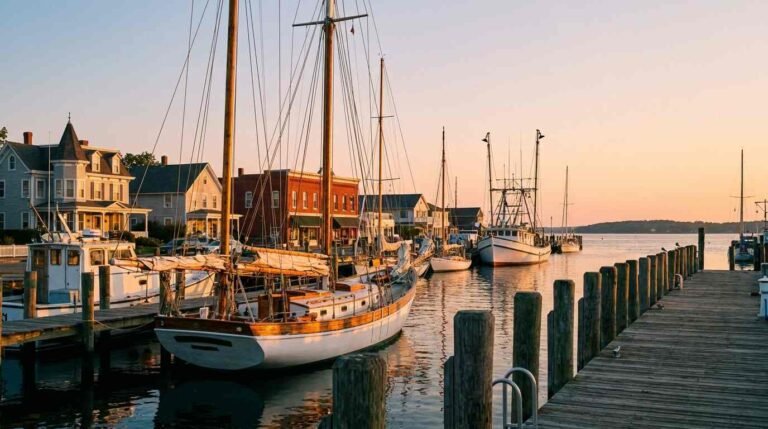
Belle Terre occupies the northeastern half of the Mount Misery peninsula, between Port Jefferson Harbor and Long Island Sound, in the Town of Brookhaven. It is a small village with a long paper trail: a planned residential park from the early 1900s, a club that burned, a fight against sand mining, and a 1974 Supreme Court case. It is also a place where public access is narrow by design, which shapes how a visit works.
Where Belle Terre sits
The Belle Terre entry on Wikipedia gives the village an area of 0.88 square miles, all land, on the peninsula that overlooks Port Jefferson Harbor and the Sound. All land access runs through the neighboring Village of Port Jefferson, so a trip to Belle Terre is, in practice, a trip that begins in Port Jefferson. The village incorporated on January 8, 1931, according to the village’s own account of the period.
From Nonowantuc to Mount Misery
The village’s village history pages describe about 1,300 acres that were inhabited by Native Americans before the 1600s, who called the land Nonowantuc, meaning “the stream that dries up.” According to the text, the inhabitants deeded the land in 1689 to three Englishmen, Smith, Floyd and Woodhull, who renamed it Mt. Misery, probably because of shipwrecks. A photo caption on the same page dates the deed to 1609, which conflicts with the 1689 date in the text, so the date should be treated as unsettled.
The Strong family of Strong’s Neck held the land for more than a century. The Strong women disliked the name Mount Misery, the history says, and renamed the property Oakwood for its large oak trees. Old Homestead Road, which began as a path between Port Jefferson Harbor and Mount Sinai Harbor, was named in memory of the Strong residence.
The history also records the only other known dwelling of the period, a driftwood shack on the harbor built in the 1800s by a Black man known as Uncle Mott, at the end of what is now Mott’s Hollow Road. The local artist William Davis, who lived from 1829 to 1920, wrote a poem and painted pictures about him.
Dean Alvord and the planned community
The next chapter, told in Dean Alvord and the Glorious Years, begins with the Port Jefferson Company, whose five directors in 1902 included Alvord and which bought Oakwood from the Strong family for development. Alvord had already worked on Prospect Park South in Brooklyn and Roslyn Heights in Nassau County. Belle Terre Estates was incorporated in 1906 with Alvord as president, and he built a home of his own called Nevalde.
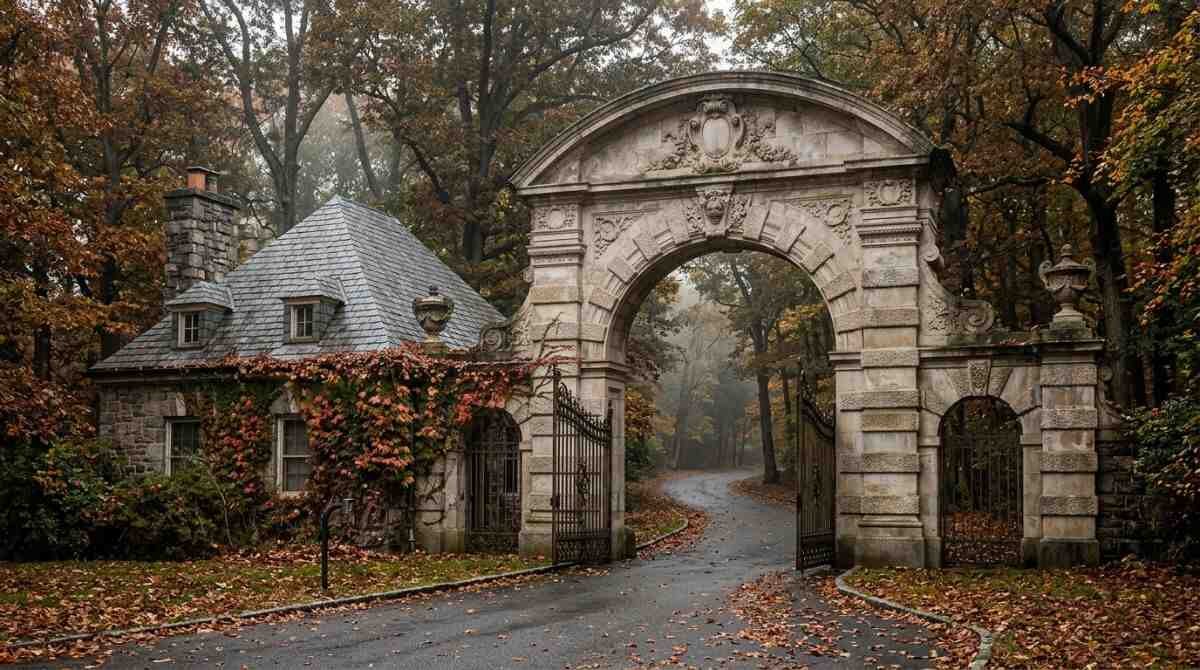
The centerpiece was the Belle Terre Club, a members-only club above Port Jefferson Harbor with rooms for 100 guests. The village history lists a fireplace in every room, an 18-hole golf course, tennis courts, bridle paths and a private bathing beach. The firm of Kirby, Petit and Green designed the club and the gatehouse, and also the neoclassical railroad station in Port Jefferson where guests were met and driven to the grounds.
Alvord promoted the club with brochures promising a “perfect home in perfect surroundings,” according to the history, and the club had a post office of its own for a time. Ralph Peters, the president of the Long Island Rail Road, helped Alvord reserve a railroad car for guests. The same page says Alvord sat on corporate boards alongside members of the Whitney, Vanderbilt, Astor and Belmont families, who were charter members of his club.
Houses followed. The British architect Frederick Sterner designed eight Tudor homes in an English section, including Teignmouth Hall, Dawlish House and Malmesbury House. Alvord distributed privet hedge seedlings to homeowners near the gates to line Belle Terre Road, and the village history says some of those hedges still survive.

Sand, gravel and the 1930s
By 1913 Alvord’s finances had failed and he went into receivership, according to Trouble on the Horizon and Belle Terre’s Victory. In the 1920s the Fallon brothers bought the club and much of its land and sold half to a sand and gravel company, whose dredging created what is now called Pirates Cove. A 1907 covenant banning commercial land use was due to expire in 1930, and a plant was started at the end of Anchorage Road. Residents led by Harry Purvis won incorporation for the village on January 8, 1931.
The new village passed ordinances banning business, sued when construction continued, and prevailed when its attorney stopped the superintendent from starting the equipment. Fire destroyed the Belle Terre Club on December 16, 1934. It was never rebuilt, and the neoclassical pergolas at the point were dismantled the same year.
Pirates Cove and the shoreline
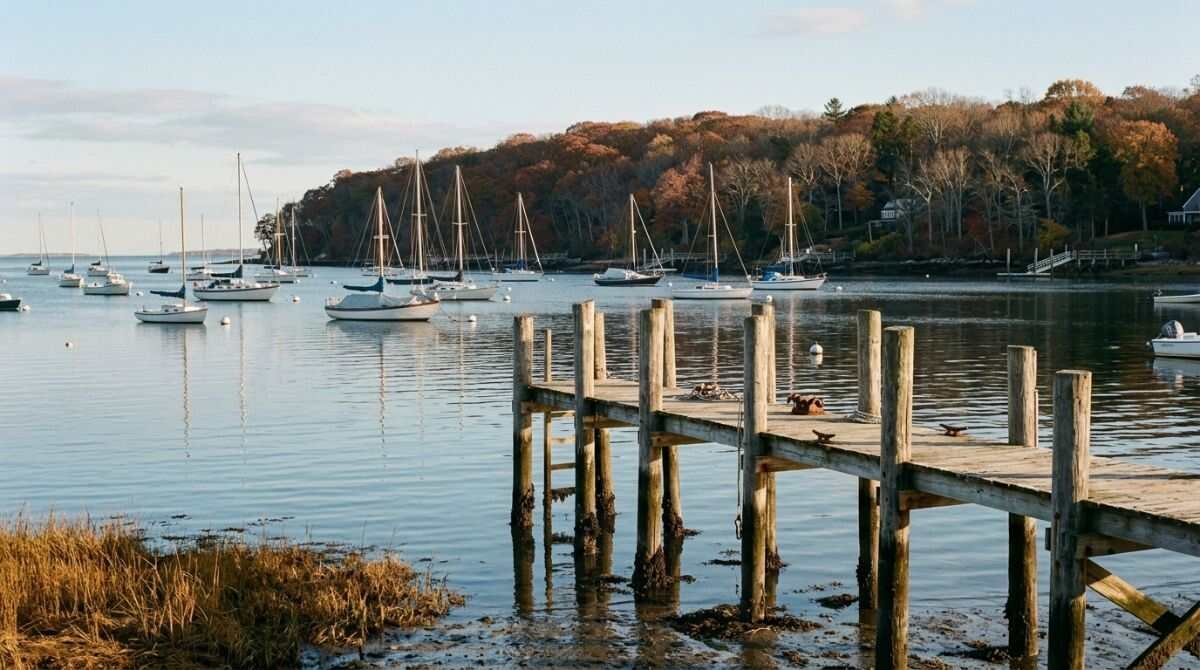
The dredging left a physical legacy. Wikipedia describes Pirates Cove as a harbor feature created when a company dredged a cove near the peninsula’s tip, and notes that it is now popular with boaters. The same entry records that residents in the 1920s and 1930s successfully opposed sand and gravel dredging, and that those operations were ordered to stop in 1931. A resident later built a home on the former site of the Belle Terre Club that incorporates many of the club’s original architectural elements, according to the village history.
Postwar growth and the gates
The village history in Postwar Belle Terre to the Present describes the 1950s as a time of new homes, many of them ranches, with the first at the corner of Cliff and Beach Roads, and says that building accelerated until almost all buildable land was occupied. By 2007 the village counted about 300 homes, up from roughly fifty in the 1940s. The entrance gates, first built in 1903, were later rebuilt by residents to match the original design. Wikipedia describes the Belle Terre Gatehouse as a Beaux-Arts structure from the first decade of the 1900s.
The 1974 Supreme Court case
Belle Terre is known well beyond Long Island for Village of Belle Terre v. Boraas, decided in 1974 (416 U.S. 1). The Court upheld a local zoning ordinance restricting how many unrelated people could live together as a single household, and Justice William O. Douglas wrote the opinion, according to Wikipedia. The case belongs to land-use law, and the longer account is in Village of Belle Terre v. Boraas and the Long Island zoning case.
What a visit can and cannot include
The village’s new residents page sets out limits that anyone planning a trip should read first. The beach, at the end of Nonowantuc Trail, is limited to Belle Terre residents who hold a parking sticker. The village park is on Park Lane, off Crooked Oak Road. Parking is not permitted along any village street. These are the village’s own rules, and nothing on its site invites non-residents to use the beach or to park on its roads.
For that reason, the more useful public stops are on the Port Jefferson side. The Village of Port Jefferson parks and beaches page describes Jeanne Garant Harborfront Park, with grassy picnic areas, landscaped walkways and a pier extending about 350 feet into the harbor, as well as a Historical Walkway along Mill Creek behind Village Hall. The Town of Brookhaven reported in a 2011 release that its renovated Harbor Walk West runs from the Port Jefferson ferry terminal to the harbormaster’s office, and that it connects to the village’s Harborfront Park and boardwalk on the east side of the harbor, as described in the Town of Brookhaven press release.
Visitors who still want to drive through should first call the Village Office at 631-928-0020 to ask what is permitted.
Related reading
Other pieces cover the surrounding area, including Port Jefferson as a walkable village and the Bayles shipyard site. This article is general information about a place and is not advice about property or legal matters.
Hours, programs and prices change; confirm details with the official sources linked above before visiting.
Sources
- Belle Terre history: The Early Period to 1900
- Belle Terre history: Dean Alvord and the Glorious Years
- Belle Terre history: Trouble on the Horizon and Belle Terre's Victory
- Belle Terre history: Postwar Belle Terre to the Present
- Village of Belle Terre: New Residents Info
- Belle Terre, New York (Wikipedia)
- Village of Port Jefferson parks, beaches and marina
- Town of Brookhaven: Harbor Walk West release