Certificate of Occupancy on Long Island: What It Proves, What Open Permits Mean, and How Unpermitted Work Surfaces in a Sale

A finished basement with a bathroom, a deck built over a long weekend, a garage quietly turned into an office. Any of them can sit inside a Long Island house for thirty years without anyone asking whether the town ever signed off, and the question tends to arrive all at once, somewhere between the home inspection and the closing table.
The paper at the center of that question is the certificate of occupancy, usually shortened to C/O. It is easy to treat as a formality. It is better understood as the town’s record of what was built, what it may be used for, and whether the work was inspected. What follows lays out what these certificates do, how to find out what a town actually has on file, what happens when a house has no records at all, and where unpermitted work tends to surface in a sale.
What a certificate of occupancy certifies
Under the New York State Uniform Code rules published by the Department of State, a municipality’s code enforcement program must provide for a certificate of occupancy or a certificate of compliance. The rule says use or occupancy of a previously permitted or converted building is to be granted only by issuing one of them, and that neither can be issued until the work has been inspected and found compliant. The certificate itself is required to carry the building permit number, the address and tax map number, the use classification, and the date of issuance.
In plain terms, a C/O ties a specific permit to a specific inspection result for a specific use. A house with a one-family certificate is documented as a one-family house. A finished attic or basement that never went through an inspection is not covered by that paper, however long it has been in use.
Local codes then add their own requirements. The Town of Huntington’s zoning code, for example, makes it unlawful to maintain, occupy or use a building where a certificate of occupancy or certificate of permitted use has not been issued, and requires a building permit and certificate of occupancy before a change of use that involves construction or an addition. The section reviewed for this post addresses use and occupancy; its text does not mention resales.
Certificate of compliance, and the temporary kind
Two related documents appear in the state rule. The text reviewed names the certificate of compliance alongside the certificate of occupancy for work under a building permit, without spelling out the difference; in general usage, a certificate of compliance closes out permitted work such as a deck or a renovation on a building that already has a certificate of occupancy, and towns differ in how they use the term. A temporary certificate of occupancy, where a town allows one, lets part of a building be occupied before all permitted work is complete. The state rule limits it to a specified period and bars it until the authority finds the structure can be occupied safely, with required fire and life-safety components operating and egress provided.
A temporary certificate that was never converted to a final one is one thing worth looking for in a file. It can look complete at a glance and still leave the house short of a final sign-off.
Brookhaven’s building division describes the end of the process this way: after the final inspection, the department mails a list of what is needed for the certificate, and depending on the project, that can include a lead solder test, a new survey, or an electrical inspection. The same page notes that a Brookhaven building permit is valid for one year from issuance and is required for new homes, additions, alterations, manufactured homes, and accessory structures.

Open permits and expired permits
A permit that was pulled, partly inspected and then abandoned is a different problem from work that was never permitted. It leaves a record in the town’s file with no closing inspection behind it.
Brookhaven’s property record search form illustrates what a records request can return. According to the form, dated August 22, 2025, the town’s C/O search includes all certificates of occupancy and compliance as well as active and expired permits, and a separate survey search is available. The listed fees are $40 for a C/O search, $15 for a survey search, and $55 for both. The form does not state a turnaround time, so a request should be placed early in the contract period rather than in the last week.
Fees, forms and procedures differ among the island’s towns and villages, and incorporated villages often keep their own building records. The town or village building department for the specific address is the place to ask.
Related reading on the permit side of a purchase appears in How to Sequence a North Shore Fixer-Upper Renovation to Avoid the Permit Trap and The Contractor Shortage Nobody Warned You About: Why Long Island Permits Are Taking 14 Months and What Savvy Renovators Are Doing Differently.
When the house has no records at all
Older houses sometimes predate a town’s files. Two Long Island towns publish a process for that situation, called a certificate of existing use.
Brookhaven issues them only for structures with no town records. According to the town’s form, dated January 16, 2026, the cutoff for a dwelling is construction before June 30, 1959, and for an accessory structure, before September 1, 1981. The residential fee is $165. The application requires the owner’s signed declaration and a notarized affidavit, two surveys dated within one year and stamped by a surveyor, photographs of all sides of every structure, and proof the structure existed before the cutoff date. That proof must be conclusive and approved by the town, and the form lists options such as a certified tax search or an original dated survey.
The Town of North Hempstead’s owner authorization form for a certificate of existing use is notarized, gives the inspector access on 48 hours’ notice, and refers to a building constructed before 1929. The form also contains a later reference to 1938, so the cutoff should be confirmed with the department directly. The form does not state a fee.
Neither process is a quick fix. Surveys, notarized paperwork and an inspection all take calendar time, which matters if a contract has a mortgage commitment date.
Where unpermitted work shows up in a sale
Three points in a typical Long Island sale can bring it to light.
- *The disclosure form.* New York’s Property Condition Disclosure Statement under Real Property Law section 462 must be completed and signed by the seller and delivered to the buyer or the buyer’s agent before the buyer signs a binding contract. Question 9 asks whether there are certificates of occupancy related to the property, with a place to explain a “no.” The form states that it is not a warranty of any kind by the seller and encourages the buyer to obtain independent professional inspections. Under section 465, a seller’s liability under the article is limited to a willful failure to perform its requirements. More on the form appears in The Seller’s Disclosure Form Is a Legal Document: Why Most Sellers Treat It Like a Survey.
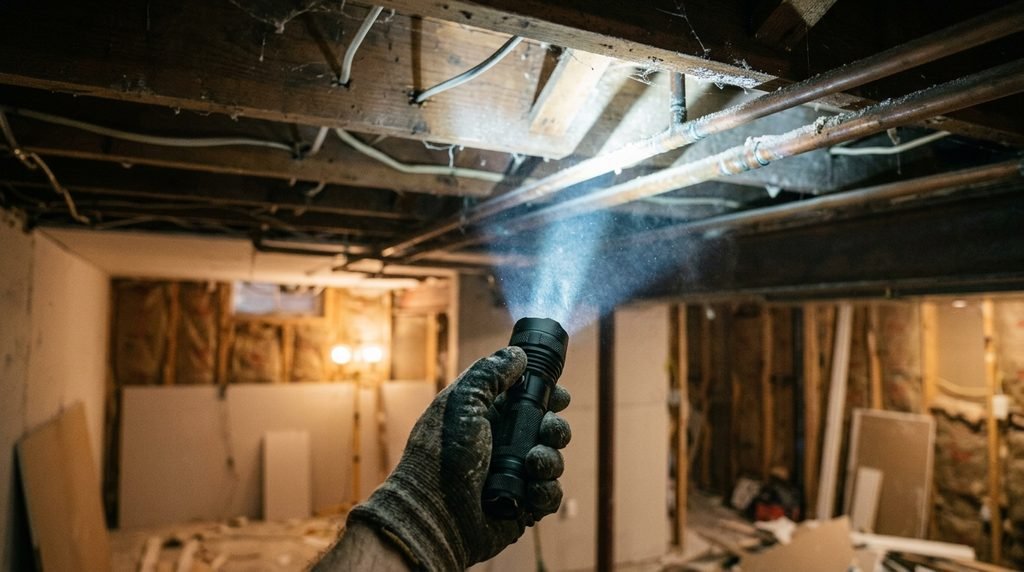
- *The inspection.* An inspector may note finished space with no visible permit history, panel work, or an addition whose framing does not match the rest of the structure. An inspection report is generally not a municipal record, and inspectors do not ordinarily search the town file. The role of the report in negotiation is covered in The Inspection Report as a Negotiating Document.
- *The survey and the certificate.* A title company or attorney comparing the survey to the C/O can spot a structure the paper does not describe. A Stewart Title underwriting bulletin from 2018 for New York agents, for one enhanced owner’s policy, called for review of the certificate of occupancy and municipal violation searches to confirm that the surveyed property matches the certificate. That was one company’s requirement for one product, but it shows where a mismatch gets caught.
Which pieces of the file a buyer’s attorney requests, and what the contract says about a missing certificate, are matters for the attorney. The reviewed municipal pages do not state that a certificate of occupancy is required at resale, and practice varies by town, by village, and by what the contract provides.
What title insurance does and does not cover
A common assumption is that a title policy protects against unpermitted work. The standard form generally does not.
The national 2021 ALTA owner’s policy, as filed with Florida’s insurance regulator (a Florida-modified copy), excludes from coverage any law, ordinance, permit or governmental regulation, including those relating to building and zoning, that restricts or relates to the use of the land or the character, dimensions or location of any improvement. Its covered risks reach a violation only to the extent described in an enforcement notice that is recorded in the public records. New York policies are written on forms filed by the Title Insurance Rate Service Association (TIRSA), whose exclusions were not separately verified for this post, so the policy’s own exclusions page is what counts.
Some enhanced residential policies add limited protection. The TIRSA Owner’s Extended Protection Policy is offered to owner-occupants of one- to four-family homes and, according to a title agency summary from August 2021, protects against forced removal of structures caused by violations of zoning laws, subdivision laws and local building ordinances. The 2018 Stewart bulletin listed deductibles of $4,000 and a $25,000 maximum for its building-permit and zoning coverages, and those figures may have changed. How title searches work, and what they leave out, is described in What a Title Search Does Not Find: The Encumbrances That Survive Closing Invisible to the Record and What Your Title Commitment Is Actually Telling You: How to Read a Chain of Title Like a Property Historian.

Questions to ask before signing
- Which certificates are on file for the address, and do they describe the house as it stands today?
- Are there open or expired permits in the town or village record?
- Does the finished space, the second kitchen, or the accessory unit appear on any certificate? Rules for the latter are summarized in Accessory Apartments on Long Island in 2026: Which Towns Allow Them, What They Require, and What Help Exists.
- Does the contract say who resolves a missing or mismatched certificate, and by when?
- What does the title policy exclude, and is an enhanced policy available?
This is for informational purposes only — consult a licensed attorney or financial advisor for your specific situation.
Questions people ask
Is a certificate of occupancy the same as a certificate of compliance?
Not exactly. Under the state rule, both are issued only after inspection and both are named in the same provision. In general usage, a certificate of compliance closes out permitted work, while a certificate of occupancy documents a building’s permitted use; ask the local building department how it uses each term.
What if no certificate can be found?
Some towns offer a certificate of existing use for older structures with no records. Brookhaven’s applies to dwellings built before June 30, 1959, and North Hempstead’s form refers to buildings constructed before 1929.
Does the seller have to disclose a missing certificate?
The state disclosure form asks whether certificates of occupancy are related to the property, and a “no” is to be explained. The form is not a warranty, and an attorney can advise on the effect of any answer.
Does a title policy cover unpermitted work?
Standard forms generally exclude building and zoning law matters, with limited exceptions. Some enhanced policies add forced-removal protection.
Can a town search be done before making an offer?
Records requests are typically made to the building department. Brookhaven’s published form lists fees and does not state processing time.
Real estate markets change. For current listings and market data, contact Maison Pawli at maisonpawli.com/about/.
You Might Also Like
- The Iron Ghost in the Yard: Why Sellers Need to Hunt Their Own Oil Tanks
- The Pre-Inspection Move: Why Long Island Sellers Who Inspect First Are Closing Faster and Cleaner
- The Inspection Contingency Is Not a Formality: What Buyers Waive When They Sign Without Reading
- Historic Homes on Long Island: What Buyers Should Know Before Falling in Love With an Old House
Sources
- New York State Department of State, Part 1203, Uniform Code administration and enforcement (full text)
- Town of Brookhaven, Certificate of Existing Use (CEU)
- Town of Brookhaven, Property Record Search form
- Town of Brookhaven, Building Division FAQ
- Town of North Hempstead, Property Owner Authorization, Certificate of Existing Use (PDF)
- Town of Huntington, Code section 198-120, Certificate Required
- New York State Senate, Real Property Law section 462 and section 465
- 2021 ALTA Owner’s Policy (state form library copy), Florida Office of Insurance Regulation (PDF)
- Stewart Title, Bulletin NY000611, February 12, 2018
- Abstracts, Inc., TIRSA Owner’s Extended Protection Policy notice, August 2021