The Stucco Over the Shingle: Reading Glen Cove’s Architectural Palimpsest as a Record of North Shore Aspiration
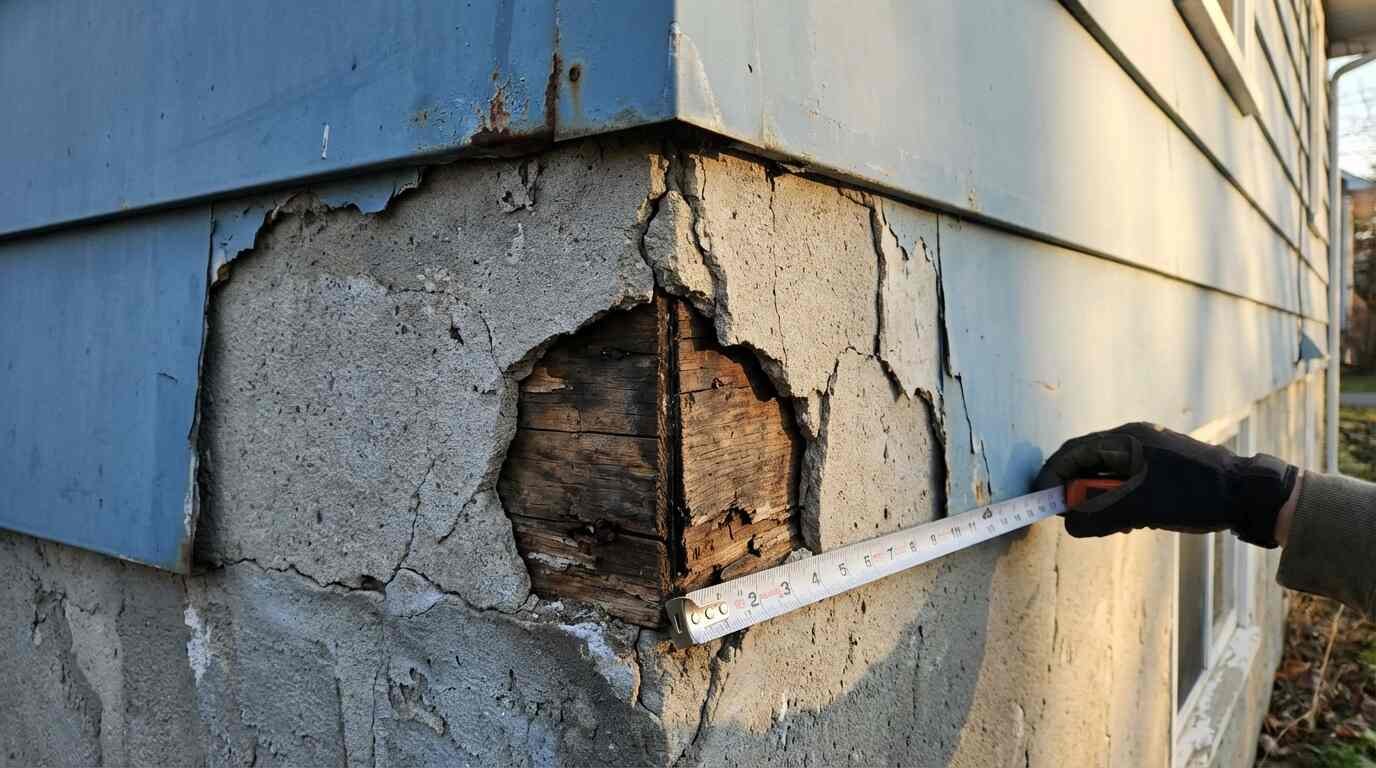
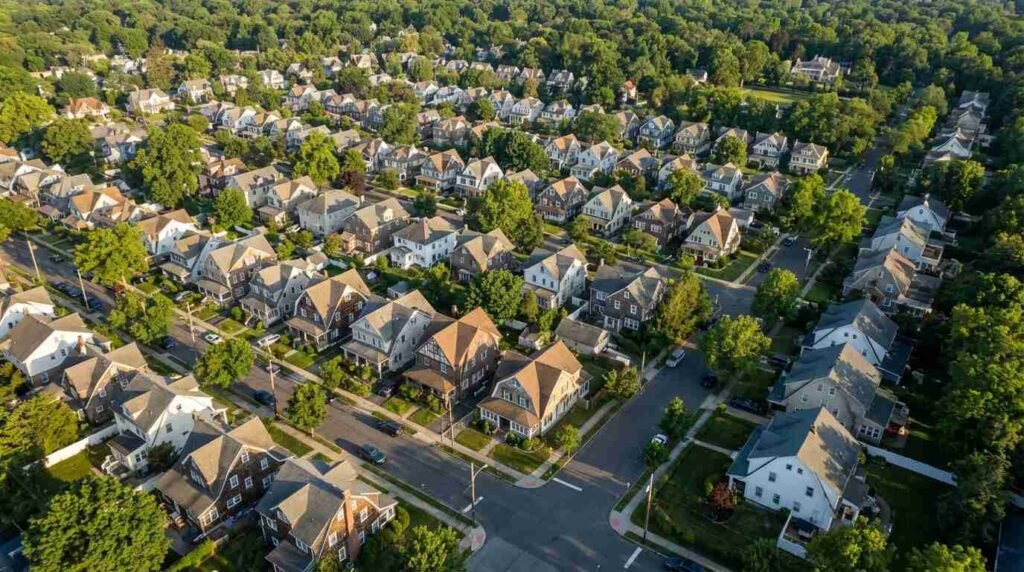
In Glen Cove, the houses do not keep their secrets particularly well. A walk down almost any block in the older residential neighborhoods — the streets that climb away from the harbor toward the former estate perimeters, or the denser grid behind Landing Road where the workers’ houses were built — will show you, if you are looking carefully, a building that has been remade at least twice and in many cases three or four times over the past century. The original structure is almost always still there, somewhere underneath. You can read it in the roofline, in the placement of windows that don’t quite align with the later siding, in the way a porch column sits on a base that was clearly designed for something of different proportions. Glen Cove’s residential fabric is, in the precise sense of the word, a palimpsest — a document that has been written over repeatedly without the earlier writing being fully erased.
I find this condition more interesting, architecturally and historically, than the pristine restoration — the Gold Coast estate that has been returned to something like its original appearance, the Shingle Style cottage that has never been touched. Those buildings are valuable as objects. The Glen Cove palimpsest is valuable as evidence: of how each generation related to the house it inherited, of what aspirations were legible in the cladding choices of the 1920s and the siding decisions of the 1955s and the restoration impulses of the 2010s, of the fact that a house is not a finished thing but a continuous negotiation between what was built and what is needed and what is fashionable at any given moment.
The Original Layer: Shingle and Clapboard on the Estate Periphery
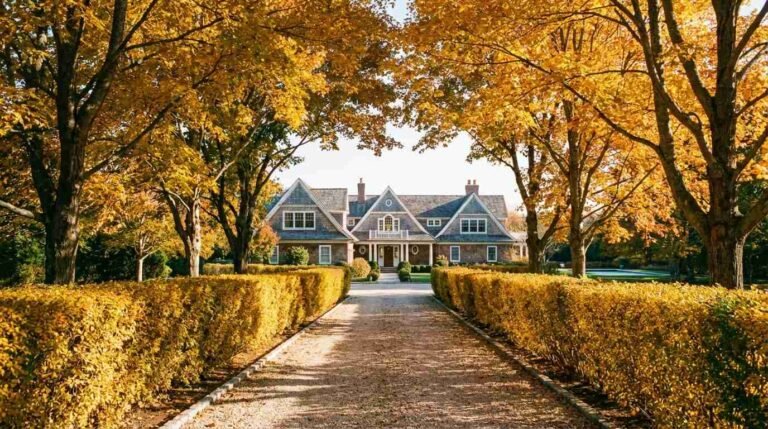
Glen Cove’s architectural history is inseparable from its Gold Coast identity. Beginning in the 1880s, entrepreneur Charles Pratt acquired nearly 1,100 acres of coastal land in the Dosoris area — a holding that he eventually subdivided among his six children, each of whom built a substantial summer residence on their allotted portion. By around 1905, the Pratt progeny had constructed shingle or clapboard homes by various architects, some with landscape settings by James Greenleaf, clustered near the shore. The Olmsted firm was engaged in two phases beginning in 1906 to develop the landscape framework for the collective property.
The shingle house that the Pratt family and their contemporaries built on the estate periphery was a deliberate architectural choice, not a default one. Shingle Style architecture — developed in the 1880s by architects including McKim, Mead and White and William Ralph Emerson — was understood as the appropriate domestic vernacular for the wealthy summer colony: informal enough to read as vacation rather than permanent establishment, sophisticated enough to signal taste, and rooted in the New England building traditions that gave the style its legitimacy. The unpainted cedar shingle, allowed to weather to a silver-gray, was the material expression of a particular kind of ease — old money relaxed in its surroundings, not performing for anyone.
This original layer is the hardest to read in Glen Cove today, because it was the most aggressively worked over in subsequent decades. The shingle houses that remain in anything like their original condition are disproportionately those on the larger lots with estate-level maintenance budgets — the converted Pratt properties now operating as schools, religious institutions, and the Webb Institute for Naval Architecture, where the original building fabric has been preserved by institutional continuity. The residential-scale shingle houses on the streets between the estate perimeters and the working neighborhoods were far more vulnerable to the interventions that followed.
The Interwar Rewrite: Stucco as Social Aspiration
The first significant rewrite of Glen Cove’s residential fabric came in the interwar decades, when stucco became the dominant aspiration cladding across Nassau County’s North Shore communities. The logic was straightforward and has been well documented in regional architectural surveys: stucco read as permanent, as European, as a departure from the vernacular wood construction that characterized the working and lower-middle-class housing stock. An owner who applied stucco over the original shingle or clapboard was not merely maintaining the building — they were reclassifying it, moving it from the register of the ordinary house into the register of something with pretensions to the Mediterranean or the Tudor or the Spanish Colonial, depending on what the plasterer and the owner agreed to do with the surface.
The Glen Cove streetscape in the 1920s and 1930s was being remade in real time by this impulse. Charles Pratt’s enormous wealth had drawn not just his family’s summer compounds but a dense supporting economy of workers, tradespeople, and mid-level professionals who built their own houses in the streets behind Landing Road and in the neighborhoods rising toward the estate perimeters. These were modest houses — two-story wood-framed structures, often of balloon-frame construction with simple clapboard exteriors — that by the 1920s were being upgraded by their owners in ways that reflected both rising incomes and rising aspirations. The stucco application was the most common upgrade: a coat of Portland cement render over the existing clapboard or shingle, finished smooth or with a textured float, sometimes detailed with false half-timbering or decorative quoins to suggest a Tudor or Georgian character that the original structure had never possessed.
This is the layer that gives Glen Cove its characteristic visual complexity when you look at it closely. The original window openings often predate the stucco by twenty or thirty years, and their proportions — taller and narrower than the casement windows that were fashionable in the interwar period — read as slightly wrong against the stucco surround, as if the facade is not quite telling a consistent story. This is not failure. It is evidence. The stucco layer is not pretending to be original; it is simply doing what every generation does, which is trying to make the inherited situation match the current aspiration.
The Postwar Layer: Aluminum as Maintenance Arithmetic
The third significant cladding intervention in Glen Cove’s residential neighborhoods came in the postwar decades, when aluminum and vinyl siding replaced or covered stucco and wood on a significant portion of the housing stock. This layer is the most maligned by preservationists and the most misunderstood in its historical context.
The aluminum siding decision was, in most cases, a maintenance arithmetic calculation. A Glen Cove homeowner in 1958 with a stucco exterior that was beginning to crack and a clapboard secondary elevation that was peeling and a painting budget that had not been adequate for several years was presented with a product that promised to solve the maintenance problem permanently, for a one-time cost, without requiring the house to be repainted every five years. The aluminum siding was not applied out of aesthetic preference. It was applied out of exhaustion.
What the aluminum did to the building is a more complicated story. It covered the stucco — which had covered the clapboard — which had covered, in some cases, the original shingle. Each layer is still present, in most cases, beneath the aluminum: a stratigraphic record of aspiration, maintenance, and pragmatism that can be recovered when the aluminum comes down. Preservation architects working on Glen Cove restoration projects in the past two decades have repeatedly documented this layering: aluminum removed to reveal intact stucco; stucco removed to reveal clapboard in good condition; clapboard occasionally intact back to original construction. The aluminum layer, paradoxically, sometimes protected the layers beneath it from moisture and UV degradation that open exposure would have caused.
Reading Two Blocks Simultaneously
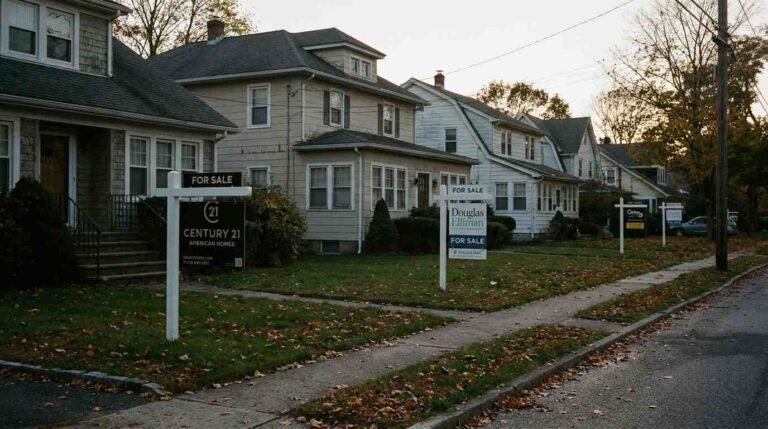
The most instructive way to understand Glen Cove’s architectural palimpsest is to walk a block where multiple layers are visible simultaneously — and there are several in the older residential neighborhoods east of the village center, where the housing stock from the late nineteenth and early twentieth centuries has not been uniformly renovated.
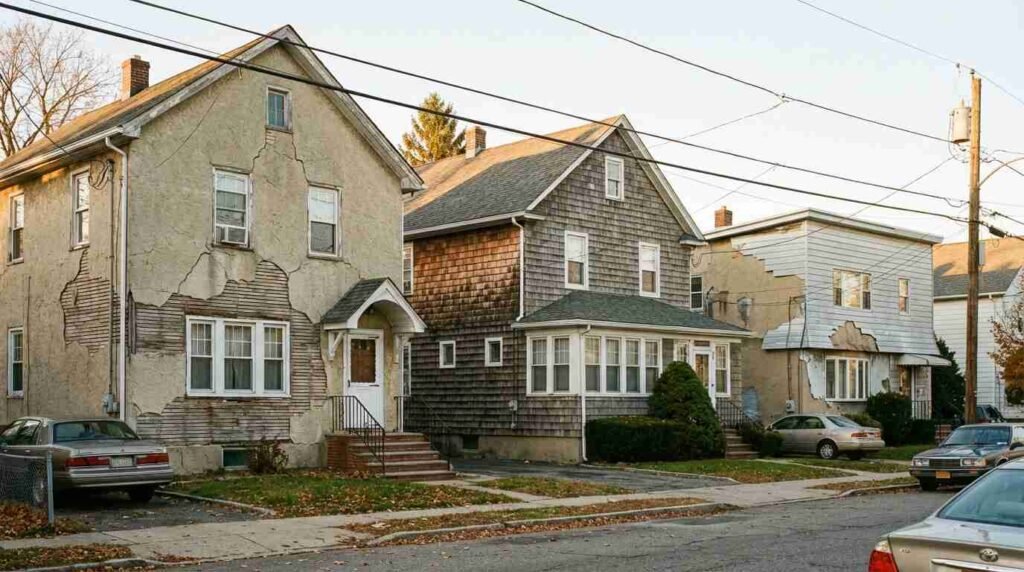
On such a block you will typically find: one house where the original shingle is visible on the rear elevation (less altered than the street facade), with interwar stucco on the front and a porch that was enclosed sometime in the 1960s; adjacent to it, a house where the aluminum has been partially removed to reveal the stucco beneath, in the middle of a restoration that has stopped for reasons of budget or attention; next to that, a house where the aluminum has been replaced with new vinyl siding and the original window openings have been replaced with double-hung insulated units that fit the rough openings but don’t match the original proportions; and somewhere on the block, one house where a serious restoration has been undertaken, the aluminum removed, the stucco repaired, the window sash replaced with appropriate wood profiles, the porch restored to something like its original open configuration.
What you are looking at, on that block, is a century of decisions compressed into a single visual field. Each house represents a different position in the negotiation between what was inherited and what the current owner decided to do with it. The block is not a coherent architectural composition. It is a document of how different families at different moments related to the same basic condition: an old house in a neighborhood where the original intent has been obscured by time and aspiration and maintenance failure and recovery.
Pawli’s Read
Glen Cove is a city — formally incorporated as such in 1918, separating from Oyster Bay — and it has the architectural complexity you would expect from a place that has housed, simultaneously, the most extravagant Gold Coast estates and the working-class neighborhoods that built and maintained them. The Pratt compounds and Winfield Hall and The Braes and Killenworth and the other great properties along the waterfront are the headliners. But the residential streets between the estate perimeters and the harbor are where the architectural record of the entire social system is actually stored.
As a broker who pays close attention to how a building’s history is legible in its construction, I find the Glen Cove palimpsest valuable for a reason that is partly historical and partly practical: it tells you what you are actually buying. A house on one of these streets is not a house in some neutral sense. It is a document with a specific stratigraphy, and that stratigraphy has direct implications for what you will find when you undertake renovation. The stucco you’re planning to paint may be covering clapboard that is in better condition than the stucco. The aluminum siding may be concealing a shingle exterior with intact historic character. Or it may be concealing moisture damage that accumulated before the aluminum went up. The only way to know is to look — and to look with the kind of historically informed attention that these buildings deserve and rarely receive.
For buyers considering Glen Cove, I’d also point to the Gold Coast preservation framework that has shaped the broader North Shore context, and to the restrictive covenant history that has structured which blocks developed in which ways. The palimpsest you’re reading on a Glen Cove residential street is not random. It is the record of specific economic decisions, specific social aspirations, and specific preservation choices made by specific people over a specific century. The house you’re buying is all of that, compressed into a parcel. Knowing how to read it is most of the work.
Real estate markets change. For current listings and market data, contact Pawli at Maison Pawli.
Sources
– City of Glen Cove — History of Glen Cove: https://glencoveny.gov/history-of-glen-cove – Welwyn Preserve / Pratt Estate, The Cultural Landscape Foundation: https://www.tclf.org/welwyn-preserve – Glen Cove City Council — Landmark Preservation Law Amendments (Patch, October 2022): https://patch.com/new-york/glencove/glen-cove-amends-landmark-preservation-laws-protect-gold-coast-past – Webb Institute for Naval Architecture (The Braes) — Glen Cove NY Historic Houses: https://historichouses.wordpress.com/tag/glen-cove-ny/ – Glen Cove Mansion history, Glen Cove Record Pilot: https://glencoverecordpilot.com/a-history-of-the-glen-cove-mansion/ – Preservation Long Island architectural surveys: https://www.preservationlongisland.org/ – New York State Historic Preservation Office (SHPO): https://parks.ny.gov/shpo/