Cutting Linocut in a Language You Don’t Speak: An American in a Vilnius Print Workshop
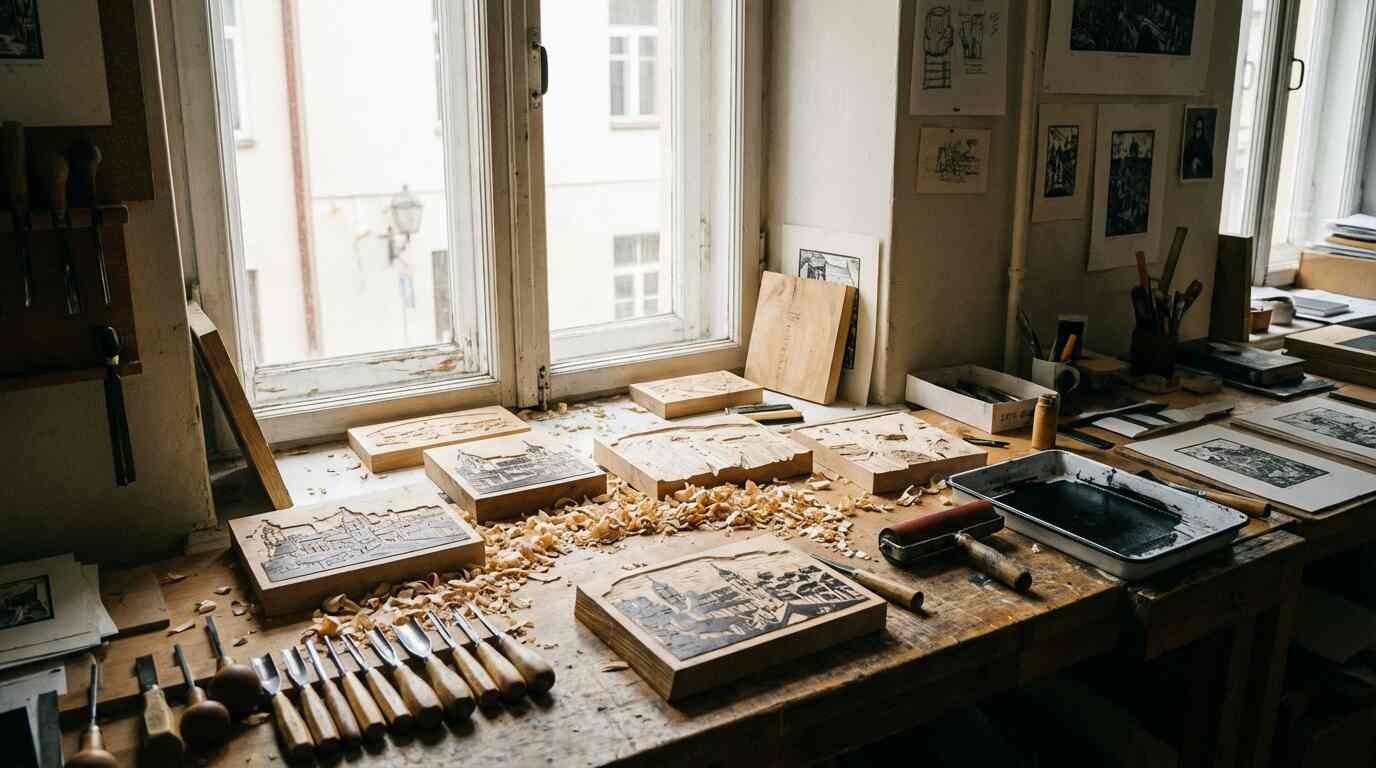
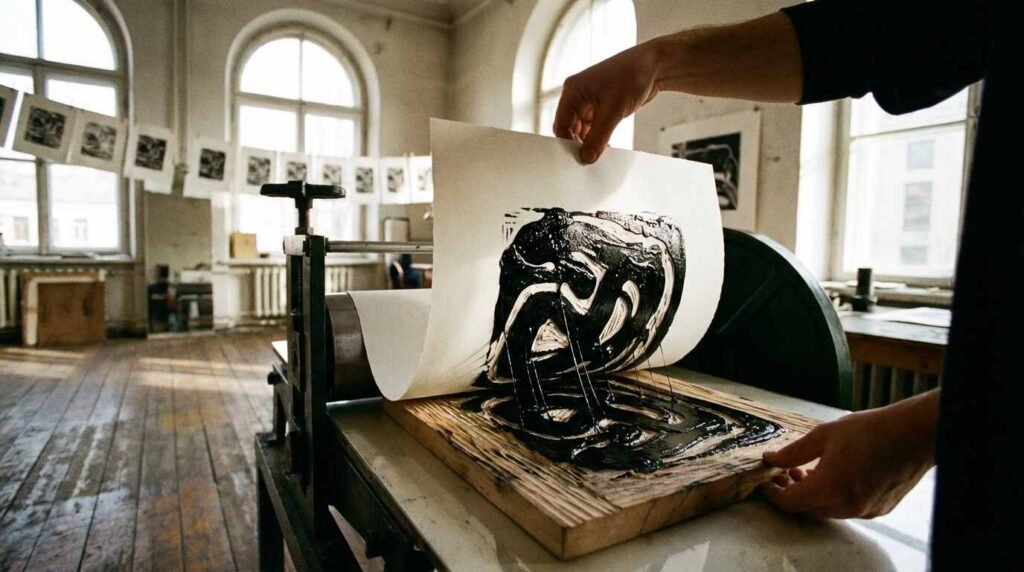
There is a specific kind of attention that arrives when language stops being available as a scaffold. I did not expect it in a print studio in Vilnius, but that is where I found it — standing at a wooden workbench in Piktura Studija, holding a U-gouge I did not know by name in a language I could not speak, watching an instructor demonstrate pressure and angle through the medium of her own hands rather than her words.
The demonstration lasted maybe four minutes. She cut a test block — linden wood, not linoleum, which surprised me — at varying pressures and showed me the results printed on newsprint. Deep cut, wide channel, total removal of material: a line that prints as white space, an absence. Shallow cut, narrow channel, fine control: a line that holds ink at its edges and releases it unevenly, a texture rather than a mark. She handed me the gouge and pointed at the block.
I understood.
What Piktura Studija Is
Piktura Studija has operated as an independent art studio in Vilnius since 2011, offering workshops in relief printmaking, etching, and screen printing. Its workshop schedule is publicly listed; its instructors are working printmakers with affiliations to the Vilnius Academy of Arts, which has maintained an active printmaking department since the Soviet period and has a formally documented tradition in Baltic graphic arts.
Lithuania’s printmaking heritage is not incidental. During the Soviet occupation, the graphic arts — printmaking especially — occupied an unusual position: technically a craft discipline and therefore less politically scrutinized than painting or sculpture, while simultaneously capable of precision, reproducibility, and a visual language dense enough to carry meaning that more explicitly monitored art forms could not. The Vilnius Academy trained printmakers under those conditions, and the rigor of that training — technical precision as a survival strategy — survived the conditions that produced it.
The Physical Logic of the Gouge
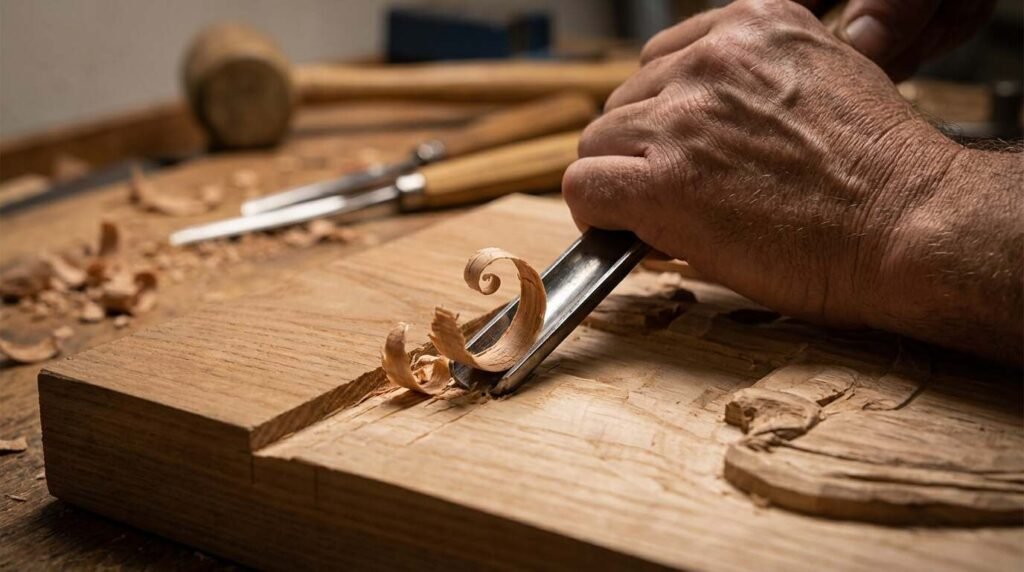
A linocut gouge — or in the case of Piktura Studija, a wood-cutting tool adapted to the softer grain of linden — communicates through resistance. Push too hard and the tool catches; the material tells you immediately that you have asked it for something it will not do. Angle too steeply and the tool digs rather than cuts; the channel opens unevenly and the ink pools at irregular depth. The correct angle — roughly thirty degrees from the material surface, adjusted for grain direction — is not a number you memorize. It is a sensation you find and then maintain.
This is the category of knowledge that does not transfer through language. The instructor could have said “thirty degrees” and it would have meant nothing useful. What she demonstrated was the feel of resistance at the wrong angle versus the absence of resistance at the correct one. The tool slides when it is right. It does not slide when it is not.
I spent the first hour producing unusable blocks. Not from inattention — from the wrong assumption that watching correctly meant I understood what I had watched. The gap between observation and execution in a physical craft is wider than most observers expect, and it does not close through continued observation. It closes through repetition.
By the third hour, the blocks were not good but they were legible. By the second day, I understood what the instructor had demonstrated in four minutes.
What Happens to Process When Language Is Removed
The conventional instruction model in a craft workshop involves verbal scaffolding around physical demonstration: the instructor names the tool, names the technique, explains the principle, demonstrates, and invites questions. Language provides both the conceptual frame and the feedback mechanism.
At Piktura Studija, with an instructor whose English was limited to a small set of procedural words and whose Lithuanian I could not follow at all, the scaffolding was entirely physical. She printed my blocks after each session and pointed at what was working and what was not. She took the gouge from my hand, made three cuts, handed it back. The correction was in the demonstration, not the explanation.
What I noticed over the five days was not frustration — it was heightened attention to everything physical. The sound the gouge makes in material that is resisting versus material that is not. The color difference between a surface that has been cut cleanly and one that has torn. The way the ink distributes on the brayer when it is loaded correctly versus overloaded. Information that would otherwise have been supplied verbally was being supplied by the work itself.
I came away from the workshop with prints I did not expect to be proud of and with a level of observational attention to process that I have not replicated in instruction-heavy settings since.
The Institutional Context That Makes This Possible
The specificity of what Piktura Studija offers — intensive, practitioner-led workshop instruction in a discipline with deep institutional roots — is not accidental. It is the product of an art education tradition in Vilnius that treated printmaking as serious technical practice rather than supplementary craft. The Academy’s printmaking program trained people to work at a level of technical rigor that the instructors at Piktura Studija carry forward into their commercial and workshop practice.
This is what distinguishes a workshop worth traveling for from one worth skipping. The physical knowledge the instructor holds was transmitted to her by someone who held it before her, in a chain of practice that gives the technique its authority. Language is not that chain. The chain is the work.
You Might Also Like
- Riven or Sawn: The Chestnut Question in the Fire Island Life-Saving Stations
- Tonnage and Tenon: The Shipwright Crossover in Port Jefferson’s Furniture Trade
- The Quiet Power of Undyed Textiles