The Island That Reinvented Itself: How the Azores Became Europe’s Quietest Luxury Escape
Somewhere between Lisbon and New York, a chain of volcanic islands has been quietly perfecting the art of disappearing — and the travelers who have found it are not in a hurry to share.
The Azores sit roughly in the middle of the Atlantic, nine islands scattered across a seam where three tectonic plates meet. The geology is always making itself felt: the ground steams in Furnas, the calderas hold lakes of impossible color, and the ocean here has a density to it, a cold-water clarity that reminds you this is not the Mediterranean performing for anyone. These islands have never had to try. That may be why they are, at last, being found.
São Miguel: Where the Earth is Still Working
The first thing you notice landing at Ponta Delgada is that the airport is too small for the landscape it serves. You descend through cloud, the island appears suddenly — intensely green, ridged with volcanic hills — and then you are on the ground in a place that still has the proportions of somewhere people actually live, rather than somewhere engineered for arrival.
São Miguel is the largest of the nine islands and the one most travelers encounter first, though “most travelers” is a relative phrase. The Azores received roughly two million visitors in recent years — a number that sounds significant until you realize it represents roughly a weekend at any major European beach resort. The infrastructure has grown, but the islands have not yet reorganized themselves around the tourist. You feel this immediately.
Furnas is the island’s thermal heart, a village built inside a volcanic caldera where the ground exhales constantly. The hot springs here have been documented since at least the 17th century, when they were described by visiting Jesuits with a mixture of astonishment and theological unease. In 2018, Furnas Boutique Hotel opened directly above active hot springs — the geology is not backdrop here but infrastructure, the source of the pools, the radiant warmth of the floors, the mineral-edged quality of the water that arrives in your room. The hotel is small, specific, and entirely unlike anywhere else in Europe. It could only exist here.
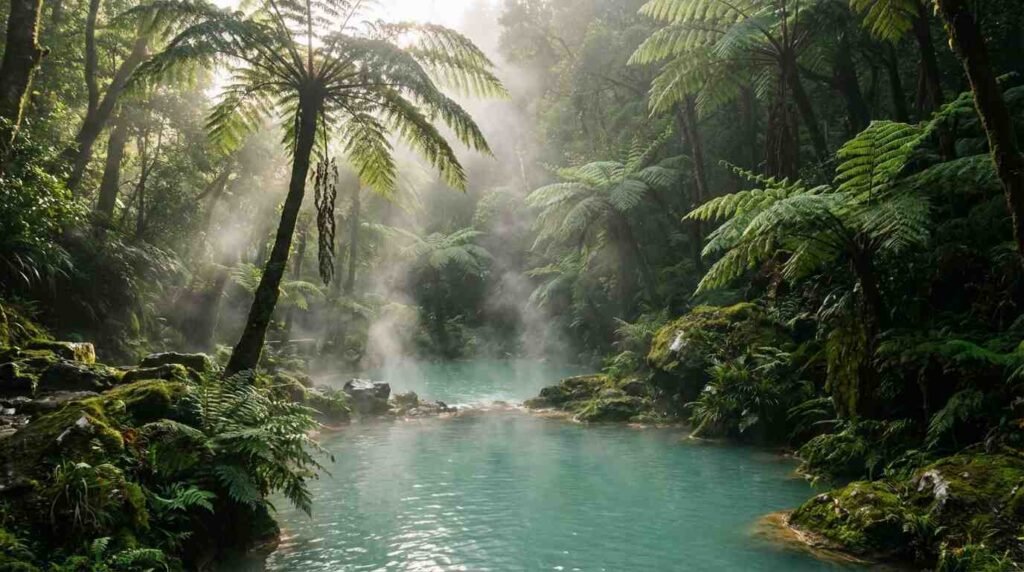
The thermal pools at Caldeira Velha, set in fern-lined forest above Furnas, are the ones worth getting to before ten in the morning. The water enters at 38 degrees, the air temperature hovers just above cool, and the combination produces something that is not quite swimming and not quite bathing but something older than either. Around you, tree ferns — a species that has been on this island for millions of years — form a green vault. You stay longer than you intended.
Lunch in Furnas means cozido das Furnas: a slow stew of beef, blood sausage, chouriço, and vegetables, lowered into the volcanic earth at seven in the morning and retrieved at noon. Restaurants cluster near the geothermal vents and do not compete with each other because they do not need to. The stew is the same everywhere and everywhere it is correct.
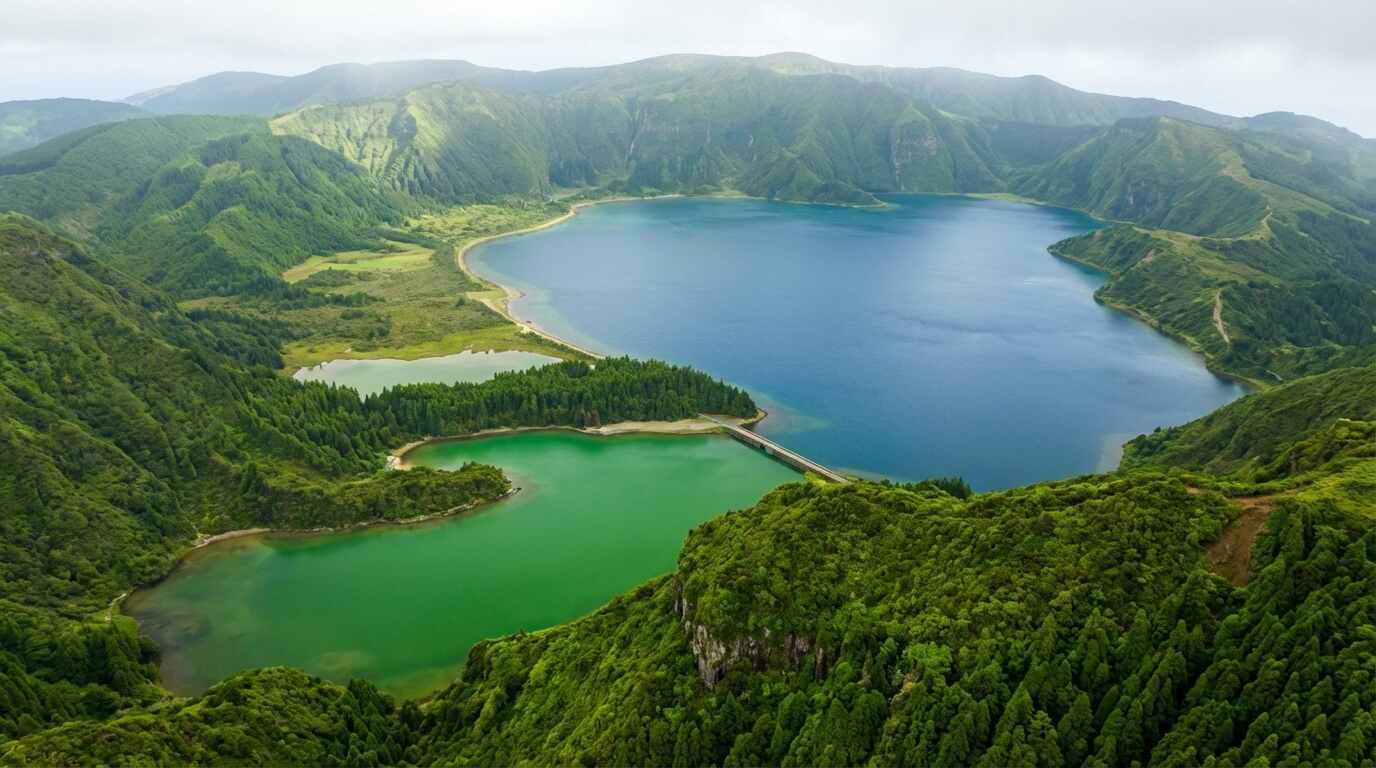
The island’s interior — the Sete Cidades caldera, the Lagoa do Fogo, the road from Furnas east toward the coast — moves through landscapes that have the quality of places not yet named. The World Travel Awards has designated the Azores as Europe’s Leading Adventure Tourism Destination multiple times running, a title the islands accept without particular excitement. The surfers have found the western coasts. The whale-watching industry, which made more ecological sense here than almost anywhere else on earth given the depth and food richness of the surrounding Atlantic, has been operating for decades. The canyoning, the hiking, the diving — all of it exists, and none of it has yet colonized the place.
Faial: The Blue Island
The crossing from São Miguel to Faial takes forty minutes by air or, if you choose the ferry in summer, considerably longer and considerably better. Faial is sometimes called the Blue Island for the hydrangeas that line every road and divide every field in July and August — a monoculture of the most improbable color, banks of cobalt and violet that make the green hills look like something designed rather than grown.
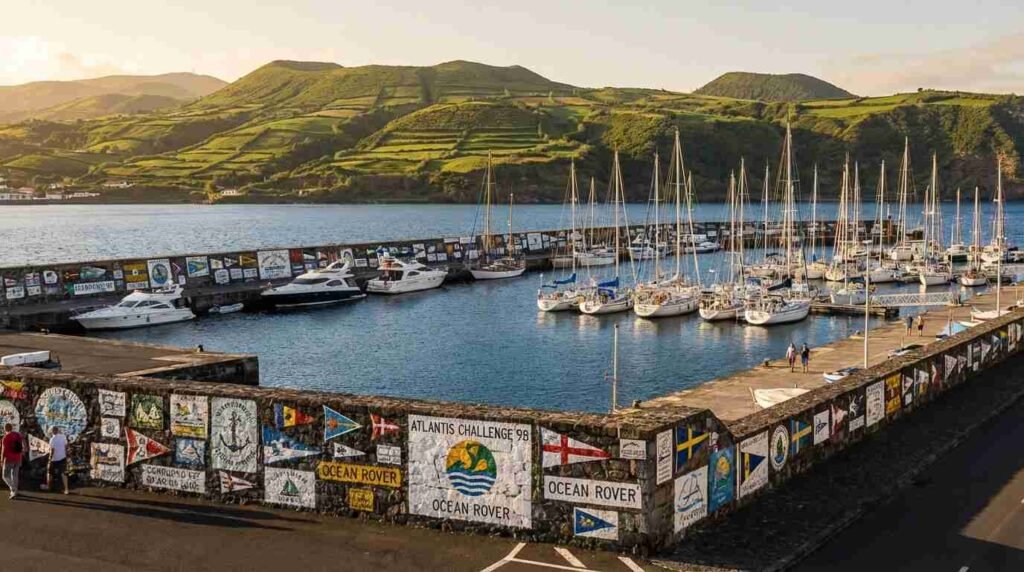
Horta, the island’s main town, is organized around the marina, which has been a waypoint for transatlantic sailors since the first wooden-hulled vessels crossed. The tradition of painting your boat’s insignia on the harbor walls goes back decades — the walls are now an archive of crossings, fading layers of paint that represent, if you follow them long enough, something close to a history of human willingness to be alone on the water. Peter’s Café Sport, open since 1918, is where they all eventually end up for a gin and to look at the same view their predecessors looked at. It is one of those rare places that has earned its own mythology without trying to.
The caldera of Capelinhos, on Faial’s western tip, is what formed in 1957 when a submarine eruption broke the surface and spent thirteen months adding land to the island. The new ground is lunar — ash grey, scrubby with pioneer plants, the lighthouse that was swallowed to its windows still partially visible. The Capelinhos Interpretation Center, embedded in the hillside, documents the eruption with footage and photographs that convey the specific quality of astonishment people felt watching new earth appear from the water. The island’s population fell significantly as a result of the eruption; many emigrated to the United States, particularly to New Bedford and Providence, which is why a Portuguese-American community of Azorean descent exists in Massachusetts in the specific form it does.
The UNESCO Biosphere Reserve designation for Graciosa Island, neighboring Faial in the central group, speaks to what has been protected across these archipelagos: the endemic species, the cloud forest, the seabird colonies that use these islands as Atlantic staging points. On Faial itself, the walk from Porto Pim beach around the headland to the whaling station museum takes an hour and passes through coastal scrub that smells of salt and wild fennel and something older than either.
What the Silence Costs
The question most often asked about the Azores, by people who have been and people who are considering it, is some version of: how long will this last? The islands have grown visitor infrastructure — the boutique hotels, the adventure operators, the restaurants in Ponta Delgada that would hold their own in Lisbon — without yet losing the fundamental quality that makes them worth reaching: the sense that the landscape is not performing.
The Visit Azores tourism authority has been deliberate about this, promoting the islands as a slow destination rather than a volume one. Whether that holds as the flights multiply and the word continues to spread is a question without a comfortable answer. For now, the answer is: arrive on a Tuesday in October. Rent a car with no plan. Drive toward the steam.
There are places that make me think about what I look for in a home — not square footage, not finishes, but the quality of the light and whether the landscape actually requires your attention. The Azores does this. It asks you to be present in a way that most places have stopped bothering to demand. That’s the rarest amenity there is.
Sources
– World Travel Awards, Europe’s Leading Adventure Tourism Destination designation: worldtravelawards.com – Furnas Boutique Hotel: furnashotel.com – Visit Azores tourism authority: visitazores.com – UNESCO Biosphere Reserve, Graciosa Island: whc.unesco.org