Why a Long Island House Creaks More Once the Heat Comes On
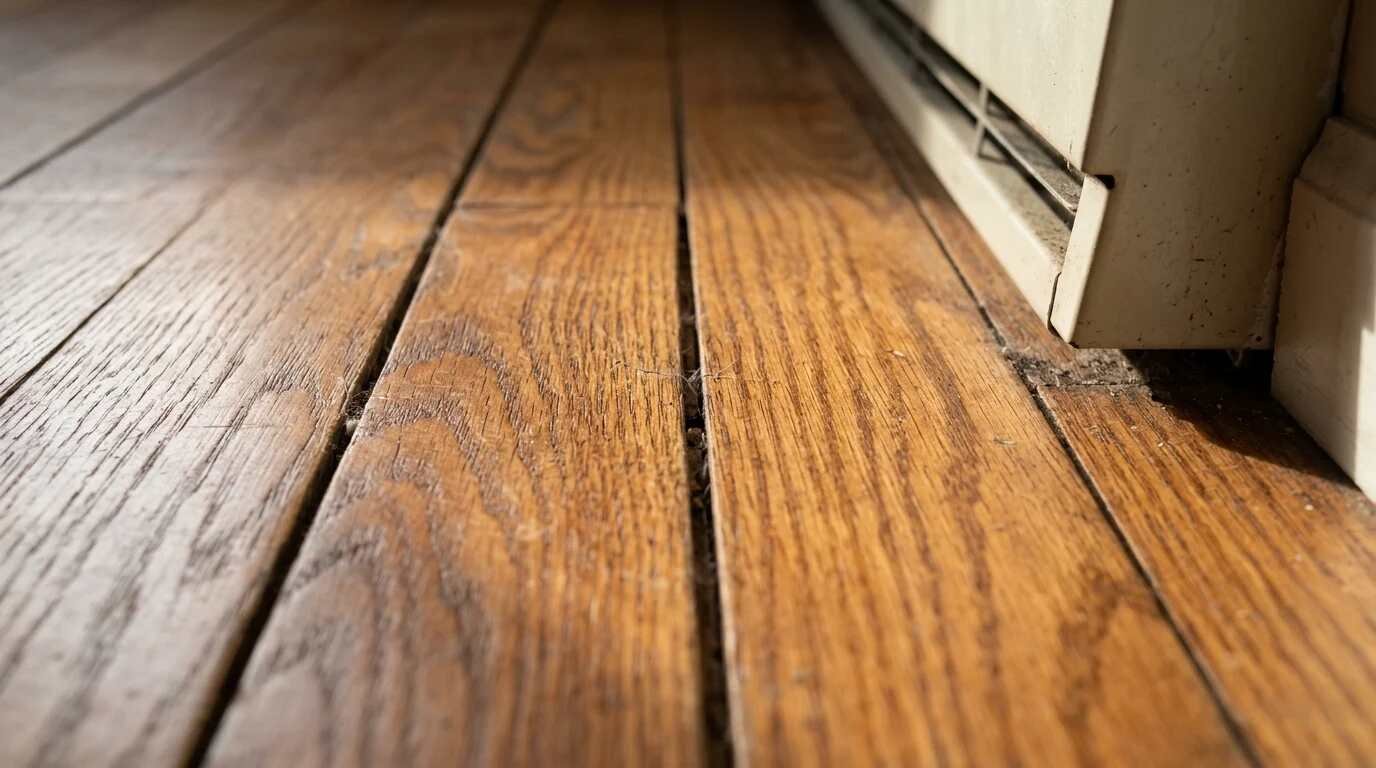
Somewhere in the first cold week after the furnace comes on for the season, an oak floor that was silent all summer starts to answer back. A board near the kitchen doorway clicks underfoot. The stair tread that never made a sound begins to groan on the way down in the morning. Nothing about the house has broken. The air inside it has dried out, the wood has given up some of its water, and a floor that was built tight in August is, by December, measurably smaller than it was.
The Air Changes First
Warming cold winter air drops its relative humidity sharply
Winter air holds little moisture, and when it leaks into a house and warms up, its relative humidity falls. Craig DeWitt, writing for Wood Floor Business, offers an example: air at 30 degrees Fahrenheit and 50 percent relative humidity, warmed to 70 degrees, will be at 10 percent. A heated house in a cold month runs drier than the same house in July.
The National Wood Flooring Association’s homeowner guidance describes the cycle. When heating systems are in use, it notes, wood floors will shrink, which will result in gaps between floor boards, and in humid summer months they swell again. The association describes this as a normal reaction of wood floors from season to season, and recommends keeping a home between 60 and 80 degrees and 30 to 50 percent relative humidity to limit it.
Long Island shares that climate pattern of humid summers and drier winters. Doug Horgan, writing in the Journal of Light Construction about the middle of the eastern United States, notes that in these conditions, it’s normal to have gaps in wood floors in winter.
How Much Water the Wood Gives Up
Moisture content tracks humidity, and the swing from summer to winter is several points
Wood never stops trading moisture with the air around it, and the level it settles at, called the equilibrium moisture content, depends mostly on relative humidity. Purdue University’s extension guide on stored lumber lists the values at 70 degrees: wood comes to about 6.2 percent moisture content at 30 percent relative humidity, 9.2 percent at 50 percent and 11.0 percent at 60 percent. The same guide notes that in winter, indoor humidity can drop to 20 percent or less, and that at 70 degrees the wood then settles at about 4.5 percent.
A floor that spends August in a house at 60 percent humidity and January in the same house at 20 percent swings from about 11 percent moisture content to about 4.5, a drop of six and a half percentage points. The Forest Products Laboratory puts a number on what each of those points does to a board.
The Arithmetic of a Shrinking Floor
One red oak strip, then a whole 12-foot room
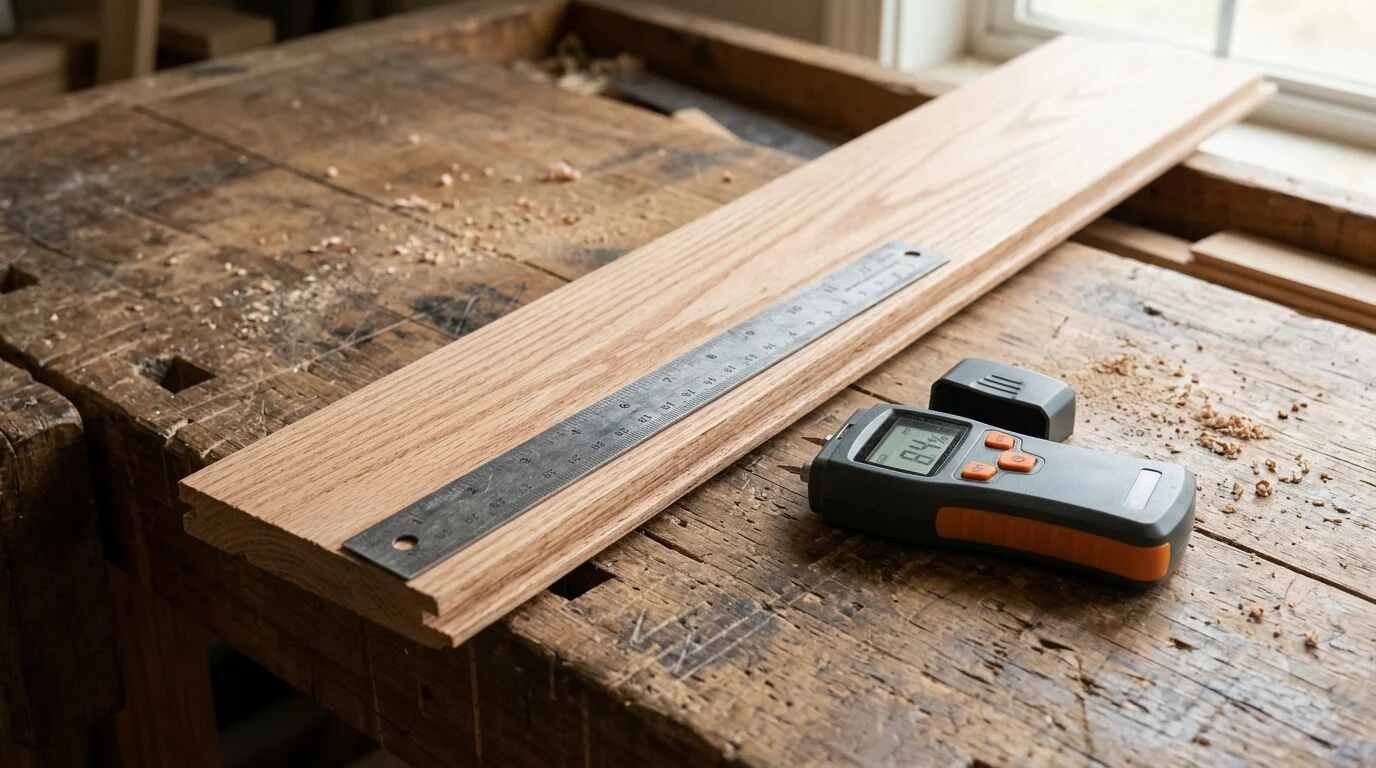
That number is the dimensional change coefficient, a published value for how much a board’s width changes with each percentage point of moisture, listed separately for each species. For flat-sawn red oak, the coefficient in the 2021 Wood Handbook is 0.00369, according to Samuel V. Glass and Alex C. Wiedenhoeft, writing in Wood Floor Business. Hardwood Floors magazine lays out the calculation flooring installers use: the change in moisture content times the coefficient times the width of the board. The magazine’s own worked example, a 5-inch red oak board losing three points of moisture, comes out to about .055 inch.
For a standard 2¼-inch red oak strip:
- Summer at 60 percent humidity to winter at 20 percent (11.0 to 4.5 percent moisture content): each strip narrows by about 0.054 inch, a little over 3/64 inch
- Humidity held between 50 and 30 percent (9.2 to 6.2 percent): each strip narrows by about 0.025 inch, under 1/32 inch
- Summer at 60 percent to winter at 30 percent (11.0 to 6.2 percent): about 0.040 inch per strip
A 12-foot room holds about 64 of those strips side by side. In the widest swing, the floor as a whole gives up about 3.45 inches of width between August and January. Held to the 30-to-50 range, the same floor gives up about 1.6 inches. A 5-inch plank in the widest swing narrows by about 0.12 inch, more than twice the strip’s movement, which is part of why wide-plank floors show bigger winter gaps.
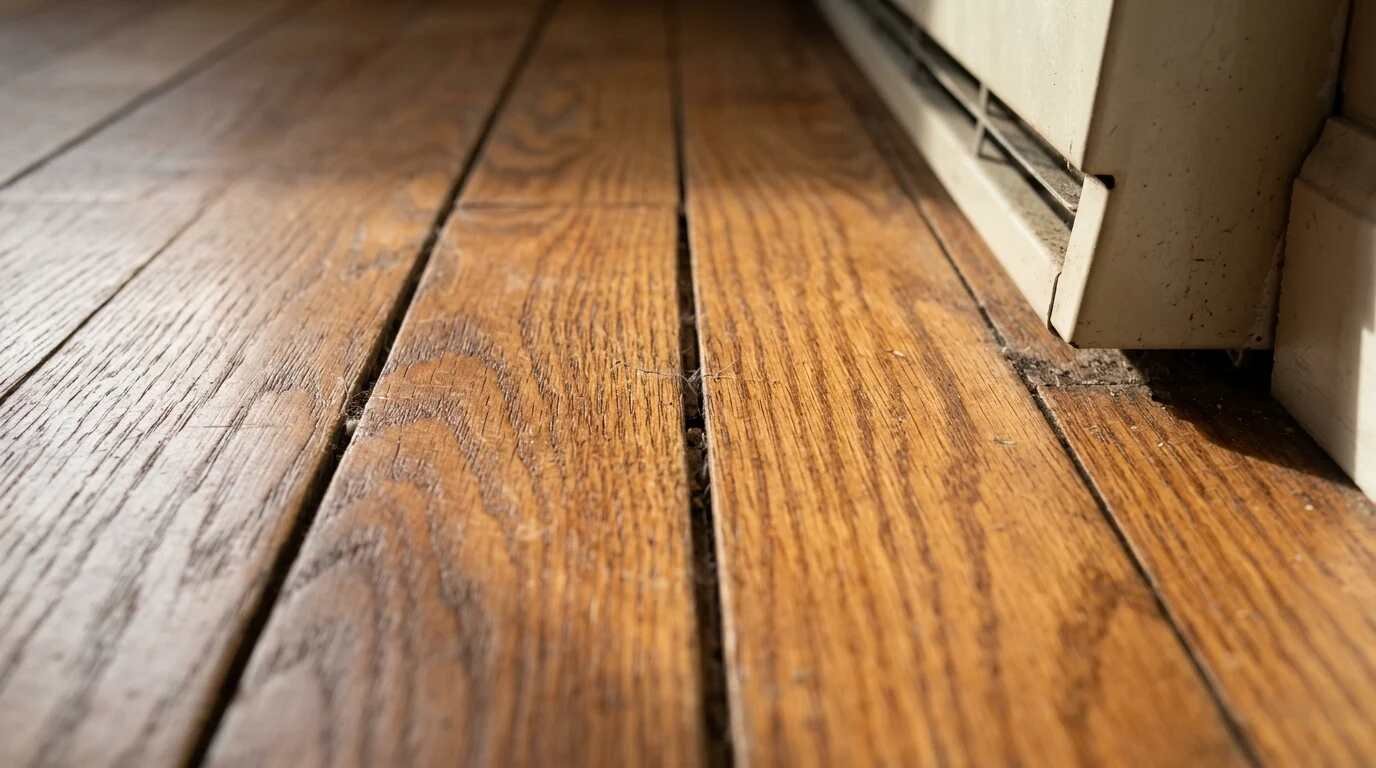
The movement spreads unevenly across the room: some joints stay tight, others open into the dark lines that appear between boards in December and close again by June.
Where the Sound Comes From
Gaps, loosened fasteners and wood rubbing on wood
The creaks come from the same shrinkage happening where it can’t be seen. Jason Shumaker, a product support engineer at Weyerhaeuser, explains that a floor system is joists, a subfloor, nails or screws and the finish flooring, and that squeaks are more prevalent in winter because drier conditions inside a house cause materials like wood to contract, which can create movement between those components. He adds that the same drier conditions explain why trim gaps and nail pops show up more often in winter.
Shumaker describes the squeak itself as one floor component rubbing against another as the floor is walked on: a board against a nail, a subfloor panel against a joist, one strip against the next. That is the click by the kitchen door.
The Humidity Fix, and Its Limits
Thirty to fifty percent is the range most guidance names
The most direct remedy is to put water back in the air. The NWFA’s 30-to-50-percent range is the one most often cited for wood floors, and DeWitt notes that the right working range varies by region, from 40 to 60 percent in the Southeast to 30 to 50 percent up north and 20 to 40 percent out west, as long as the range is not too wide. Horgan describes a house where indoor humidity ran around 20 to 30 percent before a broken humidifier was repaired and climbed to 40 to 50 percent once it was running again.
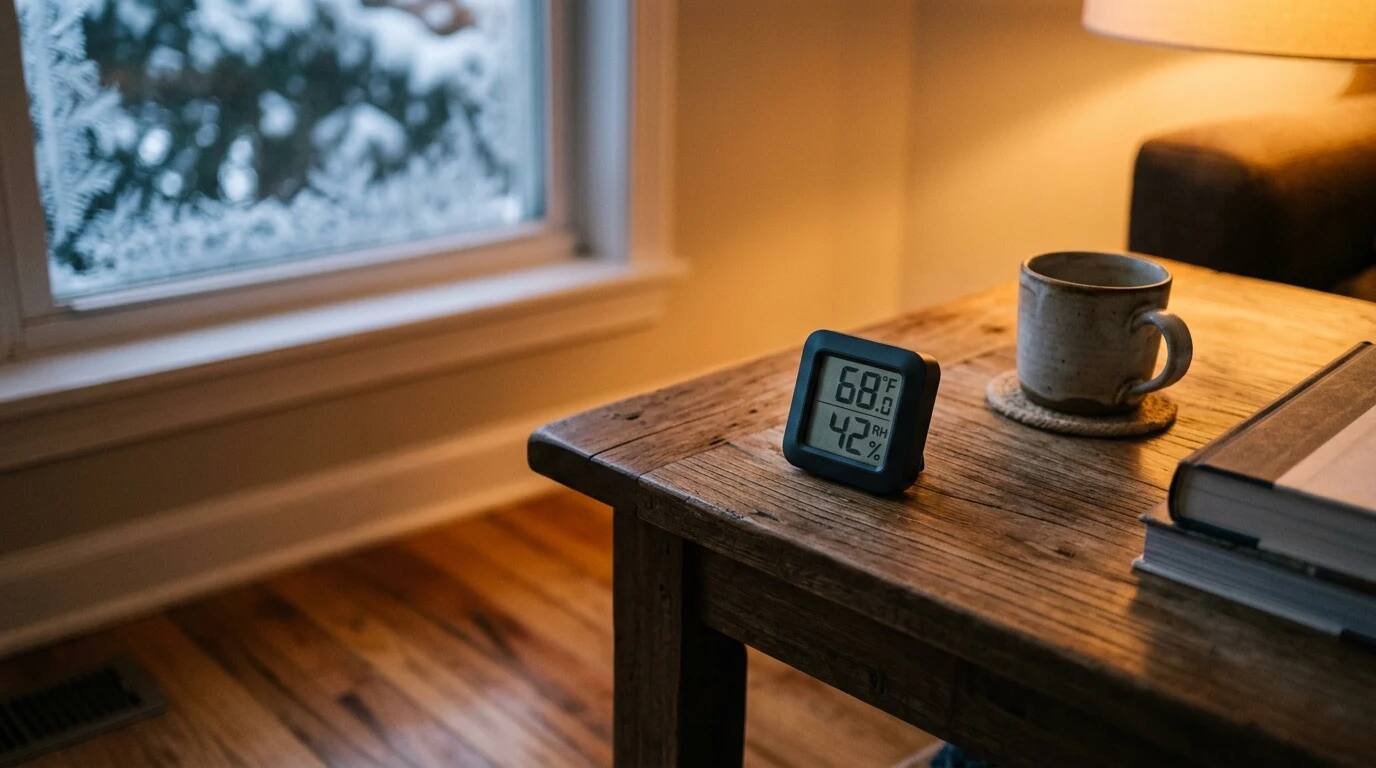
The right setting for a given house depends on its windows, insulation and ventilation, and a flooring professional can advise on a target. A hygrometer shows where the house actually sits.
Timing matters as much as humidity. Horgan reports that the NWFA recommends judging gaps only at the end of the humid season, when floors should be tight, because a gap in January is expected, while gaps that remain in late September or October point to a moisture-control problem. For buyers touring houses in the winter months, the same logic applies in reverse: modest gaps between oak boards in a December showing are a seasonal condition, and the floor’s real fit shows in late summer. The earlier Maison Pawli piece on buying a home in the off-season covers other things the cold months reveal, and the winterizing checklist covers the rest of the house.
Listening to the House
When a creak is seasonal and when it isn’t
Heat brings the creaks on, and spring humidity quiets them. A creak that persists into summer, a gap that never closes, or a board that feels soft underfoot is a different matter, and worth a flooring professional’s or home inspector’s look before the next heating season.
You Might Also Like
- Ice Dams on Long Island Roofs: Prevention Before the Snow
- Basement Mold: Testing, Cleanup, and When to Call a Pro
- Walking a Home Inspection: What to Watch and What to Ask
Sources
- Wood Floor Business (Craig DeWitt): How to Prevent Wood Floor Gaps in Winter
- National Wood Flooring Association: Care and Maintenance
- Journal of Light Construction (Doug Horgan): Avoiding Wood Flooring Gaps
- Purdue University Extension (Daniel L. Cassens): Controlling Moisture Content in Stored Lumber, FNR-403-W
- Wood Floor Business (Glass and Wiedenhoeft): A Peek Behind the Dimensional Change Coefficient Curtain
- Hardwood Floors magazine: Quick Tips, Determining Dimensional Stability in Wood
- Weyerhaeuser (Jason Shumaker, P.E.): Remedying Winter Floor Squeaks
This article is for general informational purposes only. Shrinkage figures are estimates calculated from published coefficients and equilibrium moisture values; actual movement depends on species, grain, installation and the conditions in a specific house. Consult a flooring professional or home inspector about a specific floor.