
The Refrigerator Is the Wrong Wall to Start On
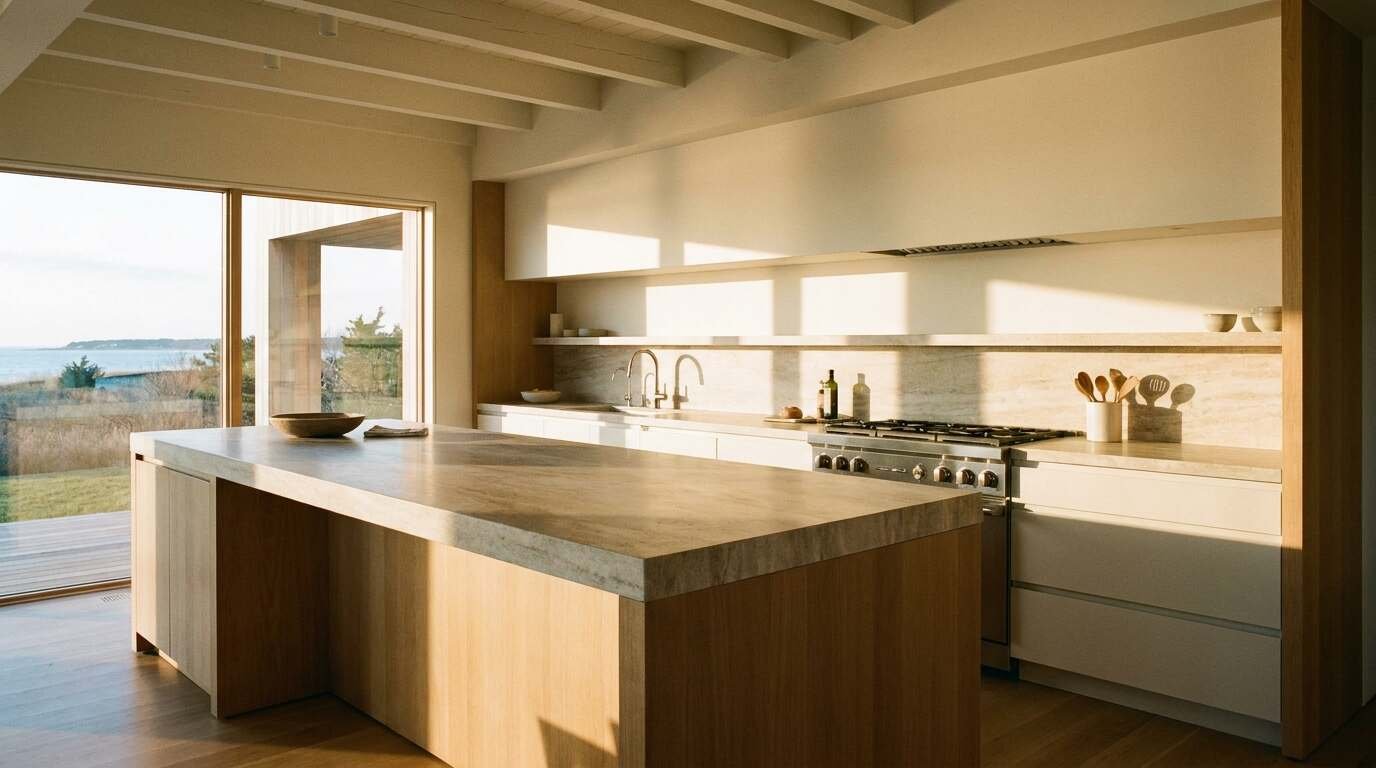
Most Long Island kitchen renovations begin with appliance placement and work backward. That’s the mistake that produces kitchens that photograph well and cook poorly.
The process usually goes like this: the refrigerator goes on the wall with the most clearance, the range goes near the gas line, and the sink lands wherever the plumbing is easiest to reach. The triangle connecting those three points gets measured, declared reasonable, and the project moves forward. The countertops fill in whatever space is left.
The result, in thousands of renovated colonials and expanded ranches across Nassau and Suffolk counties, is a kitchen that satisfies an eighty-year-old rubric while failing the people who cook in it.
Where the Work Triangle Came From
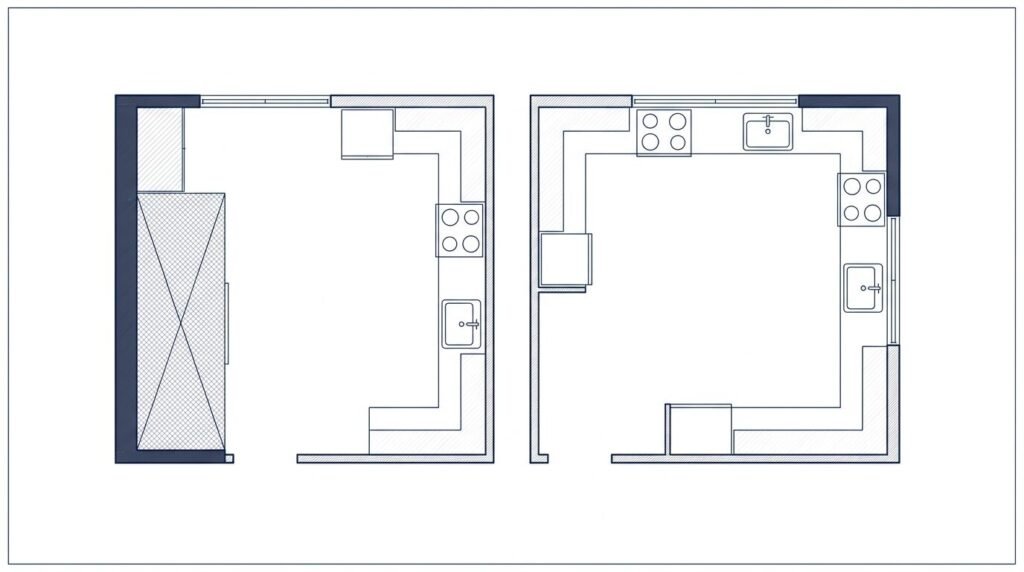
The kitchen work triangle was formalized in the 1940s by researchers at the University of Illinois’s Small Homes Council — a design heuristic for routing a single cook between three appliances in a compact galley. The principle was sound for its context: postwar America, small kitchens, one cook, three primary appliances. The triangle was never intended as the organizing logic for open-plan, multi-cook, island-centered kitchens. It was invented before those kitchens existed.
Professional kitchen design communities have been questioning the triangle’s dominance for years. Many kitchen designers now argue that the triangle, while a useful basic principle, doesn’t have to be followed rigidly — and that today’s kitchens function very differently from those of 50 years ago. The shift away from single-cook galley kitchens toward open, social cooking spaces means that the original constraints the triangle was designed to solve simply don’t apply the same way.
What the model never accounted for: a second cook who needs counter access. A prep zone that isn’t adjacent to either the sink or the range. An island that becomes the primary workspace regardless of where the triangle points. A refrigerator that gets opened once at the start of cooking — not repeatedly during it.
The Refrigerator Problem
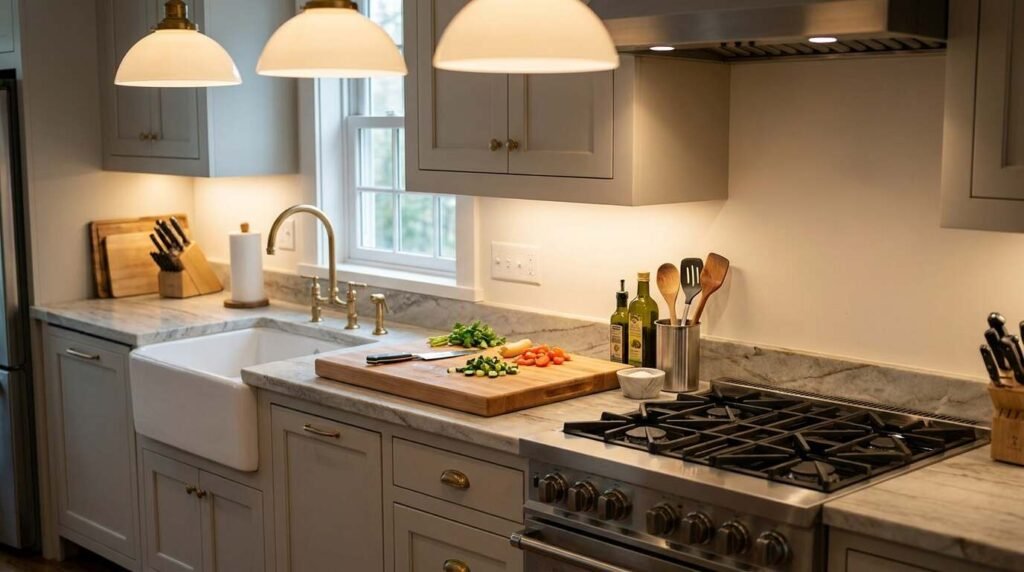
Here’s the thing the triangle obscures: the refrigerator is the least-used appliance during active cooking.
Think through a typical meal preparation sequence. Ingredients come out of the refrigerator once, at the start. After that, the cook moves between the prep surface, the sink, and the range — repeatedly, sometimes dozens of times — without touching the refrigerator again until cleanup. Treating the refrigerator as one of three equal anchors of kitchen workflow inflates its functional importance during the part of cooking that actually matters.
One kitchen design guide puts it plainly: “The fridge is the most flexible of the three activity centres in the work triangle. You may choose to move it out of the optimum triangle, since many cooks prefer to take all the ingredients out of cold storage at one time, before they start cooking.” When the refrigerator moves out of the triangle — to a wall slightly removed from the active cooking zone, or at the edge of an island — it stops interrupting the lines of work that actually govern how the kitchen functions.
Buyers evaluating renovated kitchens should notice this. A beautiful refrigerator flanked by custom cabinetry, centered on a focal wall opposite the range, looks intentional. It may also be siphoning prep counter space from the zones that need it most.
Counter Run Continuity Is the Real Metric
What experienced cooks actually notice — what determines whether a kitchen works — is uninterrupted counter run. The stretch of surface between the sink and the range. The landing space on either side of the cooktop. The prep zone that isn’t interrupted by a door swing, a wine rack, or a decorative column introduced by a builder who was designing for the listing photos.
Modern kitchen design increasingly focuses on zones rather than the traditional triangle: a prep zone centered around the primary worktop between the cooker and sink, a cooking zone built around the range with storage for pots and pans nearby, and a cleaning zone around the sink and dishwasher. This zone logic is more honest about how cooking actually unfolds — and it puts the counter at the center of the analysis, not the appliance.
In Long Island’s open-plan renovations, where walls have been removed to connect kitchen and living space, this matters more than it used to. The island becomes the prep surface, the conversation zone, and the homework space simultaneously. How much usable counter runs uninterrupted from the sink to the cooktop — without being broken by a drawer bank, a column, or an under-counter wine fridge positioned more for aesthetics than function — is the question worth asking.
What Buyers Should Actually Look For
When walking through a renovated kitchen on the North Shore, the appliance specs on the listing sheet are the least important thing to evaluate. Induction range brand and refrigerator cubic footage are recoverable decisions. Counter continuity is structural.
Walk the cooking sequence. Stand at the sink and note where the prep surface is. Put your hands where a cutting board would go. Look at where ingredients would land coming off the stovetop. Count the steps between those points — and notice whether any of them require you to navigate around a refrigerator that was placed on the most photogenic wall rather than the most functional one.
Related: The $40,000 Mistake: Why Long Island Fixer-Upper Buyers Keep Gutting Kitchens They Should Have Kept examines the renovation decisions that look right during a showing and prove costly afterward. For buyers thinking about how renovation scope affects purchase strategy, The Gut Rehab Math: Which North Shore Fixer-Uppers Actually Pencil Out lays out the numbers.
—-
You Might Also Like
- Why Your 1960s Ranch Renovation Is Fighting the Soil — The Glacial Till Problem Hiding Under North Shore Slabs
- The Return of Aged Brass: Why Designers Are Ditching Chrome for Something Warmer
- Wabi-Sabi in the Kitchen: The Case for Ceramics That Show Every Scar
—-
Sources
- Kitchen Idea Solutions. “Designing a Kitchen Layout.” https://kitchenideasolutions.wordpress.com/2012/10/29/designing-a-kitchen-layout/
- Kitchen Installation UK. “Step-by-Step Guide to Planning Your Kitchen Layout.” https://kitcheninstallationuk.wordpress.com/2025/09/03/step-by-step-guide-to-planning-your-kitchen-layout/
—-