Selling This Fall After the September Nor’easter, With Mortgage Rates Above 7%

# Selling This Fall After the September Nor’easter, With Mortgage Rates Above 7%
Somewhere between the last week of September and the first week of October, two things landed on North Shore sellers at once: a storm that left fallen limbs, wet basements and damaged utility poles across Long Island, and a rate report showing the 30-year mortgage climbing past 7%. Neither is a reason to pull a listing. Both are reasons to prepare it differently than a house would have been prepared a month ago.
What the Storm Left Behind
The early-season nor’easter arrived with a long stretch of wind and rain. According to Cotality’s hazard report on the storm, the National Weather Service office in Upton measured 5.33 inches of rain, recorded a hurricane-force gust on eastern Long Island, and noted that falling trees damaged homes and utility poles on the Island. The National Weather Service’s New York briefing pointed to the root of the problem in a single phrase: “Long duration wind and rain under full foliage”. Trees still carrying their leaves catch far more wind, and saturated soil lets roots give way.
Governor Kathy Hochul’s September 26 briefing put the emphasis elsewhere. She said “our biggest concern is coastal flooding” and named Atlantic Beach, Freeport and Lindenhurst, along with northern Nassau communities on the Sound.
For homeowners dealing with claims and repairs, the separate homeowner timeline for the September nor’easter covers the sequence of steps. This piece addresses the other question: what a house needs before it goes on the market.
Rates Moved the Wrong Way in September
Freddie Mac’s weekly survey tracked the 30-year fixed rate from 6.71% on September 3 to 7.28% on October 1. A year earlier, the same survey stood at 6.34%, according to Trading Economics. The September 3 figure comes from Freddie Mac’s own release.

| Week of | 30-year fixed (Freddie Mac) |
|---|---|
| September 3 | 6.71% |
| September 10 | 6.76% |
| September 17 | 6.95% |
| September 24 | 7.03% |
| October 1 | 7.28% |
The survey reflects conforming loans with 20% down and excellent credit, so individual quotes vary. The October 8 reading was not available at the time of writing and should be checked before relying on this table.
The practical effect shows up in the monthly payment. On a $700,000 loan at a 30-year fixed term, principal and interest come to roughly $4,351 at 6.34% and $4,789 at 7.28%, a difference of about $438 a month. That figure is illustrative arithmetic using national averages, not a loan quote, and it leaves out taxes and insurance.
A buyer carrying that extra $438 will be sharper about condition. A listing that reads as finished, dry and documented gives that buyer less to negotiate against.
A Post-Storm Walkthrough Before Photos
A house that came through the storm untouched still benefits from a methodical walk-through. One that took damage needs the work documented before it is repaired.
Trees and limbs. Hanging branches, split trunks and leaning trees over the roof, driveway or neighboring property deserve a licensed arborist’s assessment. Buyers’ inspectors notice a tree that looks unstable.
Roof and flashing. Missing shingles, lifted flashing and fresh granule loss in the gutters are easy to spot from the ground with binoculars. A roofer’s written assessment, even when the finding is “no damage,” is a useful addition to the listing file.
Gutters and downspouts. Fall leaves and storm debris clog gutters at exactly the moment when buyers walk the property in wet weather. Downspouts should discharge several feet from the foundation.
Grading and drainage. Pooled water near the foundation, washed-out mulch beds and settled soil next to the house all signal drainage problems. Regrading or extending downspouts costs far less than a buyer’s price reduction.
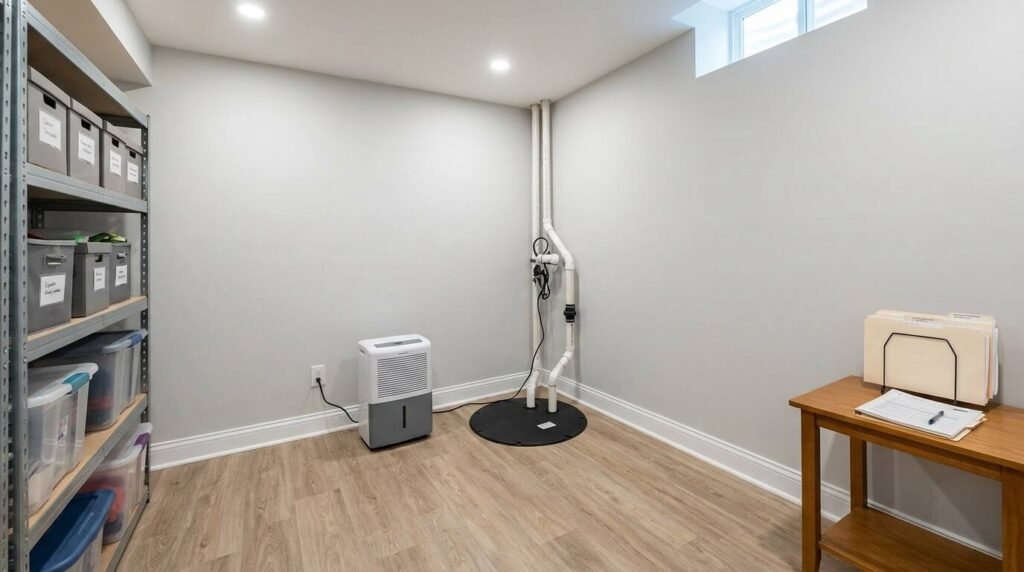
Basement and crawl space. A musty smell, a dehumidifier running in the corner or a visible tide line on the wall tells a buyer’s inspector where to look. Dry, ventilated, clearly labeled mechanical areas read well. The guide to buried oil tanks and what Long Island sellers should know is a reminder that what sits below grade draws attention too.
Paper trail. Photographs with dates, contractor invoices, insurance correspondence and inspection reports belong in one folder. A pre-listing inspection can turn open-ended worry into a defined list.
Fall Curb Appeal That Costs Little
Staging in October rewards restraint. RE/MAX’s seasonal staging suggestions include potted mums, pumpkins, a refreshed welcome mat, a wreath and a reed diffuser inside the entry. Each is inexpensive, and together they signal a home that has been looked after. After a storm, the same logic applies to cleared walkways, raked lawns, pressure-washed steps and working exterior lighting, since daylight ends earlier now.
The Disclosure Form Carries More Weight Now
Since March 20, 2024, New York sellers have been required to complete the Property Condition Disclosure Statement rather than pay a credit to skip it. Stewart Title’s overview describes the form, and the Mann Report covers the flood-related additions. The Natural Resources Defense Council has also written about the change.
Before the change, a Columbia Law School climate blog observed that “Eight out of ten sellers have used this provision” to avoid disclosure by paying the fee. That option is gone. A summary from Legal Survival notes that a revised statement is required if an earlier one becomes materially inaccurate, which matters for any seller who completed the form before the storm. How the storm affects a particular statement is a question for a real estate attorney.
Related reading: open house disclosure requirements for New York sellers and flood insurance and FEMA maps on the Sound.
Timing: Fall Against Spring
Listing now means fewer competing homes and buyers who are shopping with a deadline, but also shorter days and a rate environment that has tightened. The comparison of spring against October listings on Long Island lays out the trade-offs. The storm adds one more variable: a house that has already been dried out, inspected and photographed in good light has an advantage over one that is still waiting on repairs.

Frequently Asked Questions
Does a storm have to be mentioned to buyers?
The Property Condition Disclosure Statement asks about flooding and other conditions, and a revised statement is required when an earlier one becomes materially inaccurate. Specific questions belong with a licensed attorney.
Is fall a poor time to list on the North Shore?
Seasonality cuts both ways. Fewer listings can mean less competition, while higher rates can shrink the buyer pool. Pricing and condition matter more than the calendar.
Should repairs be made before listing?
Safety items, active leaks and anything an inspector will flag as a defect usually come first. A pre-listing inspection helps rank the rest.
Do higher rates mean prices will fall?
Rates affect affordability, and the effect on prices varies by neighborhood and price point. This is a market observation, not a forecast.
This is for informational purposes only — consult a licensed attorney or financial advisor for your specific situation.
Real estate markets change. For current listings and market data, contact Maison Pawli at maisonpawli.com/about/.
You Might Also Like
- Home inspection reports as a negotiating document on Long Island
- Mortgage rate volatility in June 2026 on Long Island
- Waterfront maintenance and resale on North Shore sounds, bays and harbors
Sources
- Cotality: Early-Season Nor’easter Floods the Northeast Coast
- National Weather Service New York briefing (PDF)
- Governor Hochul briefing, September 26
- Freddie Mac weekly release, September 3 (PDF)
- Trading Economics: US 30-Year Mortgage Rate
- Stewart: Property Condition Disclosure Statement
- Mann Report: Washed Out, New York Forces Sellers to Disclose Flooding
- NRDC: New Yorkers Now Protected From Home Flooding History Nondisclosure
- Legal Survival: NY Landlords and Sellers Must Disclose Flood Risks
- Columbia Law School Climate Blog: New York Home Buyers Deserve the Right to Know Their Flood Risk
- RE/MAX: 4 Ways to Stage a Home With Fall Flair