Jericho, NY: Housing Numbers, Schools, Getting Around, and the History Behind the Name
Until 1692 the community was called Lusum, and then it became Jericho, renamed for the biblical town near the Jordan River, according to the local history kept by the Jericho Public Library.
The name has outlasted the farms. Where English settlers, many of them Quakers, once worked fields, the Census Bureau counted 14,808 residents in 2020 across just under four square miles of Nassau County’s North Shore. The sections below pull together the housing figures, the school district’s published data, the roads and rail stations nearby, and the local history that still shows on the map, with the source and the year attached to each number so that it can be checked or updated.
Jericho at a glance
The Census Bureau treats Jericho as a census-designated place, a statistical boundary and not an incorporated village, so the figures below describe that area. Nassau County’s community profile places Jericho in the Town of Oyster Bay under ZIP code 11753 (that document dates from 2000, though the ZIP code and town have not changed), and the Jericho Public Library’s historical collection description notes that the community lies mainly in Oyster Bay with a small section in the Town of Hempstead.
| Measure | Figure | Source and period |
|---|---|---|
| Population | 14,808 | 2020 Census |
| Land area | 3.96 square miles | 2020 Census |
| Population density | 3,737.5 per square mile | 2020 Census |
| Persons per household | 3.13 | 2020–2024 American Community Survey (5-year) |
| Owner-occupied housing rate | 79.6% | 2020–2024 ACS (5-year) |
| Median value, owner-occupied homes | $948,400 | 2020–2024 ACS (5-year) |
| Median gross rent | $2,661 | 2020–2024 ACS (5-year) |
| Median household income (2024 dollars) | $167,935 | 2020–2024 ACS (5-year) |
All figures come from the Census Bureau’s QuickFacts page for Jericho. Survey-based numbers carry margins of error that the Census publishes alongside them, and the page itself reports the monthly owner-cost figure only as “$4,000+” because that measure is top-coded.
Housing, and where $1 million fits
About four of every five occupied homes in Jericho are owner-occupied, and the median value sits just below $1 million. That value is an owner’s own estimate collected in a survey, not a recorded sale price, so it works as a reference point and not as a quote for any particular house.
The nearness to $1 million has a practical side. New York State charges an additional 1 percent transfer tax on residential conveyances of $1 million or more, and the Department of Taxation and Finance says the buyer pays it. At a $1,000,000 price that comes to $10,000, calculated on the full consideration and not only the portion above the line. Two bills that would raise the threshold, Senate bill S10652 and Assembly bill A10812, were still in committee as of early June 2026 according to the legislature’s own pages, and the status of both is worth confirming before a contract is signed. The broader picture of what a Long Island closing includes is in What Closing Costs Actually Look Like on Long Island, and this is for informational purposes only — consult a licensed attorney or financial advisor for your specific situation.
Property taxes shape ownership costs here as elsewhere in Nassau County. Two existing guides cover the mechanics: The STAR Exemption Is Not Automatic Anymore and The Assessed Value Is Not the Market Value.
The Jericho schools, by the district’s own data
The Jericho Union Free School District serves the community and lists five schools: Cantiague Elementary School, George A. Jackson Elementary School, Jeffrey Ratner–Robert Seaman Elementary School, Jericho Middle School, and Jericho High School. According to the New York State Education Department’s data profile for the district, enrollment was 3,230 students in 2024–25, the four-year graduation rate for the 2021 cohort was 99 percent, and per-pupil expenditure for 2024–25 was $41,005 as shown in the district’s Financial Transparency Report.
Enrollment has moved over time. A Nassau County Youth Board profile from August 2000 gave the district’s 1999 enrollment as 2,664, which means the later figure is higher by 566 students, roughly 21 percent, though the two numbers come from different publishers. Newer graduation data may exist than the 2021 cohort shown on the state profile, so the profile page is the place to confirm the current figure.
One practical point applies to any North Shore purchase. School district boundaries do not always follow ZIP codes or hamlet names, which is the reason that buyers are best served by confirming the district for a specific address with the district office before relying on a listing. The same question comes up in Suffolk County, where it is worked through in Are Setauket, East Setauket, and South Setauket All in the Three Village School District?.
From Lusum to Jericho: the history that still shows
Records kept by the Jericho Public Library trace the area to 1648, when it was part of the Robert Williams Plantation. English families settled afterward, and many of them were or became Quakers who wanted a peaceful life farming. Elias Hicks married Jemima Seaman in 1771, moved to her family’s Jericho farm, and became a widely known Quaker preacher; the library says his efforts led to the abolition of slavery in 1817, a date it gives without further detail.
The institutions followed in sequence:
- Friends Meeting House: built in 1788 and still in use
- Quaker school: 1793
- Post office: 1802
- First public elementary school: 1905
- Jericho Water District: 1923
- Volunteer Fire Department: 1938
The map changed fastest after World War II. In the 1950s Phebe Underhill Seaman sold a large parcel to developers, a water tower went up in 1952, and in 1958 the state demolished what the library calls “Old Jericho” to widen Broadway and build a cloverleaf interchange to Jericho Turnpike. Because the library describes rapid growth following those 1950s land sales, post-war deed covenants of the kind covered in The Hidden Clause: How Nassau County’s Post-War Deed Covenants Have Quietly Collided With FHA Rules are a reasonable item to raise with a closing attorney.
One building from the earlier era sits at 4 Old Jericho Turnpike. It was the home of Valentine Hicks, an abolitionist described in local accounts as a “station master” on the Underground Railroad. Accounts of its hidden attic stairway rest on local tradition, as a history entry on Clio notes, and a 2011 Patch report puts the building’s age at around 1800 and describes a November 2011 town board hearing on landmark status, at which the board agreed to consider designation without approving it that night. The Vanderbilt Cup Races site, which covers early automobile racing on Long Island and identifies that hearing as one before the Oyster Bay Town Board, reports that the homestead was “directly on the courses for three Vanderbilt Cup Races (1905, 1906 and 1908)”, and that the property became a restaurant in 1950. The building’s current status and use should be confirmed locally, since both the 2011 reports and the Clio entry predate whatever has happened since.
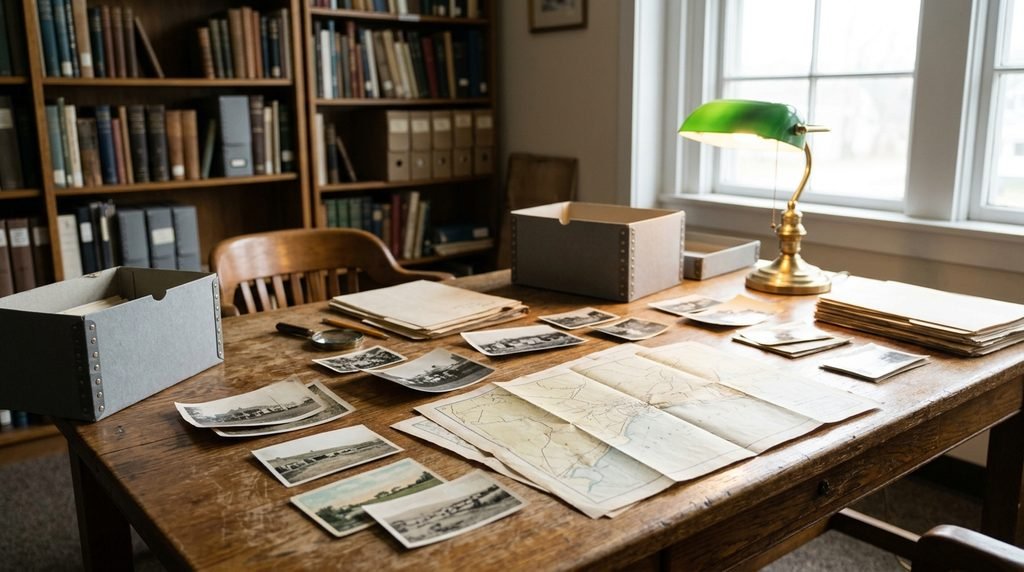
Another Quaker meeting house on the North Shore, in Locust Valley, is the subject of The Joiner’s Argument in Locust Valley. For original material about Jericho itself, the Jericho Public Library’s Jericho Historical Collection, shared through New York Heritage, holds photographs, maps, and postcards of local life dated from about 1875 to 2007.
Roads and rail
Two roads define the map. Jericho Turnpike (Route 25) runs through the community, and the library’s history names Broadway and Routes 106/107 as the road widened in 1958 alongside the cloverleaf to the turnpike. How the turnpike corridor developed across several communities is traced in The Stroad That Ate Jericho Turnpike.
Two Long Island Rail Road stations in neighboring communities, Syosset and Westbury, are the ones reviewed for this guide, and the MTA lists both as accessible. The MTA’s page for Syosset places it on the Port Jefferson Branch and describes ramps, tactile warning strips, and audiovisual passenger information, and its page for Westbury adds elevators to that list. Neither page states travel times or parking rules, so the LIRR timetables, the system map showing which station is closest to a given address, and each station’s permit rules are the sources for a real commute estimate. For general commuting context there is LIRR Commute from Long Island to NYC, along with Long Island Commuter Rail Expansion Plans Could Reshape Home Values Along Key Corridors.
Questions people ask
What county and town is Jericho in?
Jericho is in Nassau County, mainly within the Town of Oyster Bay, with its ZIP code listed as 11753 in Nassau County’s community profile.
What is the median home value in Jericho?
The Census Bureau’s 2020–2024 American Community Survey estimate is $948,400 for owner-occupied homes, an owner-reported figure and not a sale price.
Which school district serves Jericho?
The Jericho Union Free School District, which lists five schools and reported 3,230 students in 2024–25 on the state’s data profile. Confirm the district for any specific address before relying on a listing.
Why is it called Jericho?
According to the Jericho Public Library, the community was renamed from Lusum to Jericho in 1692, after the biblical town near the Jordan River.
Is there an LIRR station in Jericho?
The MTA station pages reviewed for this guide cover Syosset and Westbury, both in neighboring communities. The LIRR system map shows every station and is the place to find the closest one to a given address, with the timetables for travel times.
Real estate markets change. For current listings and market data, contact Maison Pawli at maisonpawli.com/about/. Census, school, and MTA information reflects the dates shown above and may have changed.
You Might Also Like
- The Great Neck vs. Manhasset Decision: How Two Gold Coast Zip Codes Serve Completely Different Buyers
- Matinecock’s Invisible Borders: How a Quaker Hamlet Kept Its Character While Everything Around It Changed
- Nassau County vs. Suffolk County: Which Should NYC Transplants Choose?
- What Old Westbury Gardens Does Not Show You
Sources
- U.S. Census Bureau, QuickFacts: Jericho CDP, New York
- Jericho Public Library, Jericho History
- Jericho Public Library via New York Heritage, Jericho Historical Collection
- New York State Education Department, Data profile: Jericho UFSD
- Jericho Union Free School District, Schools
- Nassau County Youth Board (Office of Planning), Community Profile of Jericho, August 2000 (PDF)
- MTA, Syosset station and Westbury station
- New York State Department of Taxation and Finance, Real estate transfer tax
- New York State Senate, Assembly Bill A10812 (2025) and Senate Bill S10652 (2025)
- Clio, Former Home of Valentine Hicks & Stop on the Underground Railroad
- Patch, Report on the Jericho landmark hearing (November 15, 2011)
- Vanderbilt Cup Races, Preserving the Maine Maid Inn and the Vanderbilt Cup Races (November 16, 2011)