
The Great Neck vs. Manhasset Decision: How Two Gold Coast Zip Codes Serve Completely Different Buyers
Both towns carry Gold Coast pedigree. Both have school districts that appear near the top of every Long Island ranking list. Both will ask you for a great deal of money. And if you’re trying to decide between them—standing at the fork in the road that is Nassau County’s North Shore—the rankings and the price tags will not make the decision for you.
Great Neck and Manhasset are not interchangeable. They attract different people for different reasons, and those reasons run deeper than square footage and commute times. I’ve worked with buyers who looked at both and chose correctly for their life, and I’ve seen buyers choose based on a single data point—a school ranking, a neighbor’s recommendation, a gut feeling about the downtown—and spend the next five years wishing they’d done the full comparison. Here’s what I’d want a client to have before they committed to either.
What the Commute Actually Costs You
Both towns sit on LIRR lines with direct service to Penn Station, which is the primary commuter draw for the Nassau Gold Coast. The difference is in the frequency, the travel time, and the walk-from-the-train reality.
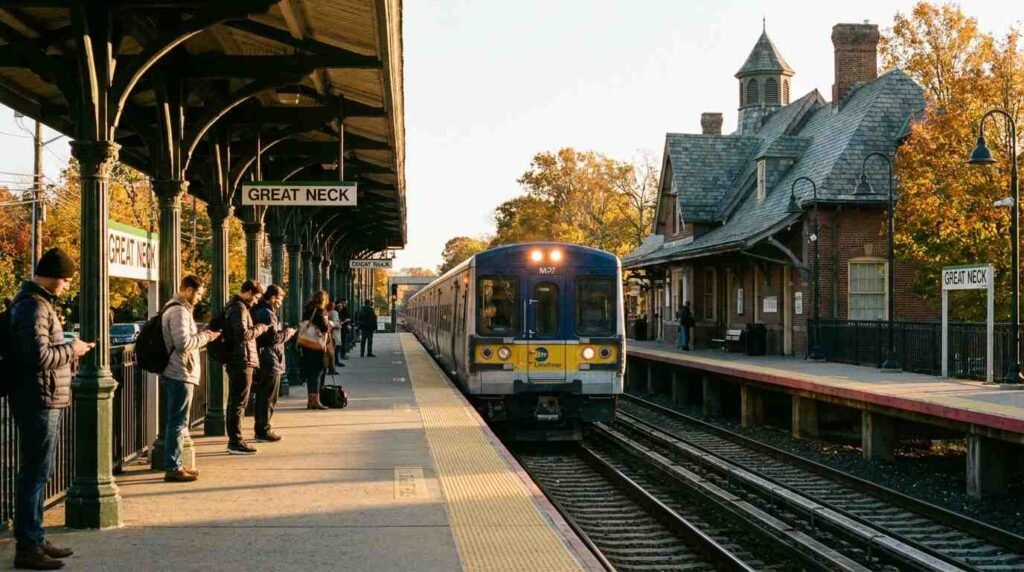
The commute data is clear enough. Suburbs 101 puts the LIRR ride from Great Neck to Penn Station at 31 minutes, and Manhasset at 34 minutes—both well under the 35-minute threshold that most city-to-suburb commuters use as their informal ceiling. One stop and three minutes separate them on the Port Washington Branch.
What the timetable doesn’t capture: Great Neck station is walkable from much of the village—a meaningful quality-of-life detail for buyers who want to leave the car at home. Manhasset’s station is not surrounded by a walkable village core in the same way. Most Manhasset buyers drive to the station or use the LIRR lot. The tradeoff is that Manhasset’s residential character—quieter, less commercially dense—is precisely what many buyers are paying for.

What the School Data Actually Shows
Both districts consistently rank among the top school districts in New York State, and both perform well against any national benchmark. The question is not whether the schools are good. The question is which structure fits your family.
Great Neck operates two high schools—Great Neck North and Great Neck South—serving a district of roughly 5,000 students. The district has a long track record of academic distinction, strong AP enrollment, and college placement data that matches elite suburban districts nationally. It is also a larger, more diverse school environment than Manhasset, with more extracurricular range as a function of size.
Manhasset’s district is considerably smaller—roughly 2,800 students K–12—and centralized into one high school. Some families find the smaller environment more appealing; others feel a larger district offers more by way of programs, teams, and social breadth.
Neither district is the wrong choice academically. The right question is whether your child does better in a large, energetic, multi-building district or in a tight-knit community that knows everyone’s name by graduation.
What Your Money Actually Buys
Great Neck has considerably more housing stock diversity than Manhasset, which translates to a wider range of entry points. Suburbs 101 puts the median sale price in Great Neck at roughly $829,000 against Manhasset’s $1.55 million—a near-doubling of the floor.
Manhasset is more compressed. The housing stock skews toward larger lots and larger homes, and the price floor reflects that. Entry-level in Manhasset is not entry-level by any relative standard. What you get for that premium is typically more land, quieter streets, and a residential character that feels more removed from commercial life than Great Neck’s village core allows.
The practical implication for buyers: if your budget is at the lower end of what either market accepts, Great Neck gives you more options and more room to find the right house. If your budget is unconstrained, Manhasset’s uniformity of product means you’re less likely to land in a block that doesn’t match your expectations.
The Character Question: What You’re Actually Buying Beyond the House
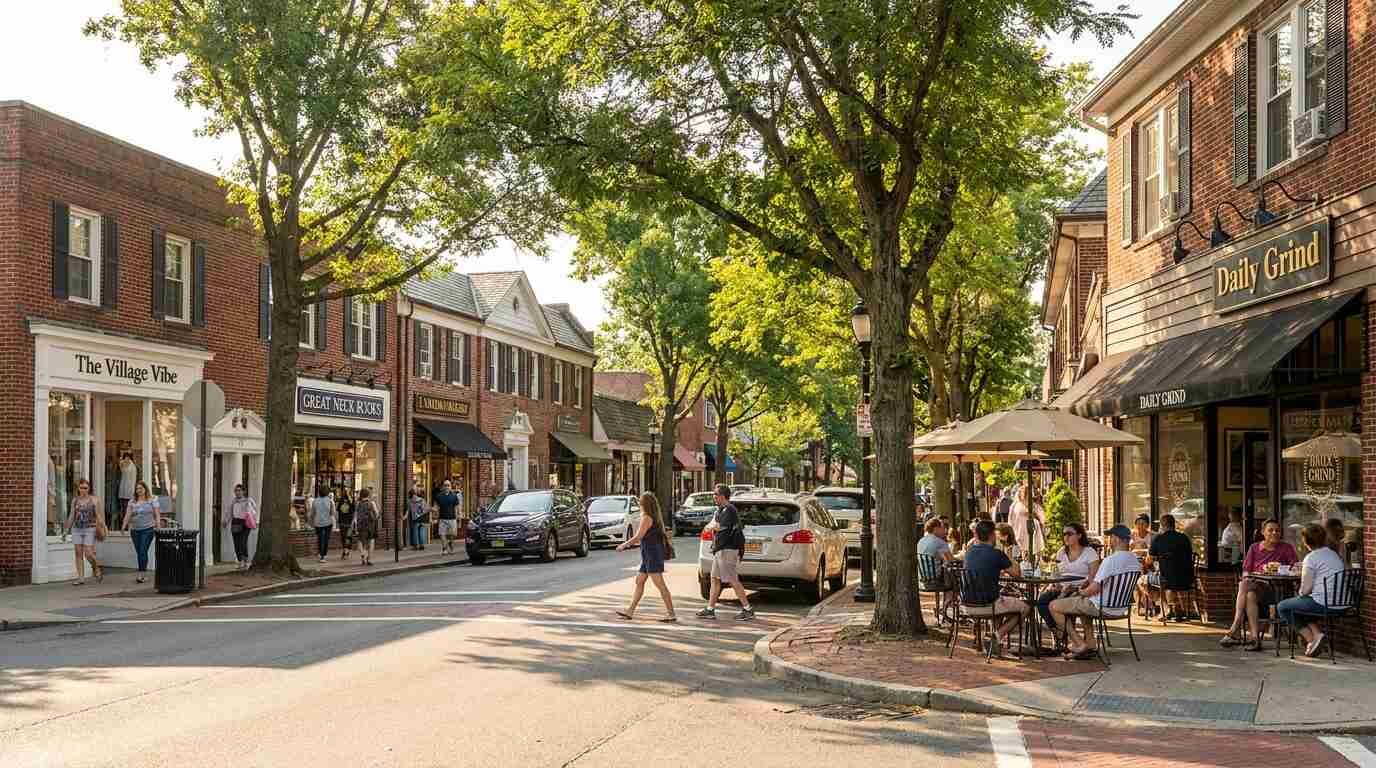
Great Neck is a town with a commercial center—a proper downtown, a restaurant row, boutiques, a Saturday farmers market character. The residential neighborhoods fan out from that center, and the village has the kind of social infrastructure that makes you feel connected to a place. It is denser, more urban in its grain, and that suits certain buyers completely. If you are coming from a city—from Brooklyn, from the Upper West Side, from Hoboken—Great Neck’s density often reads as familiar and appealing rather than as a compromise.
Manhasset is more private. The commercial strip along Plandome Road is pleasant but not the town’s identity. The identity is in the neighborhoods—the long driveways, the established trees, the sense that everyone has settled in for the long term. It attracts buyers who are specifically seeking distance from density, buyers for whom the suburb is not a compromise but a preference. The social life in Manhasset tends to organize around school and club rather than around a downtown street.
Neither of these is a value judgment. They are descriptions of genuinely different environments that produce genuinely different daily lives. The buyer who thrives in one often doesn’t thrive in the other.
Who Should Choose Great Neck—and Who Should Choose Manhasset
After walking buyers through both markets more times than I can count, the pattern is fairly consistent.
Great Neck tends to be the right choice for buyers who want walkability and commercial energy nearby, who value housing stock diversity and a wider range of entry points, who are coming from denser living and want proximity to that texture, or whose children do well in larger, more varied school environments.
Manhasset tends to be the right choice for buyers who prioritize residential quiet and lot size over commercial proximity, who are committed to a smaller, more cohesive school community, whose budget can absorb the compressed price floor without strain, or who are specifically seeking the more removed, settled character of old Nassau County residential life.
The mistake I see most often is buyers choosing on school rankings alone—as if the difference between two elite districts could override the fundamental mismatch between how they want to live and what the town actually delivers day to day. The school rankings in both places will serve your children well. The commute from both places will get you to Penn Station. The decision should be made on character. Figure out who you are first, and the right town usually becomes obvious.
This is for informational purposes only—consult a licensed real estate attorney and financial advisor for your specific situation. Fair housing laws prohibit discrimination in housing on the basis of race, color, national origin, religion, sex, familial status, or disability.
Real estate markets change. For current listings and market data, contact Pawli at Maison Pawli.
You Might Also Like
- North Shore vs. South Shore: What Relocating Buyers Actually Need to Know
- Best School Districts in Suffolk County and What They Do to Price Per Square Foot
- The Spec Home That Outsold the Custom Build Next Door
Sources
- NYSED School Report Cards—verify current enrollment and per-pupil figures before publishing
- Niche.com—Great Neck and Manhasset school and neighborhood ratings—verify current ratings before publishing
- MTA LIRR—Port Washington Branch schedules
- Suburbs 101: 9 Long Island Towns with Best Schools and Short Commute to NYC
- MLSLI—sold data by zip code (11021, 11030)—verify current median prices before publishing
- U.S. Census Bureau, American Community Survey—Great Neck and Manhasset demographic data