Sound Beach, NY — The North Shore Neighborhood Guide
There is a specific kind of buyer I have come to recognize over the years — the one who has done their homework, who has driven the stretch of Route 25A between Miller Place and Rocky Point more than once, and who keeps circling back to a hamlet that doesn’t have a dedicated real estate blog, a boutique coffee shop on the main drag, or a name that lands with much weight at a dinner party in the city. That buyer has been looking at Sound Beach. And more often than not, they are right to.
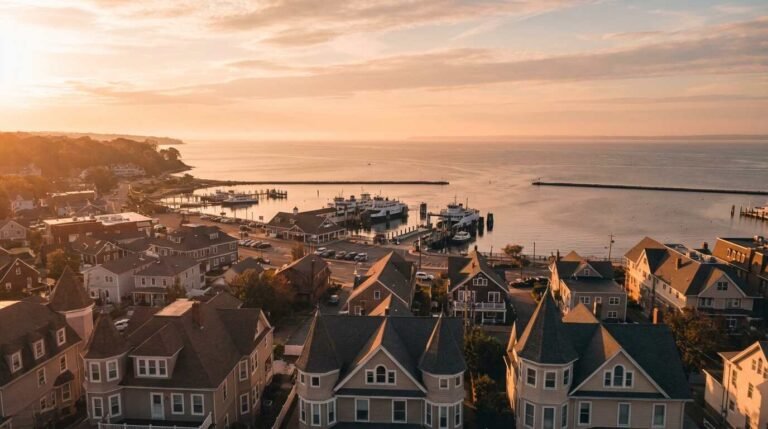
Sound Beach sits on 1.6 square miles of North Shore terrain, pressed between Miller Place to the west and Rocky Point to the east, with Long Island Sound running its entire northern edge. It is one of the smallest hamlets on the North Shore. It is also, by any honest accounting, one of the most quietly compelling.
How Sound Beach Began — and Why That History Matters
Most neighborhoods have a founding story. Sound Beach’s is stranger and more interesting than most. In 1929, the New York Daily Mirror — a tabloid — offered its subscribers the chance to buy a 20-by-100-foot parcel of undeveloped land on the North Shore for $89.50 per lot, with $12.50 down and $3.50 a month, provided the buyer took a one-year subscription to the paper. People showed up lugging groceries, pitched tents, and eventually built small summer cottages. The Sound Beach Property Owners Association was formed to handle what no municipal government yet covered: roads, sanitation, water, and community governance.
For roughly four decades, this was a summer community — a working-class escape from the city heat, modest and self-organized. After World War II, those cottages became year-round homes. The summer experiment became a permanent neighborhood.
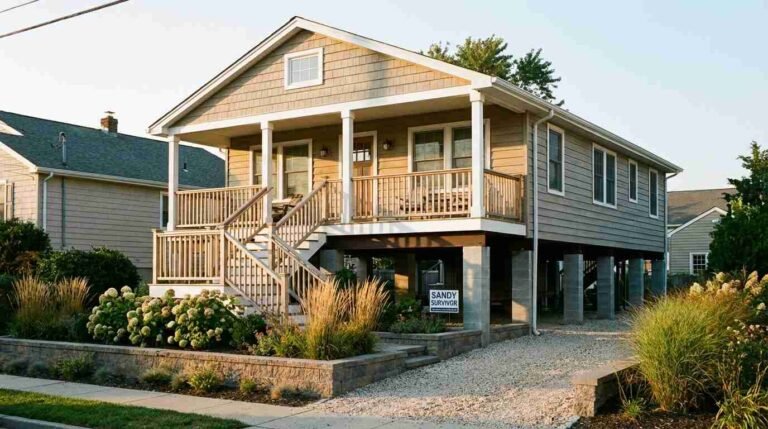
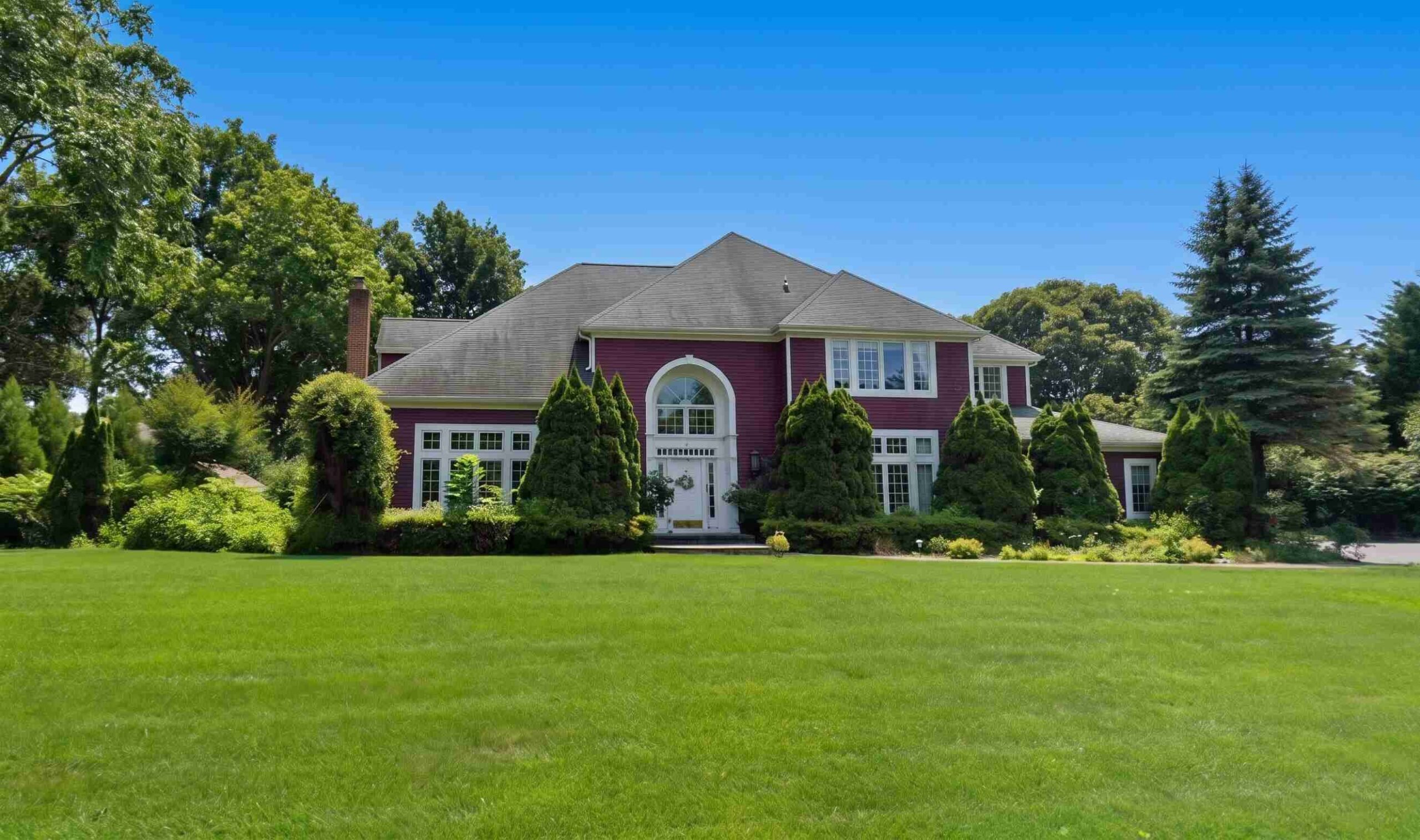
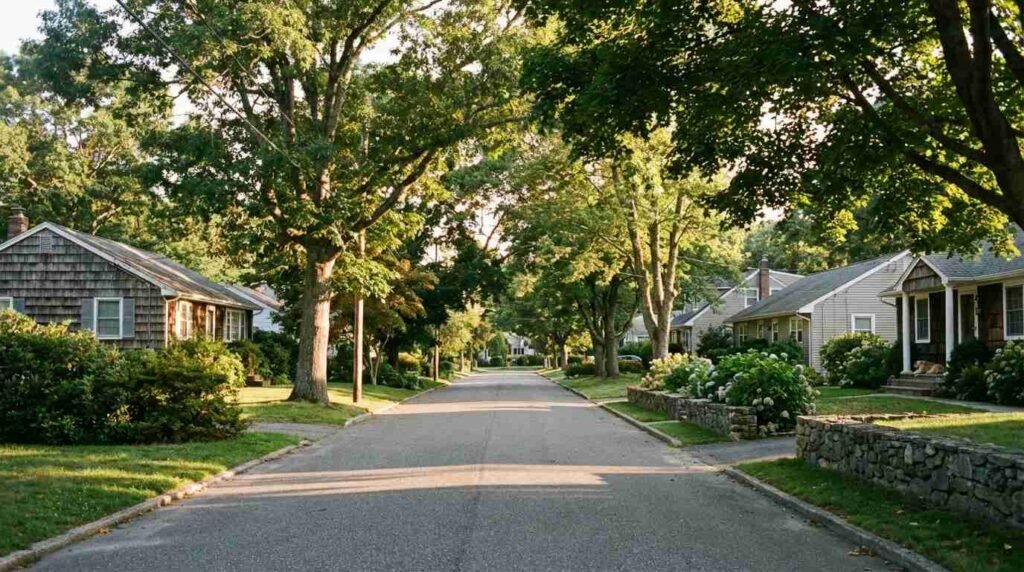
What that founding produces, a century later, is a particular kind of housing stock and community character. Ranch homes from the 1950s and 1960s sit alongside expanded bungalows from the 1940s and newer construction from the 1990s through the 2020s. The lots are not large — that original 20-by-100-foot dimension shaped how the hamlet was platted — but they are Sound-facing, tree-lined, and genuine. The residents who came from Brooklyn and Queens to build something small on the water planted roots that held. The community pride here is not performed. It is the real thing.
The Waterfront — and What It Actually Means
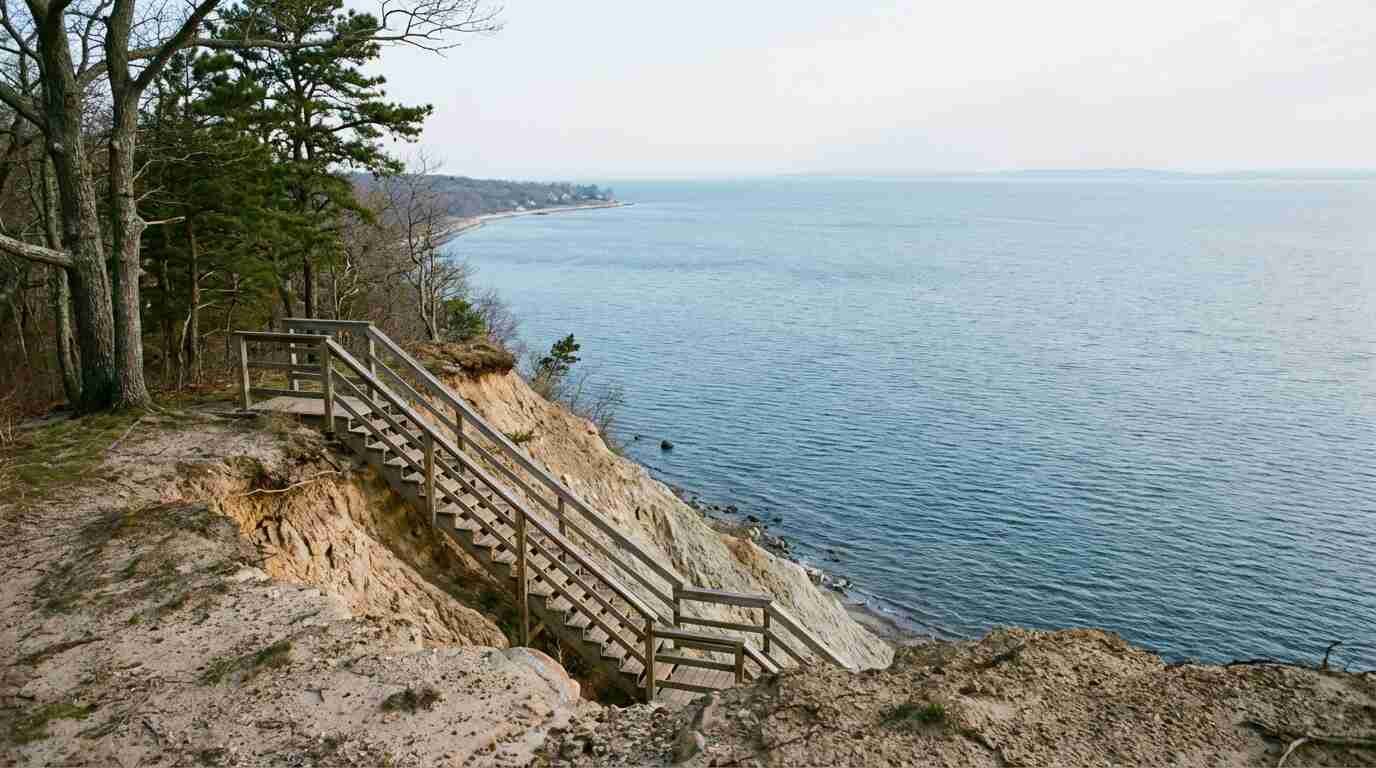
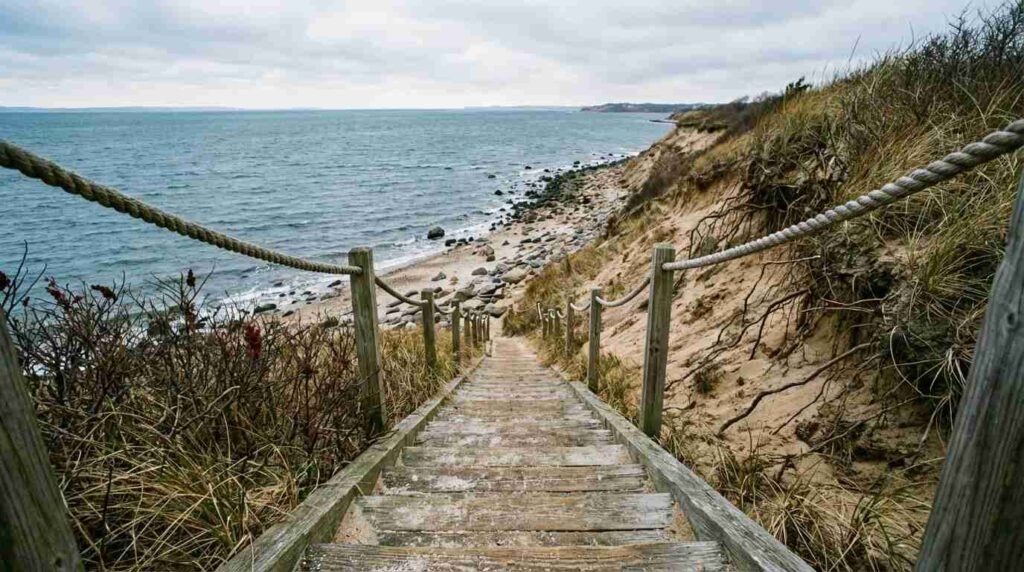
Long Island Sound defines Sound Beach more than any other single feature. The northern edge of the hamlet runs along the bluffs above the Sound, and it is that bluff character — the cliff-and-stair access, the rocky-sandy shoreline transition, the sweep of water looking toward Connecticut — that distinguishes Sound Beach from virtually every neighborhood in its price range.
The Sound Beach Property Owners Association maintains beach access for residents, with passes required year-round. West Beach and Scotts Beach are the primary waterfront access points. Scotts Beach is a gated community within the hamlet, where waterfront homes on quiet cul-de-sacs have historically sold in the $420,000-to-$890,000 range depending on condition and direct water exposure. For buyers who want Sound views without the SBPOA membership structure, the bluff-adjacent streets north of North Country Road offer the elevation and proximity without the HOA overlay.
I have walked those bluff streets in every season. In winter, the Sound is steel-grey and completely serious. In summer it is the sort of thing that makes buyers who have been looking inland feel foolish for having waited so long to consider this part of the North Shore. The stairs down from the bluffs have had to be rebuilt more than once — the winter storms that come off the Sound are not gentle — and if you are buying near the water here, you should understand what that means for maintenance and insurance before you make an offer. I have written about what FEMA flood maps do and don’t capture on Sound-facing properties; it is worth reading before you close on anything with a water view. Flood Insurance on Long Island’s North Shore: What FEMA Maps Don’t Tell You covers the specifics.
Schools — Miller Place and Rocky Point
This is the detail that trips up every buyer who didn’t grow up here: Sound Beach has no school district of its own. The district line runs down the middle of the hamlet. The western half of Sound Beach feeds into Miller Place Union Free School District. The eastern half feeds into Rocky Point Union Free School District.
This matters because the two districts are not the same. Miller Place consistently ranks among the stronger performing districts in Suffolk County — small enough to feel community-rooted, strong academically, with a high school that has a well-regarded college counseling program and consistently solid state assessment scores. Rocky Point is a competent district with a loyal community following. But for buyers with school district as a primary driver, the Miller Place side of Sound Beach is where the conversation usually ends up.
If you are buying in Sound Beach and schools are a factor, confirm the district assignment of any specific address before you make an offer. The line is not intuitive, and I have seen buyers assume they were on the Miller Place side of it when they were not. The address will tell you; the street name will not always.
For what it is worth: children attending Miller Place schools from Sound Beach are zoned for the Laddie A. Decker Sound Beach School for grades 3 through 5 — a building that sits right in the hamlet — before feeding into North Country Road Middle School and Miller Place High School. That local school presence matters. It anchors the neighborhood to the district in a way that is more than just a line on a map.
I covered the Miller Place district in more detail in the Miller Place, NY Neighborhood Guide if you want the full picture.
The Market — What Serious Buyers Are Finding
Sound Beach median listing prices have been running in the high $400,000s to low $500,000 range — numbers that represent a meaningful discount to neighboring Miller Place and a substantial discount to the western reaches of the North Shore. Days on market in early 2026 have trended around 30 to 38 days, suggesting a functional market: not the frenzied pace of 2021–2022, but not the stagnant stretch that characterizes overpriced inventory.
The housing stock here rewards buyers who understand renovation. The original cottage bones — often solid, given their Depression-era and postwar construction — sit under decades of additions and updates of varying quality. The buyers I have seen do well in Sound Beach are the ones who can read a house: who understand what is structural, what is cosmetic, and what the permit history looks like in the Town of Brookhaven. If you are buying a fixer-upper anywhere on the North Shore, it is worth understanding what Long Island’s permit delays can mean for your renovation timeline before you close.
At the upper end, waterfront-adjacent homes and fully renovated properties have pushed toward $700,000 and above. Sound Beach is not a luxury market — but it has a ceiling that is higher than its entry points suggest, which is exactly the spread that serious buyers look for.
Commute and Getting Around
Sound Beach sits approximately 60 miles from Midtown Manhattan. The Long Island Rail Road’s Port Jefferson Branch is the primary transit corridor for commuters — the closest stations are Miller Place/Sound Beach (a flag stop on the Port Jeff Branch, usable but limited in service frequency) and the fuller-service Port Jefferson station to the west.
Realistically, most Sound Beach residents drive. Route 25A runs along the southern edge of the hamlet and is the main connector east and west. Commuting by car to the LIRR stations in Port Jefferson or Stony Brook is the most common pattern. Driving times to Port Jefferson Village run about 10–15 minutes under normal conditions. To the Midtown Tunnel, plan on roughly an hour to an hour and twenty minutes depending on traffic and time of day. This is not a neighborhood that sells itself on commute convenience — it sells itself on what you come home to.
Character, Community, and What Life Here Looks Like
Sound Beach has the texture of a place that built its own community because no one else was going to do it. The Sound Beach Civic Association, the Fire Department, St. Louis de Montfort Roman Catholic Church, and the Sound Beach Property Owners Association are the institutions that have held this hamlet together since the tent-and-outhouse era. Community events — the annual Field Day at West Beach, Veterans Day memorial services, civic meetings held the second Monday of every month at the firehouse — are not manufactured programming. They are the accumulated habits of a neighborhood that has always had to take care of itself.
The business strip along 25A is modest: a handful of restaurants, local services, no particular destination dining. Rocky Point to the east and Miller Place to the west absorb most of the commercial demand. The hamlet’s identity is residential — quiet side streets, wooded lots, and the Sound at the northern edge.
There is also a piece of Sound Beach history that most people who don’t live here have never heard of: the Sound Beach Spanish Colony, a community of families from Spain who settled on and around Shelter Drive beginning in the late 1930s and early 1940s. They came originally to hunt pheasant, bought lots through the Daily Mirror program, and built what they called el paraíso — paradise. The Lopez and Galvez families were among the first. Their presence is a reminder that Sound Beach, despite its suburban surface, has an actual immigrant history layered into its streets.
Who Is Buying Here
The Sound Beach buyer is almost always someone who has done a serious comparison of the North Shore and decided that paying a premium for a more well-known address was not where the value was. They tend to be practical, community-minded, and attentive to what the land itself offers. Many are families priced out of the western North Shore who have discovered that Miller Place schools and Sound access do not require a Mount Sinai or Stony Brook price point. Others are second-home buyers who want waterfront proximity without Fire Island logistics or the East End premium.
If you are comparing Sound Beach to its immediate neighbors, I would encourage you to read the Mount Sinai, NY Neighborhood Guide as well. The two communities share a school district boundary and a coastal character, but they come at the North Shore from different angles — and understanding both helps a buyer know which side of the line actually fits their life.
The buyers I see make the best decisions here are the ones who are not buying a neighborhood’s reputation. They are buying the bluff, the school district line, the reasonable price per square foot, and the community that already knows how to take care of itself.
That is a combination the North Shore does not offer in many places. Sound Beach is one of them.
Real estate markets change. This post reflects conditions as of April 2026. For current listings and market data, contact Pawli at Maison Pawli.
You Might Also Like
- Miller Place, NY — The North Shore Neighborhood Guide
- Mount Sinai, NY — The North Shore Neighborhood Guide
- Flood Insurance on Long Island’s North Shore: What FEMA Maps Don’t Tell You
- North Shore vs. South Shore Long Island: What Buyers Need to Know
Sources
- Sound Beach Property Owners Association — Community History: sbpoa.org/overview
- Sound Beach Civic Association — Historical Record: soundbeachcivic.org
- Times Beacon Record — Sound Beach History Feature: tbrnewsmedia.com
- Movoto — Sound Beach Market Data, February 2026: movoto.com
- Miller Place Union Free School District: millerplace.k12.ny.us
- Wikipedia — Sound Beach, New York: en.wikipedia.org