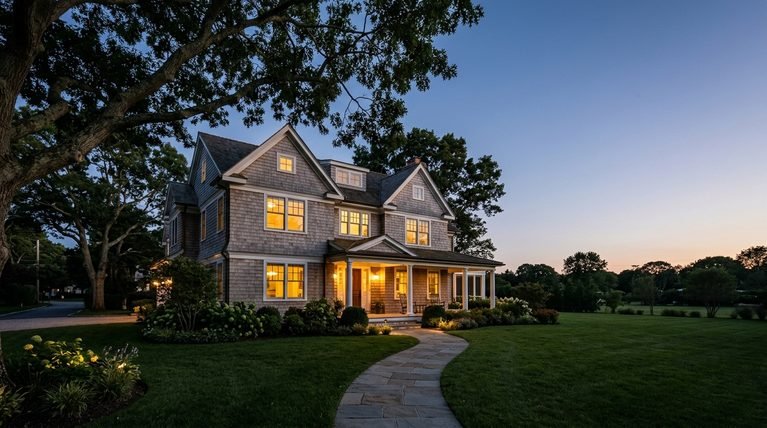
Miller Place, NY — The Historic District Nobody Rushed to Change
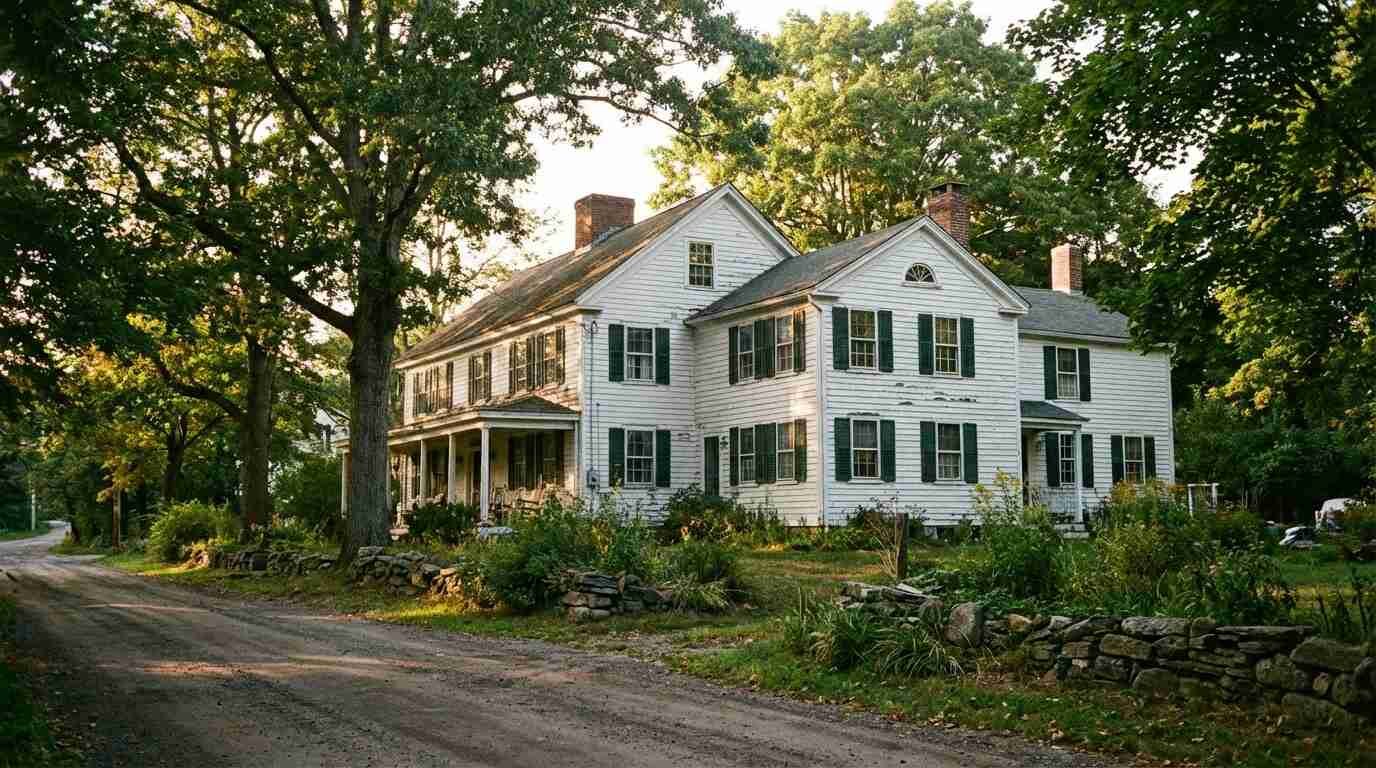
There is a house on North Country Road in Miller Place that has been standing since 1720. It belongs to the local historical society now, but for the better part of three centuries, it was simply where the Miller family lived — the family that gave the hamlet its name, back when travelers heading east from Setauket identified the route by the house they passed along the way. Andrew Miller’s place. Eventually, just Miller Place.
I drive past that house regularly. Every time, I notice the same thing: it doesn’t look rescued. It doesn’t have the too-clean quality of a museum piece. It looks occupied, which is the whole point. Miller Place became the first historic district in the Town of Brookhaven in 1979, and the reason it qualified was not that a preservation society campaigned for it. It qualified because the homes along North Country Road had simply never been torn down.
That is the character of this hamlet in a sentence. Miller Place does not perform its history. It lives in it.
The Origin of the Name — and the Pattern It Set
Andrew Miller arrived around 1671, the son of John Miller, one of East Hampton’s original English settlers. The family built along what is now North Country Road, and over the next century they were joined by the Helmes, Robinsons, Burnetts, Hawkins, and Woodhulls — families whose names still mark roads throughout the hamlet. The oldest surviving house, William Miller’s home, was assembled in three sections between 1720 and 1816, each addition reflecting a different era’s building habits. It anchors the western end of the Miller Place Historic District, which extends east along North Country Road past the Reverend Ezra King house and south along Lower Rocky Point Road.
The hamlet was agricultural first and social second. Farms produced wheat, rye, buckwheat, and corn. Young men went to sea — the harbor at Port Jefferson was close enough that Mount Sinai and Miller Place both served as residential communities for shipbuilders and riggers who worked the yards. When the Long Island Rail Road reached Port Jefferson in 1879 and extended east through Miller Place to Wading River from 1895 to 1938, the hamlet became a seasonal resort destination. City families boarded with local families or rented cottages. A place called The Holiday House offered summer rooms for young women from the 1890s until after World War II, complete with lawn games, horseback riding, and barn dances with music provided by what the historical society’s records generously describe as local “orchestras.”
That railroad is gone — destroyed by two fires, in 1903 and 1934 — but its footprint survives as the North Shore Rail Trail, the ten-and-a-half-mile paved path that runs from Mount Sinai through Miller Place to Wading River. On any weekend morning you can find half the hamlet’s population on it.

Location and Lay of the Land
Miller Place sits east of Mount Sinai and about five miles east of Port Jefferson’s harbor, on the North Shore of Long Island within the Town of Brookhaven. It borders Sound Beach to the east, Rocky Point to the southeast, Coram and Middle Island to the south. The hamlet’s two-mile stretch of Long Island Sound shoreline includes access to the eastern edge of Mount Sinai Harbor — Cedar Beach’s peninsula is actually most directly accessible from Miller Place’s side.
The terrain is gently hilly in the north near the bluffs and levels out into wooded residential neighborhoods to the south. South of Route 25A, the landscape shifts noticeably — larger lots, more trees, farmland vestiges — and borders the Rocky Point Pine Barrens State Forest and Preserve, the most biologically diverse state park in New York. If you like the idea of living five minutes from the Sound and ten minutes from a globally significant pine barrens ecosystem, Miller Place is one of the very few places on Long Island where that is geometrically possible.
The Schools
The Miller Place Union Free School District operates four schools: Andrew Muller Primary School (K–2), Laddie A. Decker Sound Beach School (3–5), North Country Road Middle School (6–8), and Miller Place High School (9–12). The district serves both Miller Place and much of neighboring Sound Beach, with a total enrollment that reflects a mid-size suburban system with a strong community investment in athletics and extracurriculars.
The Miller Place Academy — a private school founded in 1834 under the leadership of a Yale graduate — operated until 1868, served as a public school from 1897 to 1937, and now houses a free library. The building remains one of the hamlet’s most recognizable landmarks. The district’s public school history extends back to 1813, when the first school was built opposite the duck pond on North Country Road — a pond the community still maintains as Kelli’s Pond, a neighborhood anchor.
The high school has a strong reputation in athletics, including competitive soccer, lacrosse, and track programs. For families evaluating school districts as part of a home purchase, Miller Place offers a district that is well-regarded without commanding the extreme tax premium of some North Shore neighbors to the west. I wrote about how school districts function as invisible drivers of home values — the principle applies here as much as it does in Hauppauge.
What the Housing Stock Looks Like
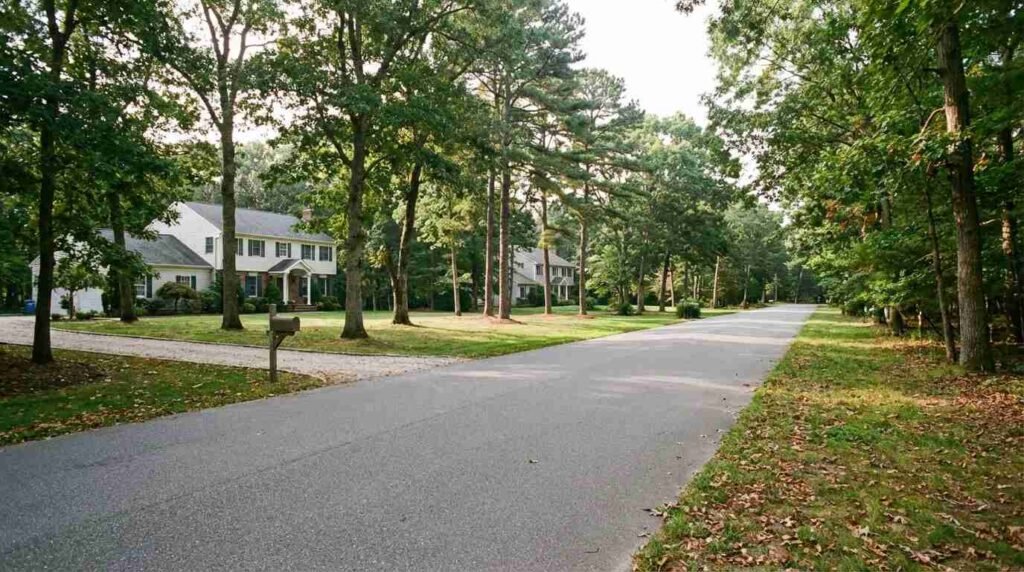
Miller Place’s housing stock skews heavily toward single-family detached homes on lots that typically range from a quarter acre to over an acre. The hamlet has one of the highest proportions of four- and five-bedroom homes in the state — built during the postwar suburban expansion that consumed most of the remaining farmland between the 1960s and the early 2000s. Architectural styles include colonials, ranches, split-levels, and the occasional post-modern contemporary from the 1980s and 1990s.
The median home sale price is currently in the low-to-mid $600,000s, with price per square foot around $350. Homes typically spend thirty to forty days on market. Entry-level opportunities tend to be older ranches and capes in the $500,000 to $650,000 range — many of which sit on generous lots south of 25A. Updated colonials and larger properties in the North Harbor area and along Shore Road can reach $1 million to $1.5 million, particularly if they offer views or proximity to the Sound.
The North Harbor section, in the hamlet’s northeast corner, features some of the most substantial homes — custom-built properties on wooded lots near the water. Cordwood Landing County Park, a pet-friendly nature trail that leads directly down to the Long Island Sound, sits adjacent to this area and is one of the hamlet’s most used outdoor spaces.
For anyone considering a split-level renovation in this part of Suffolk County, I’d recommend reading my piece on the one floor plan that breaks every renovation rule before committing to a project budget.
Commute, Dining, and Daily Life
Miller Place is car-dependent. Route 25A serves as the main commercial corridor, lined with a mix of local restaurants and chain establishments. Crazy Beans is the hamlet’s combination coffee shop and diner. Branchinelli’s draws a crowd for Italian. McNulty’s Ice Cream Parlor has been serving homemade ice cream near the historic district for over three decades. For anything beyond the basics — a good bar scene, a wider restaurant selection, a waterfront dinner — Port Jefferson is a five-mile drive west.
The nearest LIRR stations are at Port Jefferson (about four miles) and Ronkonkoma, both offering service to Penn Station. Commuters who drive have access to 25A, NY 347, and the Long Island Expressway via CR 83. A meaningful number of residents work at Stony Brook University or Brookhaven National Laboratory, both within an easy commute.
Cordwood Landing Park and the North Shore Rail Trail are the two primary outdoor recreation anchors. Heritage Park, shared with neighboring Mount Sinai, adds sports fields, walking paths, and a recreation center. The Rocky Point Pine Barrens Preserve — just south of the hamlet — offers miles of trails through one of the last intact pitch pine and scrub oak ecosystems east of the Appalachians.
The Market Proposition
Miller Place’s value proposition is straightforward: you get a North Shore address, Sound access, strong schools, generous lot sizes, and a community with genuine historical identity — at a price point that remains competitive within Suffolk County. The hamlet lacks a walkable village center, which means it doesn’t command the price premium that places like Port Jefferson or Stony Brook carry. For buyers who want the land and the quality of life more than the downtown amenities, that discount is the opportunity.
The historic district along North Country Road gives Miller Place an architectural character that most postwar suburbs don’t have. The Daniel Hawkins House, circa 1810, still stands along the road. The Samuel Hopkins House is separately listed on the National Register of Historic Places. These aren’t destinations — they’re part of the neighborhood texture.
I’ve been showing homes in Miller Place for years, and the pattern I see is consistent: buyers who come here expecting to be unimpressed leave with a different assessment. The hamlet rewards attention. It rewards people who notice that the lots are bigger, the trees are older, and the pace is a half-step slower than the towns that get more press.
That’s not an accident. It’s three hundred and fifty years of practice.
Real estate markets change. This post reflects conditions as of April 2026. For current listings and market data, contact Pawli at Maison Pawli.
You Might Also Like
- Mount Sinai, NY — The North Shore Hamlet That Earned Its Quiet
- Inside the Long Island Split-Level: The One Floor Plan That Breaks Every Renovation Rule
- Why Hauppauge School District Homes Hold Value Like Almost Nowhere Else on Long Island