Stony Brook Village Center: History and Visitor Guide
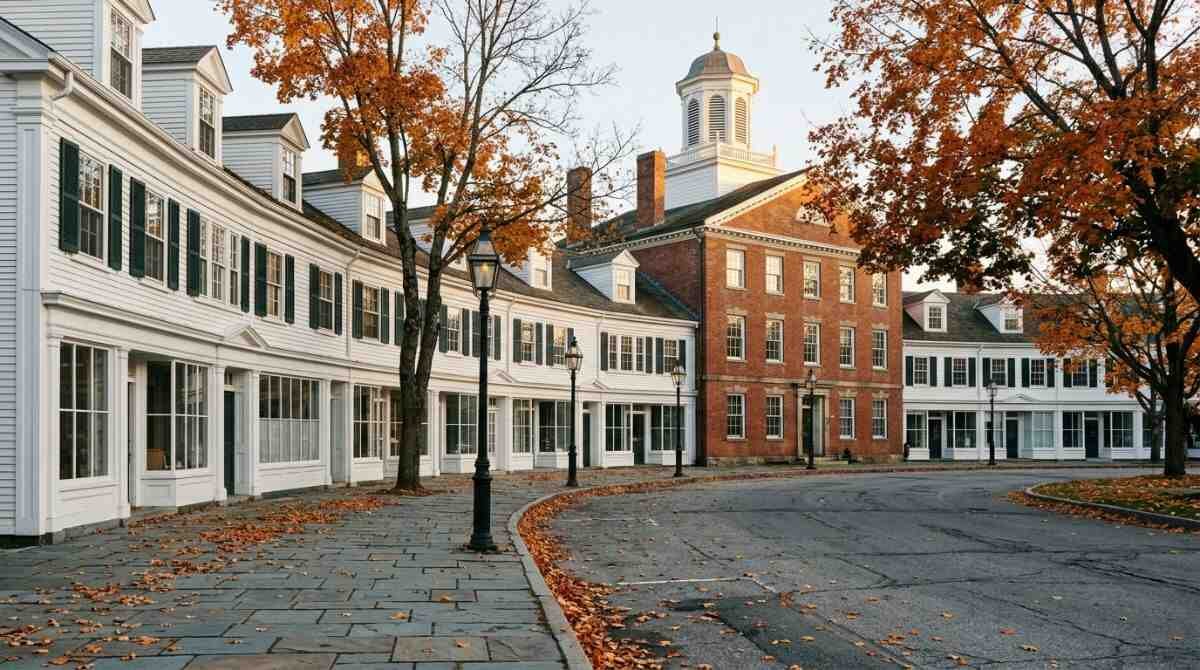
Stony Brook Village Center is a crescent of connected, colonial-style shops arranged around a Federal-style post office, and it was built as a single planned project in the early 1940s. The design was the idea of Ward Melville, the retail executive whose family had settled in the area decades earlier, and the village’s own history page describes the aim as a “living Williamsburg.” The center still operates today with shops, restaurants and several museums nearby, and its origin story is documented unusually well.
The Melville family and the idea of the Three Villages
The village’s history page traces the story to Frank and Jennie Melville, Brooklyn residents who set out for a summer retreat in the Hamptons, boarded the wrong train and ended up in Stony Brook. Jennie Melville later encouraged cooperation among Stony Brook, Old Field and Setauket, and the page credits her with the name “Three Villages.” Her son Ward succeeded his father as president of the Melville Shoe Corporation and shared his parents’ interest in conservation and economic development.
Wikipedia’s article on the Stony Brook Village Center adds that Ward Melville became CEO of the Melville Corporation in 1922, when it ranked as the third-largest retailer in the United States.
How the plan came together
In 1939 Ward Melville created the Stony Brook Community Fund, which was renamed the Ward Melville Heritage Organization (WMHO) in 1996, and began renovating the Old Hallock Homestead as the Three Village Inn. Plans for the village center were presented to the community at a dinner at the inn. The WMHO’s organizational history dates that dinner to January 19, 1940; the Wikipedia article gives January 1939, so the sources differ by a year.
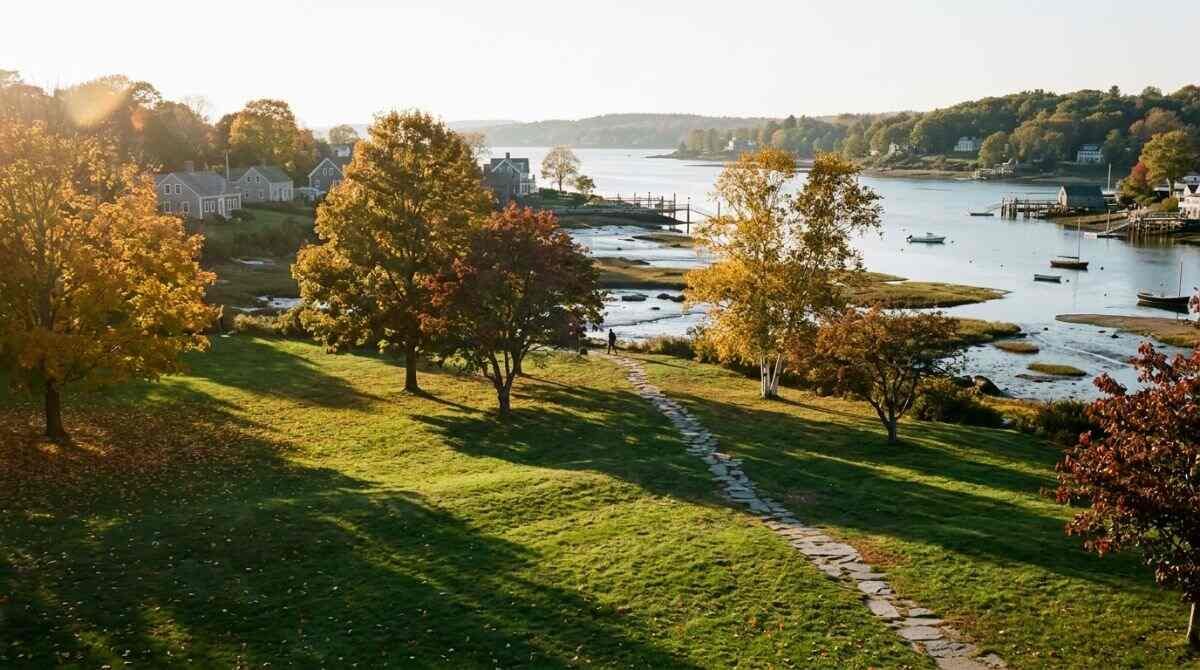
What the sources agree on is the scale. The project, funded personally by Melville at a cost the village site gives as $500,000, relocated, demolished or altered about 35 buildings. Roads were rerouted, large trees were moved, and about one million cubic yards of earth was shifted. A two-acre Village Green was created to open a view toward the harbor.
The village’s About Us page attributes the plan to architect Richard Haviland Smith, though the WMHO history spells the surname “Smythe.” Either way, the layout it describes is a curved core of connected shops centered on the post office, with cast-iron lampposts and bluestone walkways noted in the Wikipedia summary.
Completion came in 1941. The WMHO says the village was dedicated on July 4, 1941, and Wikipedia reports that the last merchant opened on December 7 of that year. The village site says the center “has long been recognized” as the first planned shopping center in the country, and also reports that the American Institute of Architects held its annual meeting there for many years.
Why the colonial look
The phrase “living Williamsburg” describes a design intent: a unified colonial-style village, with the Federal-style post office anchoring the middle. The record of 35 buildings relocated, demolished or modified shows how much of the earlier streetscape was reworked to get there. Visitors today can see the result in the way storefronts curve along a single sweep, the green opens toward the water, and the lampposts and walkways follow one palette.
What is there now
The Stony Brook Village directory lists a mix of retail, services and food. Shops include clothing stores, a children’s shop, a florist, a wine boutique, a cheese shop and an olive oil store. Restaurants and cafes listed include the Mirabelle Restaurant and Tavern at the Three Village Inn, Country House Restaurant, Robinson’s Tea Room and Premiere Pastry Shop. Listings turn over from year to year, so the directory is the better guide than any printed list.
Wikipedia describes the center as covering everyday needs as well as specialty retail, with a cleaner, an optician, a post office, a deli and other services. It also says the center holds a concert hall and a museum within its surroundings.
Historic sites and attractions nearby
Several properties sit within a short walk of the crescent, according to the village and the WMHO.
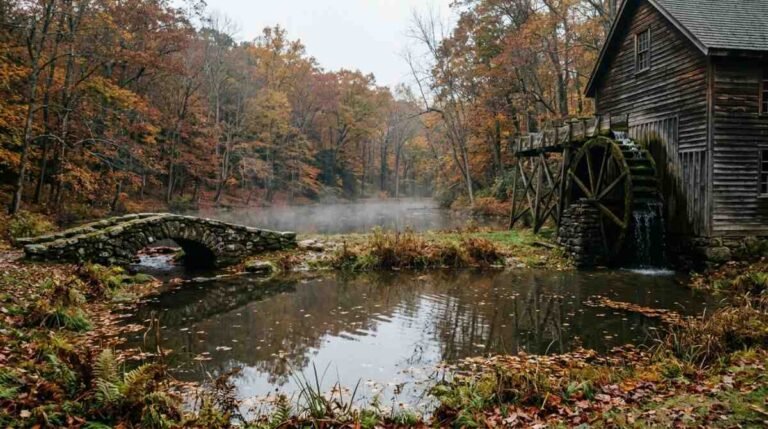
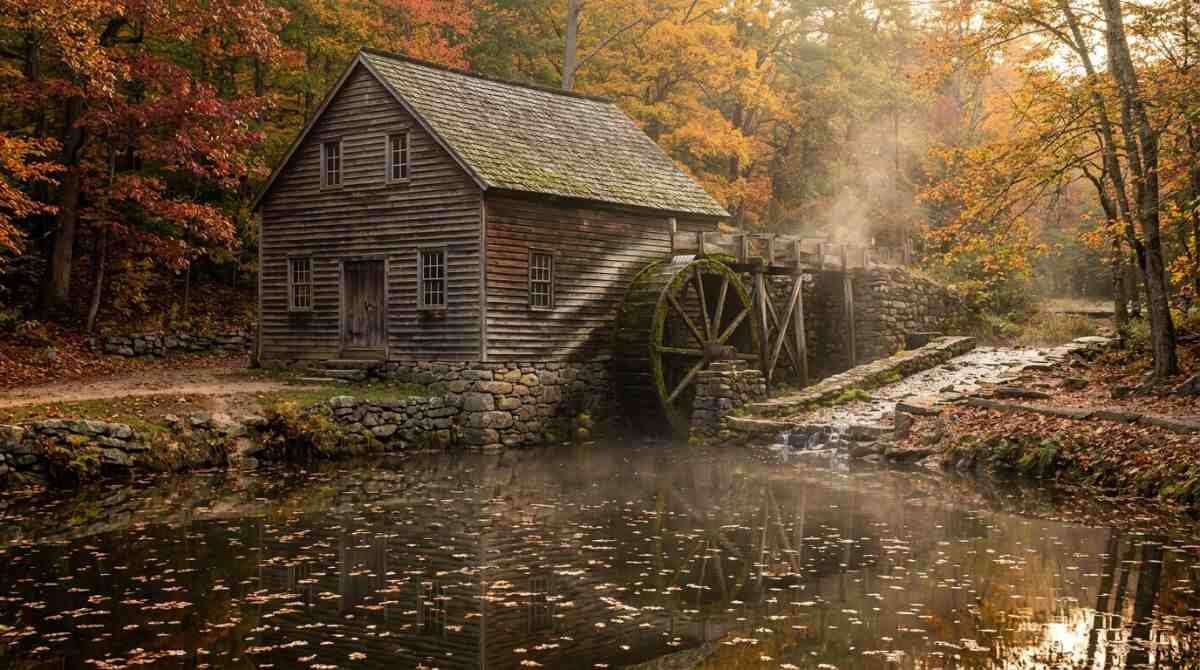
- Stony Brook Grist Mill (c. 1751). Described on the village site as Long Island’s only complete working grist mill and open from spring through fall. The events calendar notes that the mill itself is not currently accessible, and offers a free self-guided audio experience instead.
- Hercules Pavilion. Houses the figurehead of the U.S.S. Ohio and a whaleboat associated with an Arctic expedition. Wikipedia identifies the boat as the Polaris Whaleboat, from an 1870 Arctic expedition, while the WMHO page associates a whaleboat with the Peary North Pole expedition, so the two sources describe it differently.
- Brewster House (c. 1665) and Thompson House (c. 1710). Preserved colonial houses owned by the WMHO. The village site lists Brewster House as open by appointment for education.
- Long Island Museum. The WMHO leases the museum’s buildings and grounds, including the Hawkins-Mount House (c. 1725), for $1 a year, while the museum owns the collections and maintains the buildings.
- Long Island Music and Entertainment Hall of Fame and The Jazz Loft. Both are WMHO-owned properties leased to their operators.
- Bayles Minuse Mill Pond Park. A park of 11 acres plus a 2-acre upper pond, listed as open year-round.
- Wetlands Discovery Cruises. Naturalist-led trips of about 90 minutes through the harbor, running from May through October.
Avalon Park and Preserve, a 140-acre preserve with year-round trails, sits directly across from the center according to Wikipedia.
Melville’s wider gifts to the area
The village was one project among several. The WMHO history lists land donated for all of the Three Village schools and a donation of land to what became Stony Brook University, which it gives as 600 acres; Wikipedia’s biography of Ward Melville gives 400 acres in 1957, another small difference between sources. The same WMHO page says Ward and Dorothy Melville donated the Carriage Collection and the William Sidney Mount art collection to the Long Island Museum, and Wikipedia credits Melville with supporting conservation of natural areas including West Meadow Beach.
Music, wetlands and community services
Two of the leased properties are cultural. The Long Island Music and Entertainment Hall of Fame occupies about 8,800 square feet with exhibits, a theater and a museum, per the About Us page, and the village directory lists a Billy Joel exhibit among its attractions. The Jazz Loft is a 6,000-square-foot venue with jazz archives and performances, and it has a stage built from the original Roseland Ballroom dance floor. The page adds that the Loft offers classes for people with autism, learning disabilities, dementia and Alzheimer’s.
The WMHO also operates the Ernst Marine Conservation Center and an 88-acre wetlands preserve, used for education, and it owns property leased to the Three Village Society for Lending Aids to the Sick, which the About Us page says provides free medical equipment such as wheelchairs and walkers.

October events
The village’s events calendar showed several October 2026 listings when read on October 15. They included the 36th annual Scarecrow Competition, with free voting through October 31, a Colonial Tavern Tasting at the Three Village Inn on October 15, and performances at the Long Island Music and Entertainment Hall of Fame on October 17, 18 and 25. Events listed on the calendar after October 25 were not visible at that time.
Practical details
The center’s address is 111 Main Street, Stony Brook, and the village’s phone number is 631-751-2244. The village site does not publish hours or parking information on its main pages, so the calendar and the individual business pages are the places to check.
Related reading
An earlier roundup of seasonal programming is available in the Stony Brook Village summer events guide, and the surrounding area is described in the Setauket and East Setauket neighborhood guide.
This article is general information only and is not an endorsement of any business named.
Hours, programs and prices change; confirm details with the official sources linked above before visiting.