NYC or Long Island: Buying the Same $760,000 Home in Each
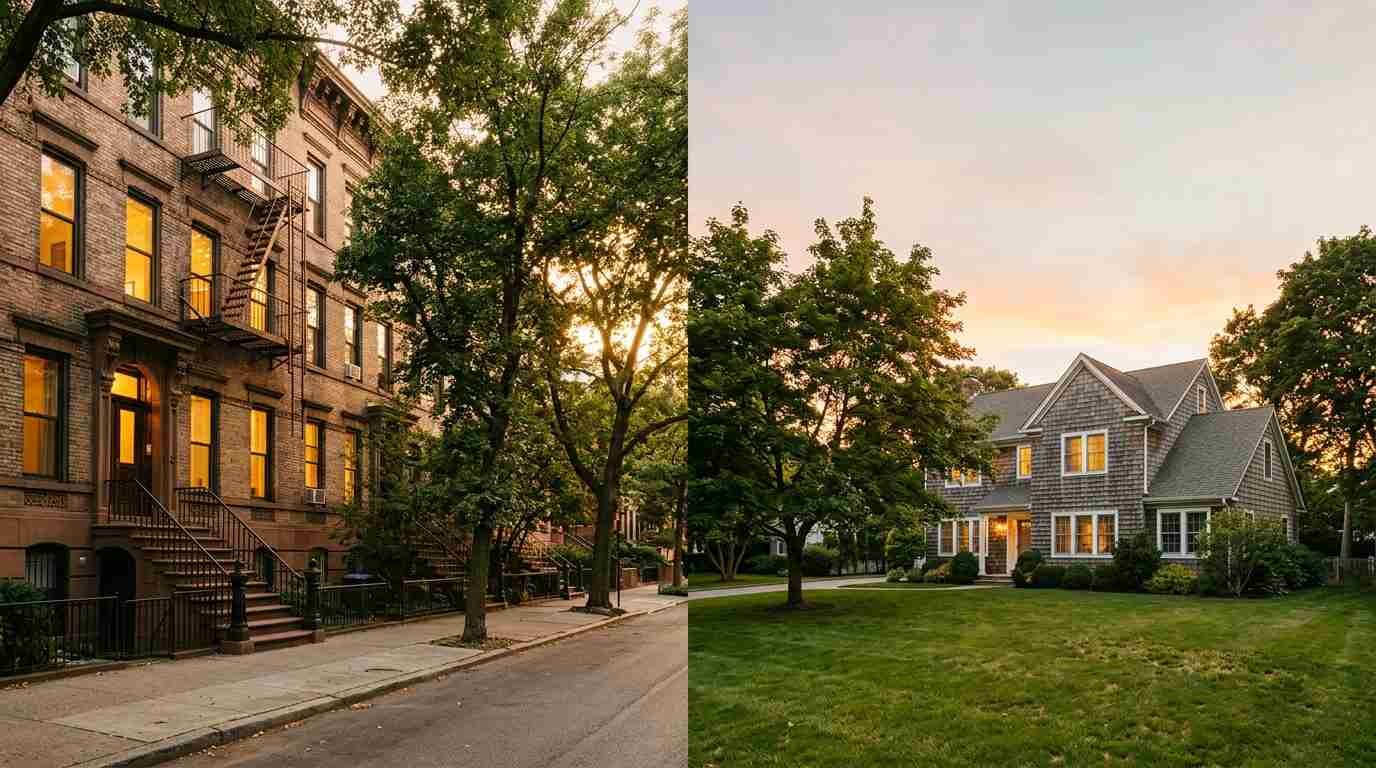
A $760,000 price reads the same on a Brooklyn contract and on a Suffolk County one, but the two closing statements that follow it do not. The mortgage recording tax differs by thousands of dollars, the monthly bill is built from different parts, and the market each buyer enters is moving at a different speed. With Freddie Mac reporting a 30-year fixed average of 7.40% on October 8, 2026, up from 6.30% a year earlier, those differences carry more weight than they did twelve months ago.
This comparison holds the price, the down payment and the rate constant, then changes only the location and the form of ownership. Every payment and tax figure below is a calculation from a published rate, and every market figure comes from a named report. For the broader relocation picture, Relocating to Long Island from NYC covers the move itself; this piece covers the purchase.
The short version
- Same loan, same payment. On a $608,000 loan (20 percent down on $760,000) at 7.40%, principal and interest comes to about $4,210 a month in either place. Against last year’s 6.30%, the same loan would have cost about $3,763.
- The closing tax gap is real. Suffolk County’s mortgage recording tax on that loan is $6,354. A New York City condo purchase with the same loan runs about $11,674. A NYC co-op carries none, because no mortgage is recorded.
- The monthly bill is built differently. NYC co-op maintenance and condo charges fold in building costs and, for co-ops, property taxes. A Long Island house sends the tax bill, the insurance premium and the heating bill separately.
- The markets are moving at different speeds. Manhattan contracts took about 90 days to sign in the third quarter, against 38 to 39 days on the market for single-family homes in Nassau and Suffolk in August.
What each market is reporting this week
Third-quarter reports for New York City arrived on October 6, and OneKey MLS published its August Long Island figures on September 22. Read together, they describe different products, so the table labels what each number covers.
| Market | Median price | Change vs. year earlier | Speed | What the figure covers |
|---|---|---|---|---|
| Manhattan, Q3 2026 | $1,250,000 | +4% | ~90 days to contract | Corcoran, all sales in the report |
| Brooklyn, Q3 2026 | $1,160,500 | -1.0% | 54 days to contract | Co-ops and condos only (Milton Coste) |
| Suffolk County, Aug. 2026 | $760,000 | +7.0% | 39 days on market | Single-family homes (OneKey MLS) |
| Nassau County, Aug. 2026 | $911,000 | +4.7% | 38 days on market | Single-family homes (OneKey MLS) |
Two cautions apply before comparing rows. The New York City figures describe apartments and the Long Island figures describe houses, and “days to contract” and “days on market” are different clocks. The borough numbers are examined more closely in Three Boroughs, Three Directions, which explains why Brooklyn’s median can slip while its condo prices climb.
Supply is the common thread. Corcoran’s report counted 6,354 active Manhattan listings, down 3 percent from a year earlier and the thinnest third-quarter supply since 2017, and Corcoran President and CEO Pamela Liebman said in the report, “The bigger structural issue continues to be a lack of supply.” Suffolk County’s inventory, 3,129 homes in August, was down 3.9 percent, and Long Island Guide’s summary of the OneKey data put it this way: “limited supply continues to support prices despite affordability pressures.”
On the Brooklyn side, the neighborhood blog Brooklyn Bridge Parents wrote in its September 2026 sales roundup that “one of the clearest things we are seeing in Brooklyn right now is that buyers are seeking good value.” The same pursuit of value is what sends many buyers to compare the two regions in the first place.
One price, three closing statements
The table below applies published tax rates to a $760,000 purchase with 20 percent down. The price is Suffolk County’s August median, used here only as a round reference point for all three columns.

| Line item | Suffolk County house | NYC condo | NYC co-op |
|---|---|---|---|
| Purchase price | $760,000 | $760,000 | $760,000 |
| Down payment (20%) | $152,000 | $152,000 | $152,000 |
| Loan amount | $608,000 | $608,000 | $608,000 |
| Principal and interest at 7.40% | ~$4,210/mo | ~$4,210/mo | ~$4,210/mo |
| Mortgage recording tax | $6,354 | ~$11,674 | $0 |
| State “mansion tax” (1% at $1M+) | $0 | $0 | $0 |
Calculated figures, not quotes. Title insurance, attorney fees, lender charges, board application fees and other items are additional and vary by transaction.
Where the tax numbers come from. The Suffolk County Clerk states that “Mortgage Tax is equal to 1.05% of the total mortgage amount (minus a $30.00 deduction if applicable),” which produces $6,354 on a $608,000 loan. For New York City, a broker-published guide, Hauseit, gives effective residential rates of 1.8% on loans under $500,000 and 1.925% on loans of $500,000 or more, and states that the tax does not apply to co-op apartments because a co-op loan is secured by shares and a proprietary lease rather than real property. Applying 1.925% less the $30 reduction to a $608,000 loan gives the roughly $11,674 shown. That rate comes from a secondary source, so a closing attorney’s figure should replace it before any budget is set.
What changes above $1 million. The New York State Department of Taxation and Finance states that “an additional tax (mansion tax) of 1% of the sale price applies to residences where consideration is $1 million or more,” and that it is “paid by the buyer.” The tax applies to the entire price once the threshold is reached, so a Manhattan purchase at the $1,250,000 median carries $12,500 of mansion tax, and a Long Island purchase at the same price carries the same amount. Co-ops and condos both count as residences for this purpose. The tax is statewide, which is why it appears in both regions.
A co-op’s missing recording tax should not be read as a pure saving. Co-op buyers meet different costs, including board application packages and building-specific fees, and the full breakdown by ownership type is laid out in Condo, Co-op, or Townhouse on Long Island. The Long Island side of the closing table is itemized in What Closing Costs Actually Look Like on Long Island.
What a rate move does to the payment
The same $608,000 loan costs about $4,210 a month at 7.40% and about $3,763 at 6.30%, a difference of roughly $450 a month, or more than $5,300 a year. The comparison matters in both regions, but it matters most where a buyer’s budget already runs near a lender’s limit, and at 7.40% the principal-and-interest line alone on this loan exceeds the typical existing owner’s total monthly cost. The Census Bureau’s 2020-2024 median selected monthly owner costs for Suffolk County homeowners with a mortgage was $3,320, a measure that includes taxes, insurance and utilities. That figure reflects owners who bought across many years, often at lower rates, so it describes the current owner population rather than a new buyer’s likely bill. Rent or Buy on Long Island in 2026 walks through running those numbers step by step.
Where the monthly money goes
Principal and interest is the same in the two regions. Everything after it is organized differently.

| Monthly cost | NYC co-op | NYC condo | Long Island house |
|---|---|---|---|
| Loan payment | Paid to lender | Paid to lender | Paid to lender |
| Property tax | Included in maintenance | Billed separately or folded into charges, depending on the building | Separate tax bill (school, town, county, village) |
| Building services | Included in maintenance | Common charges | None; owner arranges and pays |
| Heating | Often included in maintenance | Varies by building | Owner pays (oil, gas or electric) |
| Homeowners insurance | Owner buys a policy for the unit’s contents and liability | Owner buys a unit policy | Owner buys a full policy |
| Repairs | Building handles shared systems | Building handles shared systems | Owner pays for everything |
Brick Underground’s second-quarter 2026 Manhattan report, citing Miller Samuel, put average co-op maintenance at $3,077 a month, up 10.2 percent from a year earlier, and average condo common charges plus real estate taxes at $4,466 a month. Jonathan Miller of Miller Samuel told Brick that monthly charges “continue to outpace inflation for sales that closed in the quarter.”
Putting those averages beside a loan payment shows the shape of a Manhattan budget. At the $1,250,000 median with 20 percent down, the $1,000,000 loan at 7.40% costs about $6,924 a month in principal and interest. Add the average condo charges and taxes and the monthly total is about $11,390; add the average co-op maintenance instead and it is about $10,001. These are illustrations that join a median price to average-sized-unit charges, so they indicate scale rather than a quote.
The Long Island equivalent cannot be built from a single average, because the tax bill, the insurance premium and the heating cost each depend on the specific house. Each has its own breakdown: Long Island Property Taxes Explained for NYC Buyers covers the tax bill, The Insurance Quote Comes Before the Offer covers coverage, and Heating a Long Island Home in 2026 covers fuel costs.
A local video on the cost side
Newsday’s video report on why Long Islanders pay more for basic needs frames the cost question from the household side. It is embedded below; the figures in this article are separate from it.
The commute and the calendar
Distance and time shape the comparison as much as dollars do. A Manhattan buyer can often walk to work and to a train, while a Long Island buyer relies on the Long Island Rail Road or a car, and how often the office requires a presence in the city changes how that tradeoff reads. The train side is covered in LIRR Commute from Long Island to NYC, and the hybrid-work angle is covered in Forty Miles from the Bridge. Fare and schedule details change, so current figures belong on the MTA’s own pages.

The timeline of a purchase differs too. New York City co-op deals involve a board application and approval before closing, a step that Long Island house purchases do not have, while Long Island buyers more often deal with inspections of an older house and a septic or oil-tank question. Neither process is faster across the board, and a buyer weighing both should ask an attorney how long each type of closing is running right now.
Matching the numbers to the budget
The comparison tends to resolve on a few variables rather than a single winner:
- Cash at closing. A condo purchase carries the highest recording tax in this comparison; a co-op carries none; a Long Island house sits between them.
- Monthly predictability. Co-op and condo charges are set by the building and can rise with its costs; a house’s costs are lumpy and depend on its age and systems.
- Time in the home. Front-loaded closing costs spread thinner over a longer stay, in either place.
- Rate sensitivity. The payment moves with the rate identically in both regions, so the rate affects what loan size feels workable rather than which region is cheaper.
Frequently asked questions
Does a co-op avoid the mortgage recording tax?
According to the Hauseit guide, yes: a co-op loan is secured by shares and a proprietary lease, so the tax does not apply. Other co-op costs, such as board package fees and move-in deposits, are set by each building.
Does the mansion tax apply on Long Island?
Yes. The New York State mansion tax is 1 percent of the price for residences at $1 million or more, paid by the buyer, and it applies statewide.
Are the New York City and Long Island medians comparable?
Not directly. The New York City reports describe apartments, with differing coverage between reports, and the Long Island figures here describe single-family houses. Condo and co-op medians exist for Suffolk County too (about $570,000 and $257,500 in August), which is the fairer comparison for apartment buyers.
How much did the rate change affect the payment?
On a $608,000 loan, moving from 6.30% to 7.40% adds roughly $450 a month in principal and interest.
Where can the exact closing numbers for a specific purchase be confirmed?
A real estate attorney and the lender’s loan estimate are the authoritative sources; the figures here are calculations from published rates.
This article is for informational purposes only — consult a licensed attorney or financial advisor for your specific situation. Figures reflect sources published through October 9, 2026 and may have changed.
Real estate markets change. For current listings and market data, contact Maison Pawli at maisonpawli.com/about/.
You Might Also Like
- What Moving Really Costs on Long Island: Eight Common Beliefs, Checked Against the Rules
- Nassau County vs. Suffolk County: Which Should NYC Transplants Choose?
- The Hidden Costs of Selling Your Home That No One Tells You About
- Condo, Co-op, or Townhouse on Long Island
Sources
- Freddie Mac, Primary Mortgage Market Survey (30-year fixed 7.40% as of October 8, 2026; 6.30% a year earlier): freddiemac.com/pmms
- OneKey MLS, August 2026 market release (September 22, 2026): corporate.onekeymls.com
- Long Island Guide, “Long Island housing market pushes higher as Nassau and Suffolk prices rise despite slower sales, limited inventory” (September 29, 2026): longislandguide.com
- Corcoran, Manhattan Real Estate Market Report, Third Quarter 2026: inhabit.corcoran.com
- Milton Coste, Brooklyn Q3 2026 report: miltoncoste.com
- Brick Underground, “Median price for Manhattan co-ops and condos hit $1.25 million in second quarter” (July 2, 2026): brickunderground.com
- New York State Department of Taxation and Finance, real estate transfer tax and mansion tax: tax.ny.gov
- Suffolk County Clerk, Mortgage Tax: suffolkcountyny.gov
- Hauseit, The Mortgage Recording Tax in NYC (secondary source): hauseit.com
- U.S. Census Bureau QuickFacts, Suffolk County (median selected monthly owner costs with a mortgage, 2020-2024): census.gov
- Brooklyn Bridge Parents, “Property sales in our Brooklyn neighborhoods September 2026” (October 6, 2026): brooklynbridgeparents.com
- Newsday on YouTube: youtube.com/watch?v=KTAkZfkJxgM