What Buyers Should Actually Be Looking For at an Open House on Long Island

The couple showed up twenty minutes early. They had a binder — a literal three-ring binder — with printouts of the listing photos, the school district rankings, the tax records from the Suffolk County website. They walked through the house in eight minutes, told me they loved the kitchen island, and left. They never opened a single closet. They never looked at the basement. They never asked a question about the roof, the septic, or the property survey. They just loved the kitchen island.
I think about that couple sometimes. Because I see versions of them every weekend across the North Shore — earnest, prepared on paper, and completely unprepared for what an open house is actually for.
An open house is not a showing. It is not a tour. It is the only moment in the entire buying process where you are standing inside a property with no appointment pressure, no agent looking at their watch, and no obligation to make a decision. It is, if you use it correctly, the single best diagnostic opportunity you will get before you write an offer.
Here is what I want buyers looking at when they walk through a door on Long Island.
Before You Walk In, Walk Around
Start outside. Most buyers pull into the driveway and head straight for the front door. That is a mistake.
Walk the property line. Look at the grading — does the yard slope toward the foundation or away from it? On Long Island’s older housing stock, especially the postwar ranches and split-levels built on glacial till, drainage problems are endemic and expensive. Water pooling near a foundation wall is not cosmetic. It is structural.
Look at the roof from the street. Missing or curled shingles are obvious, but what you really want to notice is whether the roofline is straight. A sag in the ridge beam, even a subtle one, can indicate years of structural fatigue. On the North Shore, where nor’easters put repeated stress on roof systems, this matters.
Check the driveway and the walkways for heaving. Concrete that has lifted and cracked is often the first visible sign of root intrusion, frost heave, or a shifting grade — all of which can signal foundation movement beneath the surface.
If the property has a septic system — and most North Shore homes outside the villages do — ask the listing agent when it was last pumped and whether a Title V or equivalent inspection has been done. This is a question that separates the serious buyer from the browser, and the agent knows it.

Inside: What the Staging Is Doing and What It Is Hiding
Professional staging exists to sell a feeling. And it works — staged homes consistently sell faster and for more money. But staging also directs your eye where the seller wants it, and away from where they don’t.
I have written before about how sensory staging — scent, sound, and the first eight seconds — actually works. Read that piece from the seller’s perspective and you will understand exactly what is being done to you as a buyer. The vanilla candle is not accidental. The music is not random. The throw pillows are load-bearing, emotionally speaking.
Your job is to look past all of it.
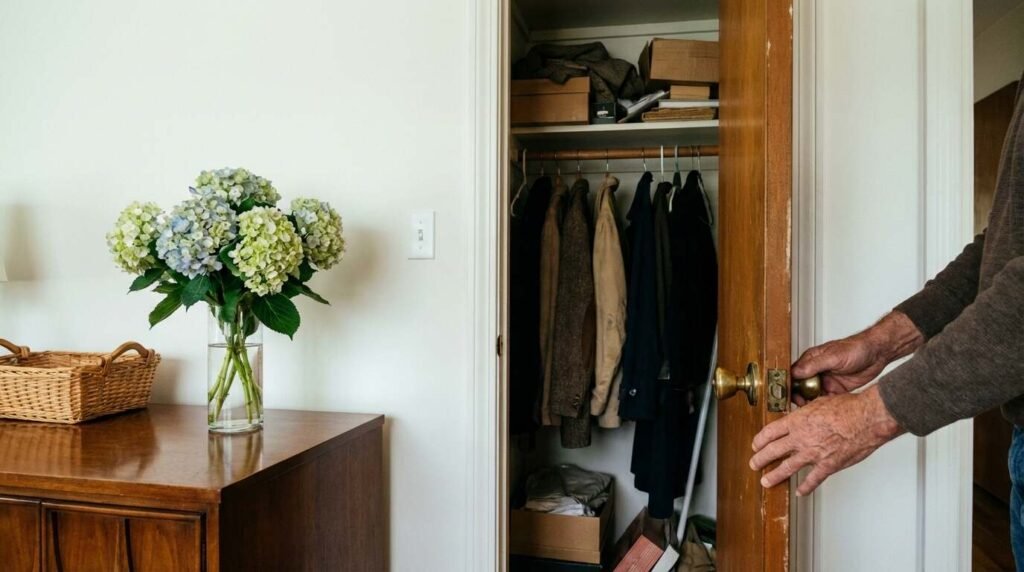
Open closet doors. How deep are the closets? How many are there? Storage is the single most complained-about deficiency in North Shore homes built before 1980, and no amount of staging will add a linen closet that does not exist.
Look at the ceilings. Water stains on a ceiling are the most reliable early indicator of a roof leak, a plumbing failure, or a condensation problem in the attic. Fresh paint on a ceiling — especially when the walls have not been painted — is a red flag. It means someone covered something up recently.
Test the windows. Open and close them. On older Long Island homes, particularly the colonials and Capes, windows that are painted shut or that stick in their frames are telling you something about how the house has been maintained. Replacement windows are a five-figure line item. Know before you offer whether you are inheriting that cost.
Run the water. Turn on faucets, flush toilets, check under the sinks. Low water pressure in an upstairs bathroom can indicate galvanized pipes that are corroding from the inside out — a common and costly problem in homes built before 1970 across Suffolk County.
The Questions the Listing Agent Expects — and the Ones They Don’t
Every open house has a sign-in sheet and a listing agent who will tell you the square footage, the school district, and the tax figure. That information is on Zillow. You do not need an agent to recite it.
Here are the questions that matter.
Has the seller completed the Property Condition Disclosure Statement? Since March 2024, New York law requires sellers of one-to-four-family homes to complete and deliver a PCDS before the buyer signs a contract. The old $500 credit opt-out is gone. If the seller has completed the form, ask to see it at the open house. It answers fifty-six questions about the property’s condition, from structural issues to flood history to environmental hazards. If they have not completed it, that is worth knowing too — it tells you something about how forthcoming this seller plans to be.
I wrote about the broader legal framework of what sellers are required to disclose at an open house — read that before you attend your next one.
When were the major systems last replaced? Roof, HVAC, water heater, septic, electrical panel. Get approximate years, not vague answers. A 22-year-old roof on a North Shore colonial is a negotiation point. A 5-year-old one is not.
Has the property ever had water in the basement? The listing agent may not answer this directly, but the PCDS requires the seller to disclose it. If the basement walls are freshly painted or there is a brand-new dehumidifier running, you already have your answer.
Are there any easements, encumbrances, or shared access agreements on the property? On Long Island, especially on parcels platted before 1960, utility and access easements can survive indefinitely and restrict what you can build, where you can build it, and what you actually own versus what you merely occupy.
Why is the seller moving? This is the question most buyers ask out of polite curiosity. Ask it instead as a strategic question. A seller relocating for work is motivated. A seller who “just wants to see what they can get” is not, and the negotiation will reflect that difference.
The Neighborhood Happens Outside
Leave the house and spend fifteen minutes in the neighborhood before you leave. Drive the route to the nearest LIRR station. Count the stop signs. Pass the elementary school at pickup time if you can. Open houses are almost always held on weekends, when every neighborhood looks quieter and more appealing than it will on a Wednesday morning when you are trying to get to Penn Station.
If this is a North Shore community you do not know well, I would encourage you to read the neighborhood profiles on this blog — Port Jefferson, Centerport, Cold Spring Harbor, Matinecock — to understand the character of each place before you set foot inside a house.
The house is half the purchase. The street, the district, the commute, the tax rate — that is the other half, and you cannot renovate any of it.
What an Open House Cannot Tell You
An open house is a diagnostic tool, not a substitute for a professional home inspection. It cannot tell you whether the electrical panel meets code. It cannot confirm that the septic system will pass. It cannot detect radon, mold behind walls, or buried oil tanks beneath the yard.
What it can do — and what I want every buyer walking a Long Island property to understand — is separate the houses worth inspecting from the houses that are not. If you walk an open house with the right questions and the right eyes, you will save yourself the cost of inspections on homes that were never going to work, and you will walk into the right home knowing exactly what to negotiate.
That is what the binder couple missed. The kitchen island was beautiful. The foundation was not.
This is for informational purposes only — consult a licensed attorney or financial advisor for your specific situation.
Real estate markets change. This post reflects conditions as of April 2026. For current listings and market data, contact Pawli at Maison Pawli.
You Might Also Like
- The Inspection Contingency Is Not a Formality: What Buyers Waive When They Sign Without Reading
- The Dual Agency Disclosure You Signed Does Not Mean What You Think It Means
- What Your Title Commitment Is Actually Telling You
Sources
- New York State Bar Association — “Property Condition Disclosure Act Amended; New Requirements Go Into Effect in March” (2024): https://nysba.org/pcda-amended-500-seller-credit-deleted-and-additional-questions-added-to-pcds/
- Long Island Board of Realtors — “Amended PCDS FAQ”: https://www.lirealtor.com/docs/default-source/default-document-library/PCDS-FAQ.pdf
- New York Senate — Property Condition Disclosure Statement, RPL § 462: https://www.nysenate.gov/legislation/laws/RPP/462
- Redfin — “Open House Checklist for Buyers” (2025): https://www.redfin.com/blog/open-house-checklist-for-buyers/
This post is part of our comprehensive guide: The Long Island Open House: What Sellers Must Disclose, What Buyers Should Ask, and What the Law Actually Says.