The Setauket House Remodel: Brick and Concrete Out, New York Bluestone In
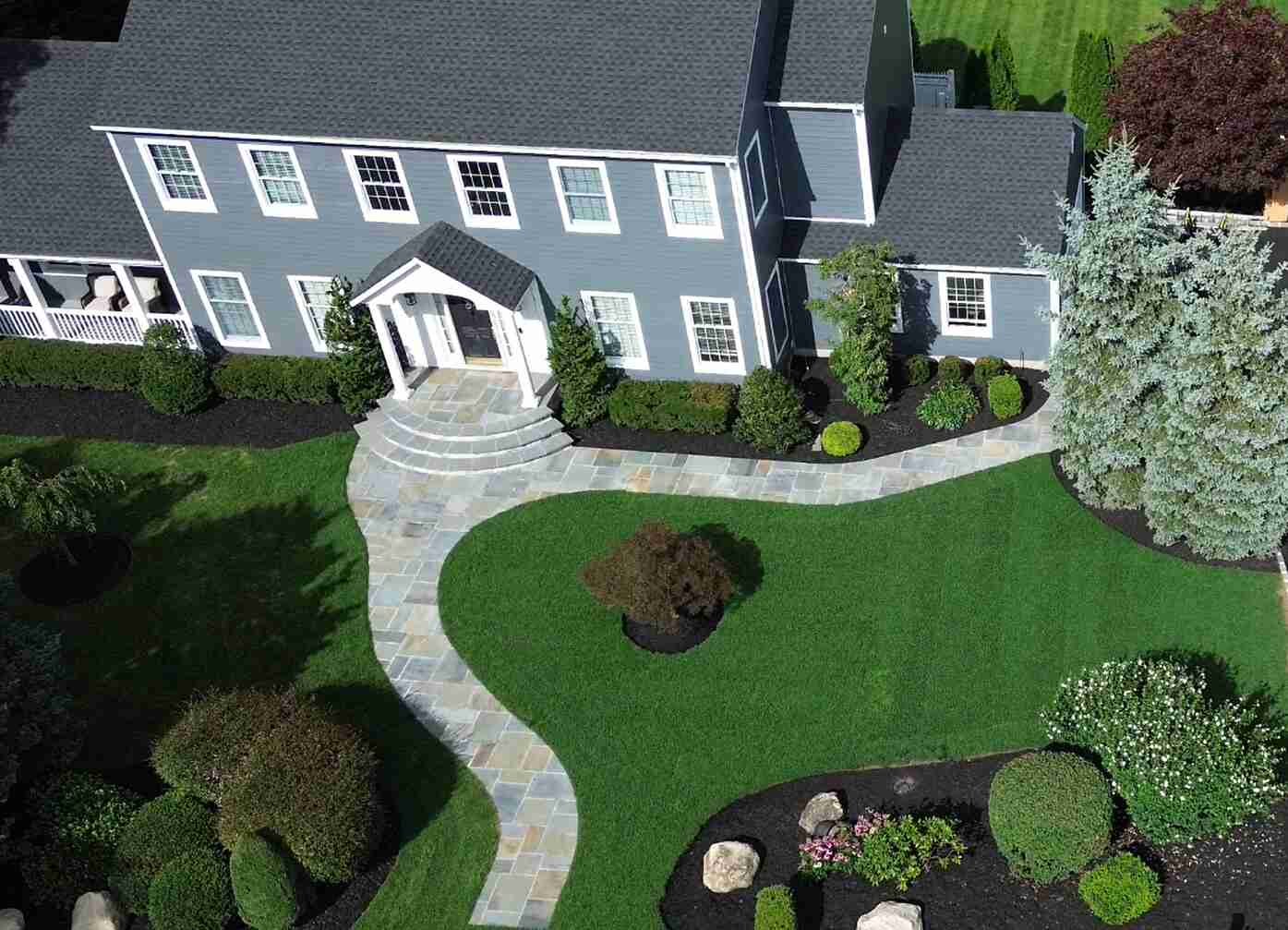
Three different surfaces used to meet at the front of this Setauket colonial, and none of them had been chosen with the others in mind. Red brick formed the landing and stairs at the door. A poured concrete walk ran off toward the garage. Out across the lawn, a single-file line of bluestone steppers wandered toward the street in a curve that had more to do with where the grass wore thin than with any plan. Each piece worked, more or less, on its own terms. Together they read as three separate decisions made across three separate decades.
That is the ordinary condition of a front entry on the North Shore. Hardscape gets patched rather than rebuilt, because patching is cheaper and the failure is gradual. This project took the opposite approach: everything came out, and one material went back in.
What Came Out
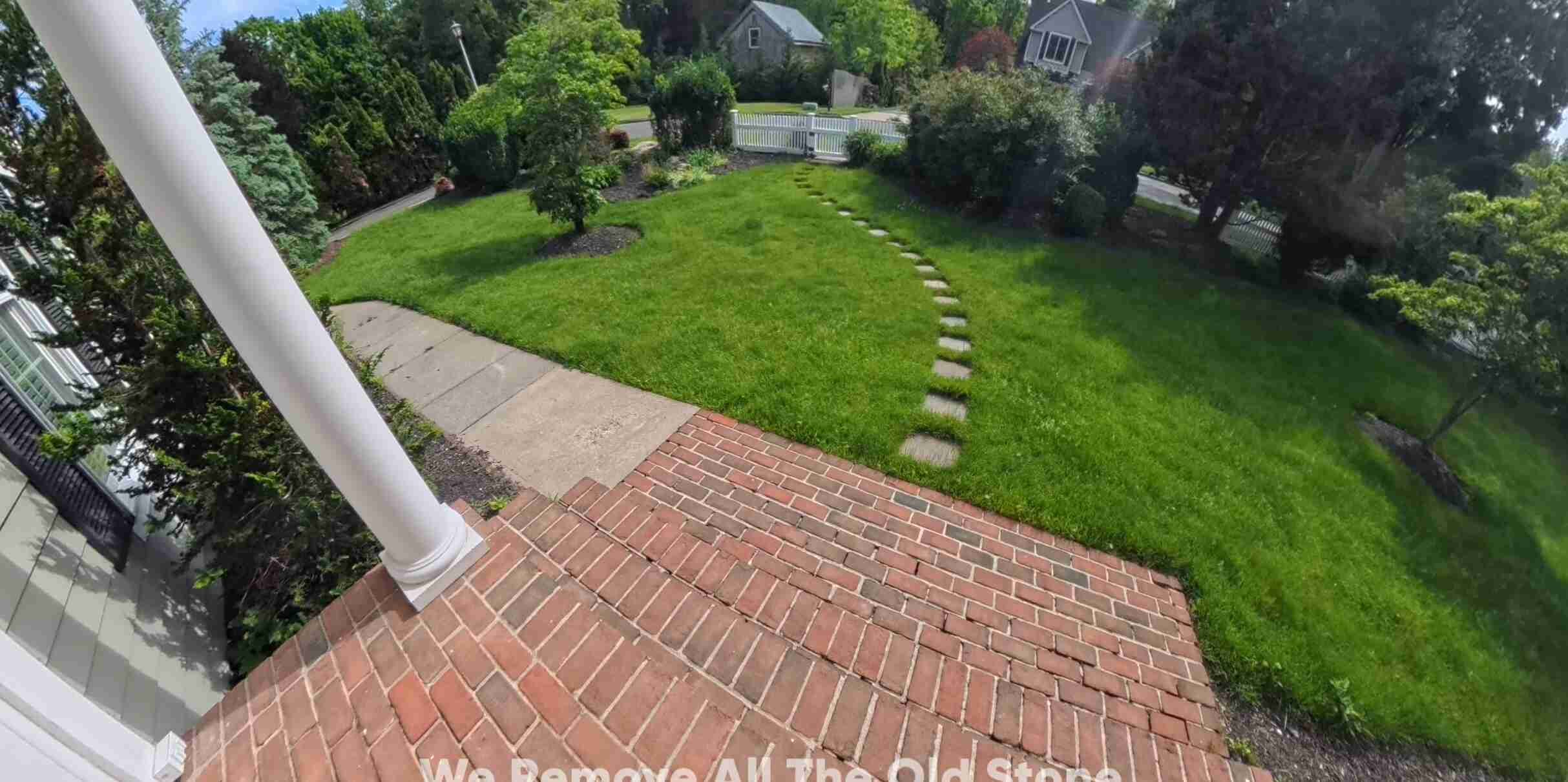
The demolition list was longer than the finished surface suggests. Brick stairs and landing, removed. Concrete walk to the garage, removed. The old stepping-stone path across the front lawn, lifted. The fence at the street line came down. Two mature trees standing in the middle of the front yard were taken out, along with the tired turf on the right side of the property.
Removing a walk rather than resurfacing it is a decision with real consequences underneath. Laying new stone over sound existing concrete is possible, but any future movement in that slab transfers straight up through the stone above it — which is why full removal and a purpose-built gravel base is the more durable route when the budget allows. Clearing the trees changed the geometry as much as the demolition did. A front lawn with two mature canopies in the middle of it is a series of obstacles; the same lawn cleared is a single plane, and a walkway crossing it can finally be designed as a line rather than a detour.
Why New York Bluestone
The replacement material is quarried a few hours upstate. Bluestone is a dense, hard, fine-grained quartz and feldspathic sandstone of Devonian age that splits cleanly along its bedding planes, and while the name suggests one color, the term covers all varieties regardless of shade, according to the New York State Department of Environmental Conservation. Sidewalks, curbing, patios, and steps have been cut from it for generations.
Its origin explains its behavior. Roughly 360 million years ago, the eroding Acadian Mountains shed quartz, feldspar, sand, and mica into a band across southern New York and northeastern Pennsylvania — the Catskill Delta — where slow-moving water laid the material down in thin sheets that eventually consolidated into sandstone, as the Stone Center describes it. Quarrymen split those layers apart along the ancient delta surfaces, and what emerges is New York bluestone.
Color is where this project made its most visible choice. Stone sold as “full color” carries the whole range — blue, gray, lilac, rust, gunmetal, and green — while blue select is sorted for consistency, and earth tones cover gray, green, and gunmetal, per Tompkins Bluestone’s specifications. The walk installed here runs full color. From the front door, the field of stone shifts from cool gray-blue in one panel to warm rust in the next, with green and gunmetal in between. Against gray siding and white trim, that variation does something a uniform surface cannot: it keeps a large expanse of hardscape from reading as a slab.
The Base Is the Whole Job
Everything visible in these photographs depends on material nobody will ever see. Bluestone does not fail on the North Shore because bluestone is weak. It fails because the base under it was thin, or because water sat where it should have drained.
Regional practice is specific about the numbers. A properly built stone walkway sits on a compacted gravel base of roughly six to eight inches of processed stone topped with a stone dust setting bed, deep enough to move water away below the frost line and give freeze-thaw cycles somewhere to go without lifting individual pieces, writes ND Landscape Services in its guide to New England stone walkways. The same guidance recommends pitching the surface about an eighth of an inch per foot so water sheds instead of ponding and refreezing, and choosing stone dense enough to resist spalling through repeated freezing — a description bluestone fits well.
Width matters too, and it is the detail homeowners most often get wrong. A front walk should let two people approach the door side by side; that guidance puts the floor at 48 inches, with 54 to 60 inches reading more generously on a typical house. The rebuilt path here is wide enough to carry that proportion across a long approach, and it curves once, deliberately, rather than wandering.
Lights in the Treads
Fixtures were set directly into the stone at the stairs. This is a small line item with an outsized effect on how the entry works after dark, and the survey data on it is interesting precisely because it cuts both ways.
Landscape lighting earned a perfect Joy Score of 10 from homeowners in the National Association of Realtors’ 2023 Remodeling Impact Report: Outdoor Features — tied for the highest of any outdoor project measured — while agents estimated cost recovery at 59 percent, among the lowest in the study, according to the report. Those are national averages built on a standard 600-watt transformer and 20 LED fixtures, so they translate loosely at best to any individual property. What they suggest is that lighting is bought for how a house feels to live in, not for what it returns at closing. Tread lighting also carries a practical argument that has nothing to do with either: on a stone stair used in January, seeing the edge of the next step is not a luxury feature.
New Sod, New Trees
Fresh sod went in on the right side of the property, run cleanly up to the edge of the stone. New trees were planted toward the center of the front yard, replacing the pair that came out.
Sod is unforgiving in exactly one way. Cornell Cooperative Extension in Nassau County is blunt about it: the leading reason sod fails to take is inadequate irrigation during the establishment window. Its guidance calls for an initial deep watering to a depth of six to eight inches applied slowly, then light watering at least twice daily until roots have knit into the soil below and the turf cannot be pulled up, in its Home Grounds fact sheet on sodding. Only after that does a normal weekly schedule apply. A crisp sod edge against new bluestone looks finished on day one; whether it still looks that way in September is decided in the first three weeks.
The new center plantings are the slower half of the design. Young trees in an open lawn do very little for a year or two, then quietly become the thing that gives the whole front yard scale.
What an Entry Rebuild Signals
Curb appeal is one of the few points on which agents are close to unanimous. Ninety-two percent of Realtors surveyed for the NAR report said they have advised sellers to improve curb appeal before listing, and 98 percent believe it matters to a prospective buyer. The same study priced an overall landscape upgrade — described as a natural flagstone front walkway, stone planters, flowering shrubs, a fifteen-foot deciduous tree, and mulch — at a typical $9,000 nationally, with agents estimating full cost recovery at resale.
That project description is a fair sketch of the work done here, though the numbers are national survey averages from 2023 and should not be read as a Long Island estimate. Costs and returns shift with region, scope, site conditions, and the state of the market at the moment of sale.
What a rebuilt entry communicates is harder to quantify than any of it. A buyer walking up a coherent stone approach, on a lawn without a patchwork of previous repairs, forms an impression of maintenance before reaching the door — and that impression tends to follow them through the rest of the showing.
This is for informational purposes only and is not legal, financial, or investment advice. Consult a licensed attorney or financial advisor about your specific situation, and work with a licensed contractor and, where required, your local building department before undertaking hardscape or drainage work.
Real estate markets change. For current listings and market data, contact Maison Pawli at maisonpawli.com/about/.
Sources
- New York State Department of Environmental Conservation — Bluestone Exploration and Mining
- Stone Center — New York Bluestone
- Tompkins Bluestone Co. — Special Cut Bluestone FAQs
- Use Natural Stone — Bluestone: Rivers and Deltas Create a Versatile American Sandstone
- ND Landscape Services — Stone Walkway Ideas That Set the Tone for a Welcoming New England Home
- National Association of Realtors — 2023 Remodeling Impact Report: Outdoor Features
- Cornell Cooperative Extension Nassau County — Sod: The Instant Lawn