The Floor Decides
Homeowners agonize over tile color and fixture finish. The decision that actually controls how a bathroom feels — and photographs — is underfoot.
Walk through ten renovated bathrooms in Long Island resale listings and the pattern repeats: new vanity, updated fixtures, fresh wall tile, dated floor. Or new wall tile and floor tile that was clearly selected in different seasons, in different stores, by people who were not speaking to each other. Or — the most common version — original 1950s floor tile still in place under a new wall treatment that was installed directly on top of it, creating a visual seam that buyers read, correctly, as incomplete.
Floor tile is the room’s tonal baseline. Everything else responds to it.
Why the Floor Controls the Room
Color theory explains the mechanics. The floor is the largest continuous surface in most bathrooms and sits below the viewer’s natural eye line — which means it registers as the room’s base note rather than its accent. Paint a bathroom wall warm cream and lay warm-toned stone on the floor, and the room reads warm throughout. Lay a cool white marble hex on the same floor and the cream walls start to read slightly greenish by contrast, because the eye recalibrates its color expectation from the floor up.
This is not a subtle effect that only trained designers notice. It’s the difference between a bathroom that feels cohesive and one that feels unsettled — and buyers notice it immediately, even when they can’t name why.
The second factor is aging. Of all the surfaces in a bathroom renovation, the floor tile shows age most visibly: in grout discoloration, in the texture shifts caused by hard water and cleaning product residue, in the micro-chipping at the corners of larger format tiles that foot traffic produces over years. Wall tile, particularly above the shower surround or behind the vanity, can retain its appearance for decades behind a coat of sealant and moderate care. Floor tile cannot hide the same way.
This means that dated floor tile — and specifically, floor tile from distinct aesthetic eras — signals age to buyers faster and more legibly than almost any other bathroom element. The pink ceramic hex from 1952 is readable as 1952. The brown-and-ivory checkerboard from 1978 is readable as 1978. A buyer can accept aged plumbing in an otherwise functioning bathroom; aged floor tile reframes the entire renovation history of the room.
The Two Strategies
Floor tile choices resolve into two distinct approaches, and choosing the wrong one for the room’s scale is one of the more common renovation missteps in Long Island’s postwar bathroom stock.
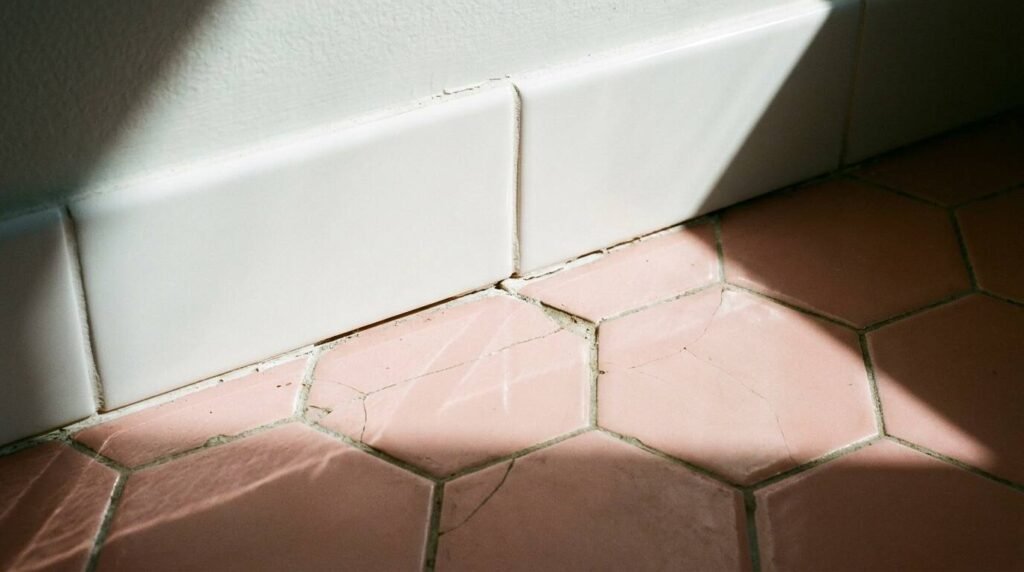
Floor tile as backdrop. Large-format neutral tile — typically 12×24 or larger, in warm gray, bone white, or soft stone tones — functions as a surface that recedes. The eye doesn’t rest on it. The room’s other elements advance: the vanity, the mirror, the hardware. This strategy works particularly well in smaller bathrooms where pattern underfoot competes with everything else for visual authority. It also ages gracefully, because neutral large-format tile reads as timeless rather than as belonging to a specific moment in design history.
The risk with backdrop tile is underestimating how much ground color still controls the room. A bathroom with bone-white large-format floor tile and cool-white wall tile isn’t neutral — it’s reading as cool, possibly clinical, depending on light conditions. Warm undertones in the floor tile are not a stylistic preference; they’re a functional correction for bathrooms that receive limited natural light, which describes most interior bathrooms in Long Island’s colonials.
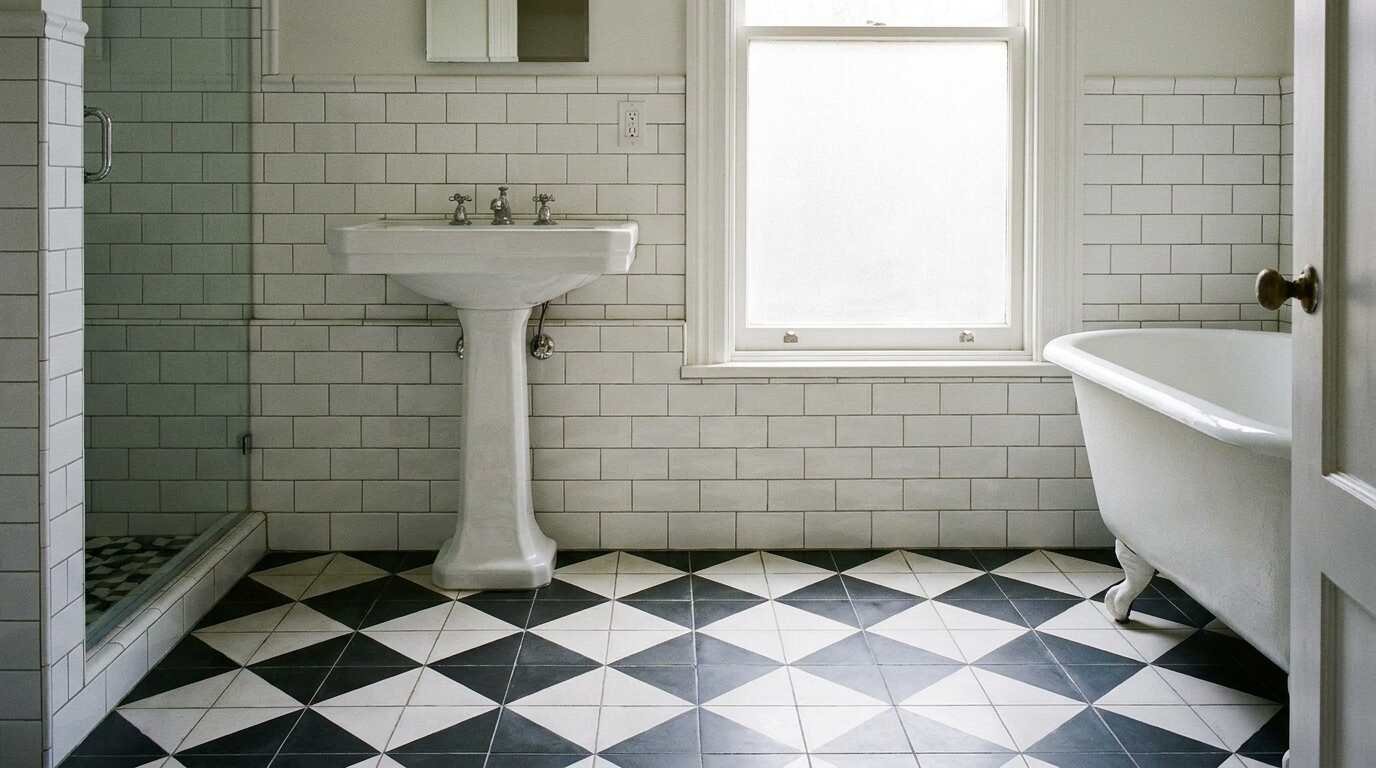
Floor tile as feature. Encaustic cement tile, small-format hex mosaic, graphic pattern tile in black and white or two-tone geometric — these treatments make the floor the room’s primary design statement. Used correctly, they anchor the room and reduce the pressure on every other surface to carry design weight. A bathroom with a strong encaustic floor can sustain a simpler wall treatment, a less distinctive vanity, hardware that doesn’t demand attention.
The scale constraint is real. Feature tile requires enough floor area to read as intentional rather than busy. In a 5×8 bathroom — a common configuration in the postwar colonials that define much of the North Shore’s housing inventory — a bold pattern can overwhelm the space. The general working principle: feature tile earns its place in bathrooms where at least one dimension exceeds seven feet, or in powder rooms where the small footprint becomes an opportunity for intensity rather than a constraint against it.
The Mismatch Problem on Long Island
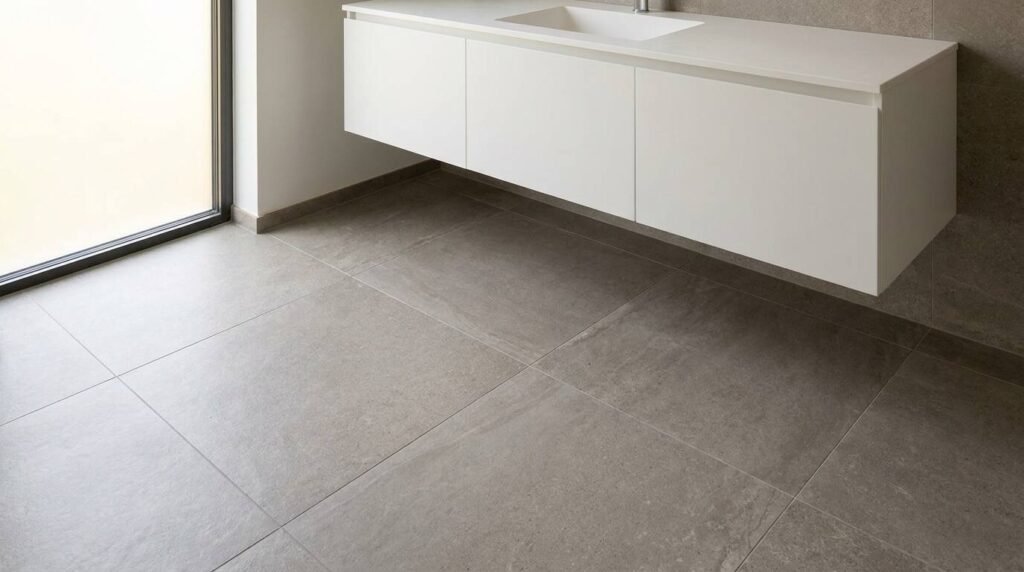
A renovation pattern specific to the postwar housing stock here deserves attention. In homes built between 1945 and 1970, the original floor tile — typically small ceramic in pink, green, black, or gray — was installed with mastic adhesive directly onto the subfloor. Removing it completely is labor-intensive and occasionally reveals subfloor conditions that require additional remediation. Tiling over it is structurally permissible in many cases, depending on current floor height and door clearances.
The problem is not structural. It’s visual. New wall tile installed above original 1950s floor tile creates a legible join at the baseboard — a color and texture discontinuity that buyers perceive as the renovation stopping short. The new wall treatment doesn’t justify the old floor; it makes the old floor more visible by contrast. A buyer who might have accepted the original tile as a period-appropriate feature now sees it as something the seller chose not to address.
The workaround that actually works — pulling the original floor tile entirely and replacing it as part of any wall tile renovation — adds cost that sellers frequently resist. But among the decisions that affect how a renovated bathroom photographs and presents at an open house, it is among the most impactful. Buyers touring a home will walk past a dated vanity with more equanimity than they’ll walk over a floor that tells two different design stories.
For sellers evaluating what to address before listing, the Staging Mistake That Costs Long Island Sellers $15,000 at the Table covers how buyers form first impressions faster than sellers expect. The bathroom floor is one of the rooms where that impression forms and sticks.
—-
You Might Also Like
- The Return of Aged Brass: Why Designers Are Ditching Chrome for Something Warmer
- Declutter Like You Mean It: The Seller’s Room-by-Room Renovation Sprint Before Listing
- Wabi-Sabi in the Kitchen: The Case for Ceramics That Show Every Scar
—-
Sources
- Apartment Therapy. “Bathroom Tile Ideas — Floor, Shower, Wall Designs.” https://www.apartmenttherapy.com/bathroom-tile-ideas-36628537
- Xing Tek Flooring. “Tile Selection for HDB Bathrooms: Size, Color, and Pattern.” https://xingfloor.wordpress.com/2025/01/21/tile-selection-for-hdb-bathrooms-size-color-and-pattern/
—-