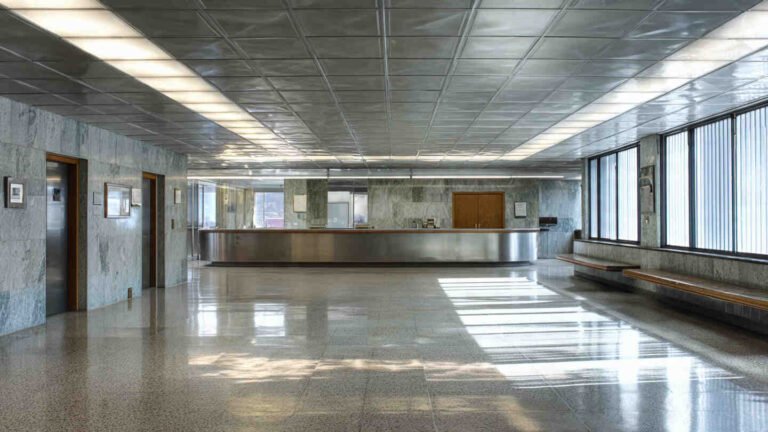
Building the Moon Buggy in Bethpage
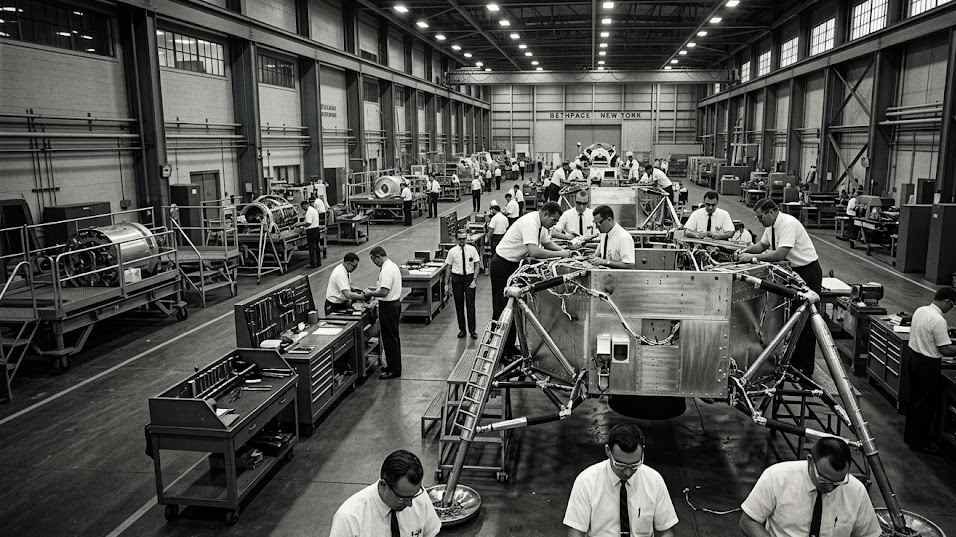
Before silicon valleys and software, Long Island grease monkeys in short-sleeve button-downs built the machine that landed on the moon. It was riveted together right off the Seaford-Oyster Bay Expressway.
This is the part of the story that gets left out.
When people talk about Apollo — and people are talking about Apollo again, now that going back feels less like nostalgia and more like an active argument with the Chinese space program — the narrative tends to collapse into two figures: the astronauts and the rocket. Neil Armstrong and Buzz Aldrin. The Saturn V. The Florida launchpad and the Houston control room. It is a good story. It is not the whole story.
The whole story includes a flat, unremarkable industrial campus in Bethpage, Nassau County, Long Island, where engineers and machinists and welders working for the Grumman Aircraft Engineering Corporation spent the better part of a decade building something that had never existed before: a vehicle designed to fly in a place with no air, no runway, and no margin for mechanical failure.
They called it the Lunar Module. The astronauts who flew it called it the LM, pronounced “lem.” It was, arguably, the most demanding piece of precision engineering ever constructed up to that point in human history. And it was built in a Long Island factory by people who drove to work on the Long Island Expressway.
Grumman Before the Moon
It is worth knowing what Grumman was before NASA came calling, because the institution that won the Lunar Module contract in 1962 did not come out of nowhere.
Leroy Grumman had been building aircraft on Long Island since 1929, when he and two partners founded the company in a garage in Baldwin. The company grew quickly on the strength of naval aviation contracts — the F4F Wildcat, the F6F Hellcat, the TBF Avenger — aircraft that flew in the Pacific in World War II and earned Grumman a reputation as one of the most precise and reliable manufacturers in the American aerospace industry. Navy pilots called Grumman aircraft “Grumman Iron Works” — not as criticism, but as high praise. These were planes that came back.
By the early 1960s, Grumman was operating a sprawling campus in Bethpage and employed tens of thousands of Long Islanders. The workforce was not populated by Ph.D.s in astrophysics. It was populated by machinists, draftsmen, tool-and-die workers, sheet metal fabricators — people who had grown up in Brooklyn and Queens, who had fathers who worked in the Brooklyn Navy Yard, who understood precision metalwork the way a carpenter understands wood grain. This was not a theoretical culture. It was a fabrication culture.
When NASA awarded the contract for the Lunar Module to Grumman in November 1962, they were betting on that culture. They were betting that the people who had been building the most demanding aircraft in American naval history could translate that discipline into something that had never been done before.
It turned out to be a reasonable bet.
The Engineering Problem Nobody Had Solved
Here is the core problem that the Bethpage engineers had to solve, and it is worth stating it plainly because no amount of abstract admiration for “ingenuity” captures what the actual constraint was.
The Lunar Module had to do the following: detach from the Command Module in lunar orbit, descend to the surface of the moon under rocket power with no atmosphere to use for aerodynamic braking, land on a surface nobody had ever physically touched with instruments precise enough to prevent tipping and catastrophic failure, keep two human beings alive in a vacuum for up to 33 hours, then re-launch from the lunar surface using only the ascent stage engine — a single engine that had to fire perfectly on the first attempt with no backup — rendezvous with the Command Module in orbit, and allow crew transfer before the ascent stage was jettisoned.
A single point failure in any of those sequences meant two people died on another world, or stranded in space between the worlds. There was no rescue mission in the architecture. There was no second chance for the descent engine. There was no backup ascent engine.
The engineering response to this was not bravado. It was rigor.
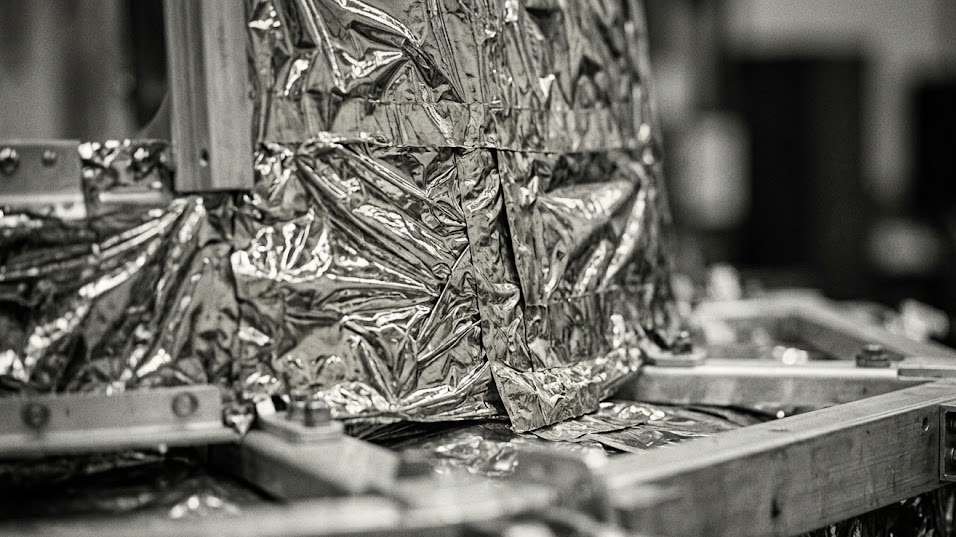
Grumman’s engineers designed and redesigned the LM through fifteen major design iterations between 1963 and the first crewed mission in 1969. The weight problem alone consumed years: the vehicle had to be light enough to be lifted from Earth on the Saturn V, yet structurally capable of withstanding the stresses of launch, the thermal extremes of the lunar environment, and the dynamic loads of descent and ascent. At various points, NASA and Grumman engineers stripped weight from the structure by shaving metal to thicknesses measured in thousandths of an inch.
The outer skin of the Lunar Module in some places was thinner than a sheet of aluminum foil. You could push your thumb through it if you applied steady pressure. This was not a design flaw. It was a design achievement — the exact minimum material required to do the job in a vacuum, with no wind load, no weather load, nothing pulling on it except the mechanical stresses of operation.
Thomas J. Kelly, the chief engineer for the Grumman Lunar Module program, wrote about this later with the precision of a man who had lived inside the problem for a decade. His account, Moon Loft, is one of the clearest technical memoirs in aerospace history — a Long Island engineer explaining, without vanity, how a group of people figured out how to build something that had no precedent.
The Factory Floor
The Bethpage plant during the Apollo years was a controlled obsession.
Quality control procedures were unlike anything Grumman had implemented for conventional aircraft work. Every fastener, every weld, every solder joint on every piece of avionics was documented. Workers who had spent careers in sheet metal fabrication now found themselves wearing clean room protocols — lint-free suits, controlled environments, procedures that made the fabrication of a naval fighter look casual by comparison.
The workforce adapted. That is the part of the story that deserves more credit than it typically receives.
These were not people selected from an aerospace elite. They were Long Island manufacturing workers — many of them immigrants or the children of immigrants, many of them without college degrees, some of them without high school diplomas — who learned a new level of precision because the mission demanded it. The machinists who drilled to tolerance on fighter plane airframes learned to drill to tighter tolerances still. The welders who had worked on wing assemblies learned to work on pressure vessels that would hold human life against hard vacuum.
There is something in that fact that resists easy sentimentality but demands acknowledgment anyway. The Apollo program is remembered as a triumph of science, and it was. It is less often remembered as a triumph of American working-class labor — of people who showed up to a factory in Nassau County and fabricated, with their hands and their tools and their accumulated skill, the machine that Neil Armstrong stepped out of onto the surface of the moon.
Apollo 13 and the Machine That Saved Three Lives
The Lunar Module’s most famous moment is not a landing. It is a rescue.
On April 13, 1970, an oxygen tank in the Apollo 13 Service Module ruptured 200,000 miles from Earth. The Command Module — the capsule NASA had spent the most engineering attention on — was dying. The crew of Jim Lovell, Jack Swigert, and Fred Haise had to abandon it and take refuge in the Lunar Module, a vehicle designed to support two people for 33 hours. There were three of them, and they needed it to last 90 hours.
It did.
The LM’s life support, its power systems, its structural integrity held under conditions it was never designed to handle. Mission controllers and Grumman engineers on the ground worked through the improvised procedures that kept the crew alive, but the equipment had to perform — and the equipment, built by the people in Bethpage, performed.
When the crew re-entered the Command Module for reentry and jettisoned the Lunar Module, astronaut Jim Lovell’s last radio transmission about it was: “Farewell, Aquarius. We thank you.”
Grumman sent NASA a tongue-in-cheek invoice afterward for the “emergency towing service.” NASA declined to pay. Grumman framed the exchange.
What’s Left
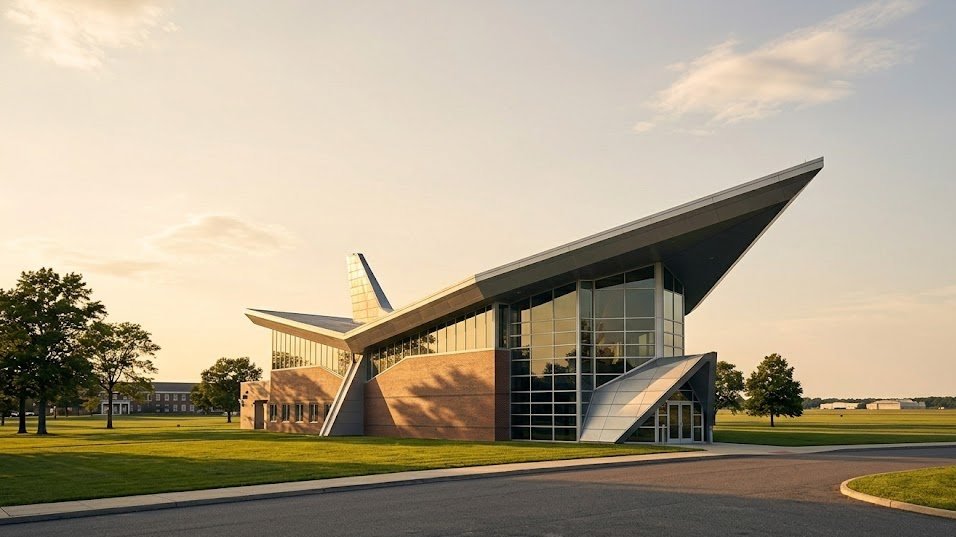
The Cradle of Aviation Museum in Garden City, Nassau County, holds the institutional memory of what Grumman built on Long Island. There you will find a Lunar Module test article — LM-13, which was never flown — and the documentation of the engineering culture that produced the Apollo fleet’s most singular vehicle.
It is worth going. It is worth standing in front of a machine that was designed to operate in the hardest environment a human-built object had ever entered, and recognizing that it was assembled a few miles from where you are standing, by people who drove home on the Wantagh Parkway afterward.
Long Island’s identity as a place is mostly built around its relationship to the city — the commuter corridor, the suburban bedroom. That story is accurate as far as it goes. But it misses something real.
For about a decade in the 1960s, one company in Bethpage was doing the most precise manufacturing work in the history of the planet. And then, on July 20, 1969, a vehicle they built touched down in the Sea of Tranquility, and two men climbed out of it, and one of them said the words that have been quoted ever since.
The other thing he said, a few minutes later, was: “Beautiful view. Magnificent desolation.”
The people in Bethpage who built what he was standing in probably agreed.
Sources
- Cradle of Aviation Museum, Garden City, NY — cradleofaviation.org
- NASA History Division — Apollo Program historical records: history.nasa.gov
- Kelly, Thomas J. Moon Loft: The Story of the Lunar Module. Smithsonian Books, 2001. (Verify current availability and edition)
- Grumman History Center Archives — available through Northrop Grumman corporate history resources
- NASA — Apollo 13 Mission Report: history.nasa.gov/SP-350/ch-13-1.html (Verify link is active before publishing)