
The Quiet Return of Couture Mourning: How Black Dress Codes Are Being Reclaimed as Acts of Elegance
There is a particular kind of woman — I have met her at Christie’s previews, at Sotheby’s evening sales, at the kind of private showings where the catalog is printed rather than emailed — who wears only black. Not as a statement. Not as a pose. As a conclusion she has reached, quietly, about what she values and what she does not.
I have thought about her wardrobe more than she probably intended me to. Because what she is wearing, without perhaps knowing its full history, is one of the most codified and exquisitely developed dress traditions in the Western world: the language of mourning cloth.
The Victorian Architecture of Grief
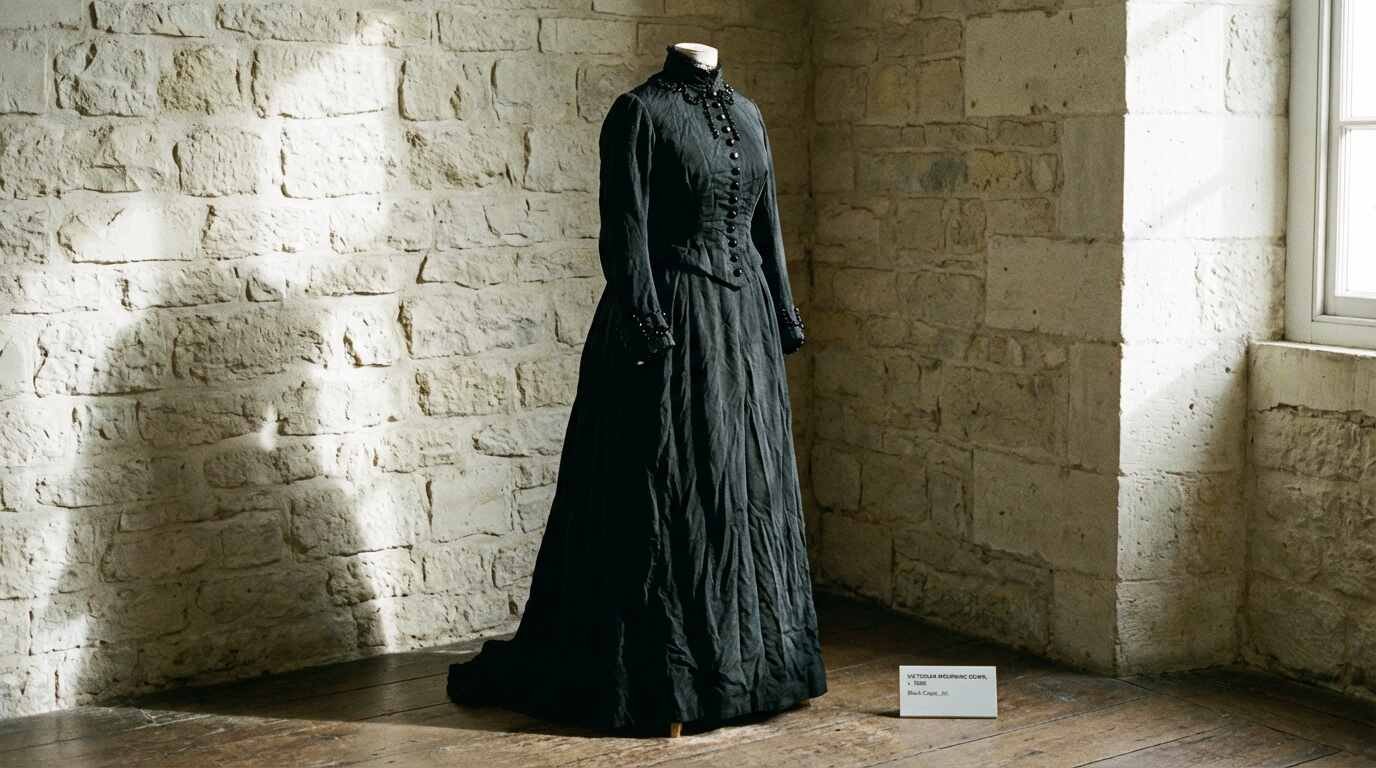
The Metropolitan Museum of Art’s Costume Institute holds one of the most instructive collections of 19th-century mourning dress in the world — and “instructive” is the right word, because what these garments reveal above all else is that Victorian mourning was not simply emotional expression. It was a precision system. The fabrics were legislated by grief’s stage: paramatta silk and wool crape in deep mourning, lustreless black silk permitted only when the heaviest period had passed, then half-mourning’s muted lilacs and soft grays as the prescribed codes slowly relaxed.
Worth and Poiret, the two most technically accomplished couturiers working across the cusp of the 20th century, both produced mourning commissions of extraordinary refinement. Worth’s house, which dressed the wealthiest women on both sides of the Atlantic, understood mourning wear as an architectural problem: how to drape grief with dignity, how to make restraint its own form of richness. The fabrics were matte, the silhouettes severe, the construction beneath them immaculate.
What is striking, viewed now, is how modern they look.
Kawakubo’s Argument
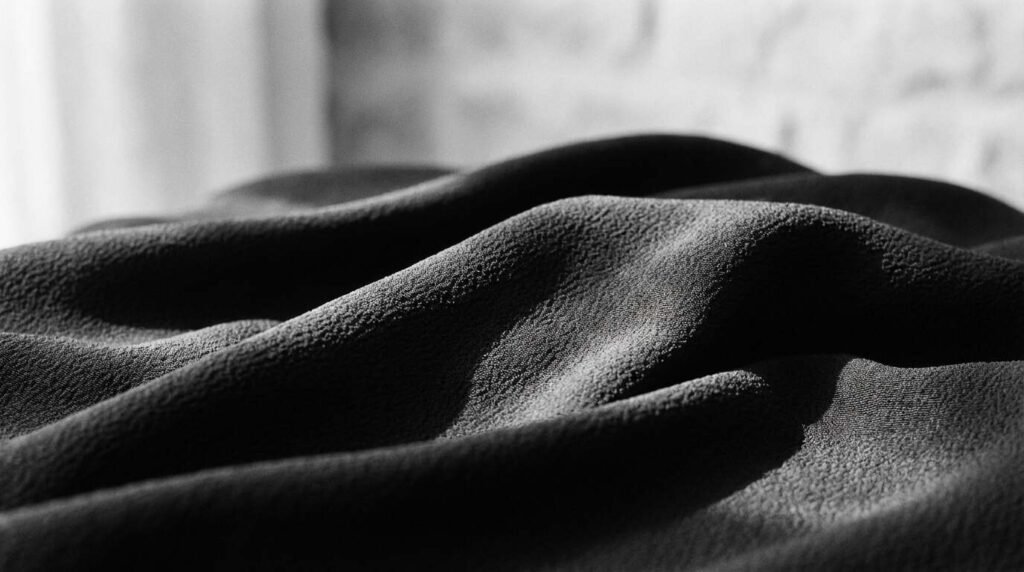
When Rei Kawakubo presented Comme des Garçons’ Spring 2017 collection — the subject of her concurrent retrospective at the Metropolitan Museum of Art — she was doing something that the Victorian mourning industry had done a century earlier, though she would likely have refused the comparison. She was insisting that black, stripped of ornament, stripped of sociability, was not absence. It was presence of a very specific and demanding kind.
Vogue’s 2017 coverage of the Met Gala retrospective positioned the collection as a meditation on the relationship between body and dress — Kawakubo’s phrase, Body Meets Dress, Dress Meets Body, capturing something the Victorian crape-makers had understood intuitively: that clothing which refuses to perform carries more weight than clothing that tries to dazzle. The asymmetries, the volumes, the unresolved hems — all of it was a sustained argument for incompleteness as sophistication.
Olivier Theyskens, whose gothic romanticism animated some of the most remarkable eveningwear of the early 2000s, arrived at a similar position from a different direction: the black dress as elegy, as something that acknowledges weight without collapsing under it.
The Victorian widow had known this. She dressed in crape because the code demanded it. But Kawakubo dressed in black because she understood, as the Victorians did, that constraint is its own form of expression.
The Auction Room as Fashion Laboratory
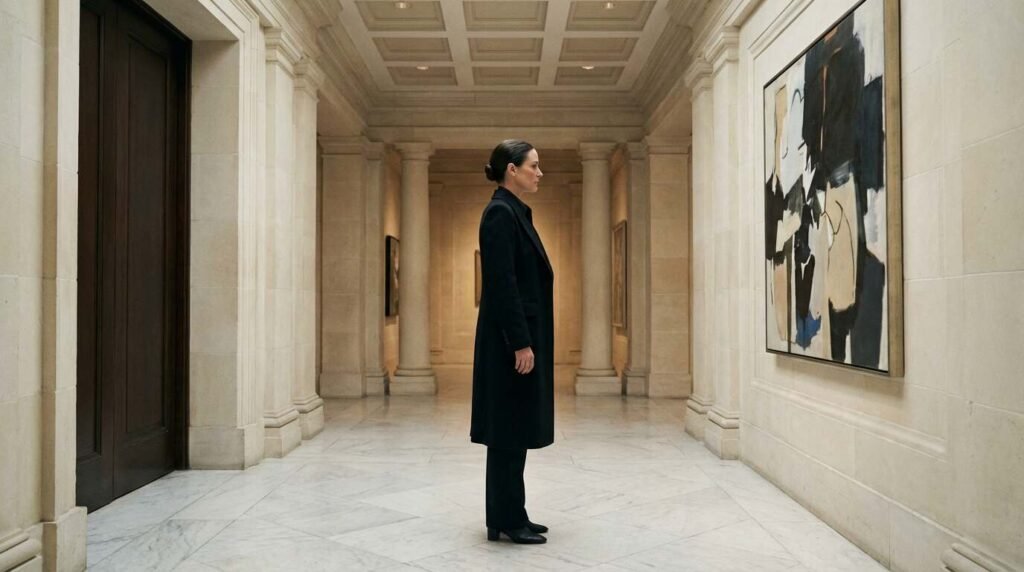
Christie’s editorial coverage of dress codes at private sale previews in London and New York has documented something that any regular attendee would confirm: the women who navigate these rooms with the most authority are overwhelmingly dressed in black. Not fashion black, not trend black — something quieter and more considered.
I find this interesting as someone who has spent years reading rooms — not auction rooms, but showings, open houses, the particular social choreography of a property that is being considered by people with real resources. The dress codes in those rooms operate the same way. The buyer who arrives in restraint, who communicates through quality rather than volume, who lets the property do the talking — she is speaking the same sartorial language as the Comme des Garçons collector at Christie’s.
Black, deployed with conviction, is a form of editing. It removes everything that does not contribute. What remains is the thing itself.
Reclamation, Not Revival
What is happening now is not nostalgia for the Victorian mourning period, and it would be a category error to call it a revival. What is being reclaimed is the underlying logic: that black worn deliberately, worn with knowledge of its history and its codes, is one of the most powerful positions available to a woman who has decided to stop performing for audiences she does not respect.
The Met’s Costume Institute collection shows us what this looks like at its most rigorous — the crape collars, the jet buttons, the carefully graded fabrics marking time’s passage through grief. What the Christie’s preview rooms show us is what it looks like when that rigor is chosen rather than prescribed. When the all-black wardrobe becomes not a uniform of loss but a philosophy of presence.
I have been watching this long enough to know it is not going away. The women I see dressed this way are not in mourning. They are, in the most precise sense of the word, in command.
This post reflects current cultural observations and is not associated with any specific commercial interest. For questions about North Shore properties and the art of presenting a home well, reach out to Pawli at Maison Pawli.