The Aristocrat of the Roasting Pan: How Long Island Mass-Produced the Duck
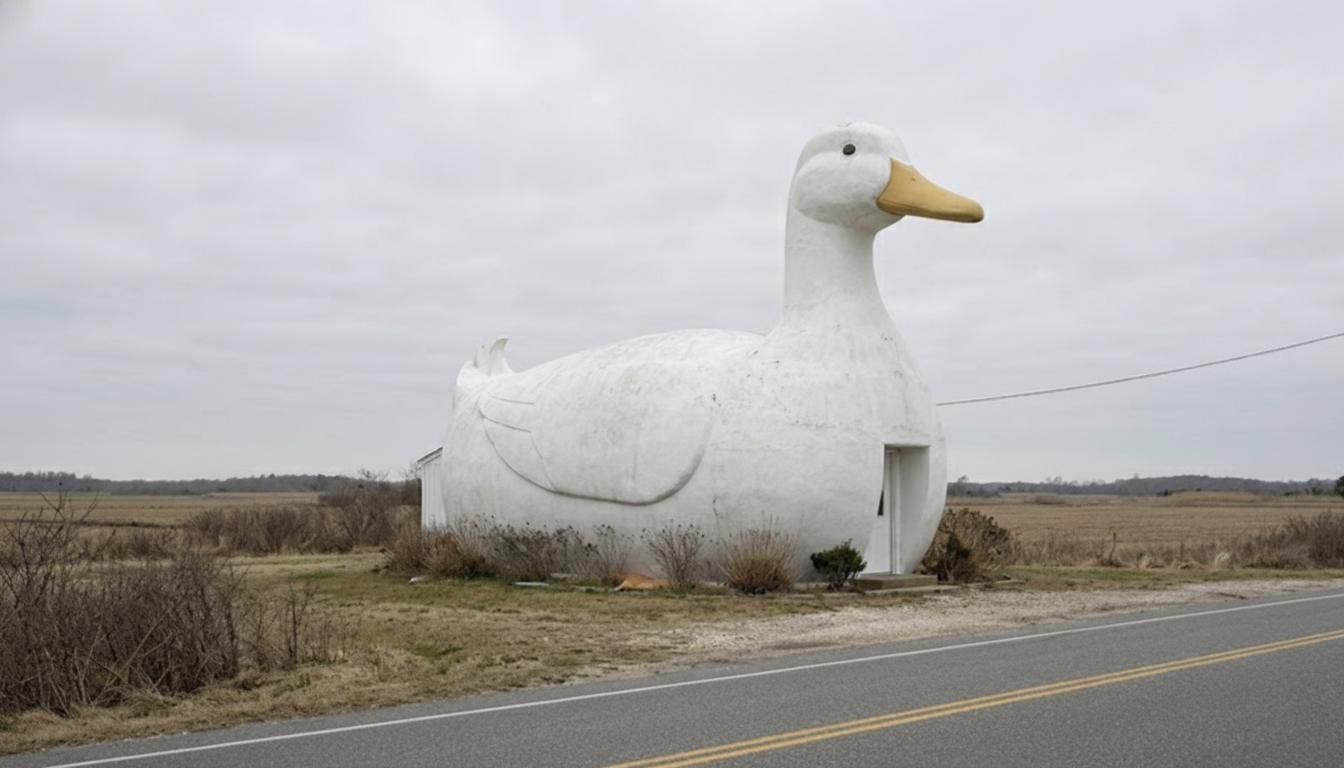
There is a building in Flanders, New York, shaped like a duck. It is twenty feet tall, made of concrete and wire lathe, and was constructed in 1931 by a duck farmer named Martin Maurer to sell ducks and duck eggs out of the bird’s hollow belly. It is now on the National Register of Historic Places. People drive out specifically to take photographs of it.
The Big Duck is charming. It is also a pretty good monument to the distance between what an industry actually is and what we remember it as.
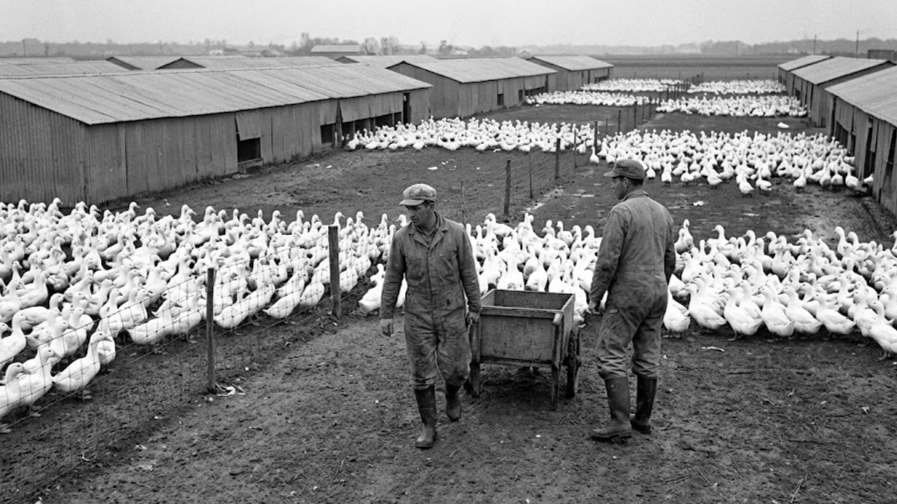
What the duck industry on Long Island actually was, at its height, was one of the most intensive and unglamorous agricultural operations in the northeastern United States. Millions of birds. Miles of low corrugated sheds. Crews of workers doing the kind of labor that people who eat duck at nice restaurants prefer not to think about. The smell, documented in county health board complaints from the 1950s through the 1980s, was considerable. The Peconic River, which runs through the heart of Suffolk County’s former duck country, spent decades under various degrees of pollution pressure from the nutrient runoff the industry produced.
And yet: Long Island duck. On menus. In cookbooks. Held up as a regional delicacy with the same casual confidence that you’d cite Vermont maple syrup or Chesapeake blue crabs.
This is the trick that mass production learned to perform. It takes the grit out of provenance. It leaves the romance.
How It Started: One Shipment, One Industry
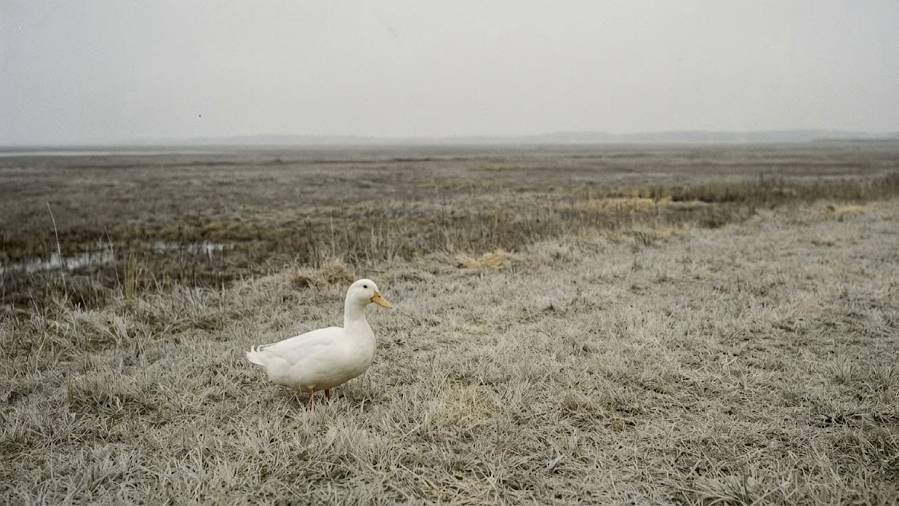
The story begins in 1873, with a Yankee clipper captain named James Palmer and a cargo hold containing nine Pekin ducks — brought from China, possibly via England, accounts differ slightly — that arrived and were acquired by a Long Island farmer. The Pekin duck — white-feathered, fast-growing, mild-flavored, and adaptable to the flat, marshy terrain of eastern Long Island’s South Fork and the Flanders Bay area — proved to be an almost perfectly engineered commercial bird.
Within a generation, duck farming had become a significant Suffolk County industry. By the early twentieth century, Long Island was producing millions of ducks annually and supplying a significant share of the nation’s duck market. The Suffolk County Historical Society archives document the industry’s expansion in detail: the proliferation of farms along the Peconic River watershed, the infrastructure of feed operations and processing plants, the labor networks that supported them.
At the peak of the industry — roughly the 1950s through the 1970s — Long Island farms were producing somewhere in the range of seven million ducks per year. Seven million. In a county that today people associate with beach traffic and vineyard tourism.
Who Was Eating Them
Long Island duck, by the time it had achieved name recognition, was landing primarily on restaurant tables catering to people who had never set foot near a duck farm. The language around it — the cookbooks, the menu descriptions, the food press — treated it as a refined, almost aristocratic protein. Henri Soulé, whose restaurant Le Pavillon essentially defined haute cuisine in mid-century New York, served duck. The great French restaurants of Manhattan were using Long Island duck as a matter of course. It was, in the parlance of the time, the correct duck.
The men and women raising those ducks, meanwhile, were working in conditions that bore approximately zero relationship to the settings in which the birds were being consumed. Duck farming is hard, wet, cold, and malodorous work. The processing end is harder. What the restaurant menu accomplished — what it always accomplishes — was to remove the production from the product. To make the duck an object of pleasure without any residue of the labor that created it.
“Long Island duckling” became a category, a quality signal, a reason to charge more. The farms it came from were invisible by design.
The Decline
The industry began contracting significantly in the 1980s and 1990s, under pressure from multiple directions simultaneously. Land values in Suffolk County had risen to the point where duck farming was no longer the most profitable use of the real estate. Environmental regulations, particularly around water quality in the Peconic River watershed, increased compliance costs. National competition from Midwestern producers with lower land and labor costs undercut the economics.
By the early 2000s, the industry had shrunk to a handful of operations — most notably Crescent Duck Farm in Aquebogue, which by most accounts is now the last significant commercial duck farm operating on Long Island. The Crescent birds still carry the Long Island duckling designation; the operation has survived by combining production efficiency with a heritage brand identity that the larger industry could not maintain.
The irony is complete: what began as an industrial operation — a volume business built on cheap land, available labor, and a remarkably productive bird — has become, in its final surviving form, a specialty product. The thing that industrialization was supposed to eliminate — scarcity, provenance, regional specificity — is now the product’s primary marketing claim.
What The Big Duck Means
Martin Maurer built his duck-shaped building to sell ducks. He was a farmer who understood that a roadside stand needed to attract attention, and he hired a builder to construct something that would do exactly that. It worked. People stopped. People bought ducks.
The building survived because it is genuinely strange, genuinely delightful, and genuinely of its moment: a piece of American vernacular commercial architecture that has no pretension beyond its function and ends up, precisely because of that lack of pretension, being more interesting than most buildings designed by people with degrees.
The Suffolk County Historical Society has worked to preserve the context and documentation around the duck industry — the farm records, the labor history, the environmental record — because that context is the actual history. The Big Duck is the attraction. The archive is the truth.
What I find worth sitting with is the persistence of the gap between the glamour attached to local food and the reality of local food production. Long Island duck traveled from a Suffolk County river basin to a Manhattan dining room and gained social status in transit. The labor that made the journey possible was, as it almost always is, quietly left behind.
The duck was the aristocrat. The farmer was not. The menu never mentioned either one’s name.
Sources
- Suffolk County Historical Society: suffolkcountyhistoricalsociety.org
- National Register of Historic Places — The Big Duck, Flanders, NY: nps.gov/subjects/nationalregister
- Crescent Duck Farm, Aquebogue, NY: crescentduck.com
- Cornell Cooperative Extension — Suffolk County agricultural history records