Madeleine Vionnet’s Bias Cut and the Architecture It Quietly Inspired for a Century
The problem she was solving was architectural. How do you build a garment that moves the way a body moves — that doesn’t resist the body, doesn’t impose geometry onto it, but instead discovers geometry through it? Most designers in 1906 were still working from the outside in: the corset as armature, the structure as primary fact, the body as something to be corrected.
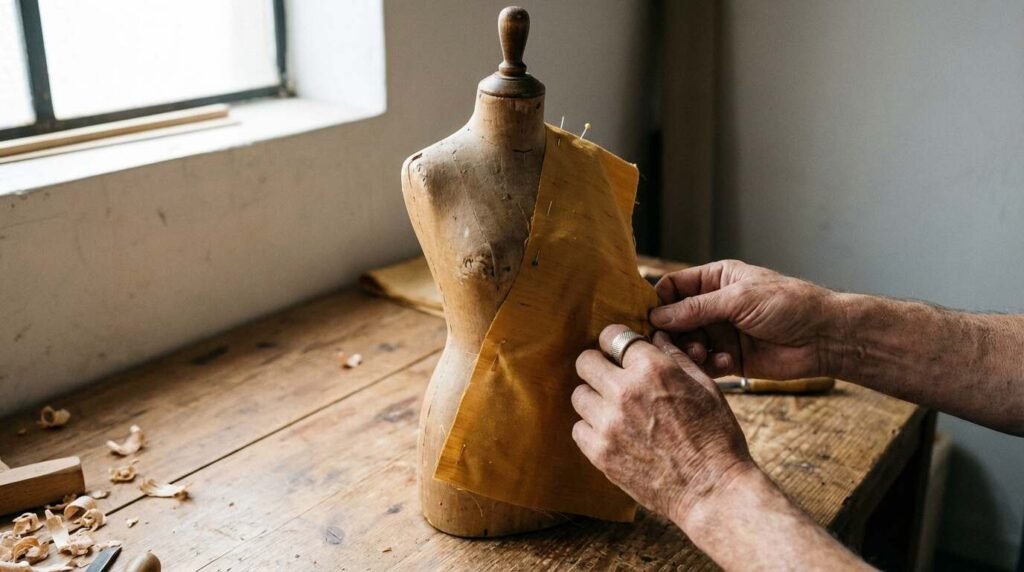
Madeleine Vionnet worked from the inside out. She never sketched on paper. She draped directly onto a small wooden mannequin — scaled to half a human body — and solved problems of grain and geometry with her hands rather than her eyes. What she discovered, cutting fabric at a 45-degree diagonal to the grain, would quietly restructure fashion for the next hundred years.
The Geometry of Surrender
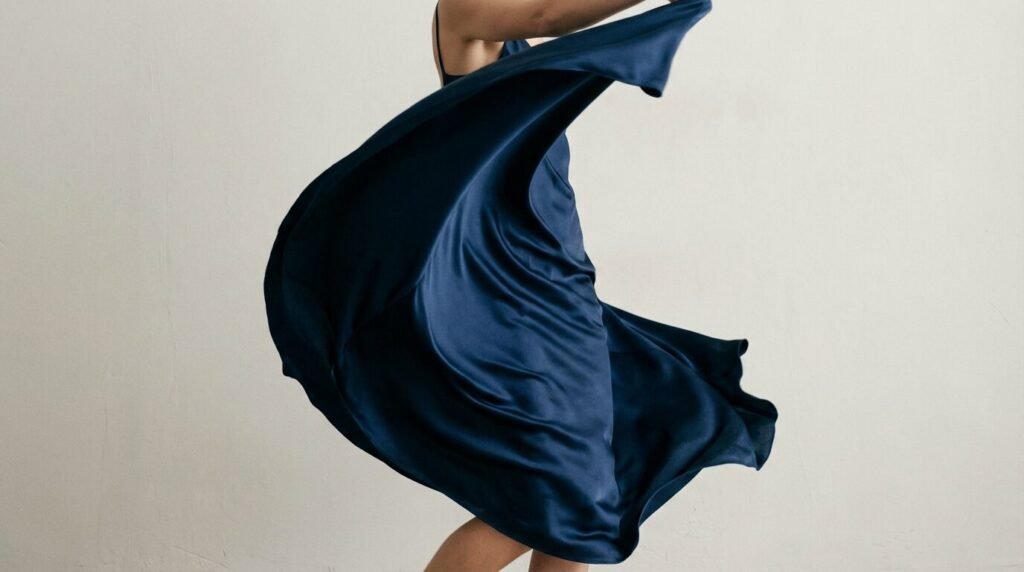
Betty Kirke’s authoritative monograph Madeleine Vionnet (Chronicle Books, 1998) is, among other things, a technical manual — and the technical passages are among the most illuminating things written about clothing in the 20th century. Kirke documents how the bias cut exploits the natural elasticity of woven fabric: at 45 degrees to the grain, fabric that would otherwise be rigid gains the ability to stretch, to recover, to cling and release in response to movement.
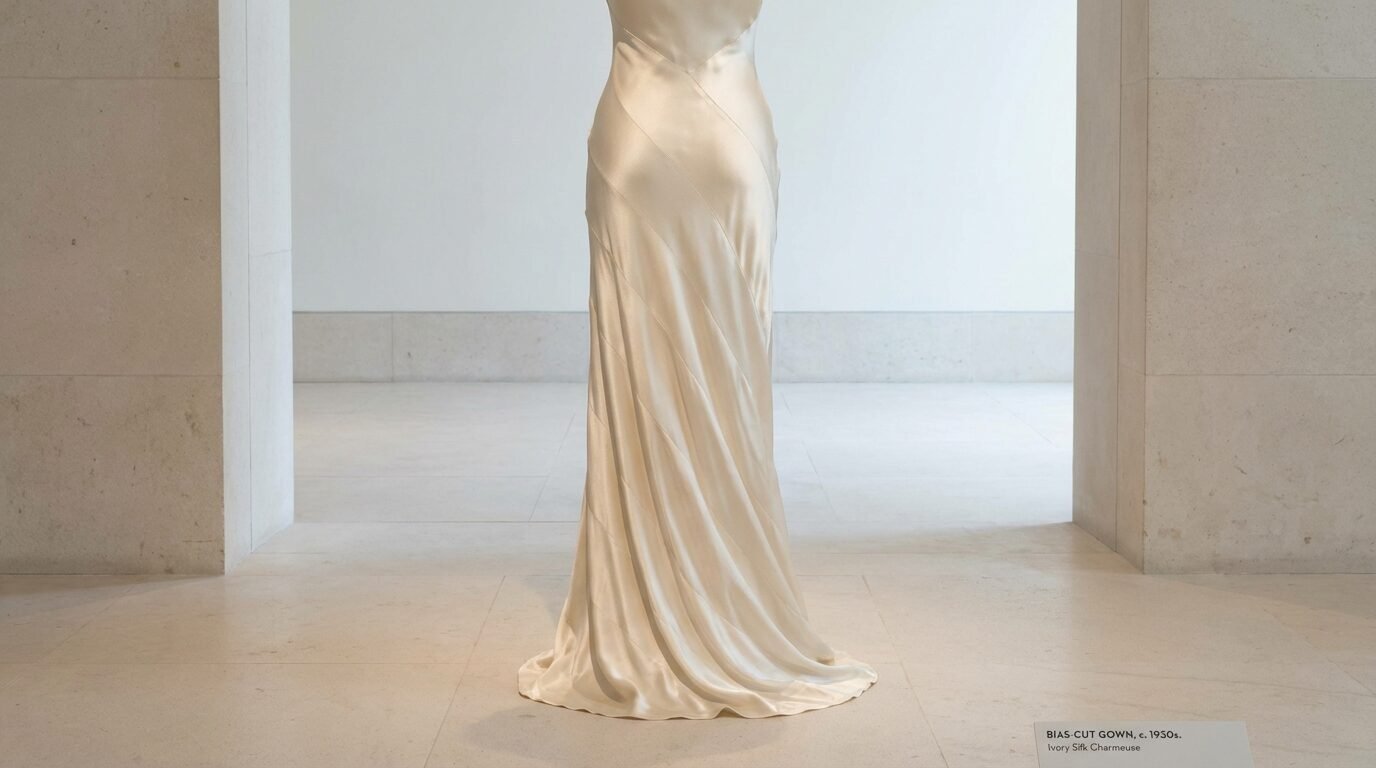
The Palais Galliera in Paris, which holds the world’s largest Vionnet archive — including her original miniature mannequins — preserves the record of how she refined this discovery over decades. The garments in that collection do something extraordinary under gallery lighting: they appear to breathe. Not because of any trick of exhibition, but because they were built for bodies in motion, and even without a body they retain that potential.
What Vionnet understood, and what took the rest of the industry years to absorb, is that true luxury in clothing is not a question of material richness. It is a question of structural intelligence. The bias cut is luxurious because it requires more fabric — the diagonal grain means more waste per pattern piece — and because it demands a level of technical mastery in construction that cannot be imitated cheaply. You can copy the look. You cannot copy the physics.
The Lineage
Azzedine Alaïa, in multiple interviews over his career, credited Vionnet directly. This was not politeness. Alaïa’s work — the sculpted jersey dresses, the seaming that followed the body’s contours with the precision of topography — was a sustained conversation with Vionnet’s argument. Suzy Menkes, reporting for the International Herald Tribune, documented Alaïa’s almost scholarly engagement with the history of construction: he understood that what he was doing had precedents, and he wanted those precedents named.
John Galliano’s Dior years — 1996 through 2004 — constitute perhaps the most technically ambitious sustained body of work in late 20th-century fashion. The archive documentation shows direct references to Vionnet’s construction methods: the spiral seaming, the handkerchief hems, the use of bias across multiple panels to create garments that moved with a fluidity that photographed as liquid. Galliano understood Vionnet the way a great architect understands a structural precedent: not as something to replicate, but as a solved problem that opens new problems.
The current generation of minimalist designers working in silk and crepe — The Row, Totême, Khaite at its most considered — are the quieter heirs. They would not all name Vionnet, but the commitment to construction over ornament, to fit as the primary form of luxury, is the same argument she was making in her Rue de Rivoli atelier a century ago.
What the Bias Cut Actually Says
I think about structural intelligence often — not in fashion, where my expertise is limited, but in the properties I work with on the North Shore. The houses that hold their value across decades, that age with dignity rather than dating themselves, are almost always the ones where the original architect solved a problem rather than decorated a surface. The bias cut is fashion’s equivalent of that kind of solution.
It says: the most sophisticated thing a garment can do is get out of the way. It says: structure, properly understood, is not constraint but liberation. It says: true luxury does not announce itself. It moves.
The Palais Galliera archive makes this argument in three dimensions. Standing in front of a Vionnet evening gown — even at rest, even on a mannequin — you understand that you are looking at a problem solved so completely that the problem has disappeared. What remains is only the solution.
That is what a century of influence looks like. Not quotation, but continuation. Not homage, but argument.
This post is for informational and cultural purposes. For questions about North Shore properties and what enduring architectural quality looks like in real estate, contact Pawli at Maison Pawli.