Long Island Sound Bulkheads: What Owners Maintain
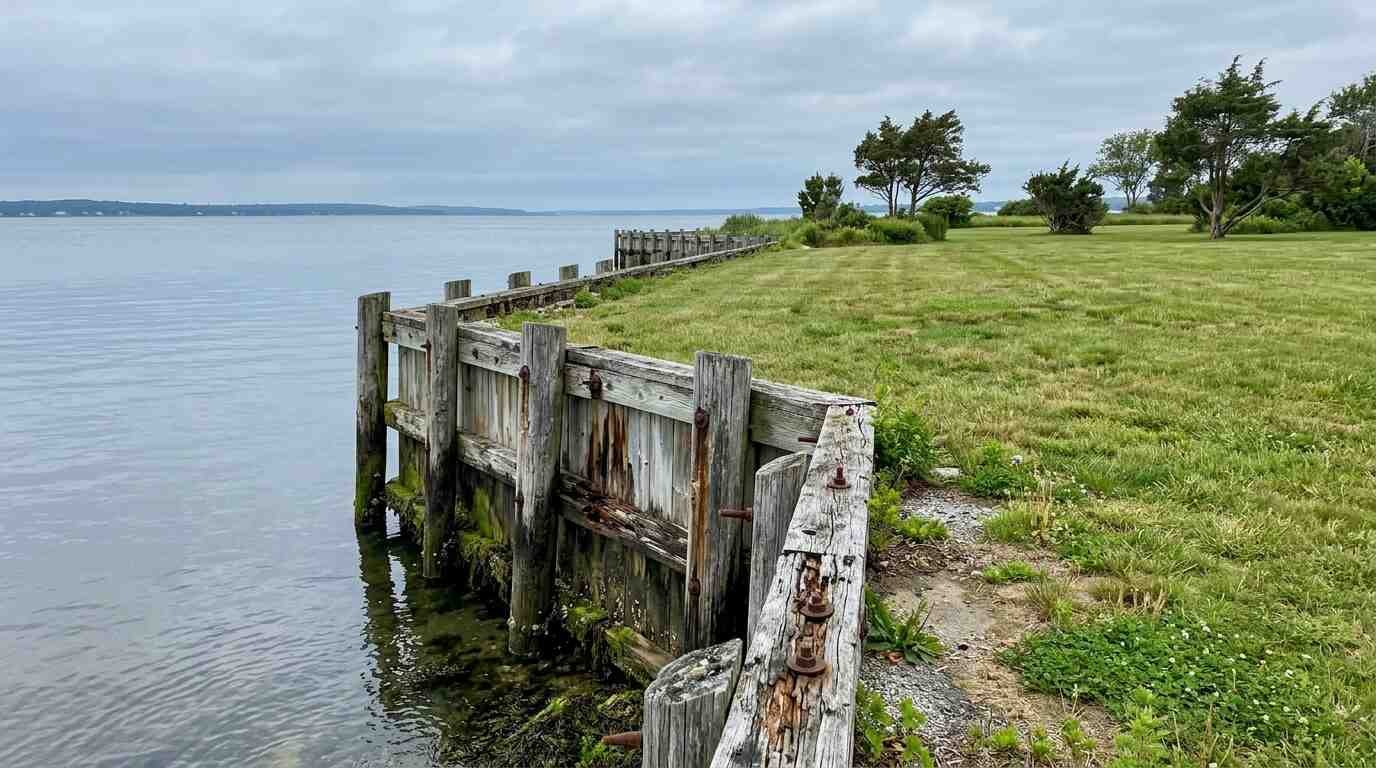
A bulkhead is a vertical wall at the water’s edge, built to hold soil in place and blunt wave action. The New York State Department of Environmental Conservation (DEC) describes it as a structure that prevents soil loss and shore erosion and that can be built from rock, steel, concrete, or wood (see the agency’s living shoreline guidance document). On a Long Island Sound lot that has one, the wall is the structure standing between the lawn and the tide. Much of its work happens below the waterline and behind the surface, which is why small problems can go unnoticed until something visible changes.
This guide covers what a bulkhead owner can inspect, which signs usually mean trouble, and how state and town permitting affects repair and replacement.
Routine inspection
A maintenance guide hosted on the Stony Brook University Sea Grant site makes a simple argument: routine upkeep costs far less than late repair. Its wording is that “the ounce of prevention here is often worth far more than a pound of cure.” The document is undated and does not name a publisher, so it is best read as general technical guidance rather than a regulation. It is available as the Sea Grant maintenance guide (PDF).
The guide suggests comparing a structure’s current condition with its original appearance and photographing new structures so later changes are easy to spot. Its inspection list breaks down by area:
- The toe, at the waterline: undermining, tilting toward the water, or uneven settling.
- The wall itself: cracks, separation, new gaps or holes, and hollows beneath or behind it.
- The land behind the wall: voids, persistently wet ground, or debris left by heavy waves, which can point to overtopping.
- The ends: erosion that wraps around the end of the wall, known as flanking.
- Hardware: fasteners that are loose, corroded, or protruding.
Timber walls
Wooden bulkheads have their own checklist. Sighting along the top edge can reveal waviness or bowing, which the guide links to possible failure of the tiebacks or anchors known as deadmen. Sighting along the base can show boards angled seaward, a pattern associated with scour at the toe. Rot, soft spots, hollow sounds, and marine borers are the other warning signs.
On borers, the guide is direct. Replacing damaged boards or piles is acceptable, but it should be treated as a temporary fix, since borers usually indicate infestation throughout the wood. It also recommends treating exposed wood with preservative, capping pile ends, and using only commercially pressure-treated lumber.
Concrete, steel hardware, and drainage
Concrete walls call for a different set of checks. The guide lists leaning, cracks, and clogged weep holes, and it singles out cracks where water freezes, a concern in a climate with winter freeze-thaw cycles. Cracks can be sealed with epoxy or patching concrete, and clogged weep holes can be cleaned. New weep holes, according to the guide, should be installed by a contractor instead of drilled by the owner.
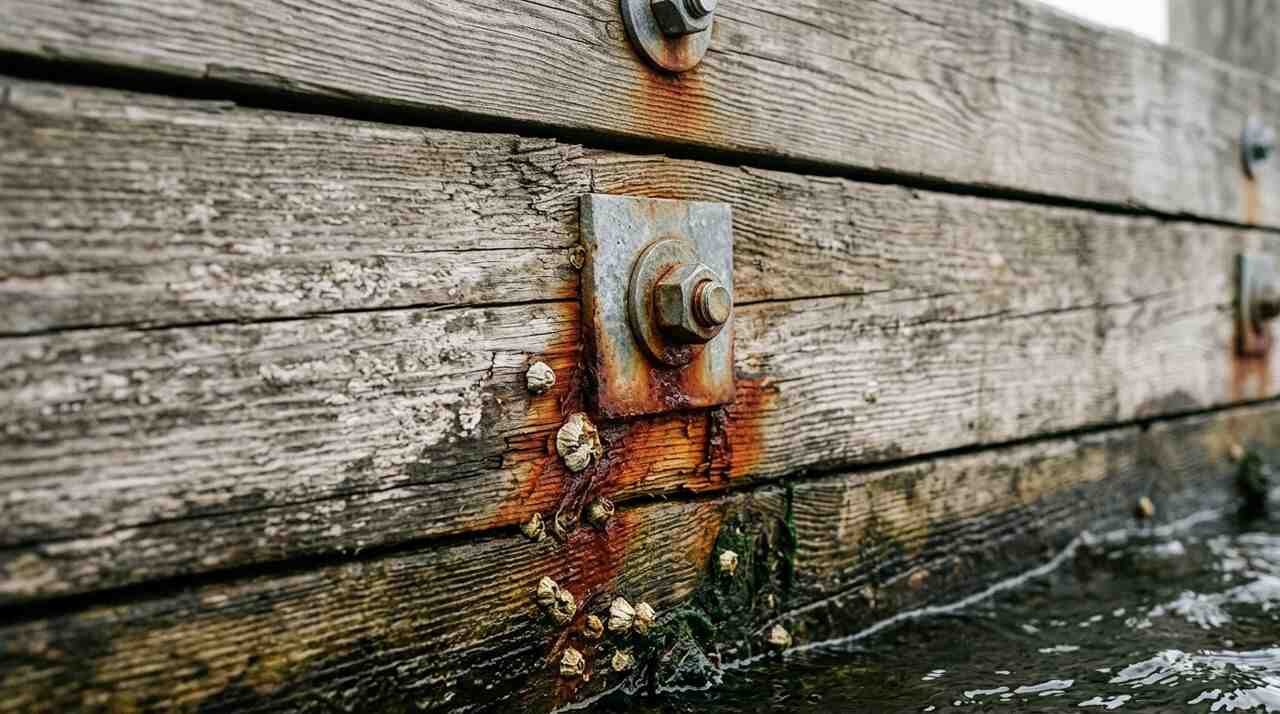
Hardware is a smaller topic but a recurring one. Loose fasteners can be redriven or tightened, and corroded pieces should be replaced with corrosion-resistant galvanized steel or wrought iron. The guide also advises avoiding contact between dissimilar metals.
What the symptoms mean
The same guide groups failure signs into a few families, each with its own typical response.
- Soil loss (voids, holes, hollows behind the wall): install filter cloth or gravel where fill is leaking, then refill with clean fill. If a filter was never installed, the area has to be excavated to add one.
- Toe scour: add protection such as armor stone, a cutoff wall, or a scour apron.
- Overtopping: raise the structure if practical, or install a splash apron.
- Flanking: extend the structure and tie it back into the land.
One principle runs through all of these. The guide says to find the cause first and then correct it, rather than patching the symptom. Whether repair makes sense at all depends on cost and physical feasibility, and the guide recommends consulting a qualified marine engineer, contractor, or Sea Grant coastal erosion specialist before deciding between repair and replacement.
Keeping records
Documentation turns out to matter at several points. The Sea Grant guide recommends photographs of the structure for later comparison. DEC’s application asks for three representative color photos, each showing the time and date taken, along with a survey that shows the existing bulkhead. Brookhaven’s wetlands application, for its part, asks for photographs of the front, rear, and sides of the property and the project area.
A dated photo series made during routine checks therefore serves two purposes. It records gradual change in the wall, and it can supply the starting material for an application if replacement eventually becomes necessary. A current survey is the other piece. The related article on reading a waterfront lot survey explains what such a drawing shows.
State permits for replacement
Maintenance that stays within a wall’s footprint is one thing; replacement is another. For Nassau and Suffolk counties, DEC offers a general permit, GP-1-22-001 for bulkhead removal and replacement, effective October 25, 2022. According to the permit text, its authorizations expire on October 24, 2032.
The general permit covers replacement of functional, lawfully existing bulkheads, either in place or landward of the existing wall. Re-sheathing is allowed too, with limits on how far the new face can extend seaward: no more than 4 inches for timber boards and no more than 8 inches for corrugated materials such as vinyl or steel. A replacement wall may be up to 18 inches higher than the existing one, with allowances for the local FEMA flood elevation or guidance under the state’s Community Risk and Resiliency Act where justified.
Several conditions narrow its reach. Coastal Erosion Hazard Areas and high-energy wave areas fall outside it, as do locations within 10 feet of vegetated tidal wetlands or eelgrass beds and marsh island communities. A change in the wall’s location or configuration requires an individual permit instead. The permit lists approved materials: treated wood, naturally rot-resistant untreated wood, vinyl, plastic, fiberglass, or steel. Creosote-treated wood is prohibited in the water and upland areas.
Dredging is tightly limited as well. On bay and river fronts, it is prohibited from January 1 through September 30, it can occur only once per bulkhead replacement, and it must be done with a closed bucket, according to the permit text.
The application sequence
Property owners cannot simply start work after reading the general permit. DEC’s page states that no work is authorized until the permittee receives a signed Project Authorization. The Request for Authorization goes to the DEC Regional Permit Administrator and includes a site location map, project plans with measurements, a survey showing the existing bulkhead, three representative color photos that show date and time, and a Permission to Inspect Property form.
After authorization, the permittee and contractor must return a notification form at least 48 hours before work begins, and a completion form with photos of the finished work within 30 days. The permit sign is posted at the worksite. DEC’s division of environmental permits lists a telephone number of 518-402-9167 on its page.
Town permits in Brookhaven
Setauket sits in the Town of Brookhaven, which maintains its own wetlands permit process. The town’s wetlands page lists bulkheads among the permit types, alongside residential docks, structural projects, and dredging. It states that a permit is required for projects within 150 feet of a freshwater wetland or 25 feet of an artificial wetland, and that the standard application fee is $275, with additional fees depending on the type of work.
The online application asks for a deed, a survey under ten years old, and a project plan prepared by a licensed engineer, surveyor, or architect, along with photographs of the property and the project area. Review runs through pre-screen and plan review, with a public hearing if required and a final inspection before approval. Work release permits are valid for one year and Category A and B permits for two. The town’s page does not give bulkhead-specific requirements, so applicants can confirm with the Department of PELM named on the page which paths apply to a particular shoreline.
Questions for a marine contractor or engineer
The documents above suggest a handful of questions worth putting to anyone proposing work on a bulkhead.
- Is the existing wall functional and lawfully existing, the condition the general permit sets for replacement?
- Will the new wall sit in place or landward, and by how much, if at all, will the face move seaward?
- Which materials are proposed, and do they appear on the permit’s approved list?
- Does the plan include dredging, and if so, does the schedule avoid the January through September prohibition on bay and river fronts?
- Who is preparing the survey, plans, and photographs, and who submits the Request for Authorization?
- Does the site fall inside a Coastal Erosion Hazard Area or within 10 feet of vegetated tidal wetlands, either of which takes it outside the general permit?
Answers to the first and last items can change the permit path entirely, so they are worth settling before bids are compared. The Sea Grant guide also recommends a marine engineer where the cause of a failure is unclear.
Living shorelines as an alternative
DEC’s 2017 guidance classes bulkheads, seawalls, and revetments as hardened shorelines with no living components. The same document states that DEC prefers ecologically sustainable techniques to hardening where erosion control is needed in the Marine District, and it encourages converting existing structures into living shorelines where appropriate. Living shorelines use natural features alone or combined with materials such as rock, wood, or bagged shell, and the guidance says they suit low-to-moderate wave energy sites.
The guidance strongly encourages a pre-application conference with the regional DEC office. It also lists possible additional requirements, including State Environmental Quality Review, shellfish permits, authorization from the Office of General Services, federal Army Corps permits, and local permits. Maintenance and monitoring reports are often required for five years after construction. In-kind, in-place replacement of functional bulkheads is one of the activities the guidance covers.
Related reading
- DEC tidal wetlands permits for Long Island waterfront renovations
- Waterfront maintenance on the Sound, bays, and harbors
- Setauket Harbor study and waterfront owners
- How to read a waterfront lot survey
This article is general information and is not legal, engineering, or financial advice.
Rules, rates, fees and procedures change; confirm current details with the official sources linked above and with a licensed attorney or other qualified professional before making decisions.
Sources
- NYS DEC: Bulkhead Removal and Replacement General Permit (GP-1-22-001)
- NYS DEC: GP-1-22-001 permit text (PDF)
- NYS DEC: Tidal Wetlands Guidance Document, Living Shoreline Techniques (Nov. 22, 2017, PDF)
- Sea Grant (Stony Brook University site): Maintaining coastal erosion control structures (PDF)
- Town of Brookhaven: Wetlands permits