Borrowed Light
Victorian architects had a word for it. We’ve mostly forgotten both the word and the technique — and our interior rooms are darker for it.
Borrowed light is not a metaphor. It is a specific architectural strategy: moving natural light from a room that has exterior windows into a room that doesn’t, using interior windows, glass partitions, transoms above doors, and open soffits. The technique was standard practice in British and American residential design through the early twentieth century. Then fluorescent overhead lighting made it seem unnecessary, and it dropped out of the builder’s vocabulary almost entirely.
Long Island’s postwar housing stock is paying that price now.
The Problem With Deep Footprints
The expanded ranch and the center-hall colonial are the dominant residential forms across Nassau and Suffolk counties — and both of them, in their typical postwar configurations, produce center rooms that receive zero natural light. The kitchen-to-dining pass-through, the hallway connecting front and rear, the interior bedroom that was originally a converted garage: these rooms exist behind the rooms that face the outside world, and no amount of recessed lighting fully compensates for the absence of daylight.
This shows up differently in different housing types. In the deep colonial, the formal dining room often sits between the kitchen and the living area with no exterior wall exposure. In the expanded ranch, the addition that pushed the footprint further back frequently produced a family room or master suite that borrows its light, if it borrows anything at all, from a ceiling fixture rather than the sky.
Buyers see this during showings. The front of the house feels bright and welcoming; the center feels dim regardless of how many lights are switched on. It reads as a structural problem. Often it’s a design problem — one that borrowed light could solve.
What the Technique Actually Involves
At its simplest, borrowed light requires cutting an opening in an interior wall and filling it with glass. The applications vary considerably depending on room configuration and renovation scope.
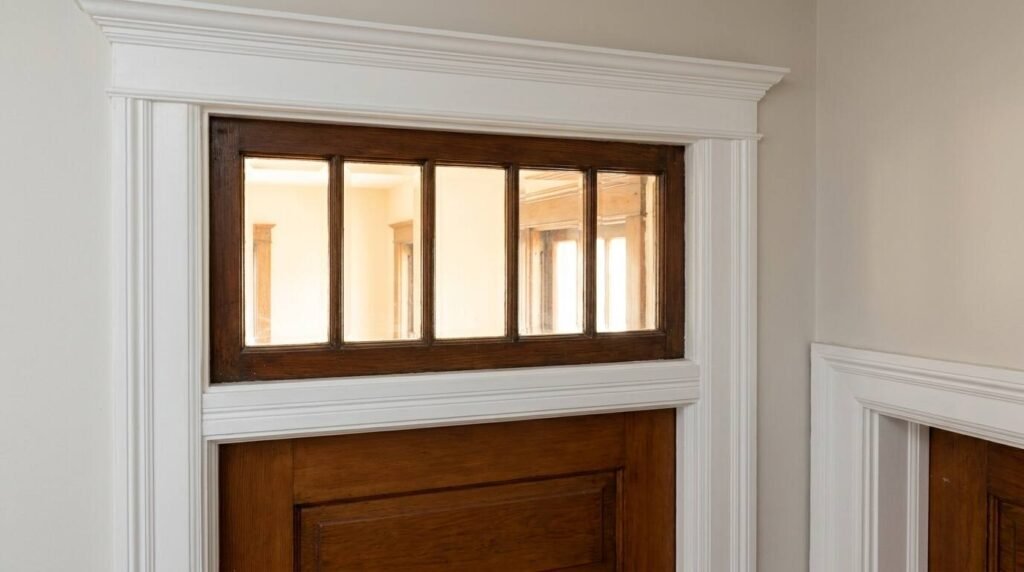
Interior transom windows sit above door frames on interior walls — typically between a brighter exterior room and a darker interior corridor or room. They were standard in American residential construction through the early twentieth century. A dormered rowhouse in Jackson Heights, Queens built in the teens would have had interior transoms as a matter of course, letting light from the bedrooms spill into the hallway, and letting air circulate with doors closed. That same house in a suburban reinterpretation, built in 1958, probably had neither.
Transoms Direct, a company that specializes in the product, describes the original function plainly: interior transom windows were installed so that glass could allow both candlelight and natural daylight to penetrate more deeply into poorly lit interiors. The reintroduction of the concept to modern residential renovations has been slow but measurable — driven partly by homeowners renovating older urban rowhouses and discovering that the transoms already existed under the plaster.
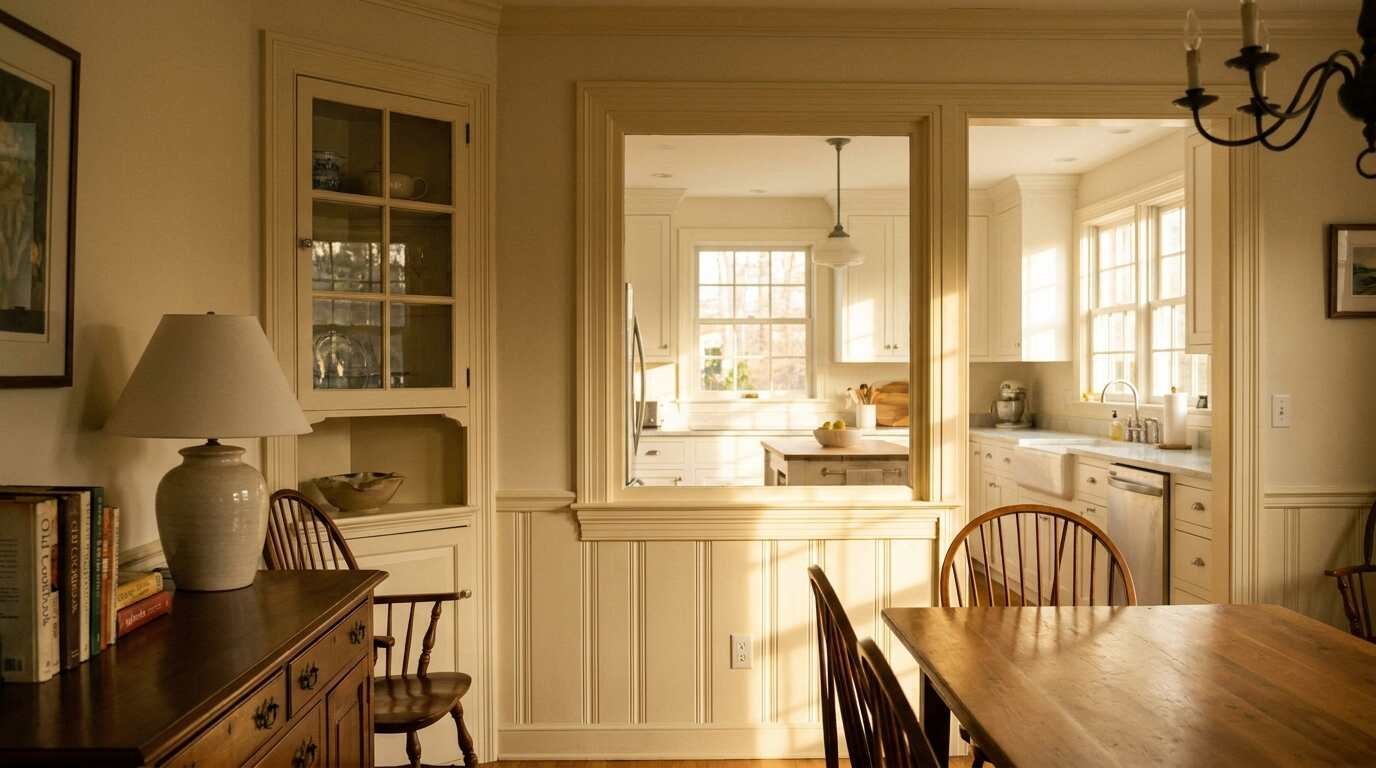
Interior windows between rooms take the principle further. An opening cut between a well-lit kitchen and a darker dining room — filled with fixed glass or a hinged sash — moves light laterally through the house without requiring a full structural opening. The kitchen still functions as a distinct room; the dining room stops reading as a cave. In older Long Island homes where kitchen-to-dining walls are non-load-bearing, this is often a relatively contained project.
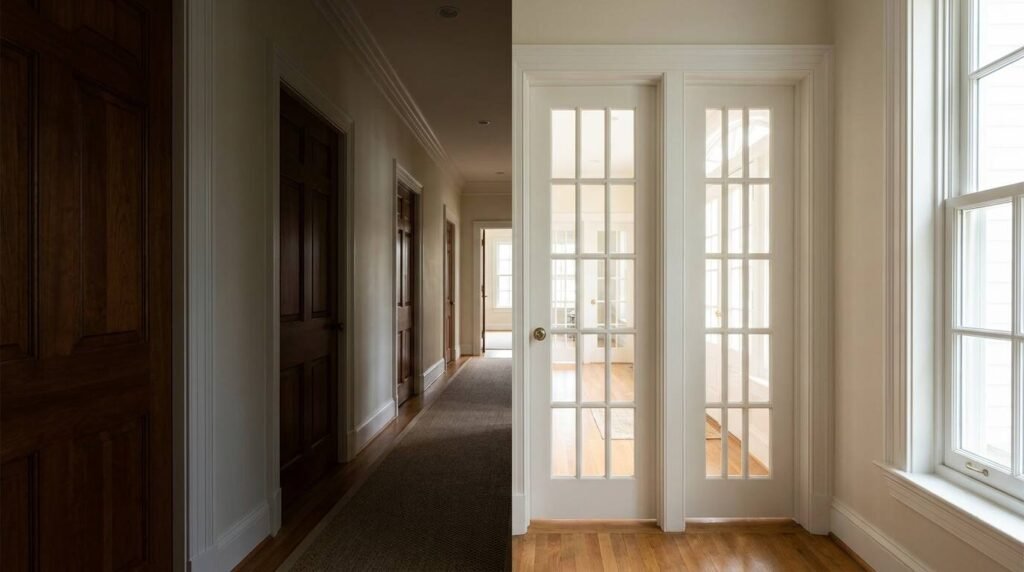
Glass-panel interior doors work similarly. Replacing a solid-core interior door with a glass-lite version allows light to travel through the door plane rather than stopping at it. This is particularly effective at hallway junctions, where a solid door at the end of a corridor can make the entire hallway feel enclosed even when the room behind the door is bright.
Why It Matters for Long Island Buyers and Sellers
For sellers, borrowed light interventions are among the most cost-effective pre-listing improvements available. Cutting a transom above a dining room door costs a fraction of adding a skylight, doesn’t require structural engineering, and produces a qualitative change in how a buyer experiences the home’s center. A dark interior room is one of the more common reasons buyers mentally discount an otherwise sound property — not because they can’t articulate the problem, but because it registers as something wrong.
The Staging Mistake That Costs Long Island Sellers $15,000 at the Table is often not what sellers expect. The first-impression problem frequently isn’t the entry or the kitchen — it’s the corridor and the rooms that feel cut off from the light the rest of the house promises.
For buyers evaluating a deep-footprint home with dark center rooms, the question isn’t whether the current lighting is adequate. Lighting can always be added. The question is whether the architectural conditions exist to bring in daylight — and whether a borrowed light intervention is structurally feasible given the wall layout.
Load-bearing walls complicate the calculus. But many of the interior walls in postwar colonials and ranches are partition walls, not structural ones. A consultation with a contractor who knows Long Island’s residential construction types — particularly the platform-framed stick-builds that dominate the suburbs — will usually reveal which walls can take an opening without engineering work and which ones cannot.
The Colonial Specific Case
The dining room problem recurs in North Shore colonials with enough regularity to deserve its own mention. In the classic center-hall layout, the dining room sits to one side of the entry — often with a single window on the exterior wall if the house is older, and no window at all if the dining room was enclosed by a later addition. A kitchen-to-dining interior window or transom, combined with updated window treatments that allow the exterior kitchen window to work harder, can transform that room’s character without touching its footprint.
The Japanese Art of Ma and the Western Rooms Finally Getting It Right covers related territory: how light and space work together to make rooms feel larger or smaller than their dimensions suggest. Borrowed light is a Western architectural solution to the same perceptual problem.
—-
You Might Also Like
- The Quiet Power of Undyed Textiles: Why Natural Fibers in Their Raw State Are Dominating Interiors
- Stone That Tells Time: The Designers Using Fossiliferous Marble to Anchor a Room
- Why Your 1960s Ranch Renovation Is Fighting the Soil — The Glacial Till Problem Hiding Under North Shore Slabs
—-
Sources
- Hints and Echoes. “When Is a Window Not a Window?” https://hintsandechoes.wordpress.com/2014/04/08/when-is-a-window-not-a-window/
- Transoms Direct. “Re-Defining Interior Perspectives.” https://transomsdirect.wordpress.com/
- Daystar Window Tinting. “Adding Transom Windows in Your Home.” https://daystarwindowtinting.wordpress.com/2022/11/22/adding-transom-windows-in-your-home/
—-