Dock Rights, Riparian Claims, and the Fine Print: What Waterfront Buyers on Long Island Sound Actually Own

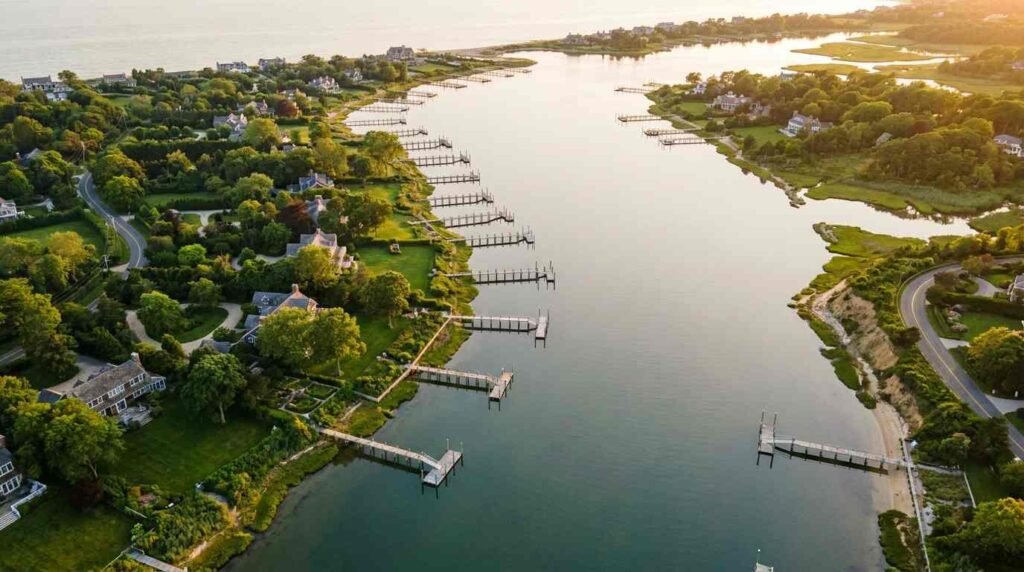
There is a particular kind of listing photo I’ve learned to read carefully. The dock is in the foreground — freshly treated timber, cleats gleaming, a Boston Whaler tied off like punctuation at the end of a very expensive sentence. The water is Long Island Sound, still and silver in the morning light. The listing says: waterfront with private dock. The buyer sees it and thinks: mine.
What they may actually own is considerably more complicated.
I’ve had this conversation more times than I can count, and it almost never happens at the right moment — which is before the offer. It usually happens somewhere around attorney review, when the title search comes back and the buyer’s lawyer is asking questions that weren’t on anyone’s checklist at the showing. Dock rights on the Sound are one of the more legally layered things a buyer can acquire on Long Island, and the gap between what a listing implies and what a deed conveys can be tens of thousands of dollars wide, or wide enough to kill the transaction entirely.
This is what you need to understand before you make an offer on any Long Island Sound waterfront property with dock infrastructure.

What Riparian Rights Actually Mean — and Why Your Deed Might Not Say What You Think
The term riparian rights comes from the Latin ripa, meaning riverbank. In New York State, riparian rights are the bundle of property rights held by the owner of land abutting a body of water. They typically include the right to reasonable use of the water, the right to access the water from your land, and — critically — certain rights to wharf or dock construction in the adjacent navigable waters.
Here’s the complication: in New York, the navigable waters of Long Island Sound are owned by the state, not by the adjacent landowner. What a waterfront buyer acquires is the right to use and access those waters from their property — not the water itself, and not necessarily the submerged land beneath a dock.
What this means practically is that a deed conveying “waterfront property with dock” may be conveying the upland parcel and the riparian right to access — but the dock itself may require separate permits, easements, or authorizations that don’t automatically transfer with the property. Those authorizations have names: DEC permits, Army Corps of Engineers permits, town dock permits. And they have expiration dates, conditions, and compliance requirements.
I’ve seen buyers assume that a dock that has existed for forty years is grandfathered into permanence. It is not, not automatically. The DEC can require permit updates, structural compliance reviews, or remediation as a condition of continued use. A buyer who doesn’t request and review all outstanding permits before closing may be acquiring a dock that is technically in violation of its own authorization — and inheriting the liability that comes with that.
The baseline rule: when a listing says “private dock,” your attorney should be requesting every permit document associated with that structure before you sign anything binding.
The Difference Between Private Dock Rights and Shared Beach Associations
Not all waterfront access on Long Island Sound is private. A significant portion of what buyers see marketed as “waterfront” or “water access” involves shared beach associations — HOA-governed arrangements where a group of homeowners collectively owns or has easement rights to a shoreline parcel, and dock use may be governed by association rules, waiting lists, or seasonal fees.
This is common throughout the North Shore, particularly in communities developed in the mid-20th century when subdivision developers created beach associations as a selling amenity. What gets transferred to each homeowner is not a fee simple interest in the beach parcel — it’s a membership in the association, or sometimes simply an easement appurtenant to their lot.
The implications for dock access vary enormously. Some associations have permitted shared docks or mooring fields. Others have the right to a dock but haven’t built one. Others have neither the infrastructure nor the permitting. A buyer paying a premium for “water access” who discovers post-closing that access means shared use of a 50-foot strip of beach with no dock rights has a legitimate grievance — and usually not much legal recourse if the disclosure was technically accurate.
What to request before making an offer on any property in a beach association: the full association declaration, any recorded easements, the association’s most recent meeting minutes, and documentation of any dock permits held by the association or its members. If the listing agent cannot produce these on request, that itself is information.
The distinction between private riparian rights and shared association membership is also a pricing question. A property with genuine private dock rights — where the homeowner has a DEC-permitted structure on their own shoreline — commands a different premium than a property with association membership. I’ve seen listings conflate the two, sometimes inadvertently. Reading the deed carefully is the only way to know which you’re actually buying.
How Town Permits, DEC Rules, and Coastal Zone Management Complicate Ownership
Long Island Sound waterfront is among the most regulated shoreline in New York State, and that regulation operates at multiple overlapping levels simultaneously. Understanding the framework is not optional for a buyer who wants to know what they’re actually acquiring.
NYS DEC Tidal Wetlands Permits (6 NYCRR Part 661): The DEC regulates construction, reconstruction, and modification of structures in and adjacent to tidal wetlands, which include the intertidal zone and certain upland areas near the water. Any dock on Long Island Sound has almost certainly required a DEC tidal wetlands permit at some point. The permit identifies the specific structure authorized, its dimensions, its setbacks, and any conditions of use. Permits are issued to individuals, not to properties — they don’t automatically transfer at closing. What a buyer needs is documentation that the permit has been assigned to them, or that the selling permits are current and transferable, or that the structure was built under a previous permit regime that does not require present-day compliance action.
Army Corps of Engineers Section 10 Permits: For structures in navigable waters of the United States — which includes Long Island Sound — federal authorization under Section 10 of the Rivers and Harbors Act may be required. This is separate from the DEC permit. For many older docks, the Corps’ permit may be in the form of a Nationwide Permit or a general permit, rather than an individual authorization. The point is that it exists, and should be in the file.
Town Dock Permits: Every municipality along the Sound has its own permitting requirements for dock construction and maintenance. The Town of Huntington, for example, requires a dock permit from its Engineering Department that is separate from DEC authorization. These municipal permits are typically renewed periodically and may require structural inspections. A dock that last had a town permit renewal in 2008 and hasn’t been touched since may be technically out of compliance with current requirements.
Coastal Zone Management: New York’s Coastal Management Program applies to all activities within the state’s coastal area, which encompasses Long Island Sound. Projects requiring state or federal permits must be consistent with the Coastal Management Program, which adds another layer of review and potential restriction on dock modification, expansion, or reconstruction.
The net effect is that a dock on Long Island Sound sits at the intersection of at least three regulatory regimes — state, federal, and municipal — each with its own permit record, compliance history, and renewal requirements. A buyer’s attorney and, ideally, a licensed marine contractor should review all of them before closing. I also recommend having a title company specifically search for DEC violations or open enforcement actions against the property, which is not standard in every title search but is advisable for waterfront purchases.
Real Closings That Almost Fell Apart Over Dock Access
I’ll share two situations without identifying the properties, because the patterns are instructive.
The first involved a property in the Northport area with a dock that had been there for decades. The seller’s family had built it in the 1970s. The original DEC permit was found in a filing cabinet. The problem was that the dock had been extended — just twelve feet, to accommodate a larger boat — sometime in the 1990s, without a permit amendment. The extension was clearly visible in aerial photography. The buyer’s attorney flagged it. What followed was three weeks of negotiations about who would bear the cost of either removing the extension or obtaining an after-the-fact permit approval, which the DEC does not make easy and does not guarantee. The deal survived, but not without a seller credit and a delayed closing.
The second involved a property in a beach association on the Sound, where the listing described “deeded beach and dock access.” What the deed actually conveyed was membership in the beach association, which had a permitted communal dock — but the dock had eighteen slips and forty-two member households. Dock use was allocated by seniority in the association, and the current owners were nineteenth on the waiting list for a permanent slip. The buyer was a boater. The deal fell apart the day the association documents arrived.
Both of these situations were preventable. The information existed. It just wasn’t surfaced until the attorney review phase, by which point both parties had significant emotional and financial investment in the transaction.
Questions to Ask Before Making an Offer on Any Waterfront Listing
These are not questions for the open house. They’re questions to bring to your attorney before you submit an offer, or at minimum before attorney review begins. On a waterfront property with dock infrastructure, you cannot wait until the title search to start asking.
On the dock structure itself: Is there a current, valid NYS DEC tidal wetlands permit for this dock, and who is the named permit holder? Has the dock been modified, extended, or reconstructed at any point, and were those modifications permitted? Are there any open DEC enforcement actions or violation notices associated with this property?
On access and ownership: Does the deed convey private riparian rights, or is water access through a beach association membership or easement? If through an association: what are the dock allocation rules, and what is the current owner’s position in any slip waitlist? Are there any recorded easements across the shoreline portion of this property?
On regulatory history: Has the property undergone any wetlands delineation? Is the property in a coastal erosion hazard area, and what restrictions apply to future dock modification or bluff reconstruction?
I tell buyers to think of a waterfront purchase as two transactions happening simultaneously: the upland purchase you’re familiar with, and the regulatory history of the water infrastructure, which has its own timeline, its own documentation, and its own set of professionals who should be reviewing it. A real estate attorney, a marine attorney if the situation is complex, a licensed marine contractor for structural assessment, and a title company experienced with waterfront closings — that’s the team for a Sound property with dock infrastructure.
The dock in the listing photo is real. What it represents legally, in terms of what you own and what you’re authorized to do with it, is a document question. Get the documents first.
This post is for informational purposes only and does not constitute legal advice. Riparian rights, dock permitting, and DEC regulations are complex and fact-specific. Consult a licensed New York real estate attorney and, where appropriate, a marine attorney before closing on any waterfront property.
Real estate markets change. For current listings and market data, contact Pawli at Maison Pawli.
You Might Also Like
Dock Rights, Mooring Rights, and the Difference: What North Shore Waterfront Buyers Need to Settle Before Closing
The DEC Permit Nobody Mentions at the Showing: Wetlands Regulations and Long Island Waterfront Renovation
How to Read a Waterfront Lot Survey Before You Make an Offer
Sources
NYS DEC Tidal Wetlands Regulations, 6 NYCRR Part 661
NYS DEC Coastal Permits Program
US Army Corps of Engineers, New York District — Section 10 Permits
Town of Huntington Engineering Department — Dock Permitting
NY Real Property Law Article 12-B
NYS Coastal Management Program