The Gold Coast Estate as Tax Problem: How Heirs Have Been Selling, Subdividing, and Converting Since 1945
Every Gold Coast estate that survived the postwar decades survived because someone solved a math problem. The math wasn’t complicated — carrying costs on one side, available income on the other — but the solutions varied enormously depending on who was holding the property, when they were holding it, and what options the law and the market gave them.
I’ve spent enough time with these properties, and with the title histories and deed records that trail behind them, to have formed a pretty clear picture of the forces that shaped what the North Shore looks like today. The estates that got demolished — Harbor Hill, Meudon in Lattingtown, the Belmont property in Sands Point — are the ones that failed to solve the math problem. The ones that survive are the ones where somebody found an equation that worked. Sometimes the solution held. Sometimes it only delayed the reckoning.
Understanding that history matters practically, not just historically. It shapes what you can buy on the North Shore today, what encumbrances those properties carry, and what the market for estate-adjacent real estate actually reflects.
The Tax Mechanism That Triggered Everything
To understand what happened to the Gold Coast after 1945, you have to understand what federal estate taxation looked like in the years when the original owners died.
The modern estate tax was established by the Revenue Act of 1916. Through the 1930s and 1940s — precisely the period when the Gold Coast’s first generation of builders was dying off — the top marginal estate tax rate climbed steeply, reaching 77 percent by 1941, where it would remain for decades. An estate valued at $10 million could face a federal estate tax bill in the millions of dollars, to be paid in cash within a defined period after the owner’s death.
This is the mechanism that turned property into a crisis. An heir who received a Gold Coast estate in 1942 received not a gift but a problem. The property itself was worth less than its nominal value because there was no liquid market for a 600-acre estate with a 60-room house requiring a staff of forty. The estate tax was assessed on the appraised value, not on what a buyer would actually pay. And the cash to pay the tax had to come from somewhere — from the sale of other assets, from liquidation of furnishings, from parceling out and selling pieces of the landholding.
A historical paper on the Gold Coast decline published by the Nassau County Historical Society summarized the forces precisely: income and inheritance taxes, dramatic increases in property taxes, the Depression, Robert Moses’s eminent domain seizures for the Northern State Parkway right-of-way, and the postwar generation’s unwillingness to enter domestic service — all converging simultaneously on a class of property that required all of those resources to survive.
The Subdivision Wave: 1945 to 1975
The dominant response to the postwar Gold Coast crisis was subdivision. An estate that couldn’t be sold whole could often be sold in pieces, and the postwar Long Island housing boom made those pieces valuable in a way they had never been before.
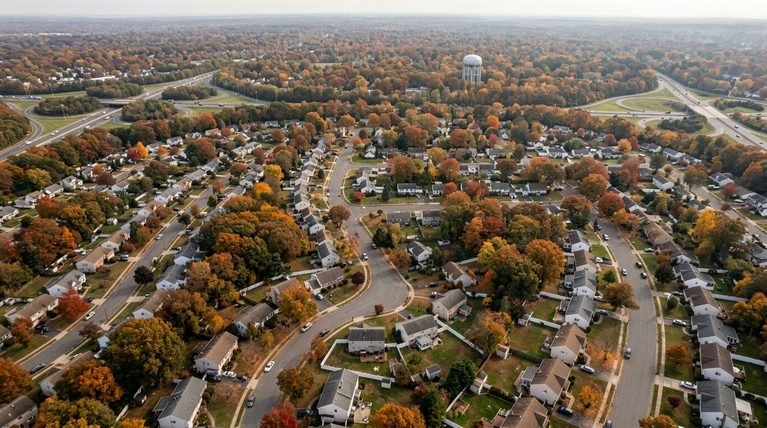
The pattern was consistent: the main house would be retained (sometimes), and the surrounding acreage — the farm, the gardens, the meadows, the woodlands — would be platted into residential lots and sold to developers or directly to buyers. The Levittown model had demonstrated that Long Island land, if subdivided and developed efficiently, could be converted into enormous returns. The Gold Coast estates, sitting on hundreds of acres of prime North Shore land, were enormous repositories of that convertible value.
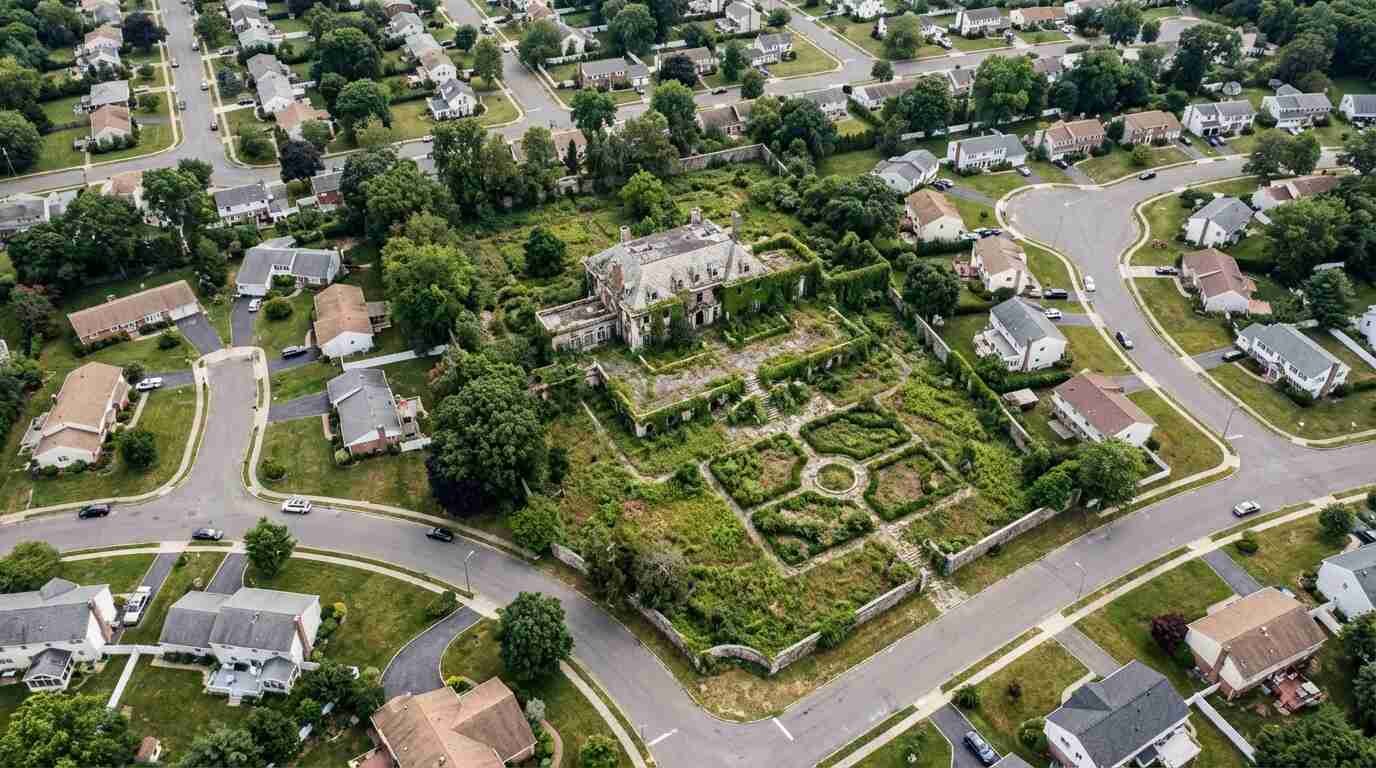
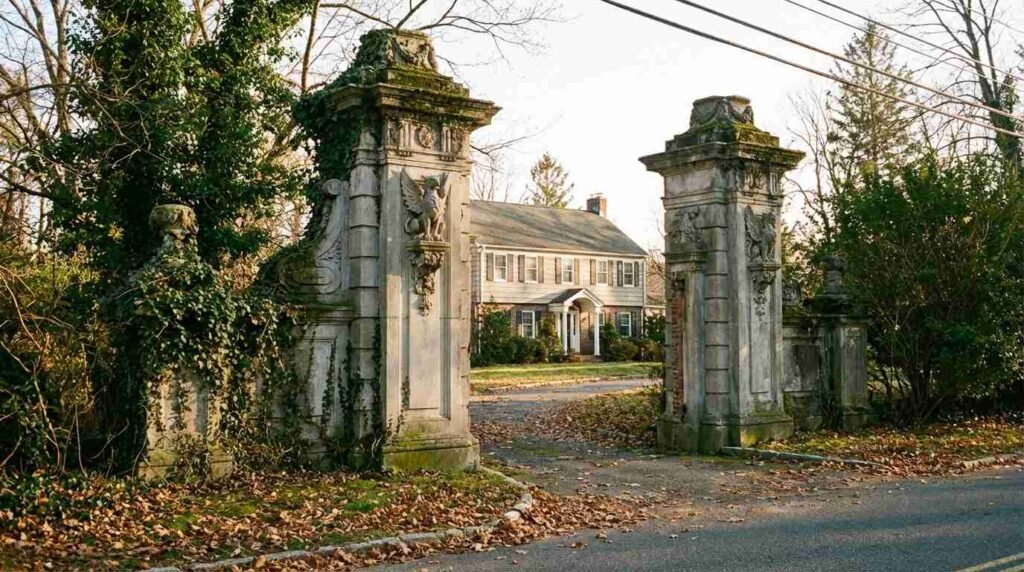
Harbor Hill’s 688 acres became Country Estates in East Hills. The Jennings estate at Cold Spring Harbor was subdivided. Dozens of others followed the same arc: acreage sold to generate cash to pay taxes or simply to liquidate an asset that had become a liability. The houses themselves fared differently. Some came down with the subdivision. Some survived in diminished form on retained lots, separated from their original landholdings. Some were sold as individual parcels — the main house on three acres, stripped of everything that made it architecturally coherent.
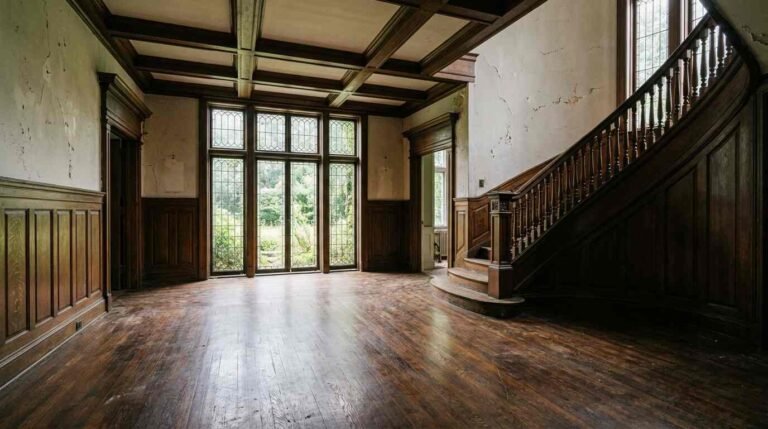
It’s that last category that generates the most interesting properties on the North Shore today: the isolated estate house, surrounded by mid-century suburban development, carrying the architectural DNA of a 1905 McKim, Mead & White commission but living on a three-acre lot in a neighborhood of 1960s colonials. Their title histories are almost always complicated.
The Institutional Conversion: A Parallel Strategy
Where subdivision converted land into cash, institutional conversion converted the property itself into a sustainable operational use. Universities, schools, religious organizations, research institutions, and eventually county and state governments acquired Gold Coast properties and applied programming that could support the carrying costs the original owners could not bear.
The Vanderbilt estate at Centerport — Eagles Nest, the Spanish Revival complex that William Kissam Vanderbilt II built over four decades — was bequeathed to Suffolk County at Vanderbilt’s death in 1944, with the specific instruction that it serve as a museum for his marine and natural history collections. The estate survived because the donor anticipated the problem and built a solution into the bequest.
Oheka Castle in Cold Spring Harbor passed through multiple institutional uses after Otto Kahn’s death in 1934 — a Depression-era retreat for New York City sanitation workers, then a military academy from 1948 to 1979 — before entering a period of near-total ruin. It was rescued in 1984 by a private developer and eventually restored as a hotel and events venue. Cold Spring Harbor Laboratory now occupies a campus that includes Nobel Prize-winning research facilities whose estate character is still legible in the landscape.
Planting Fields Arboretum in Oyster Bay was acquired by New York State in 1955 after the last Coe heir declined to take it on, and operates today as a state historic park. Old Westbury Gardens — the Phipps estate — survived through a private foundation established by the family, which continues to operate the gardens as a public resource.
These institutional solutions share a common structure: they converted the private estate into a use that had recurring revenue or mission-driven funding that could support maintenance costs the private market could not sustain. They also preserved architecture that would otherwise have followed Harbor Hill into demolition.
What This History Means for the Present-Day Market
The Gold Coast’s postwar history has direct consequences for what the North Shore real estate market looks like in 2026.
The surviving estate properties carry complex title histories. Any property that passed through the postwar subdivision wave may have deed restrictions, easements, or covenant language that reflects the original estate’s legal structure. Title searches on Gold Coast-adjacent properties can surface encumbrances recorded before 1960 that have never been formally resolved — access rights, water rights, restrictions on use that were recorded when the estate was a going concern and have simply remained in the chain of title ever since.
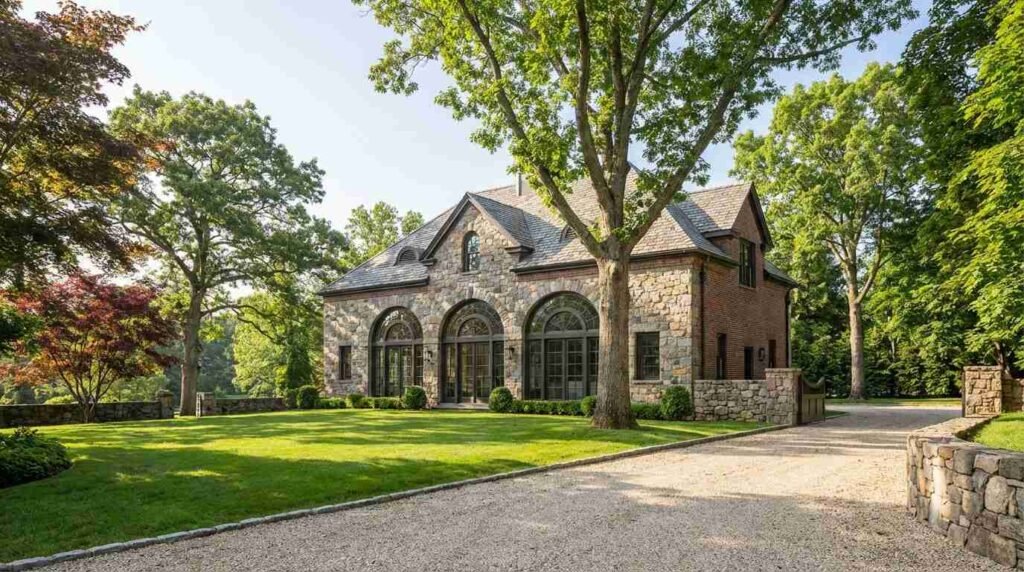
The carriage house market exists because of the subdivision wave. When the main house on a Gold Coast estate was demolished or sold, the outbuildings — carriage houses, gate lodges, gardener’s cottages — frequently survived on their own parcels. These conversions now constitute a distinct and vigorous market segment on the North Shore, and the Oyster Bay area in particular has seen significant activity in adaptive carriage house reuse.
Preservation easements were created in response to the demolition wave. The Nassau and Suffolk County preservation mechanisms — landmark designations, conservation easements, historic district protections — were developed largely in response to the losses of the 1945–1975 period. If your North Shore property is subject to a preservation easement, that constraint on your renovation is the institutional response to a history of demolitions that the market, left to its own devices, would have repeated indefinitely.
The tax problem hasn’t disappeared — it’s been managed. The same arithmetic that destroyed Harbor Hill is still present in any large historic property transaction. Carrying costs on a century-old structure are not modest. Property taxes on Gold Coast-adjacent land in Nassau County are among the highest in the state. Any buyer considering a significant Gold Coast property — or a property that borders one, shares a deed restriction with one, or sits within a historic district defined by one — should be working with advisors who understand the full ownership cost picture, not just the purchase price.
What It Feels Like to Be at the End of That History
When I’m walking a property that carries the DNA of this era — an estate-scale lot on a North Shore road, an outbuilding with the proportions of a Gold Coast carriage house, a main house whose bones predate the subdivision wave — I feel the weight of the math problem that the original heirs were handed. Most of them didn’t solve it. The ones who did found a solution that was specific to their moment: the right buyer, the right institution, the right foundation, the right use.
The properties that survive on the North Shore today are the record of successful solutions. They didn’t make it through by accident. Someone solved the equation. And when you buy into that history — whether you’re acquiring a Gold Coast structure directly or purchasing in a neighborhood shaped by the postwar subdivision of an estate that’s now a memory — you’re inheriting not just the property but the logic that allowed it to survive. For buyers and sellers navigating properties with estate history, I’m happy to talk through what that means for your specific situation. Reach out through Maison Pawli.
You Might Also Like
- Harbor Hill and the Estates That Didn’t Survive
- The Servant Stair and the Service Wing
- Chain of Title and the Matinecock Deed
- The Chandelier Clause: Mackay Estate Auction and the Legal Precedent It Set
- What the Carriage House Knows
Real estate markets change. This post reflects conditions as of April 2026. For current listings and market data, contact Pawli at Maison Pawli.
This post is for informational purposes only and does not constitute legal, tax, or financial advice. Consult a licensed attorney and financial advisor regarding estate planning, property tax, and historic property transactions.
Sources
- Nassau County Historical Society / Spinzia — The Gold Coast Estate Class (PDF)
- Untapped New York — 13 Lost Mansions of Long Island’s Gold Coast
- Untapped New York — 10 Gold Coast Mansions of Long Island
- Roslyn Landmark Society — Harbor Hill Estate
- Atlas Obscura — The Ruins of Harbor Hill
- Gold Coast Wealth Management — A Brief History of Estate Taxes