Dock Rights, Mooring Rights, and the Difference: What North Shore Waterfront Buyers Need to Settle Before Closing
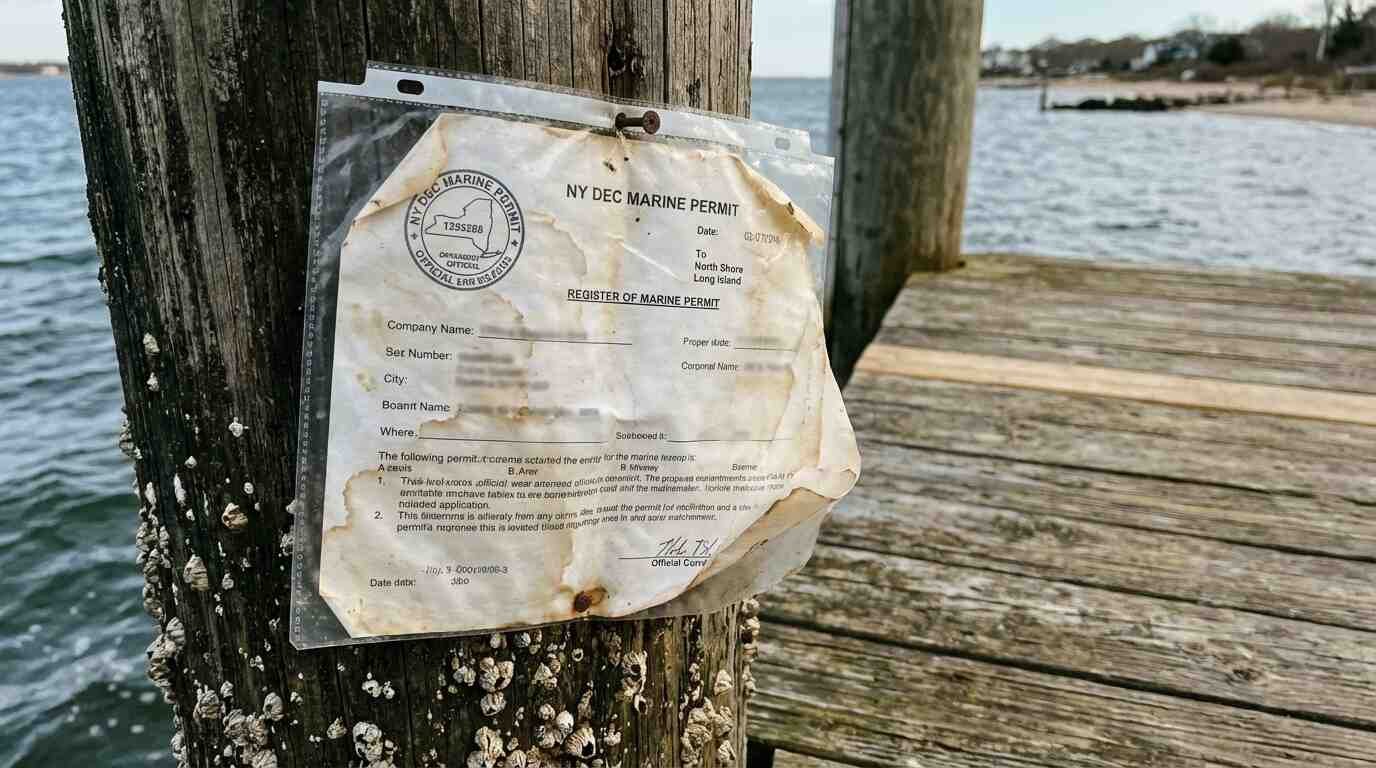
When buyers first come to me about waterfront property on the North Shore, the conversation almost always goes the same way. They’ve seen the listing. They’ve done the drive-by. They’ve looked at the photos and confirmed that yes, there is in fact a dock in those photos — a dock with a boat tied to it, which to most people reads as clear evidence that the dock comes with the house and the boat can be replaced by their boat.
What they don’t yet know is that a dock in a listing photo is not a guaranteed property right. It may be permitted. It may be unpermitted. It may be permitted under a variance that expired three years ago. The right to maintain that dock, to reconstruct it when it fails, and to put a boat on it — those rights are distinct from each other, and none of them is automatically conveyed by the deed.
This is the part of North Shore waterfront buying that most buyers don’t encounter until they’re already under contract. I want you to encounter it now, before you’ve committed to anything.
The Riparian Rights Foundation
All waterfront property rights on Long Island flow — legally and literally — from riparian rights. I covered the full picture of where your property ends and what those rights actually mean on the East End in an earlier post. The short version for this conversation: as an owner of land abutting navigable water, you have a set of common-law rights that include access to the water, the right to wharf out to navigable depth, and the right to use the water abutting your property for reasonable purposes.
Notice that phrase: the right to wharf out. Not the right to maintain a dock permanently. Not the right to put in a dock of any size or configuration. The right to extend a structure into the water to reach navigable depth — subject to state and local permitting requirements that govern every aspect of what that structure can be.
Riparian rights are the legal foundation. Permits are the practical constraint. The two interact in ways that frequently surprise buyers who assumed that owning waterfront meant owning the right to use the water in whatever way they wanted.
What Dock Rights Actually Are
A dock right, as it’s commonly understood in North Shore real estate, is the permitted, legally documented ability to construct and maintain a dock or pier on a specific waterfront parcel. On Long Island, that documentation typically consists of some combination of the following:
A DEC Article 25 tidal wetlands permit. Any construction in, on, or adjacent to tidal wetlands — which includes virtually any shoreline structure on the North Shore — requires a permit from the New York State Department of Environmental Conservation under Article 25 of the Environmental Conservation Law. The DEC tidal wetlands permit process is something I’ve covered in detail elsewhere; the key point here is that this permit is property-specific, condition-specific, and not automatically transferable to a new owner without review.
A Town of [Smithtown / Huntington / Brookhaven / Oyster Bay] wetlands or harbor permit. Every town on the North Shore has its own local permitting layer for shoreline structures. These are separate from the DEC permit and subject to separate conditions and renewal requirements. Some towns have harbor ordinances that restrict dock length, float size, or the number of boats that can be moored at a residential dock.
A U.S. Army Corps of Engineers Section 10 permit. For any structure in navigable waters of the United States — which covers most of the Sound-facing shoreline of the North Shore — Corps authorization is required. For small residential docks, this often comes in the form of a Nationwide Permit (NWP), which is a general permit that applies if the project meets specific criteria. If the existing dock was built under a Nationwide Permit, that permit may have lapsed if the dock has been substantially altered or if the underlying NWP has been revised.
The critical question for any waterfront buyer: are all of these permits current, and can they be transferred to a new owner or re-applied for by a new owner?
The answer is not always yes.
Some DEC permits are issued to a specific person or entity and require re-application upon sale. Some town permits attach to the land and transfer automatically; others do not. Some Corps authorizations expire and are not renewable under current regulations if conditions in the waterway have changed. A dock that was legally built twenty years ago may be impossible to rebuild today under current permit conditions — not because the law prohibits docks, but because the environmental baseline has changed enough that the permit thresholds no longer apply.
Before closing on any North Shore waterfront property with a dock, your attorney needs to pull all active permits, confirm their current status, and confirm whether they transfer. This is not a standard title search item. You have to ask for it specifically.
What Mooring Rights Are — and Why They’re Different
A mooring right is the right to anchor a vessel at a fixed mooring in a defined water area. Moorings — typically a concrete or metal anchor block on the bottom, connected by chain to a surface buoy — are regulated separately from docks, and the regulatory structure is meaningfully different.
On Long Island’s North Shore, mooring rights are generally governed by one of three mechanisms:
Town harbor mooring permits. Most North Shore towns — Huntington, Smithtown, Brookhaven, Oyster Bay — issue mooring permits to waterfront property owners that authorize the placement of a mooring within a designated mooring field or within a specified distance from the property’s shoreline. These permits are typically annual, renewable, and tied to the individual property owner. They are not automatically conveyed with the sale of the property.
Private marina or yacht club membership. If the “mooring right” in a listing is actually a membership or slip at a neighboring marina or club, it may not be transferable to a new owner at all without approval from that institution.
Undivided interest in a shared mooring field. In some older waterfront communities on the North Shore, a deed may convey an undivided interest in a shared mooring area — a legacy of the original subdivision that has never been modernized. These rights are highly property-specific and must be reviewed by an attorney familiar with local waterfront deed structures.
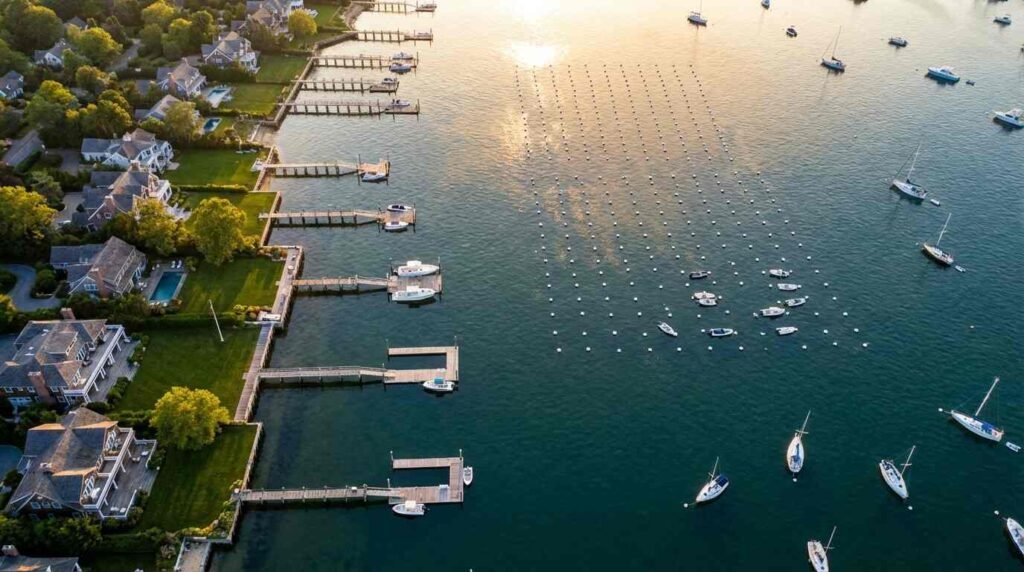
The distinction that matters most for buyers: a dock is a structure attached to your land. A mooring is a permit to use a specific area of public water. The public water aspect means the right is inherently more fragile — it can be revoked, modified, or not renewed by the governing body, and the previous owner’s continuous use does not guarantee yours.
I’ve had buyers under contract on North Shore waterfront properties who assumed that a mooring shown in the listing photos was a permanent feature of the purchase. In two cases, the mooring permit was not renewed because the town had designated that area of the harbor for navigation purposes. In one case, the mooring permit was in the name of a yacht club the seller belonged to, with no transferable right to the buyer. None of these situations killed the deal, but all three required significant negotiation and legal work to resolve — and all three could have been identified before the offer if the buyer had known what questions to ask.
The Questions to Ask Before You Offer
My standard dock-and-mooring checklist, for every North Shore waterfront offer:
On the dock:
- Is there a current DEC Article 25 permit for the dock structure? Who is it issued to? Can it be transferred?
- Is there a current Town wetlands or harbor permit? Same questions.
- Is there a U.S. Army Corps of Engineers permit or authorization? Under what Nationwide Permit or individual permit was it issued? Is it still valid?
- When was the dock last structurally inspected? Are there any outstanding violations?
- If the dock needed to be rebuilt from scratch today, would a new permit be obtainable under current DEC, town, and Corps conditions?
On the mooring:
- Is there a mooring permit? Issued by whom? Attached to the property or the person?
- Is it renewable? What are the conditions for renewal?
- If it’s a marina or yacht club membership, is that membership transferable to the buyer? At what cost?
- Is the mooring in a town-designated mooring field? What are the field’s current occupancy and waiting list conditions?
On both:
- Has the previous owner received any notices of violation from the DEC, the town, or the Corps related to shoreline structures?
- Are any outstanding compliance requirements attached to the existing permits?
This is the conversation your real estate attorney should be having before contract, not during attorney review. By the time you’re in attorney review, you’ve already negotiated a price based on the assumption that these rights exist and transfer cleanly. If they don’t, you’re renegotiating under time pressure — or you’re in a position where you need to decide whether to walk away.
When the Previous Owner “Always Had a Dock”
The phrase I hear most often at showings is some version of: “They’ve had a dock here for thirty years.” Sometimes from the listing agent. Sometimes from the seller directly. Sometimes from a neighbor chatting over the fence.
Thirty years of continuous use does not create a legal right that doesn’t otherwise exist. New York does not recognize prescriptive easements in navigable waters. The DEC does not grandfather unpermitted structures simply because they’ve been there for a long time. And a seller who has had a dock for thirty years without a permit has been lucky, not legal — and the new owner inherits neither the luck nor a cure for the missing documentation.
The practical implication: if a dock has been in place for a long time without a clear permit trail, the path to legitimizing it under current conditions may be difficult or impossible. DEC’s tidal wetlands program has become meaningfully more restrictive over the past two decades, and structures that would have been permitted in 1990 may not be permittable today given current baseline assessments of wetland function, eelgrass presence, or aquatic habitat.
For the parallel buyer-side picture on what specific water types mean for maintenance costs and value — which affects how to weigh a dock or mooring right against the overall property — my post on Sound vs. Bay vs. Harbor waterfront covers that ground. And if the property has an elevation issue that complicates flood insurance — which dock and mooring properties often do — my FEMA maps and flood insurance post is required reading before any offer.
A Note on Dock Rights in the Deed
Occasionally, on older North Shore waterfront properties — particularly in communities that developed before the DEC’s tidal wetlands regime was established in the 1970s — a deed will contain explicit language about dock rights. This might be a grant of the right to wharf out, a covenant preserving access to a shared dock, or an easement across a neighbor’s property to reach the water.
These deed provisions are not the same as permits. They may convey a property right that exists independently of the permit system — but exercising that right still requires obtaining the necessary environmental and town permits. A deed right to build a dock is not a substitute for a DEC permit. It is, at most, protection against a neighboring landowner trying to block your access. The regulatory agencies are not parties to your deed and are not bound by its terms.
Your attorney should review any dock-related deed language in conjunction with current permit requirements, not treat the deed language as independently sufficient.
Pawli’s Bottom Line
Waterfront on the North Shore is irreplaceable in a way that inland property simply isn’t. The view, the access, the quality of light off the Sound — I’ve watched buyers fall in love with waterfront parcels in under ten minutes, and I understand why. That connection is real and it’s worth something.
What I want for every one of those buyers is that the thing they fall in love with is actually, legally, and documentably theirs — the dock included. Not assumed. Not inherited from a previous owner’s informal arrangement. Not borrowed from a thirty-year-old permit that no longer reflects current conditions.
Ask the dock questions before you write the offer. Pull the permits before you go hard. Get the answers in writing before you close.
The Sound isn’t going anywhere. The legal complexity of what you can do on it — that’s the part you need to resolve while you still have leverage.
This post is for informational purposes only and does not constitute legal advice. Consult a licensed real estate attorney experienced in New York waterfront law before making any offer on waterfront property.
Real estate markets change. For current listings and market data, contact Pawli at Maison Pawli.
You Might Also Like
- Where Does Your Property Actually End? The Legal Swamp of East End Dock Rights
- The DEC Tidal Wetlands Permit Nobody Mentions at the Showing
- Holding Back the Sound: The Brutal Economics of North Shore Bulkheads
Sources
- New York State DEC Article 25 Tidal Wetlands Program: https://www.dec.ny.gov/lands/4717.html
- U.S. Army Corps of Engineers Regulatory Program, New York District: https://www.nan.usace.army.mil/Missions/Regulatory/
- Town of Huntington Harbor Management: https://www.huntingtonny.gov/harbor
- Town of Smithtown Wetlands and Waterways permits: https://www.smithtownny.gov/213/Conservation-Board [VERIFY: confirm this is the correct current URL]
- New York Environmental Conservation Law Article 25: https://www.nysenate.gov/legislation/laws/ENV/A25