Indigo Belongs Somewhere It Cannot Be Ignored: Natural Dyeing in the Villages of Tokushima, Japan
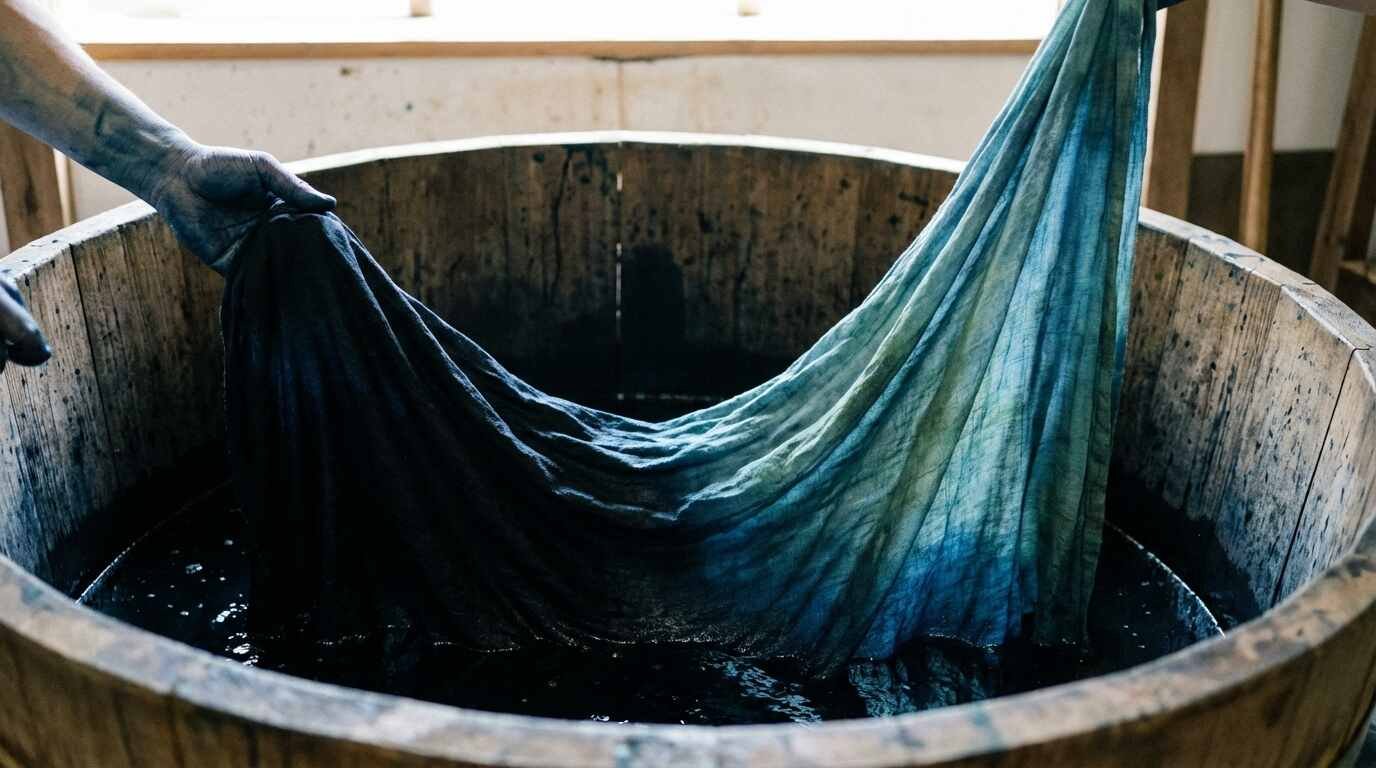
I came to Tokushima Prefecture for the indigo and stayed two days longer than I planned.
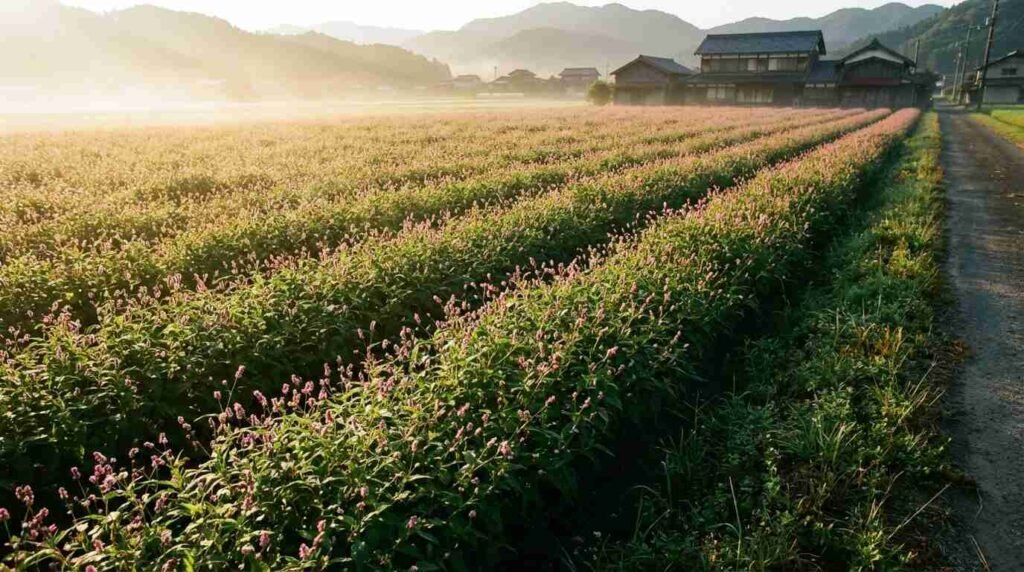
That is the standard accounting of what happens when a place is doing something that matters and has not yet been overrun by the infrastructure of people who have discovered that it matters. The ryokan where I stayed had four rooms. The road to the awa-ai cultivation fields outside Aizumi-cho narrowed to one lane and stayed that way for several kilometers. No signage. No gift shop at the end of it. Just fields of Persicaria tinctoria — Japanese indigo — in staggered rows, and the smell, which is unlike anything else, a living ferment that registers as both ancient and precise.
The word awa refers to the old provincial name of the region, Awa Province. The word ai means indigo. Awa-ai is not a style of dyeing. It is a specific agricultural and artisanal tradition: the cultivation of Japanese indigo, the composting of the dried leaves into a fermented paste called sukumo, and the maintenance of a living vat — tate, in Japanese — that can take weeks to mature and requires daily reading of temperature, pH, and behavior before a single thread enters it.
The Preservation Argument
Japan’s Agency for Cultural Affairs has designated awa-ai production as an Intangible Cultural Heritage — a formal recognition that carries legal weight in terms of government support, documentation obligations, and the right to apply for additional UNESCO consideration. That designation is not merely honorific. It reflects an institutional judgment that the knowledge embedded in this tradition cannot be reconstructed from documentation once the practitioners who hold it are no longer practicing.
The designation matters to a traveler because it marks a moment. Places with living Intangible Cultural Heritage designations are, by definition, at a threshold: the formal recognition comes precisely when the tradition is at risk of not surviving without intervention. Tokushima’s awa-ai production community is small. The number of families still cultivating Persicaria tinctoria at the scale required to produce sukumo commercially is in the dozens. The number who have passed full vat knowledge to the next generation is smaller.
The Aizome Kaikan center in Tokushima city is open to visitors and serves as both a working demonstration facility and a documentation site. It is not a museum in the sense of past-tense display. The vats are alive when you visit them. The staff can tell you what the vat is doing that day.
Buaisou and the Problem of Transmission
The collective most responsible for bringing awa-ai into international awareness is Buaisou — four artisans, based in Tokushima Prefecture, who have operated as a collaborative practice since the early 2010s. Their work has appeared in publications from Tokyo to New York; in 2016, they ran a workshop in Brooklyn that received coverage in the New York Times, introducing a specific material and a specific regional tradition to an audience that had no prior point of reference for it.
What Buaisou documents publicly — through their workshops, their published documentation, and their international collaborations — is the precision required to work with natural indigo at this level. A synthetic indigo vat can be mixed from formula. An awa-ai vat is fed, read, and adjusted daily. It has microbial life. It behaves differently in summer than in winter, differently at altitude than at sea level. The knowledge of how to read it is not written down anywhere that substitutes for watching someone who knows do it repeatedly.
That is also what makes the international collaborations significant: not the product, but the documentation of process happening between practitioners across language barriers. What Buaisou brought to Brooklyn was not a recipe. It was a demonstration that the knowledge was still alive enough to travel.
What It Looks Like From Inside the Vat Room
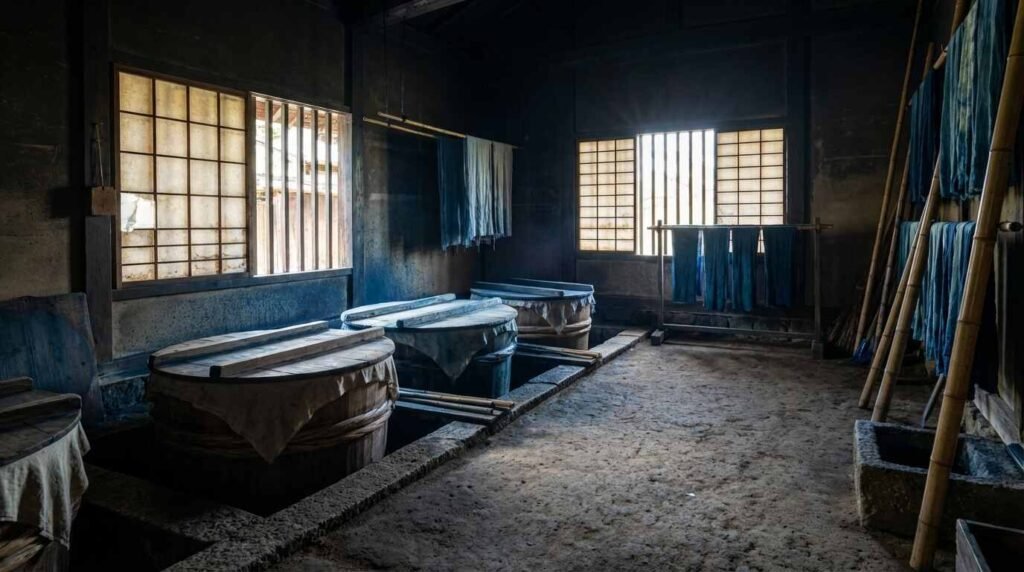
The vat room at a working awa-ai workshop is not a dramatic space. Low ceiling. Wooden vats, each one capped with a cloth, set into the earthen floor or on raised platforms. The temperature in the room is controlled — not mechanically, but by the placement of the vats relative to the building’s orientation and by charcoal braziers in winter. The smell is fermentation: deep, green-brown, like the underside of an old forest.
The dyer enters the room the way a baker enters a kitchen early — with the expectation that things have changed overnight and the first task is assessment, not production. The vat is stirred, the pH checked, the color of the foam read. An active vat produces a specific coppery-bronze foam called ai-hana, indigo flowers, that indicates healthy reduction chemistry. A vat that has gone wrong produces something else — a different color, a different smell — and recovery, if possible, takes days.
This is the knowledge that does not survive in writing alone.
Why This Matters to Anyone Who Works With Materials
I think about craft traditions from the standpoint of someone who lives with materials. The knowledge of how to read a living material and respond is the same category of knowledge as what the Tokushima dyers hold: embodied, precise, and not fully transmissible in documentation form.
That parallel is not a romanticization. It is an observation about what knowledge actually is when it is attached to a material process. And it is why the places where that knowledge is still alive — still practiced by people who learned it from people — deserve more than a passing mention in a travel roundup.
Tokushima is not on most itineraries. The awa-ai fields are not photographed often. The vats are not designed for visitors. All three of those things are reasons to go now, while the window is still open.
You Might Also Like
- The Quiet Power of Undyed Textiles
- The Ebonized Cherry Problem: How Tiffany Studios’ Oyster Bay Workshop Finished Furniture to Deceive the Eye