Why the Vanderbilt Mansion at Centerport Was Designed to Feel Like No American House That Had Ever Been Built Before
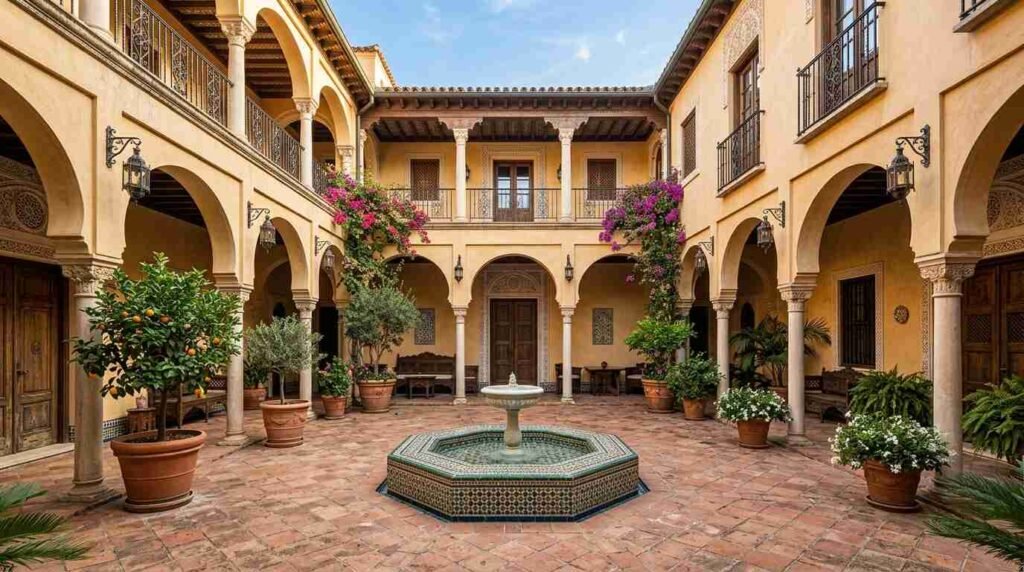
The first time I walked through the courtyard at Eagle’s Nest, I stopped moving. Not because the space is overwhelming — it isn’t, not in the way that Oheka or the Vanderbilt mausoleum in Staten Island are overwhelming. It stopped me because it was so precisely right, in a way that took a moment to identify. The proportions of the enclosed patio, the rhythm of the arched colonnade, the way the light fell through the open center onto the tile — it felt less like an American house than like a memory of somewhere else, somewhere very specific, filtered through the sensibility of someone who had actually been there. That is exactly what it is. And understanding why it is that way tells you something important about the man who built it, about the North Shore in its Gilded Age fullness, and about what an architectural commission can mean when it functions as a genuine statement of conviction rather than a display of wealth.
Eagle’s Nest — now the Suffolk County Vanderbilt Museum in Centerport — is well known as a museum destination on the North Shore. It is almost never discussed as an architectural argument. That is a significant oversight, because it is one of the most deliberate acts of architectural self-definition in the history of American domestic building.
The Man Who Did Not Want Newport
William Kissam Vanderbilt II was, by birth and fortune, among the most prominent Americans of his generation. He was also, by temperament, constitutionally unsuited to the performance his family’s position required. The Newport scene — the Bellevue Avenue cottages, the Breakers, The Elms, the summer social calendar that was less a leisure activity than an obligation of caste — was his family’s territory. His grandmother had essentially invented it. He found it suffocating.
This is documented, not inferred. W.K. Vanderbilt II’s personal correspondence, held by the Suffolk County Vanderbilt Museum, is direct on the subject of Newport and what it represented to him. [VERIFY: specific correspondence dates and direct quotations available from museum archive before citing.] He was not a man interested in competing on terms set by others. He was interested in automobiles, in oceanography, in the physical world as it actually existed rather than as it was represented in the social rituals of the American plutocracy. His racing career, his deep-sea expeditions, his eventual construction of a marine research facility at Eagle’s Nest — these are the biography of someone whose relationship to the world was tactile and curious, not ceremonial.
Eagle’s Nest was his counter-manifesto. When he began transforming the Centerport property in 1910, the instruction he gave his architects was essentially: produce something that could not be categorized. Something that had no American precedent. Something that would make clear, to anyone who arrived at this house, that its owner was not playing the game everyone else was playing.
Warren & Wetmore’s Unlikely Brief
The commission went to Warren & Wetmore — a choice that, understood in context, reveals everything about Vanderbilt’s intentions. Warren & Wetmore had, by 1910, designed Grand Central Terminal. They were not a firm associated with domestic whimsy or exotic eclecticism. They were serious architects capable of serious work at monumental scale. Hiring them for a private residence on the Sound was a statement: this project deserved the same level of architectural intelligence as a building designed to move two hundred thousand people a day. [VERIFY: Warren & Wetmore commission records for Eagle’s Nest from Avery Architectural and Fine Arts Library, Columbia University, before citing specific dates or contract terms.]
The synthesis they produced — Spanish Colonial crossed with Moroccan vernacular, with Mediterranean Revival details applied at precise moments — was essentially unprecedented for a private Long Island estate. The closest American precedents were in California, where the Mission Revival style had been building momentum since the 1880s and where the Spanish Colonial idiom had geographic and historical roots that Long Island conspicuously lacked. Vanderbilt did not care about geographic authenticity. He cared about the specific spatial and sensory qualities that the Andalusian and Moroccan building traditions delivered — and those qualities were not available in any existing American architectural vocabulary.
The Courtyard as Argument
The courtyard at Eagle’s Nest is the architectural thesis statement. It is modeled on the Andalusian patio tradition — the enclosed garden court that sits at the center of a domestic building, organizing the rooms around it, mediating between the public face of the house and its private life, and creating a microclimate within the larger structure that is cooler, quieter, and more intimate than the rooms that surround it.
This is not a decorative gesture. The Andalusian patio tradition is a functional building type that evolved over centuries in response to a specific climate — hot, dry, sun-intense — and the social organization of domestic life in that climate. Vanderbilt had traveled extensively in Spain and North Africa; he understood the tradition from direct experience, not from photographs. [VERIFY: specific Vanderbilt travel itineraries and dates from museum correspondence or archival materials before citing.] What he asked Warren & Wetmore to reproduce was not the visual vocabulary of the patio but its spatial logic — the way it controls light, moderates temperature, and creates the particular quality of interior silence that an enclosed water feature and thick masonry walls produce.
The result is a space that feels, to a visitor arriving from the Long Island sound of summer, like a form of relief. The courtyard does not perform its Mediterranean origins. It delivers them.
The Marine Museum Wing
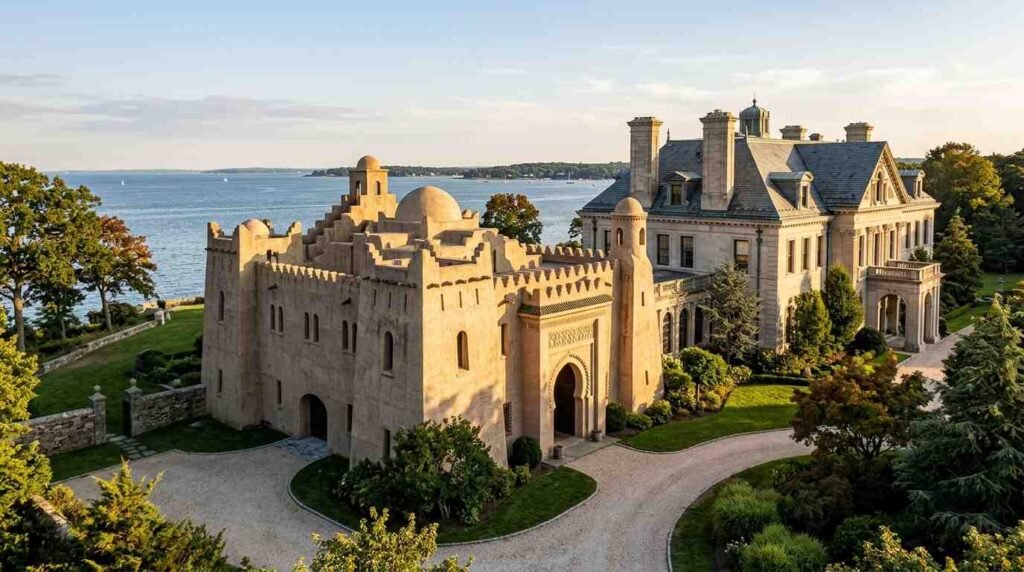
The marine museum wing — built to house Vanderbilt’s oceanographic collections from his deep-sea expeditions aboard the Ara and the Alva — is the most formally radical element of the ensemble. Warren & Wetmore designed it to read as a Moroccan casbah: thick walls, narrow window openings, a roofline that steps and terraces in the manner of North African vernacular construction rather than anything in the European aristocratic tradition. [VERIFY: specific design references and documentation of Moroccan influence from Avery Library Warren & Wetmore collection before publishing.]
The choice was not arbitrary. A Moroccan casbah is, at its functional core, a building type designed to protect valuable things — to create an interior environment that is stable in temperature and humidity, difficult to penetrate, and organized around the preservation of its contents rather than the display of its exterior. Vanderbilt needed exactly this. His oceanographic specimens — fish, invertebrates, sediment samples, biological collections from expeditions across the Atlantic and Pacific — required stable storage conditions. He had the wit to choose a building type that had been solving this problem for four hundred years rather than designing a purpose-built facility from scratch.
The marine museum wing also functions as the clearest expression of Vanderbilt’s rejection of the Gold Coast idiom. The great North Shore estates of this period — the Pratt compounds, the Whitney holdings, the Morgan and Morgan-adjacent properties — drew from the English country house tradition and the French chateau. They announced themselves. They were designed to be seen from a distance, to read as monuments. The marine museum wing at Eagle’s Nest does the opposite: it turns its back to the view, presents its thickest walls to the Sound, and reserves its architectural interest for the interior. This is a building that takes care of its contents. The content, in this case, was Vanderbilt’s life’s work.
The Bell Tower and the Mission Reference
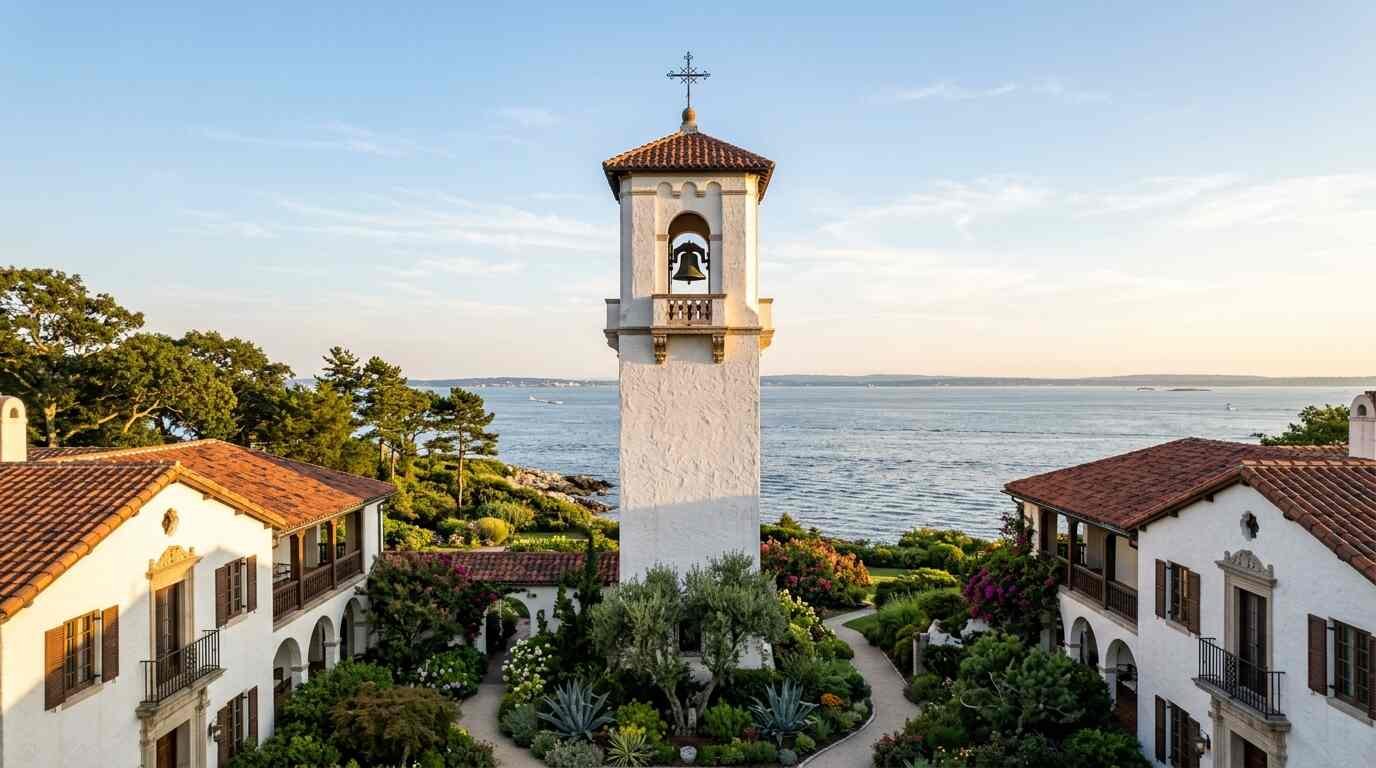
The bell tower at Eagle’s Nest — the element most frequently photographed, the one that reads most clearly in profile against the sky — consciously evokes a Californian mission rather than anything in the European aristocratic tradition. [VERIFY: specific design documentation or Vanderbilt correspondence referencing mission architecture from museum archive before citing.]
This was a pointed choice. The California missions are American buildings — built by Spanish Franciscan missionaries beginning in 1769, using indigenous labor and local materials, in a tradition that owes nothing to the English or French precedents that defined East Coast architectural aspiration. Referencing them at Centerport was a refusal to participate in the transatlantic conversation that animated every other Gold Coast commission of the period. Vanderbilt was not looking to Europe for his architectural vocabulary. He was looking at the full geographic range of what American building had actually produced — and choosing, deliberately, the strand of that tradition that his social peers would never have considered.
The tower also works as pure composition. It gives the estate’s roofline a vertical anchor against which the horizontal mass of the courtyard wing and the marine museum read with clarity. Warren & Wetmore understood what they were doing formally, regardless of what Vanderbilt was doing rhetorically. The architecture is good enough to justify itself on its own terms.
What Eagle’s Nest Means Now
The Suffolk County Vanderbilt Museum maintains the estate and its collections today, and the experience of visiting — walking the courtyard, moving through the marine museum, climbing to the bell tower — is unlike anything else available on the North Shore. There is no comparable ensemble: not in its architectural ambition, not in the specificity of its rejection of prevailing taste, not in the degree to which it encodes a single, coherent point of view about what a house in this place and time should be.
The statement holds. Walk into that courtyard on a summer afternoon, when the light falls through the center onto the tile and the Sound is visible through the arched openings on the north side, and it is impossible to mistake this for any other building on Long Island. That, of course, was the entire point.
Real estate markets change. For current listings and market data, contact Pawli at Maison Pawli.
You Might Also Like
- The Landlord Nobody Remembers: How the Vanderbilt Estate Breakup Shaped Modern Centerport
- The Servant Stair and the Service Wing: What the Hidden Architecture of Gold Coast Estates Reveals About Today’s Luxury Floor Plans
- Selling History: How to Price and Market North Shore Pre-War Details
Sources
- Suffolk County Vanderbilt Museum — architectural records, W.K. Vanderbilt II correspondence: vanderbiltmuseum.org
- Avery Architectural and Fine Arts Library, Columbia University — Warren & Wetmore collection: library.columbia.edu
- Suffolk County Vanderbilt Museum — visit and collections: vanderbiltmuseum.org/visit
Part of the Gold Coast Series: This post is one of fifteen pieces in the Maison Pawli Gold Coast cluster. For the full guide — surviving estates, architectural history, legal sediment, and what buyers need to know — visit The Gold Coast of Long Island: Gilded Age Estates, Architectural Heritage, and What Survives.