The Sunken Meadow Sanatorium and the Beach Nobody Remembers Was a Tuberculosis Cure

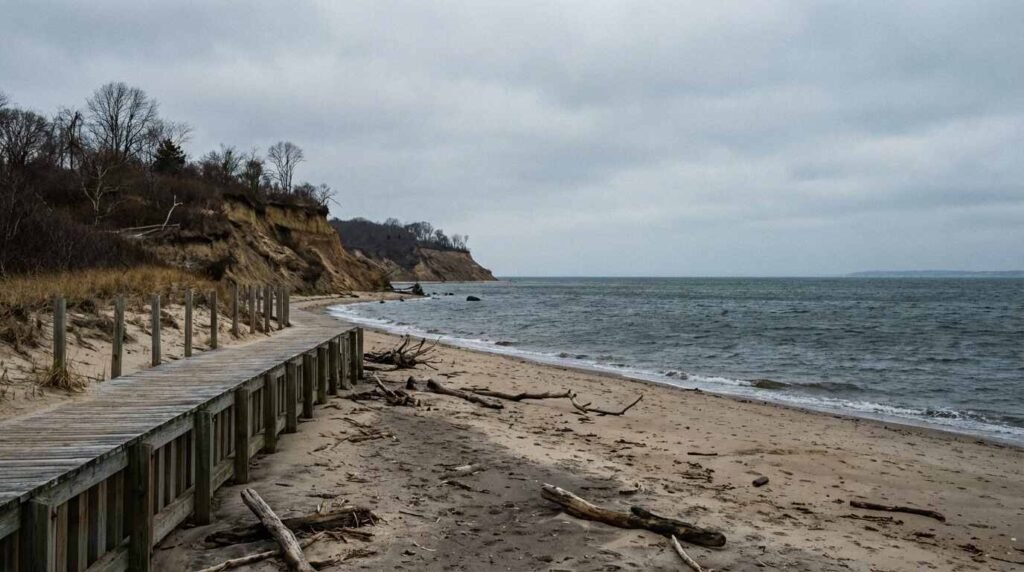
The beach at Sunken Meadow at six in the morning in early spring has a quality I can’t quite name — something between solitude and presence. The mist holds over the Sound, which is still and gunmetal gray. The bluffs rise on the western end of the park, glacier-formed and abrupt, striated with iron-red clay. The boardwalk is empty. The concession stands are locked. And across the water, the Connecticut shore is a low dark line, barely distinguishable from the horizon.
This is the light the patients knew. Not the summer light — the other light. The light of recovery and waiting.
The Theory of Curative Air
Tuberculosis was the defining disease of the late nineteenth and early twentieth centuries. By 1900, it was responsible for roughly one in seven deaths in the United States. Transmitted through the air, concentrated in the overcrowded tenement districts of industrial cities, it killed slowly and not always — which made it, in a period before antibiotics, something that medicine tried to manage rather than cure.
The prevailing theory, by the early 1900s, was heliotherapy: exposure to sunlight, salt air, and rest. The logic had roots in the work of Dr. Edward Livingston Trudeau, who founded the Adirondack Cottage Sanitarium at Saranac Lake in 1885 after his own tuberculosis seemed to respond to outdoor life in the mountains. The model spread. By 1909, New York State legislature mandated that counties establish sanatoriums for tuberculosis patients. On Long Island, the response came in multiple forms — the Nassau County Sanitarium in Plainview, the Suffolk County facility that preceded Suffolk Community College’s Ammerman campus in Selden, and, eventually, the institution that would operate on the bluffs above the Sound between Kings Park and Stony Brook.
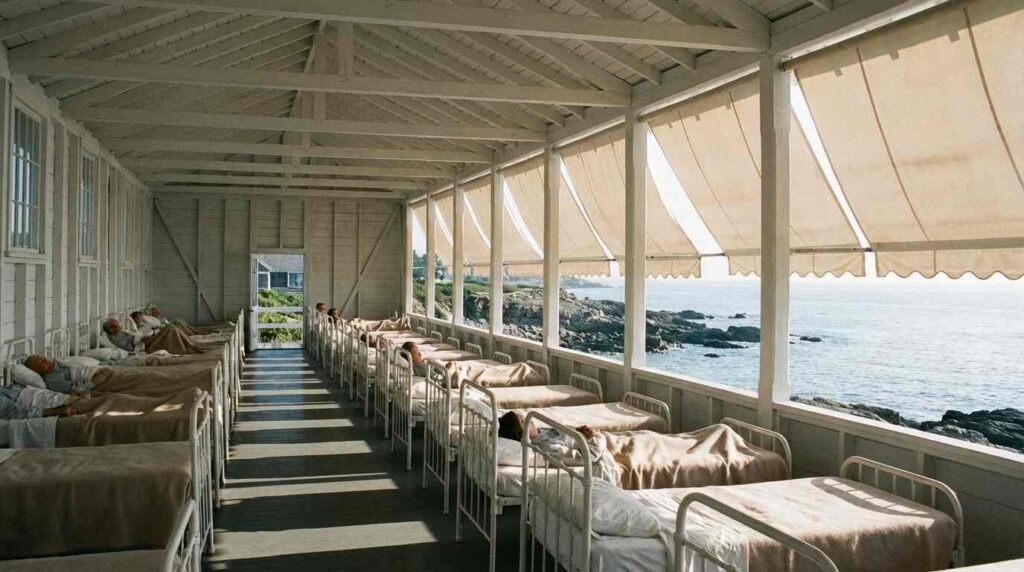
The Stony Brook Retreat, as the National Park Service now identifies it in records related to Avalon Park & Preserve, was constructed in the 1930s and operated as a tuberculosis sanatorium until 1967. The site was rural, elevated, and faced the water — built to maximize sunlight exposure and prevailing onshore winds from the Sound. Patients were housed in pavilions designed to channel salt air from the water below the bluffs.
Who the Ferry Carried
The patients were not wealthy. This is the part that the park interpretive panels don’t discuss, because there are no park interpretive panels — this history has been almost entirely absorbed into silence.
The sanatorium era on Long Island was a public health project aimed at the immigrant working class. Tuberculosis rates in New York City’s tenement districts — the Lower East Side, East Harlem, the neighborhoods of the outer boroughs where newly arrived families from Southern and Eastern Europe were packed eight to a room — were catastrophic. The city’s public health infrastructure, overwhelmed by the scale of the epidemic, relied on county and state facilities to absorb patients who could not be treated in urban hospitals.
This meant ferry crossings from the city to Long Island. It meant pavilions facing the water, where patients lay in beds positioned to catch the prevailing south-southwest wind off the Sound. It meant a regimen of enforced rest, measured sunlight exposure, and the particular cruelty of false hope — because the salt air did not cure tuberculosis, could not cure tuberculosis, though in some patients rest and improved nutrition genuinely extended life expectancy.
The records that document this period are held in pieces: Suffolk County Department of Health historical archives, New York City Municipal Archives containing patient transfer logs and Department of Health annual reports from 1905–1920, and special collections at Stony Brook University. Georgina Feldberg’s scholarly work Disease and Class: Tuberculosis and the Shaping of Modern North American Society (1995) provides essential context for the intersection of progressive-era public health ideology and the working-class patients who bore its full weight.
Kings Park’s Other Ruins
Sunken Meadow State Park and the Kings Park Psychiatric Center occupy adjacent stretches of the Sound’s north shore in the Town of Smithtown. Most people who know this stretch know the Psychiatric Center’s ruins — those enormous brick buildings visible from the bluffs, windows long gone, surrounded by state park land that has absorbed the property. The Psychiatric Center, which opened in 1885, operated for over a century as a state institution for the mentally ill. In its early decades, it also admitted and housed tuberculosis patients, following the same logic of curative air that would later animate the dedicated sanatoriums.
The ruins are visible from the Sunken Meadow bluff trail if you know where to look. They have become, in a certain genre of photography, atmospheric shorthand for Long Island’s abandoned institutional past — beautiful and sinister, the brick weathered to orange-gray, the scale suggesting an ambition that outlasted its purpose by decades. What they represent, more precisely, is a century of the state’s obligation to the city’s poorest residents — an obligation exercised at arm’s length, across the water, on the presumption that distance and salt air together might accomplish what medicine could not.
The Erasure
Sunken Meadow State Park was formally assembled in 1928, when the State acquired most of its original 520 acres from the Lamb family estate. The park’s official history makes no mention of the tuberculosis sanatorium operations that occurred in the same neighborhood in the same decades. This is not unusual. Parks, by design, present the present tense.
But the erasure is worth noting. The patients who came to this shore — working-class immigrants, most of them, sent north from the city by public health authorities — were treated in an institutional framework that was simultaneously a genuine attempt at care and a form of removal. The shore was curative; it was also distant. The families they left behind in the city did not follow. Some patients did not come back.
The beach at Sunken Meadow is now a place of deliberate, ordinary pleasure. Volleyball. Kayaking. The parking fields fill up on summer weekends with the particular democratic mix of Long Island families that would have been unrecognizable to the early state park planners. Children run the boardwalk. The concession stand sells Italian ice.
This is good. This is what public land should do. But it is worth pausing, occasionally, to acknowledge what the shore was before it was recreational — what the water meant to the people who came here not for pleasure but for the diminishing hope of survival.
What the Bluffs Hold
I’ve shown properties near this stretch of the North Shore’s Smithtown Bay area. Buyers are often drawn by exactly what the sanatorium administrators were drawn by: the elevated perspective, the unobstructed view across the Sound, the quality of light on the water in the morning. These are real things. The bluffs here — the same glacier-formed ridges that give Sunken Meadow its dramatic western end — create properties with a physical presence that the flat south shore cannot match.
What I find myself thinking about, when I show these homes, is the strange continuity between the curative logic and the contemporary real estate logic. Fresh air. Space. Water. The Sound. These things were prescribed to sick immigrants at the beginning of the twentieth century; they are marketed to buyers now. The language is different. The desire underneath is not entirely.
Real estate markets change. This post reflects conditions as of April 2026. For current listings and market data, contact Pawli at Maison Pawli.
You Might Also Like
- North Shore Bluff Homes and the Erosion Question: What Buyers Need to Know
- The Lock-In Effect: Why North Shore Inventory Is So Tight Right Now
- The Covenant in the Deed: How Restrictive Covenants Shaped Long Island Neighborhoods
Sources
- National Park Service — Dormitory and Former Tuberculosis Sanatorium (Stony Brook Retreat)
- Georgina Feldberg, Disease and Class: Tuberculosis and the Shaping of Modern North American Society (1995)
- Suffolk Community College Ammerman Campus TB history — Suffolk Sentinel
- Farmingdale Public Library — Nassau County Sanitarium history
- Sunken Meadow State Park overview — Long Island Exchange
- Smithtown Historical Society — smithtownhistorical.org
Research note: No sanatorium was located specifically within Sunken Meadow State Park’s current boundaries; the documented facility in this area is the Stony Brook Retreat, within Avalon Park & Preserve in Stony Brook. Verify with Suffolk County Department of Health Archives before publication.