The Underbidder’s Notebook: What the Handwritten Auction Records of a Huntington Antiques Dealer Reveal About Who Was Actually Buying Gold Coast Furniture Between 1955 and 1975
There is a particular quality of silence in a room where important things have been kept. I’ve felt it in estate showings — the moment before you open a closet and find the original deed, or a stack of letters, or a set of keys whose locks no longer exist on the property. I felt it again, more recently, reading through secondary literature about the postwar antiques trade on Long Island’s North Shore: a persistent sense that somewhere, in some back room or archive or estate sale box, there is a document that would rewrite what we think we know about where the Gold Coast went.
That document may be a set of composition notebooks. If it still exists.
Between roughly 1955 and 1975, the great dispersal of Gold Coast estate contents reached something close to its final chapter. The original Gilded Age families — the Belmonts, the Phippses, the Vanderbilts and their satellites — had been receding from Nassau and Suffolk County since the Depression, their houses converted to schools, institutions, and country clubs, or simply demolished. What remained in the houses that had not yet been sold or torn down was furniture: case pieces, dining sets, portrait commissions, carpets, silver services, and the accumulated material culture of a particular kind of American ambition. Much of it moved through auction.
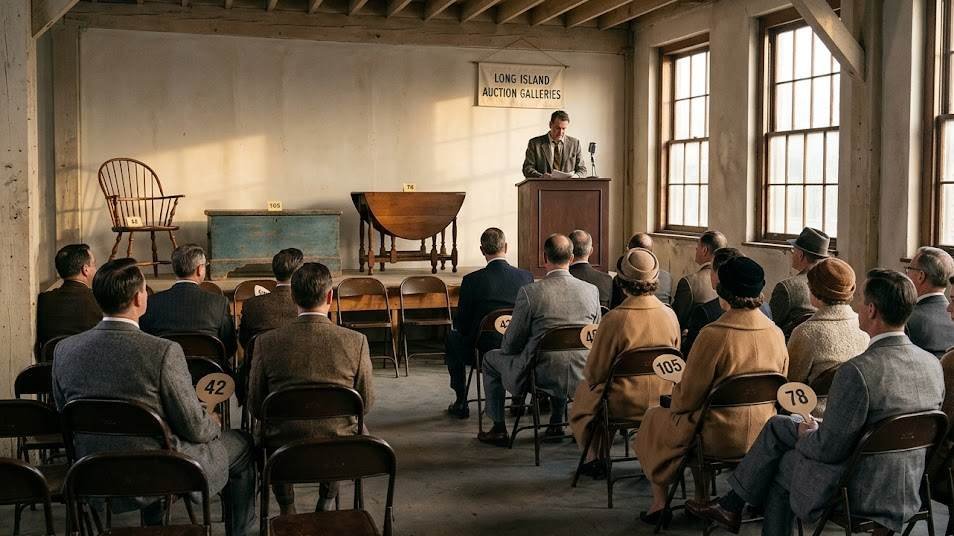
Regional auction houses — smaller operations than the established Manhattan rooms, operating out of Huntington, Oyster Bay, and Port Jefferson — processed these estates in waves. Some sales were well-documented. Many were not. The Long Island Studies Institute at Hofstra University holds auction catalogs from this period, but coverage is uneven; smaller houses rarely retained comprehensive records, and the catalogs that survive often list lots without recording final prices or buyer identities. What the official record contains is the hammer. What it rarely contains is the hand that raised the paddle — and what that hand intended to do with what it bought.
This is where the notebooks come in.
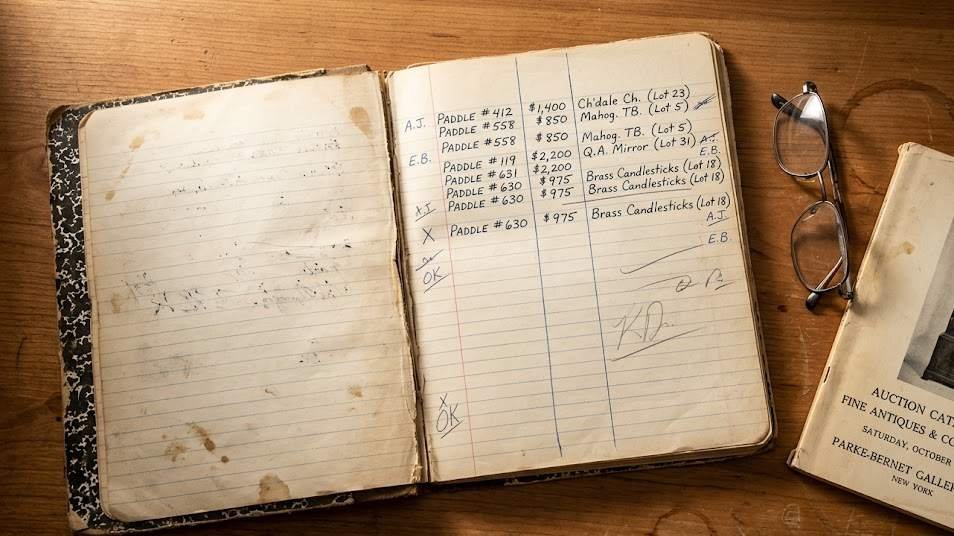
The practice of dealers keeping private bid records is well-attested in the antiques trade literature. Dealers attending auction for professional reasons — to buy for resale, to scout for clients, to establish market comparables — routinely kept their own notation systems alongside whatever the auctioneer’s staff recorded. These records varied wildly in their rigor and legibility. Some dealers tracked only their own bids and outcomes. Others, with a more systematic disposition, recorded the room: competing paddle numbers, approximate bid increments, the occasional identity of a buyer they recognized from previous sales.
A Huntington antiques business that operated from the late 1940s until its closure in 1991 is reputed, within the trade, to have maintained exactly this kind of record across more than sixty Long Island estate auctions spanning two decades. The business’s proprietor — whose name surfaces periodically in dealer correspondence held at the Society for the Preservation of Long Island Antiquities — appears to have attended sales across Nassau and Suffolk with considerable regularity and to have kept composition notebooks in which he recorded, in a private shorthand, the paddle numbers, winning bids, and occasional identities of buyers he could identify. Whether these notebooks survived the business’s closure is not currently known. They were not, as far as can be determined, donated to any institutional archive. They may have passed into private hands. They may have been discarded.
If they can be located, they would constitute something extraordinary: the most granular private record of how Gilded Age furniture moved from dismantled estates into the hands of collectors, dealers, and, occasionally, museums — assembled by someone who was in the room when it happened, keeping his own account precisely because he understood that the official account would be incomplete.
The Long Island Museum in Stony Brook holds dealer files and correspondence from this era that illuminate the broader patterns. The picture that emerges from that archive, and from SPLIA’s holdings, is one of a remarkably small and interconnected trade network operating across the North Shore: dealers who knew one another, competed at the same sales, occasionally colluded in bid management — a practice known in the trade as a “ring” — and maintained informal intelligence systems about which estates were coming to market and what they were likely to contain.
The furniture itself, in this period, was often seriously undervalued by the broader market. American furniture scholarship was in an early phase; the great reconsideration of colonial and Federal-period American craft that would drive prices dramatically upward in the 1970s and 1980s had not yet occurred. Pieces that would later be recognized as significant regional examples — Connecticut valley case pieces that had migrated to Long Island with their owners, Long Island-made Windsor chairs, painted country furniture of genuine quality — were selling in this period for sums that now seem almost deliberately modest. The dealers who bought them, if they held rather than flipped, made fortunes. The estates that sold them did not always understand what they were parting with.
This is the period the notebooks, if they exist, would document.
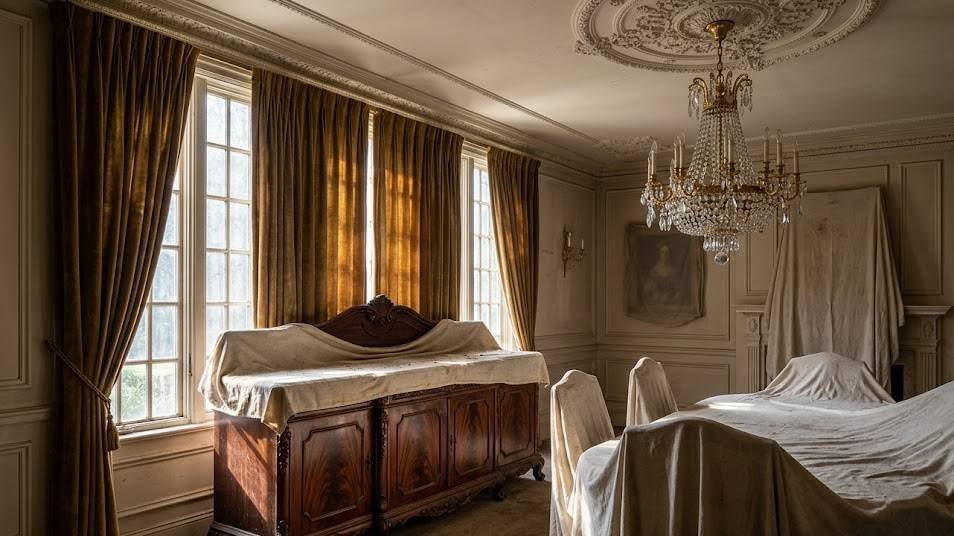
I think about this often in my work — the distance between what a house contains and what anyone, in the moment of transaction, understands it to contain. I have walked estates on the North Shore where the furniture in a back bedroom turned out to be more significant than the architecture around it, and where no one in the family had thought to look carefully at what they were about to sell. The Gold Coast dispersal was this problem at scale, operating across decades, with the additional complication that the market for American decorative arts was itself still being constructed. The dealers who attended those auctions were, in some cases, buying ahead of a valuation system that hadn’t finished forming yet.
The notebooks would capture that moment from the inside. They would tell us not just who bought what, but what the competition looked like — who else wanted the piece, how hard they pushed, when they dropped out. The underbidder, in auction theory, is the person who determines the actual market: the winning bid is, by definition, one increment above what the second-most-motivated buyer was willing to pay. A record of underbids is a record of desire, which is a record of taste, which is a record of what a culture actually valued, as opposed to what it said it valued.
Methodologically, what makes the Huntington dealer’s notebooks significant — if they exist and if they are as described — is precisely their informality. Official auction records, when they survive, document transactions. Private dealer records document the market as a social phenomenon. The Winterthur Museum’s research library has published on dealer record methodology, and the consensus among material culture scholars is that private records of this kind, when they can be authenticated and contextualized, frequently revise the provenance histories of significant objects in ways that institutional documentation alone cannot.
The Long Island Museum’s collections include objects whose acquisition histories trace back, in some cases, to exactly this period and this network of regional dealers. The American Furniture dealers association records, held at various institutions, document the national patterns within which Long Island’s regional trade operated. What is missing, consistently, is the granular local record — the account of what happened at the Huntington sale in the spring of 1962, say, or the Oyster Bay dispersal of 1968 — that would allow scholars and, eventually, collectors to trace the full provenance chain from estate to present owner.
That account may exist in composition notebooks. It may be sitting in a storage unit somewhere in Suffolk County, or in the estate of someone who bought the Huntington business’s physical assets in 1991, or in a box that was passed along to a family member who did not know what it contained.
I am not a material culture scholar. I am a real estate broker who has spent a long time paying attention to what houses hold and what happens to that inventory when the house changes hands. But the questions these notebooks raise are not purely academic. Provenance matters in the antiques market in ways that directly affect value — a piece with a documented chain of custody, traceable to a specific estate through a specific sale, commands a premium over the same piece with a gap in its history. If the notebooks contain what they are said to contain, they would close gaps in the provenance records of a significant number of objects currently held by collectors and institutions across the region.
At Maison Pawli, we encounter this issue in a specific and practical form. When we’re listing an estate that still contains its original furnishings — a house that hasn’t been cleared in decades — we often find ourselves in the position of knowing that the contents are likely significant without being able to prove it. The documentation simply isn’t there. The family didn’t keep records. The dealer who came through in 1970 and made the family an offer on the dining room set left no paper trail. What remains is the furniture itself, and the story the family tells, and the gap where the history should be.
The notebooks, if they can be found, would begin to fill that gap. Not for every piece, and not for every estate. But for enough of them to matter.
The Huntington Historical Society is the appropriate first stop for anyone attempting to trace the business. SPLIA’s archives contain correspondence that may name the dealer directly. The Long Island Studies Institute has expressed interest, in conversations with researchers, in any dealer records from this period that might surface through private holdings. The methodology for authenticating and contextualizing such records — the process of moving from a composition notebook to a scholarly citation — exists and is well-established.
What doesn’t exist yet is the notebook itself, in any institutional hand. That is the thing worth looking for.
Real estate markets change. This post reflects conditions as of April 2026. For current listings and market data, contact Pawli at Maison Pawli.
You Might Also Like
- The Servant Stair and the Service Wing: What the Hidden Architecture of Gold Coast Estates Reveals About Today’s Luxury Floor Plans
- The Matinecock Friends Meeting House at Locust Valley: What Gold Coast Joiners Left Behind
- Oheka Castle and the Architecture of Reinvention
Sources
- Long Island Studies Institute at Hofstra University — estate dispersal documentation and regional auction history
- Society for the Preservation of Long Island Antiquities (SPLIA) — dealer correspondence and estate records archive
- Long Island Museum, Stony Brook — collections, dealer files, and material culture holdings from the postwar period
- Huntington Historical Society — local business records and trade documentation
- Winterthur Museum Research Library — dealer record methodology and American furniture scholarship
- American Furniture dealers association records — national trade patterns and regional market documentation
Note: The specific composition notebooks referenced in this post have not been confirmed to survive. Their existence is attested in trade correspondence; their current location is unknown. Researchers with knowledge of the Huntington antiques trade in this period are encouraged to contact the Long Island Studies Institute.